


A U.S. LLC does not automatically qualify you for tax treaty relief. I start with your treaty residence and the LLC’s tax classification, then check the income and your U.S. business activity.
Here’s what I check before claiming relief:
- Who can claim: You, the LLC’s members, or the LLC itself, depending on its tax classification and the treaty’s rules.
- Which income qualifies: A treaty may reduce withholding or limit U.S. tax on business profits. For example, a valid 15% dividend rate instead of 30% would cut withholding on $10,000 from $3,000 to $1,500.
- Where business happens: U.S. offices, employees, and agents can affect whether a permanent establishment exists.
- Which paperwork remains: The right withholding forms, federal returns, and state filings may still be required – even when no federal income tax is due.
My rule: <u>confirm eligibility before claiming relief</u>. Lower tax does not mean fewer filing duties.
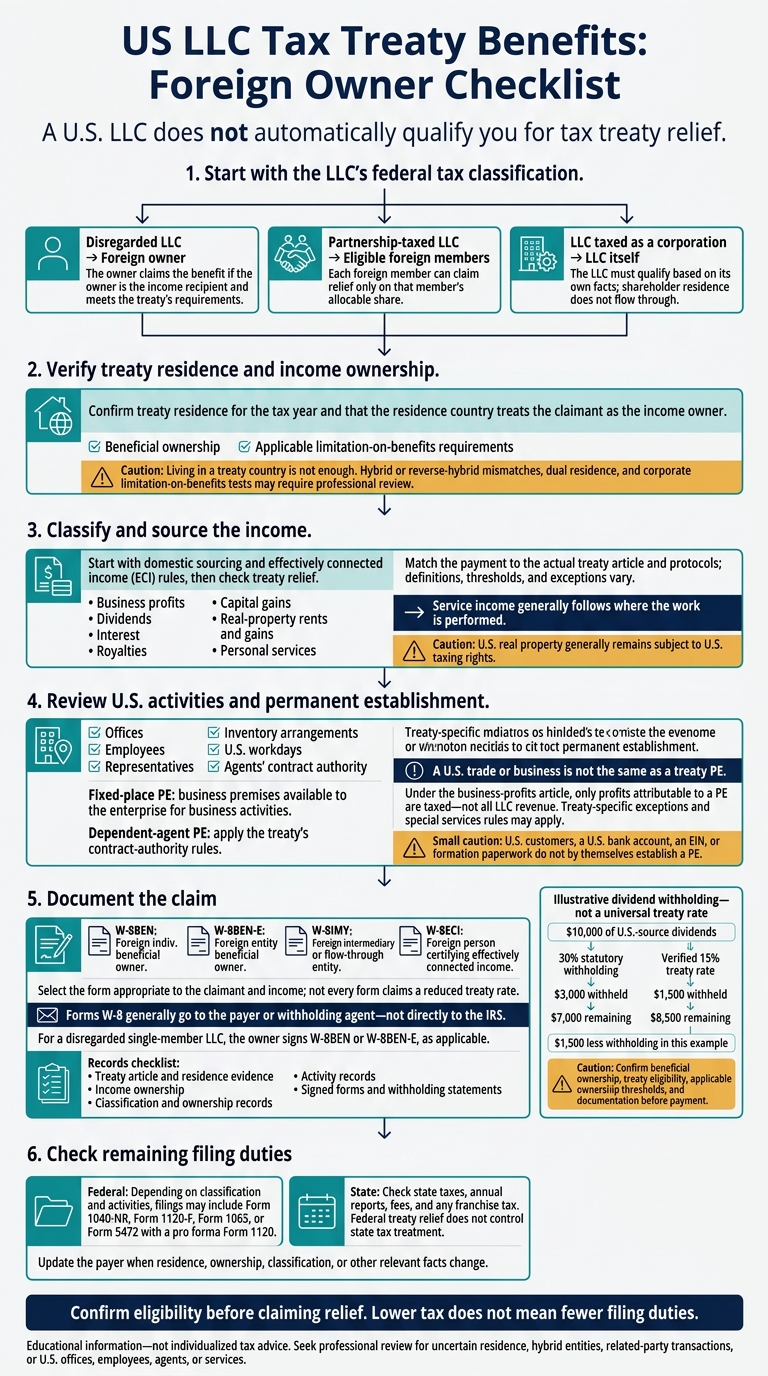
US LLC Tax Treaty Benefits: Foreign Owner Checklist
Identify Who Can Claim Treaty Benefits
How LLC Tax Classification Affects Treaty Claims
Once you know which treaty may apply, identify who the IRS treats as the income recipient. Start with the LLC’s federal tax classification after you start a US LLC. Treaty claims follow the owner only when the LLC is disregarded or taxed as a pass-through.
| Classification | Potential treaty claimant | Main eligibility issue |
|---|---|---|
| Disregarded LLC | Foreign owner | The owner claims the benefit if the owner is the income recipient and meets the treaty’s requirements. |
| Partnership-taxed LLC | Eligible foreign members | Each foreign member can claim relief only on that member’s allocable share. |
| LLC taxed as a corporation | LLC itself | The LLC must qualify based on its own facts; shareholder residence does not flow through. |
Corporate taxation separates the LLC from its owner. That means treaty eligibility is tested at the entity level – not through the shareholder. The classification determines who moves on to the income-type and permanent-establishment tests.
Treaty Residence and Income Ownership
Tax classification is only part of the test. The claimant’s residence country must also treat the claimant as the income owner. If that country treats a disregarded LLC as a separate corporation, don’t assume the owner can claim treaty benefits.
Get professional review for hybrid or reverse-hybrid mismatches, dual-residence tie-breakers, and corporate limitation-on-benefits tests. Living or being based in a treaty country does not, by itself, establish that a company meets the treaty’s ownership, business-activity, or other limitation-on-benefits requirements.
Keep classification elections, ownership records, residence evidence, and income documents ready for review. An EIN or formation records – including a registered agent designation – do not, on their own, establish treaty residence or a permanent establishment. Those depend on tax-residence rules and actual activities, not registration paperwork. Next, match the income type and check whether U.S. activity creates a permanent establishment.
sbb-itb-ba0a4be
Check Income Types and Permanent-Establishment Rules
Start with domestic sourcing and ECI rules, then check treaty relief. Service income generally follows where the work is performed. Effectively connected income (ECI) generally requires U.S. reporting, though treaty limits may restrict U.S. taxation.
Once you’ve identified the owner, match each payment to its treaty article using three filters: income type, source, and permanent establishment (PE).
Match Each Income Type to Its Treaty Article
| Income | Potential treaty article | Eligibility test | Typical U.S. withholding issue | When relief may fail |
|---|---|---|---|---|
| Business profits | Business Profits | Treaty residence; profits not attributable to a U.S. PE | Documentation may be required; ECI generally requires reporting | Profits are attributable to a U.S. PE, or a special services rule applies |
| Dividends | Dividends | Beneficial ownership, treaty residence, and applicable ownership or limitation-on-benefits requirements | Generally 30% withholding unless properly reduced | Documentation or treaty conditions are not met |
| Interest | Interest | Treaty residence and beneficial ownership; check exemptions and exceptions | U.S.-source interest may trigger withholding unless a domestic exemption or treaty reduction applies | Treaty conditions or anti-abuse rules prevent relief |
| Royalties | Royalties | Treaty definition and beneficial ownership | U.S.-source royalties commonly trigger withholding | Payment is actually for services, beneficial ownership is absent, or a PE rule applies |
| Capital gains other than real-property gains | Capital Gains | Asset type and connection to a PE | Treaty protection may require documentation | Gain is attributable to a PE or another treaty exception applies |
| Real-property rents and gains | Income from Immovable Property and related gains provisions | U.S. real property generally remains subject to U.S. taxing rights | Rents and sales can trigger withholding and filings | Treaty relief generally does not eliminate tax, including on covered real-property holding company interests |
| Personal services | Independent Personal Services, employment, or another treaty-specific provision | Applicable days-present, fixed-base, employer, and payment tests | Establish classification and source before claiming relief | A fixed base, U.S. workdays, employer connection, or another threshold triggers taxation |
Read the actual treaty and its protocols. Article numbers, definitions, and thresholds vary. Dividends generally follow the corporation’s residence, interest follows the payer’s residence, and royalties follow where the rights are used.
Income type is only part of the test. What the business does in the United States can also affect treaty protection.
Check Whether US Activities Create a Permanent Establishment
A fixed-place PE involves business premises available to the enterprise, such as an office used for core business work. A dependent-agent PE depends on the treaty’s contract-authority rules. Some treaties also address a representative’s principal role in securing contracts.
Review offices, employees, representatives, inventory arrangements, and U.S. workdays. Exceptions for preparatory or auxiliary activities depend on the treaty.
A U.S. trade or business is not the same as a treaty PE. Filing duties can remain even when a treaty limits tax. Under the business-profits article, if a PE exists, only the profits attributable to it are taxed – not all LLC revenue.
Mail handling alone does not create a U.S. trade or business or treaty PE. Check access to premises, actual business activities, employee locations, and agents’ authority. Keep leases, service agreements, travel calendars, and work logs to support your assessment.
Examples: Remote Consulting, a US Office, and Dividends
These examples show how income sourcing, PE rules, and withholding apply.
Hypothetical consulting cases: A Spanish treaty-resident consultant owns a disregarded U.S. LLC and performs all client work in Spain. Even with U.S. customers and a U.S. bank account, the service income is generally foreign-source under domestic rules. Contrast that with regularly performing client work and concluding contracts from a dedicated U.S. office: those facts require a fixed-place PE analysis and records attributing revenue and expenses to that office. U.S. customers alone do not create a PE.
Hypothetical dividend comparison: On $10,000 of U.S.-source dividends, the statutory 30% withholding rate produces $3,000 of withholding, leaving $7,000. A verified 15% treaty rate produces $1,500 of withholding, leaving $8,500. The 15% rate is illustrative – not universal. Confirm beneficial ownership, treaty eligibility, applicable ownership thresholds, and documentation before payment; eligible individuals generally claim the reduction using Form W-8BEN, while foreign entities generally use Form W-8BEN-E.
Document Treaty Claims and Meet Filing Duties
After applying the treaty article and PE tests, document the claim and submit the required forms. A treaty benefit does not remove filing duties.
Choose the Right Withholding Form
| Form | Typical user | Purpose | Recipient |
|---|---|---|---|
| W-8BEN | Foreign individual beneficial owner | Establish foreign status and claim treaty benefits | Payer or withholding agent |
| W-8BEN-E | Foreign entity beneficial owner | Establish foreign status and claim treaty benefits | Payer or withholding agent |
| W-8IMY | Foreign intermediary or flow-through entity | Document status and pass along owner documentation where required | Payer or withholding agent |
| W-8ECI | Foreign person claiming effectively connected income | Certify that income is effectively connected with a U.S. trade or business | Payer or withholding agent |
For a disregarded single-member LLC, the owner signs W-8BEN or W-8BEN-E, as applicable. Forms W-8 generally go to the payer or withholding agent, not directly to the IRS. Follow the IRS W-8BEN instructions for names, taxpayer identification numbers, and treaty claims.
The form starts the claim. Your records support it.
Keep Records and Review Filing Requirements
Keep a claim file with:
- Treaty support: The applicable article, proof of residence, and income ownership.
- Entity records: Ownership documents, LLC classification records, and required taxpayer identification numbers.
- Activity records: Business records that support the claim.
- Payer records: Signed forms, withholding statements, and correspondence confirming the claim.
Update the payer when residence, ownership, classification, or other relevant facts change. Review the return instructions for any required treaty disclosure or attached statement.
Separate Federal Filings From State Duties
Even when treaty relief eliminates federal income tax, foreign-owned LLCs with U.S. trade or business activity generally must still file federal returns. Depending on classification and activities, those filings may include Form 1040-NR, Form 1120-F, Form 1065, or Form 5472 with a pro forma Form 1120.
Federal treaty relief does not control state tax treatment. Check every state where the LLC operates for state taxes, annual reports, and fees. Some states also impose franchise tax.
Conclusion: Confirm Eligibility Before Claiming Treaty Relief
Start with the owner: confirm treaty residence for the tax year and verify the LLC’s classification. Then match the income to the treaty article and check beneficial ownership, limitation on benefits (LOB), and permanent establishment (PE) rules. Follow that sequence to determine whether treaty relief applies.
Only then submit the documents needed to claim reduced withholding. Treaty relief does not eliminate federal reporting requirements, state taxes, annual reports, or fees.
This article is educational, not individualized tax advice. Get professional review before filing or certifying a claim involving uncertain residence, hybrid entities, related-party transactions, or U.S. offices, employees, agents, or services.
FAQs
Can I recover excess withholding if I qualified for treaty relief?
Yes. If you qualified for treaty relief but had 30% withheld, you may be able to recover the excess. Withholding agents generally must use the standard rate if they don’t receive proper documentation before payment. That means you may need to request a refund separately.
Update your documentation with the withholding agent and check the IRS refund process. A refund is different from a foreign tax credit: foreign tax credits cover only the treaty-eligible amount, not the full amount withheld.
When must I disclose a treaty claim on Form 8833?
You generally must attach Form 8833 to your annual U.S. tax return, such as Form 1040-NR or 1120-F, if you claim treaty benefits that change or override Internal Revenue Code provisions and lower your federal tax bill – even to $0.
Examples include residency tie-breaker rules, exemptions for gains from U.S. real property, and changes to income sourcing. You typically don’t need Form 8833 if the income totals $10,000 or less.
Could changing my LLC’s tax classification affect treaty benefits?
Yes. A single-member LLC is generally treated as a disregarded entity by default. Electing C-corporation taxation changes how its income is taxed: profit distributions are treated as dividends and generally subject to 30% withholding. A tax treaty may lower that rate, depending on your entity structure and income type.
The classification change may also affect reporting requirements and permanent establishment status. Review how the election affects your specific treaty position.