
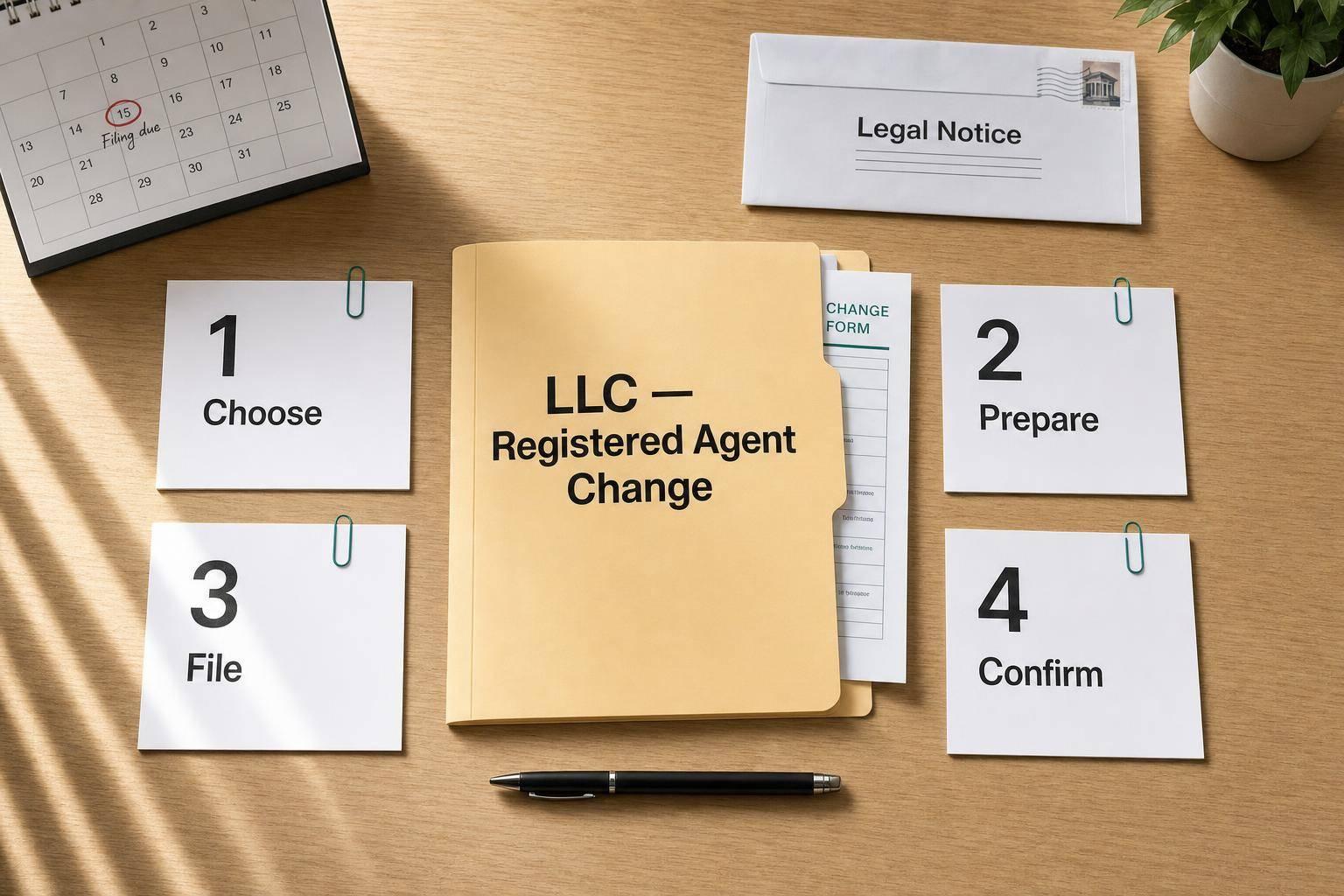
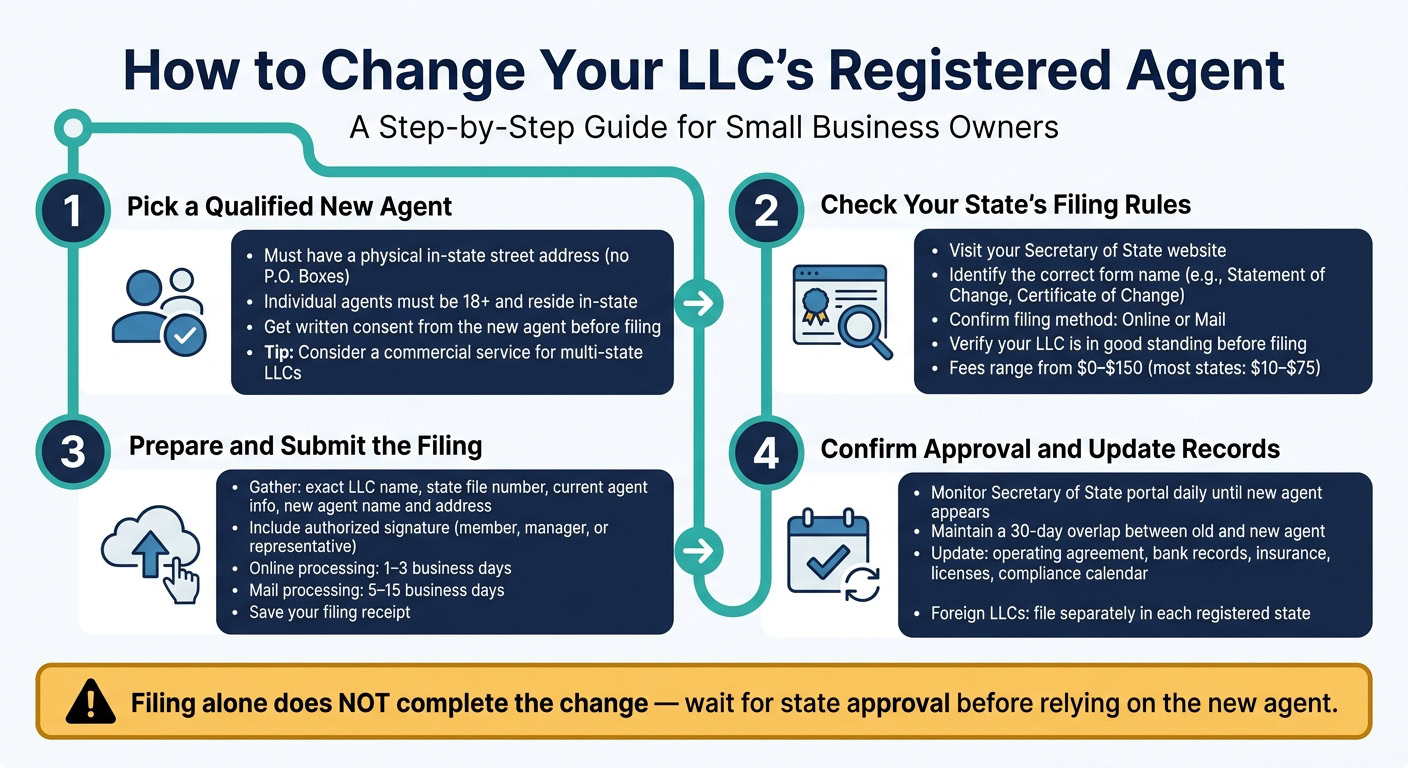
If your LLC’s registered agent is no longer reliable, change it fast. In most cases, I’d handle it in four steps: pick a qualified new agent, check my state’s form and fee, file the change, and wait for state approval before relying on the new agent.
Here’s the short version:
- Don’t wait if the current agent resigned, moved, or misses mail
- Most states require a physical in-state street address, not a P.O. Box
- Fees often range from $0 to $150, with many states falling between $10 and $75
- Online filings often process in 1–3 business days; mail filings often take 5–15 business days
- Foreign LLCs usually must file in each state where they’re registered
- State approval matters because filing alone does not complete the change
- Missed legal notices can lead to default judgments, penalties, loss of good standing, or dissolution
A few points I’d keep in mind:
- If I serve as my own agent and move out of state, I may no longer qualify
- Some states ask for the new agent’s written consent with the filing; others want me to keep it in my records
- A 30-day overlap between the old and new agent can help prevent missed notices
- After approval, I’d update my operating agreement, bank records, licenses, insurance files, and compliance calendar
This process is usually simple. The main risk is a gap between agents or a filing error that slows approval.
When you need to change your LLC’s registered agent
Change your LLC’s registered agent as soon as possible if the current agent resigns, can’t be reached, or no longer meets your state’s rules. If the agent drops the ball, your LLC can miss legal notices. That can lead to default judgments, loss of good standing, or administrative dissolution, which ends the LLC’s legal status in that state. In most cases, the switch happens because the agent resigns, relocates, or simply isn’t available when needed.
Common reasons LLC owners replace a registered agent
If an agent steps down, most states give you 30 to 60 days to name a replacement before you risk administrative dissolution. Some owners also make the change for privacy, especially if they don’t want a home address listed on the public record. Others switch because the current agent travels often or moves out of state, which can make dependable coverage tough.
If you’re serving as your own registered agent and you move, that’s a problem too. Most states require an in-state physical presence, so once you relocate, you no longer meet that rule and should update the record fast. For LLCs doing business in more than one state, a commercial registered agent can make life a lot easier by putting notices into one account with one compliance contact.
Once you know the reason for the switch, check that the new agent meets your state’s eligibility rules before you file.
Who can serve as the new registered agent
Most states require the new agent to have a physical street address in the state. Before filing the change, get the new agent’s written consent to serve in that role. If the agent is a person rather than a company, that person usually must be at least 18 years old and live in the state where the LLC is registered.
If you’re deciding between an individual and a commercial service, it helps to compare the day-to-day differences that matter most for compliance.
| Feature | Individual Agent | Commercial Service |
|---|---|---|
| Privacy | Personal address on public record | Service address used instead |
| Availability | Must be present 9–5, Mon–Fri | Guaranteed business-hour coverage |
| Document handling | Physical mail only | Digital scanning with online access |
| Multi-state scalability | Difficult to manage | Single dashboard for all 50 states |
sbb-itb-ba0a4be
Check your state’s filing rules before you start
Once your new agent meets your state’s eligibility rules, check the filing office rules before you send in the change. Start on the Secretary of State website for the state where your LLC was formed or is registered. States don’t all handle this the same way. Form names, fees, processing times, and signature rules can all change from one state to the next. So the first thing to nail down is simple: the right office, the right form, and the right fee.
The baseline rule is the same everywhere, and the SBA’s guide to registering your business states it plainly: the registered agent has to be located in the state where you registered the company. If your replacement agent fails that test, the filing will not fix your problem.
Also, make sure your LLC is in good standing before you file. Past-due filings can stop the change from going through and leave your LLC exposed.
Find the correct form, filing method, and fee
States use different names for the same basic filing. You might see forms called Statement of Change of Registered Agent, Certificate of Change, or Statement of Information. Some states use other titles, like Statutory Agent or Agent for Service of Process.
Many states let you file online or by mail. Online filing is often faster than mailing paper forms. Fees vary by state too.
Domestic LLC vs. foreign LLC filing differences
If you have a domestic LLC, you usually file the change one time in the state where the LLC was formed. That updates your home-state record.
If you have a foreign LLC, you need to file the change in each state where the LLC is registered. Every state has its own form, fee, and processing timeline. And if you’re moving the whole business to another state, not just swapping agents, the paperwork may go beyond an agent change. You may also need domestication, withdrawal, or a new foreign qualification filing.
After you confirm where to file, get the form ready and make sure you have the consent the state asks for.
Sample state form names and filing methods
Use the examples below as a quick reference. Then check the current rules on the state website before filing.
| State | Common Form Name | Usual Filing Method | New Agent Consent Required? |
|---|---|---|---|
| California | Statement of Information | Online / Mail | Yes |
| Texas | Statement of Change | Online / Mail | Yes (kept in LLC records) |
| Delaware | Certificate of Change | Online / Mail | Yes |
| Florida | Statement of Change | Online / Mail | Yes |
| New York | Certificate of Change | Online / Mail | Yes |
Some states want signed consent sent in with the filing. Others only ask you to keep that consent in your internal records. Either way, get it in writing before you file.
Alaska shows how specific this gets. The state’s registered agent FAQs confirm the change is filed on a Statement of Change, costs $25, and has to arrive by U.S. mail — there is no online option. Miss the requirement for 30 days or more and the LLC drops out of compliance, which can end in involuntary dissolution.
Once you have the right form and know the filing rules, you’re ready to gather the details and signatures the state wants.
How to prepare and file the change of registered agent
First, lock in the new agent. Then file the change with the state. Once the new agent is set, pull together the filing details and submit the form.
What information and signatures the state will require
Before you start, have the following details ready:
| Required Data Point | What to Know |
|---|---|
| Exact LLC name | Must match state records exactly, including punctuation and suffix |
| State file number | The ID assigned by the Secretary of State when your LLC was formed |
| Current agent name and address | The agent now listed on the public record |
| New agent name and in-state street address | Must be a physical street address – no P.O. boxes |
| Effective date | Some states let you choose a future date for the change to take effect |
| Authorized signature | Signature from a member, manager, or authorized representative of the LLC |
Also, get the agent’s signed consent before you file.
Submit the form and save proof of filing
Online filing is usually the fastest option. In many states, online submissions are processed in 1 to 3 business days, while mail-in forms often take 5 to 15 business days.
Fees vary by state, but they usually fall between $0 and $150. Many states land in the $10 to $75 range.
One small mistake can trip you up here. Make sure the LLC name matches state records exactly, down to the punctuation and LLC suffix. A missing comma or the wrong suffix is one of the most common reasons a filing gets rejected.
After you submit, pay the fee and save the receipt with your LLC records.
Confirm the state has approved the change before relying on the new agent
Sending the form is only the first step. It does not mean the change has been approved yet.
Wait for the state to update the record. After filing, pull your LLC’s profile from the Secretary of State’s online portal and check it daily until the new agent’s name appears.
A 30-day overlap between the old agent and the new one is a practical buffer. During that period, keep an eye on both agents for legal notices or mail from the state. If the state sends a deficiency notice, reply right away with the corrected details to avoid more delay.
Save the state approval notice with your LLC records. Once approval comes through, update your company records.
Update company records after the agent change
After the state approves the change, update every record that still shows the old agent. If you kept a short overlap between the old and new agents, use that window to wrap up these updates before the old agent is removed. The state filing is just the first step.
Records to update after the state accepts the change
Start with your operating agreement. If it names the registered agent or includes that address, change it so your internal records match the details the state now has on file.
Then move through four main groups:
- Advisors: Tell your CPA, attorney, and bookkeeper so tax notices and legal mail go to the right contact.
- Financial accounts: Update your bank, lender, and payroll records so compliance-related mail reaches the right address.
- Insurance: Check your insurance records so any legal notice terms still point to the new agent.
- Licensing and vendors: Contact any licensing boards or vendors that still have the old agent listed. Also update your annual report and compliance calendars so future state notices go to the new agent’s address.
Next, review any out-of-state registrations that still name the old agent. If your LLC is foreign-qualified in other states, those states may need a separate filing. A home-state change does not automatically update your agent in every state where you are registered.
Store the approval notice in your governance folder and record the effective date in your compliance log. Then download the updated state record from the Secretary of State portal so you have a clean paper trail for audits or due diligence.
The goal is simple: keep legal notices, tax mail, and state reminders going to one current contact.
FAQs
Can I be my own registered agent?
Yes. You can be your own registered agent in any U.S. state or Washington, D.C., as long as you meet your state’s rules.
In most cases, that means you must be at least 18, have a physical street address in the state, and be available at that address during standard business hours to receive legal and official documents.
One thing to think about: your name and address will become part of the public record.
What happens if my agent resigns suddenly?
If your registered agent resigns, you need to name a replacement within your state’s required timeframe, which is usually 30 to 60 days. Miss that window, and your LLC could run into serious trouble, including administrative dissolution.
There’s not much room to wait here. In many states, a resignation becomes effective in 30 to 31 days. That means you should move fast: pick a new registered agent and file the required state paperwork so your business stays in good standing.
Do I need to change my registered agent in every state?
Yes. You need a registered agent in every state where your business is registered or foreign-qualified.
If you switch agents, you have to handle that change state by state. Each state has its own physical address rules, filing forms, and filing fees.