


When forming an LLC, appointing a registered agent is mandatory in the U.S. This agent handles legal notices, tax documents, and state communications on your behalf. Choosing the right one can protect your privacy, ensure compliance, and prevent missed deadlines. Here’s what you need to know:
- What they do: They receive lawsuits, subpoenas, tax notices, and compliance reminders.
- State requirements: Must have a physical address in the state of operation, be available during business hours, and meet state-specific rules.
- Risks of not having one: Your LLC could face legal penalties, lose liability protection, or even be dissolved.
- Options:
- Professional services: Reliable, maintain privacy, and offer compliance tools ($100–$300/year).
- Individual agents: Free but require constant availability and use your address publicly.
To choose the best option, prioritize dependability, knowledge of state rules, and tools like document scanning and deadline alerts. Professional services are ideal for multi-state operations or privacy concerns, while individual agents suit businesses with simple, single-state needs.
Quick Tip: Use professional agents for peace of mind and to avoid risks like missing legal notices or state deadlines.
What Does a Registered Agent Do?
A registered agent acts as your LLC’s official point of contact for all state and legal communications. Essentially, they handle important correspondence on your behalf, including lawsuits, subpoenas, tax notices, and reminders for annual reports sent by the Secretary of State.
Main Duties of a Registered Agent
The core responsibility of a registered agent is managing service of process. This involves receiving legal documents like court summons or subpoenas. For example, if your LLC is sued, the registered agent ensures you get these documents immediately so you can respond promptly. Missing these notifications could lead to a default judgment against your business, which could have serious consequences.
In addition to legal documents, registered agents handle tax-related communications (such as franchise tax notices and warnings about delinquencies), reminders for annual reports, and other compliance-related notifications from state agencies. Many professional services even offer automated alerts to keep you informed about upcoming deadlines, helping you stay on top of your filing requirements.
These responsibilities highlight why states enforce strict requirements for registered agents.
State Requirements for Registered Agents
Every state mandates that a registered agent must have a physical street address in the state where your LLC is incorporated. P.O. boxes and virtual mailboxes don’t qualify because legal documents must be delivered in person. The agent also needs to be available at this address during regular business hours – typically 8:00 a.m. to 5:00 p.m., Monday through Friday.
If you choose an individual as your registered agent, they must be at least 18 years old. For businesses operating in multiple states, you’ll need a registered agent with a physical presence in each state where your LLC conducts business.
Failing to meet these requirements can lead to severe consequences.
What Happens Without a Registered Agent
Not having a valid registered agent puts your LLC at significant risk. For starters, the state could administratively dissolve your business. This means your LLC would be shut down, and your business name could become available for others to use. Worse, you’d lose the liability protection that separates your personal assets from your business debts or lawsuits.
Other potential risks include losing your good standing with the state, which could block you from securing loans or government contracts. You could also face default judgments in lawsuits you weren’t notified about. In states like Texas, not having a registered agent might even prevent your LLC from filing lawsuits. Moreover, states may impose fines or reject new filings until you appoint a valid registered agent.
"States require most business entities to have a registered agent so the business has a reliable point of contact to receive official documents."
– Stephen Fishman, J.D., Nolo
sbb-itb-ba0a4be
What to Look for in a Registered Agent
Choosing a registered agent goes beyond simply meeting state requirements – it’s about finding a reliable partner to help protect your business and keep it compliant. The right agent ensures your LLC stays on top of deadlines, handles legal documents efficiently, and avoids unnecessary risks. Here’s what you should consider when evaluating a registered agent.
Dependability and Business Hours Coverage
A registered agent must be available at their listed address during standard business hours – typically 9:00 a.m. to 5:00 p.m., Monday through Friday. If a process server shows up with legal documents and no one is there to accept them, your business could face serious consequences, such as a default judgment where the court rules against you automatically. Professional registered agent services guarantee this availability every business day. On the other hand, relying on an individual requires them to be consistently present without fail. Beyond availability, an agent should also be familiar with state-specific filing deadlines and procedures to ensure nothing slips through the cracks.
Knowledge of State Requirements
Each state has its own set of compliance rules, and these can vary widely. For example, in California, LLCs must file a Statement of Information every two years, while stock corporations are required to file annually. A registered agent should have a strong understanding of these nuances and track deadlines specific to your state. Missing important obligations, such as California’s $800 annual franchise tax payment, can result in hefty penalties from the Franchise Tax Board. Additionally, experienced agents are familiar with processes like California’s "substituted service" rule, which allows legal documents to be served through the Secretary of State if the agent is unavailable at their registered address (for an extra $50 fee). Agents who leverage technology to streamline document management further enhance their reliability – more on that in the next section.
Digital Tools and Document Access
The best registered agents use modern tools to simplify document management. Look for services that offer same-day document scanning and instant email notifications when legal papers are received. Many also provide secure online dashboards, giving you 24/7 access to your documents. Automated compliance alerts for deadlines like annual reports and franchise taxes by state are another key feature. These alerts help you avoid penalties ranging from $50 to $500 and prevent administrative dissolution of your business. Since most businesses have only 20 to 30 days to respond to legal actions, timely notifications are crucial for taking swift action.
Clear Pricing Structure
Registered agent services typically cost between $100 and $300 annually. Before signing up, check exactly what’s included in the fee. Some providers charge extra for document scanning, mail forwarding, or compliance alerts – services that others might include in their standard package. Be cautious of hidden fees; for example, a provider advertising a $99 annual rate might charge additional fees for each scanned document or customer support call. Annual billing often proves more affordable than monthly payments, with some providers offering rates as low as $89 per year if you commit to a three-year plan.
Coverage Across Multiple States
If your business operates in more than one state, you’ll need a registered agent with a physical presence in each state where your LLC is registered. A national registered agent service can simplify this process by allowing you to manage all filings through a single account and dashboard. This eliminates the hassle of coordinating multiple agents, addresses, and schedules. Many national providers even offer discounts for multi-state filings, making it a more economical choice than hiring separate agents for each state.
Professional Service vs. Individual Registered Agent
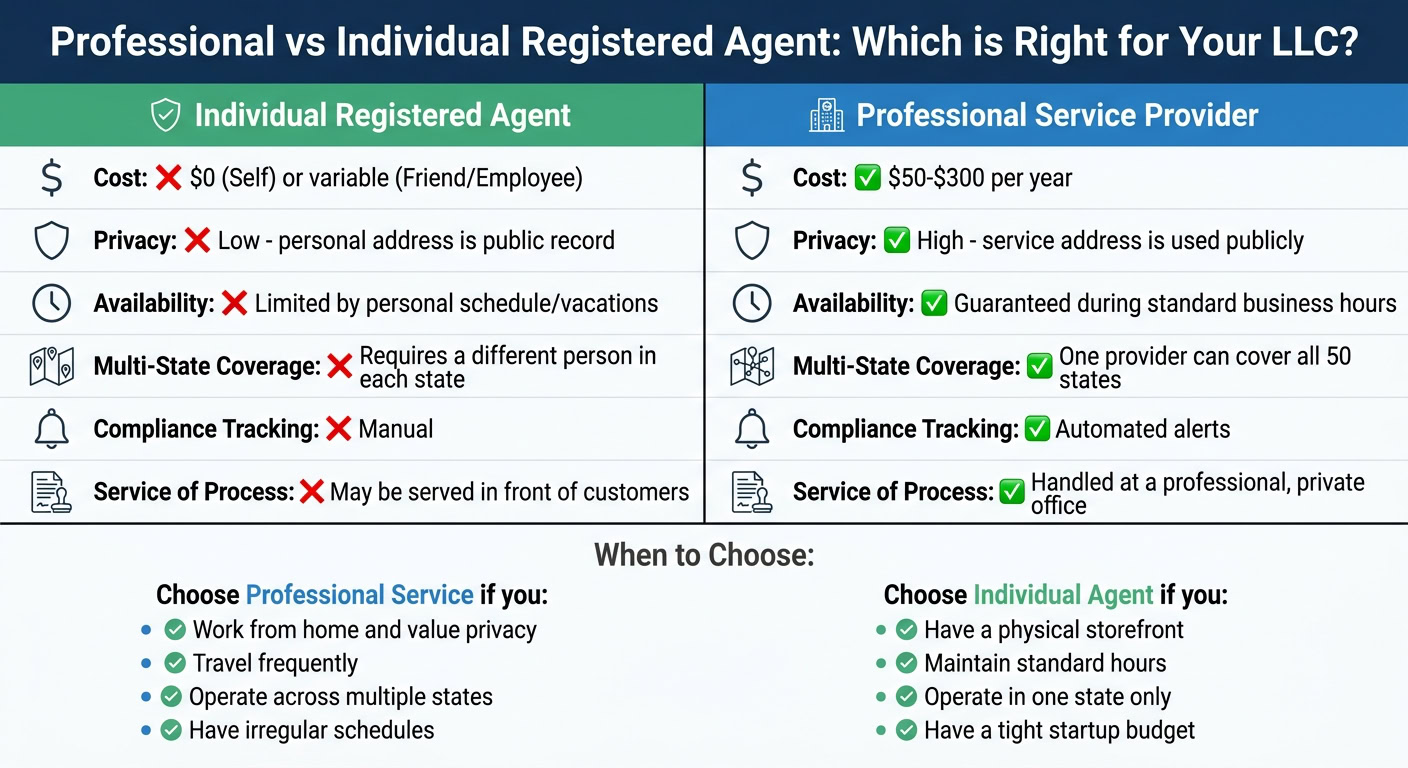
The choice between a professional registered agent service and an individual agent plays a crucial role in maintaining your legal compliance and managing potential risks. Both options meet state requirements, but they vary in how they align with your business needs and operational flexibility.
Pros and Cons of Professional Services
Professional registered agent services offer reliability and convenience by ensuring someone is always available during standard business hours – typically 8:00 a.m. to 5:00 p.m., Monday through Friday. This consistency means you won’t miss important legal documents due to vacations, illness, or other scheduling conflicts. Additionally, these services protect your privacy by using their address on public records instead of your home or office location.
For businesses operating in multiple states, national providers simplify things by covering all jurisdictions under one account. Many even offer discounted rates for multi-state filings. The cost for these services typically ranges from $50 to $300 per year. While this may seem like an added expense, it pales in comparison to the risks and costs associated with missing legal notices or deadlines.
Pros and Cons of Individual Agents
On the other hand, appointing yourself or a trusted associate as your registered agent can save money upfront, as there are no service fees beyond state filing costs. This approach works well if you operate exclusively in your home state, have a physical storefront with regular hours, and can handle direct communication efficiently.
However, this option comes with significant drawbacks. Using an individual agent means your personal or business address becomes public record, potentially exposing you to unwanted attention. Additionally, you or your agent must be physically present during business hours every single day – missing even one service of process can lead to severe consequences, such as a default judgment against your LLC. Compliance tracking, like filing deadlines or franchise tax payments, must be managed manually, adding another layer of responsibility. For businesses looking to expand into other states, you’ll need a separate agent for each jurisdiction, which complicates operations.
| Feature | Individual Registered Agent | Professional Service Provider |
|---|---|---|
| Cost | $0 (Self) or variable (Friend/Employee) | $100 – $300 per year |
| Privacy | Low; personal address is public record | High; service address is used publicly |
| Availability | Limited by personal schedule/vacations | Guaranteed during standard business hours |
| Multi-State Coverage | Requires a different person in each state | One provider can cover all 50 states |
| Compliance Tracking | Manual | Automated alerts |
| Service of Process | May be served in front of customers | Handled at a professional, private office |
When to Choose Each Option
- Professional service: Ideal for those who work from home and value privacy, travel frequently, operate across multiple states, or have irregular schedules.
- Individual agent: Suitable for businesses with a physical storefront, standard hours, operations limited to one state, and a tight startup budget.
Balancing these factors will help you decide which option best suits your business needs while minimizing risks and distractions from your core operations.
How to Evaluate Registered Agent Service Providers
Choosing a professional registered agent service is just the beginning. To ensure your business stays compliant, you’ll need to evaluate the provider’s reputation, compliance tools, cost, and support quality. This isn’t something to take lightly – between 36% and 53% of small businesses face legal issues annually, with costs ranging from $3,000 to $150,000. Reliable service can make all the difference.
Checking Reputation and Experience
A provider’s reputation and experience speak volumes about the quality of their service. Start by confirming how long they’ve been in business and whether they have a physical office in the states where you operate. Avoid providers that rely heavily on subcontractors, as they may process documents more slowly. Those with established relationships with state agencies tend to handle filings more efficiently.
Transparency is another key factor. Providers that openly share information about their leadership and management often signal reliability. Test their customer support by calling directly – ensure you’re speaking with knowledgeable specialists, not generic call center operators. Also, check the provider’s authorization status with your state’s Secretary of State office. For added peace of mind, consider services that offer a money-back guarantee if they don’t meet your expectations.
Compliance Features and Tools
A good registered agent service goes beyond forwarding mail. Look for providers offering automated tools to track important deadlines, like annual reports and state filings. Ask about what’s included in their annual fee – does it cover multiple same-state agency listings, DBAs, or trademark registrations, or are there additional charges? If your business operates in multiple states, some providers offer volume discounts, which can save you money.
Once you’re confident in their compliance tools, take a closer look at their pricing to ensure you’re getting good value.
Reviewing Costs and Fee Structures
Costs for registered agent services can vary widely, so it’s essential to understand what you’re paying for. Many providers offer a free first year if bundled with LLC formation, but renewal rates often increase significantly. Some services start with a low introductory rate that nearly doubles later, while others offer discounts for multi-year commitments. Be sure to check whether document scanning and mail forwarding are included in the base price or if they come with extra fees.
Watch out for hidden charges, such as fees for EIN applications – something you can obtain directly from the IRS for free. If you operate in more than one state, confirm whether the provider offers volume discounts and a single point of contact. Missing deadlines due to a lapsed service can result in reinstatement fees ranging from $50 to over $500.
Customer Support Quality
Timely and knowledgeable customer support can be a lifesaver when dealing with urgent legal documents or compliance questions. The difference between speaking with a state-specific specialist and a generic call center can be huge. Before committing to a provider, test their support team by asking specific questions about your state’s requirements. Take note of response times and the accuracy of their answers.
Providers that prioritize staff training tend to deliver better service, which is especially important if your business expands to multiple states or encounters unexpected legal notices. Having a reliable support team ensures you’re prepared to address any compliance challenges quickly and effectively.
Appointing Your Registered Agent
Once you’ve chosen a registered agent, the next step is to officially appoint them through your state’s filing process. This involves submitting the necessary paperwork, keeping accurate records, and understanding how to make updates if your business circumstances change.
State Filing Process and Required Information
In most states, you’ll need to designate your registered agent when filing your Articles of Organization. This requires providing the agent’s full legal name and a valid street address within the state. The agent must formally accept the role, often by signing the filing document. For example, in Florida, agents can electronically consent by typing their name during the online filing process.
"The registered agent must sign the application. The signature confirms the agent is familiar with and accepts the obligations of s.605.0113, F.S." – Florida Department of State
Make sure your agent meets all state-specific requirements, such as residency and availability during business hours. If you opt for a business entity as your agent, verify that it is active and authorized to operate in your state. In Florida, for instance, the fee for designating a registered agent is $25, paid alongside the $100 fee for filing the Articles of Organization. It’s a good practice to keep a signed copy of the agent’s consent on file for compliance purposes.
How to Change Your Registered Agent
As your business evolves, you might need to switch your registered agent. To do this, select a new agent and obtain their written consent. Then, file a "Change of Registered Agent" form with your Secretary of State and pay the applicable fee, which typically ranges from $0 to $25. For instance, Georgia requires this change to be filed within 30 days, while in Texas, the fee is $15 for most entities and $5 for nonprofits.
Notify your previous agent and update your internal records to avoid confusion or unnecessary charges. Many states mandate that these updates be filed within a specific timeframe – usually 30 to 60 days after the previous agent’s termination.
"Keeping your registered agent information up-to-date is not just a legal necessity – it’s a strategic action that supports your business’s success and stability." – LLC Attorney
Staying on top of these updates is essential for compliance and ensuring your business operations run smoothly.
Keeping Records and Staying Compliant
Maintaining accurate and current registered agent information is critical for preserving your LLC’s legal standing. Regularly update your internal records and notify the Secretary of State promptly if your agent’s details change. For example, California requires businesses to file a Statement of Information within 90 days of forming an LLC and then every two years, which includes registered agent details.
Failing to update this information can have serious consequences. If your registered agent becomes unreachable, some states – like Illinois – allow the Secretary of State to accept service on your behalf. This could lead to missed notices and even default judgments.
To avoid complications, review and confirm your registered agent’s contact information annually. Also, ensure they have your current business address to handle communications effectively. Staying proactive in this area helps safeguard your business from unnecessary risks.
Conclusion
Picking the right registered agent is a key decision for keeping your LLC compliant. The agent you choose plays a big role in ensuring your business stays in good standing, handles legal notices promptly, and maintains privacy. Every state requires LLCs to have a registered agent at all times. Without one, your business risks administrative dissolution and reinstatement fees that can range from $50 to over $500.
When assessing potential agents, focus on reliability, availability, and compliance support. Professional services ensure there’s always coverage during business hours and often include features like automated monitoring and deadline tracking to prevent missed filings. These services typically cost between $100 and $300 per year, which is far more affordable than the $55,000 average salary for hiring an in-house professional. Acting as your own agent, however, ties you to one location every business day, leaving little flexibility.
Look for a service with transparent pricing – no hidden fees for document forwarding or compliance alerts. Make sure they offer same-day or next-day scanning since legal deadlines can be strict. If your business operates in multiple states or plans to expand, choose a national provider to simplify compliance across jurisdictions.
"The right partner helps protect your business from missed deadlines, legal surprises, and compliance risks – while making it easier to manage growth across multiple states." – RASi Staff
Selecting a dependable and compliance-driven registered agent protects your LLC’s legal standing and frees you up to focus on growing your business.
FAQs
Can I be my own registered agent?
Yes, you can act as your own registered agent if you meet these conditions: you must be at least 18 years old, have a physical street address in the state where your LLC is registered, and be available during regular business hours. It’s important to note that the registered agent must comply with state-specific rules and be physically present at the designated address during those hours.
What happens if my registered agent is unavailable?
If your registered agent isn’t available, your business could run into major legal and compliance troubles. Critical legal documents – like lawsuits or official notices – might not be delivered, causing missed deadlines or even default judgments. On top of that, not maintaining a registered agent could lead to fines, penalties, or even the dissolution of your LLC. It’s essential to have an agent who is dependable and always accessible.
How do I change my registered agent after forming my LLC?
To switch your registered agent, you’ll need to file a specific form with your state – often called a Certificate of Change. This form requires you to provide information about your current registered agent, the new agent, and any other necessary details. Make sure to sign the form and pay any required fees.
Submit the completed form to the appropriate state agency, such as the Secretary of State. Since rules and fees differ from state to state, it’s important to check the specific requirements for your jurisdiction. Once your filing is approved, the change will be reflected in your LLC’s records.