
The short answer: I’d pick the state based on where I run the business, what kind of privacy I want, and whether I need a home base for travel – not just the lowest fee.
A virtual mailbox can give me a U.S. street address for business mail, but it does not replace a registered agent. And it does not set my tax status on its own. If I work in one state and use a mailbox in another, I may still have filing and tax duties where I actually do business.
Here’s the simple way I’d think about it:
-
If I live and work in one state: I’d usually use my home state to avoid extra filings.
-
If I want more privacy for an LLC: I’d look at Wyoming.
-
If I plan to seek VC funding: I’d look at Delaware.
-
If I live in a no-income-tax state like Florida or Texas: I’d often keep things there.
-
If I travel full time: I’d consider South Dakota for mail handling and domicile use.
A few facts matter right away:
-
USPS Form 1583 is required to let a mailbox provider receive mail for me.
-
5 out of 5 states covered here still require a registered agent with a physical in-state address.
-
Delaware LLCs pay a $400 annual franchise tax.
-
Wyoming’s annual report starts at $60.
-
Florida’s annual report is $138.75.
-
Texas formation is $300, though many smaller LLCs owe $0 franchise tax if they stay under the revenue limit.
Quick comparison
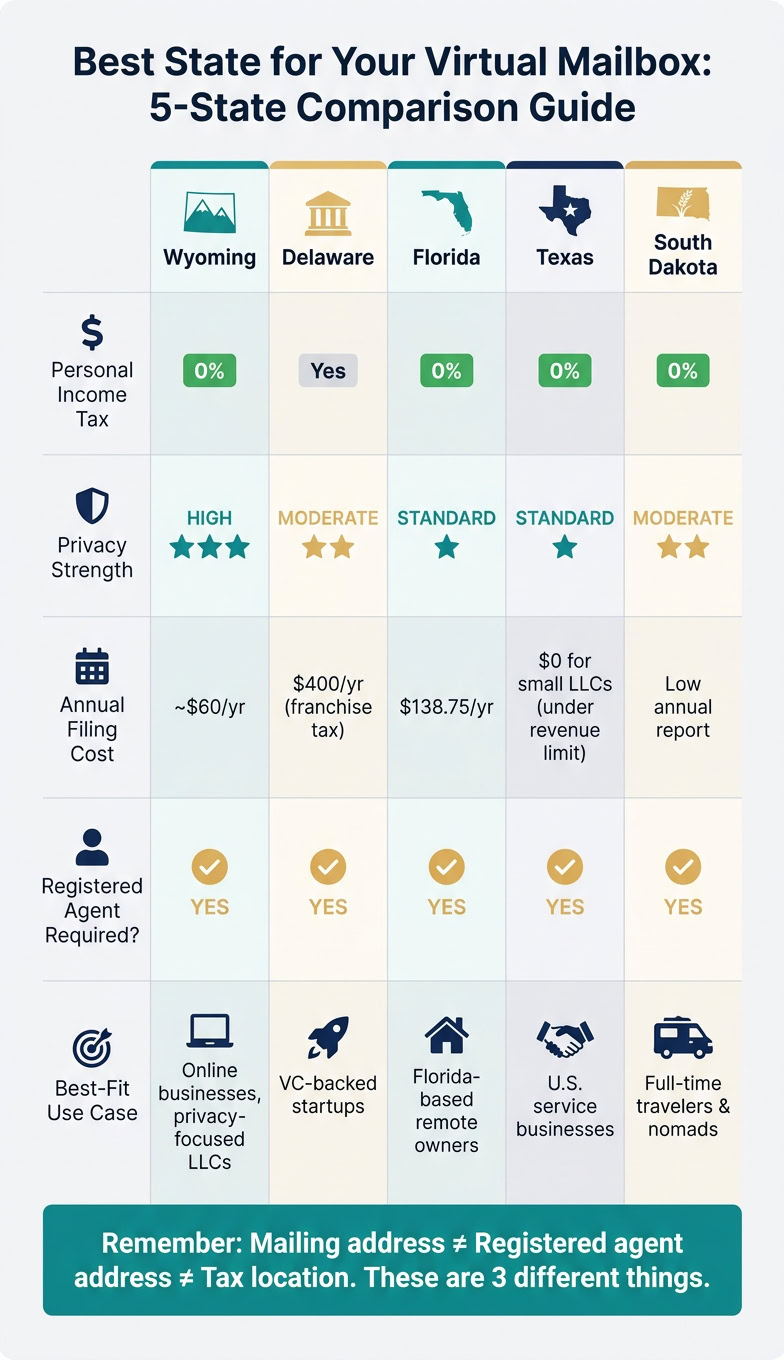
Best State for Your Virtual Mailbox: 5-State Comparison Guide
|
State |
State Income Tax |
Main Draw |
Main Tradeoff |
Good Fit |
|---|---|---|---|---|
|
Wyoming |
0% personal income tax |
Privacy |
Still need registered agent and annual report |
Online businesses, holding companies |
|
Delaware |
Yes |
Investor-friendly setup |
$400/year LLC tax |
Startups planning to seek funding |
|
Florida |
0% personal income tax |
Simple, familiar setup |
Annual report required |
Owners living in Florida |
|
Texas |
0% personal income tax |
Common choice for U.S. business presence |
Extra yearly filing steps |
Service businesses, Texas-based owners |
|
South Dakota |
0% personal income tax |
Good fit for full-time travelers |
Not the right fit for every fixed-location business |
RVers, nomads, travelers |
My rule of thumb: mailing address, legal address, and tax location are three different things. Once I keep those separate, the right state usually becomes much easier to pick.
Step 1: Check the rules that affect your setup
Start with the state where your business has actual activity. If you have employees, an office, or local licenses in one state, begin there. Forming in another state can lead to foreign qualification, extra filings, and more compliance costs.
Business address vs. registered agent address
These two addresses do very different jobs, and mixing them up is one of the most common mistakes remote owners make.
Your business mailing address is where you get day-to-day mail, like invoices, bank statements, client mail, and vendor letters. A virtual mailbox often works well for this. Your registered agent address has a different role. It must be a physical street address in the state where you form the business, and someone must be there during business hours to accept legal notices.
|
Address Type |
What It’s Used For |
Can It Be a Virtual Mailbox? |
|---|---|---|
|
Business mailing address |
Daily mail, banking, invoices, public listings |
Yes, in most cases |
|
Registered agent address |
Service of process, state legal notices |
No – must be a physical in-state address |
Banks and vendors usually ask for a business mailing address, not a registered agent address.
That separation between your mailing address and registered agent makes the next step – choosing the right state – a lot simpler.
Tax nexus, residency, and state compliance
Check nexus and residency as separate issues from your mailing address. A mailing address by itself does not create nexus or change residency. States usually look at things like employees, property, and revenue. So if your actual operations are in one state and your mailbox is in another, you should expect separate compliance.
Once you know those rules, you can compare states based on privacy, fees, and mail handling.
Step 2: Compare five states that fit most remote business needs
Now that the difference between a mailing address and a registered agent is clear, it helps to compare states based on the trade-offs that matter to remote owners. The best pick usually comes down to formation rules, privacy, taxes, annual filings, and how easy it is to handle mail while living on the move. Cheapest isn’t always best.
Here’s a side-by-side view of five states that come up again and again:
|
State |
Personal Income Tax |
Privacy Strength |
Main Annual Filing |
Registered Agent Required |
Best-Fit Use Case |
|---|---|---|---|---|---|
|
Wyoming |
None |
High |
Annual report/license tax |
Yes |
Privacy-focused LLCs, online businesses, asset-holding companies |
|
Delaware |
Yes |
Moderate |
Annual LLC franchise tax |
Yes |
Venture-backed startups, founders expecting investor due diligence |
|
Florida |
None |
Standard |
Annual report |
Yes |
Domestic service businesses, lifestyle-driven remote owners |
|
Texas |
None |
Standard |
Public Information Report and franchise tax filing |
Yes |
Service businesses, entrepreneurs with U.S.-based customers |
|
South Dakota |
None |
Moderate |
Annual report |
Yes |
Full-time travelers, RV owners, digital nomads |
All five states require a registered agent with a physical street address in that state. A virtual mailbox doesn’t count unless that same provider also offers registered agent service.
Wyoming and Delaware: LLC privacy vs. investor alignment
These two states often sit at the center of formation decisions, but for very different reasons.
Wyoming tends to appeal to privacy-first LLC owners. Public filings generally don’t require member or manager names, which can keep your personal identity off the Secretary of State’s database when you use a registered agent [1][3]. Annual costs are also low, so Wyoming fits solo founders, online businesses, and LLC owners who want less of their personal information in public records.
Delaware is built for a different path. If you may go after venture capital, this is often the state investors expect to see. Its business law system is familiar to funds, attorneys, and buyers doing due diligence. Delaware LLCs pay a flat $400 annual franchise tax, due June 1, and they don’t file an annual report for LLCs [2].
Florida and Texas: familiar U.S. business presence
Florida and Texas both offer no personal income tax, and both are a common fit for owners who want a straightforward U.S. business presence instead of extra privacy layers.
Florida requires an annual report. Texas requires a Public Information Report and a franchise tax return each year. That said, many smaller LLCs end up owing no franchise tax if they stay under the revenue threshold [5].
If your customers, vendors, or partners are mostly in the U.S., these states can feel more conventional on paper. Sometimes that matters more than people expect.
South Dakota: a stable base for full-time travelers
If you travel full time, your needs shift a bit. You’re not just picking a state for filing. You’re picking a base camp.
South Dakota has no personal state income tax and no corporate income tax [8][9]. It also has a mature mail-forwarding setup that gives travelers a steady address for business mail [4][6][7]. That makes it a good match for RV owners, digital nomads, and others who need one dependable mail base while their day-to-day location keeps changing. Many travelers also set up custom mail delivery to ensure they receive physical documents wherever they happen to be.
Step 3: Pick your state using a simple decision framework
Match your business profile to the right state
Use this checklist to make the state comparison above easier to act on. The goal is simple: match your day-to-day setup to the state that fits it best.
|
Your Situation |
Best State Match |
Why |
|---|---|---|
|
You already live and operate in one state full time |
Your home state |
Avoids duplicate compliance |
|
Privacy-focused LLC, online business, or asset-holding company |
Wyoming |
Strong privacy norms |
|
Startup planning to raise venture capital |
Delaware |
Familiar to investors and attorneys |
|
Remote entrepreneur who actually lives in Florida or Texas |
Florida or Texas |
No personal income tax |
|
Full-time travelers, RVers, or digital nomads |
South Dakota |
Nomad-friendly mail handling |
If you already live and run the business in one state, forming in another one often creates extra paperwork. You may still need to register locally as a foreign LLC, which means more filings without cutting your home-state tax bill.
Once you’ve narrowed down the fit, look at the recurring costs and the mail setup tied to each option.
Review total cost, mail logistics, and compliance support needs
Look at the full yearly cost, not just the filing fee. For a Wyoming LLC, that includes the $60 annual report, plus registered agent and virtual mailbox fees [15][12][13]. For a Florida LLC, expect about a $125 formation fee and a $138.75 annual report [10]. Texas costs $300 to form, and many smaller LLCs owe no franchise tax if they stay under the revenue threshold [10][11].
Mail handling matters just as much. Check scan speed, forwarding fees, and package limits before you sign up. If you travel outside the U.S., review forwarding rates up front. International label fees can start at $2.50 plus postage, and that can stack up fast [14]. Scan frequency and package storage caps matter too, especially if you’re waiting on legal notices or other time-sensitive mail.
For many remote owners, the easiest path is to use one provider for formation, registered agent service, mailbox handling, and compliance reminders. Keeping it under one roof can cut down on missed filings and billing mix-ups.
Choose the setup that makes compliance easy and keeps your mail dependable.
Conclusion: Choose the state that fits how your business actually runs
After comparing the rules, costs, and mail setup, the choice comes down to one thing: fit. Pick the state that matches how your business actually works, not the cheapest option or the one you already know best.
Two rules shape the whole decision. A mailbox address does not replace a registered agent. And tax duties follow where your business actually operates. A virtual mailbox doesn’t change that.
It also helps to keep your formation, registered agent service, mailbox handling, and compliance support lined up. When those pieces are spread across different states or providers for no clear reason, things can slip through the cracks. You might miss an annual report, overlook a deadline, or lose track of an important notice.
The best state is the one that makes your mail, filings, and taxes as simple as possible.
FAQs
Can I use a virtual mailbox in a different state than my LLC?
Yes. You can use a virtual mailbox in a different state than your LLC for your principal business address, marketing materials, and general mail.
But there’s one big limit: it does not replace a registered agent.
A registered agent must have a physical address in your formation state and be available to receive legal papers and state notices. That part can’t be handled by a virtual mailbox alone.
You’ll also want to watch your foreign qualification duties if you’re doing a lot of business in other states. If your company has a strong presence outside your LLC’s home state, you may need to register there too.
When do I need to foreign qualify my business?
You generally need to foreign qualify when your business operates or has a physical presence in a state other than the one where your LLC was formed.
If your business operates in more than one state, you’ll usually need to register as a foreign entity in each state where you do business. Even using a virtual address as your principal office, or running active operations from another state, can trigger that requirement.
How do I choose between Wyoming, Delaware, and South Dakota?
Choose based on what matters most to you: privacy, taxes, or legal standing.
-
Wyoming is low-cost, privacy-friendly, and a good fit for solopreneurs and online businesses.
-
Delaware is best known for VC-backed startups and a strong legal track record, but it comes with a $400 annual franchise tax.
-
South Dakota works well if your main goal is lowering taxes and keeping trust details private, but it takes more work to set up domicile and it lists member names in annual reports.
One more thing: a virtual mailbox is not a substitute for a required registered agent.