


The short answer: a single-member LLC has 1 owner and usually files taxes on the owner’s personal return, while a multi-member LLC has 2 or more owners and usually files a separate partnership return.
If I were choosing between the two, I’d focus on 3 things right away:
- Who owns the business now
- Who makes decisions
- Which tax forms need to be filed
Here’s the plain-English version:
- A single-member LLC gives one person full control.
- A multi-member LLC splits ownership, profit, and decision-making between two or more people.
- By default, the IRS treats a single-member LLC as a disregarded entity.
- By default, the IRS treats a multi-member LLC as a partnership.
- A multi-member LLC usually files Form 1065 and gives each member a Schedule K-1.
- A single-member LLC often reports business income on Form 1040, often with Schedule C.
- Both types can help protect personal assets, but only if the business is kept separate from personal finances.
In most cases, the main tradeoff is simple: one-owner LLCs are easier to run, while multi-owner LLCs need more tax records, more written rules, and more coordination.
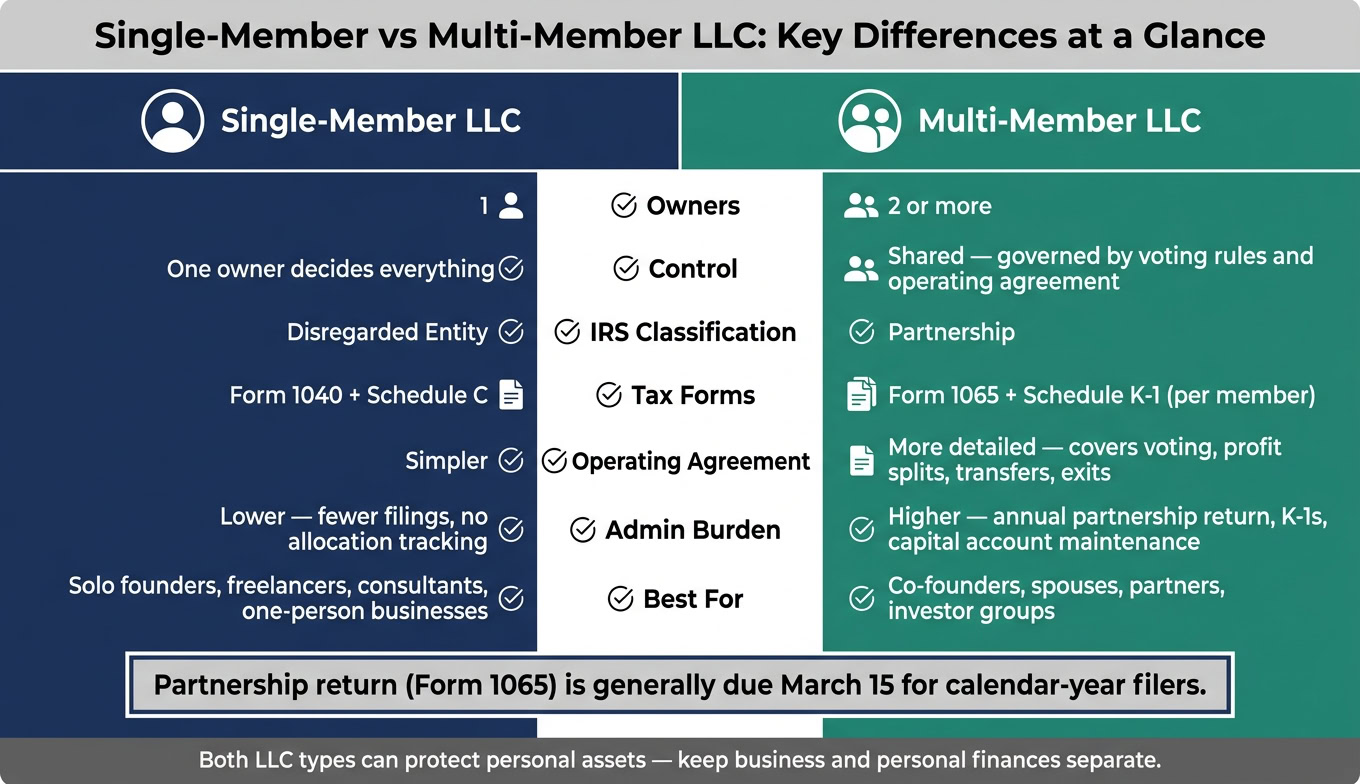
Single-Member vs Multi-Member LLC: Key Differences at a Glance
Quick Comparison
| Factor | Single-Member LLC | Multi-Member LLC |
|---|---|---|
| Owners | 1 | 2+ |
| Control | One owner decides | Members share decisions |
| Default IRS treatment | Disregarded entity | Partnership |
| Main federal tax filing | Form 1040, often Schedule C | Form 1065 + K-1s |
| Paperwork | Lower | Higher |
| Operating agreement | Shorter in many cases | More detailed in many cases |
| Best fit | Solo founders, freelancers, one-person businesses | Co-founders, spouses, partners, investor groups |
One tax date matters here: a calendar-year partnership return is generally due by March 15. That alone can affect how a multi-member LLC handles tax season.
If I wanted the simplest setup, I’d lean single-member. If I were starting with a partner, I’d use a multi-member LLC and make sure the operating agreement clearly covers ownership, voting, profit splits, and exits.
sbb-itb-ba0a4be
Single-member LLC: one owner, direct control, and simpler default filing
A single-member LLC has one owner, period. No co-owners. No equity split to work out. No voting rules to sort through. That makes it a solid choice for solo freelancers, consultants, online sellers, and real estate investors who want liability protection without shared ownership. Where this setup stands out most is in day-to-day control.
Ownership and management in a one-owner LLC
In a single-member LLC, the owner makes the calls directly. That includes decisions on contracts, pricing, and expenses. Most single-member LLCs are owner-managed, which means the owner handles daily operations without naming a separate manager.
Take a U.S.-based freelance graphic designer who sets up a single-member LLC. The daily work may look almost the same – choosing clients, setting rates, and delivering projects – but the paperwork changes in an important way. Contracts and invoices go out under the LLC’s name. The designer signs as the owner of the LLC, not as an individual. There are no partner meetings, no deadlocks, and no profit-sharing formulas to keep track of, so decisions can move fast.
That said, simple control doesn’t erase tax and compliance work.
Default tax treatment and compliance for a single-member LLC
Income and expenses usually pass through to the owner’s Form 1040, often on Schedule C, and the LLC itself usually does not file a separate federal income tax return. The owner still pays self-employment tax on net earnings and may also need to make estimated quarterly tax payments.
A simpler federal filing setup doesn’t mean you can ignore the rest. State rules still apply. Those may include formation filing fees, annual or biennial reports, and keeping a registered agent with a physical in-state address.
To help preserve the liability shield, keep a separate business bank account, sign contracts in the LLC’s name, and maintain clean records. Courts can pierce the LLC veil when personal and business finances get mixed.
Once you add another owner, those same rules get harder to manage.
Multi-member LLC: shared ownership, shared decisions, and more filing complexity
Once an LLC has more than one member, the setup changes in a big way. It’s no longer about one person calling the shots. A multi-member LLC has two or more owners, which means control, profits, and duties are split across the group. Those members might be business partners, spouses, family investors, or co-founders. And because each person can put in different amounts of cash or property, a multi-member LLC gives the owners room to divide ownership, profits, and control in different ways. That’s exactly why the operating agreement carries so much weight here.
Ownership structure, voting rights, and operating agreement terms
When several people own one business, vague rules can turn into a mess fast. An operating agreement should clearly lay out ownership percentages, each member’s cash or property contributions, how profits and losses are divided, when distributions go out, and how voting works. It should also say which choices need a simple majority, a supermajority, or unanimous approval. On top of that, it needs rules for departures, buyouts, and deadlock.
A strong operating agreement sets ownership percentages, voting rights, profit splits, and exit rules.
Default partnership taxation and added administrative work
By default, the IRS treats a domestic multi-member LLC as a partnership for federal tax purposes. The LLC files Form 1065 each year, which is generally due by March 15 for calendar-year filers. The LLC itself does not pay federal income tax. Instead, each member gets a Schedule K-1 that shows their share of income, deductions, and credits, and they report that on their personal Form 1040.
This setup usually means more admin work than a single-member LLC. The business has to keep separate capital accounts for each member, track profit splits during the year, and issue a K-1 to every member at tax time. If the operating agreement includes fixed payments for services, called guaranteed payments, those must also be tracked and reported on their own.
Tax prep often costs more than it does for a single-member LLC because the business has to file a partnership return and prepare K-1s. Active members may also owe self-employment tax on their share of ordinary business income and on any fixed payments for services, which adds one more layer to the math. Track each member’s capital account and splits throughout the year.
These differences stand out most when you compare the two side by side.
Single-member vs. multi-member LLC: side-by-side comparison
Both LLCs can offer liability protection if you keep the business in good standing. But once the LLC is up and running, the day-to-day differences become much more noticeable. The main split shows up in ownership, taxes, and paperwork.
| Factor | Single-Member LLC | Multi-Member LLC |
|---|---|---|
| Ownership count | One owner | Two or more owners |
| Decision-making | Centralized; sole owner has full control | Shared; governed by voting rules and operating agreement |
| Default IRS classification | Disregarded entity | Partnership |
| Core tax forms | Form 1040 + Schedule C | Form 1065 + Schedule K-1 for each member |
| Operating agreement complexity | Simpler; still recommended | More detailed; covers voting, allocations, transfers, and exits |
| Ongoing administrative burden | Lower; fewer filings and no allocation tracking | Higher; annual partnership return, K-1s, and capital account maintenance |
The liability shield only works if you treat the business like a separate business. That means keeping personal and business finances apart and following your state’s rules.
Where the biggest practical differences show up
The biggest gap usually doesn’t appear at formation. It shows up later, when the business starts operating.
A single-member LLC is usually faster to run. One owner can make decisions, sign contracts, and handle day-to-day work without needing anyone else’s approval. That’s simple, and for many small businesses, that’s a big plus.
A multi-member LLC gives up some of that speed in exchange for shared resources. Members can pool money, split up work, and share risk. For example, one co-founder may put in startup cash while another handles operations, and both can share profits based on the operating agreement. That’s often a smart setup. But it also means more back-and-forth, more records to keep, and more tax work.
Taxes are one place where this becomes hard to ignore. A multi-member LLC usually files Form 1065, and each member gets a Schedule K-1. In plain English, each member often has to wait for that K-1 before finishing a personal tax return.
That tradeoff is the heart of the choice: one-owner LLCs tend to be simpler and faster, while multi-member LLCs can make it easier to combine money, skills, and risk under one roof.
How to choose the right LLC structure for your business
Start with ownership. Are you the only owner right now, and is that likely to change in the near term?
Once that part is clear, the next things to look at are control, paperwork, and speed. A solo freelancer, independent consultant, or one-person real estate holding company is often a better fit for a single-member LLC. You keep full control, and filing is simpler. If you’re starting with a co-founder or plan to add a co-owner or investor, a multi-member LLC is often the better choice. You take on more tax and recordkeeping work, but the structure spells out each person’s stake, decision-making role, and exit terms.
Use these three filters to pick the better fit:
- Who owns the business today, and will that change soon? If you expect to add co-founders or equity partners, starting as a multi-member LLC can save you from a messier switch later.
- How much admin work can you handle? A single-member LLC keeps filing simpler. A multi-member LLC comes with more tax and recordkeeping work.
- How quickly do you need decisions made? One owner can act right away. With multiple members, you may need group agreement. That can work well for investment partnerships, but it can slow down a fast-moving startup unless the operating agreement clearly gives a manager the power to act.
The main goal is to pick the structure that fits your ownership plan before you file. You can change it later, but that usually means more paperwork and possible tax issues.
FAQs
Can a single-member LLC become a multi-member LLC later?
Yes. A single-member LLC can later become a multi-member LLC.
That usually means a few updates behind the scenes. You’ll need to revise the operating agreement, file any state forms tied to the ownership change, and let the IRS know. In many cases, you’ll also need a new EIN.
The process often takes four to six weeks, so it’s smart to plan ahead.
Do both LLC types need an operating agreement?
Both types benefit from an operating agreement, but not for the same reason.
For multi-member LLCs, the agreement is a must-have. It should spell out voting rights, profit sharing, dispute resolution, and exit procedures. That way, everyone knows how the business runs before problems show up.
For single-member LLCs, an operating agreement usually isn’t legally required in most states. Even so, it’s still a smart move. It can help protect the LLC’s legal status and keep management records clear. In many cases, a simple version is enough for a single-member LLC.
How does adding a member affect taxes?
Adding a member usually changes your LLC from a disregarded entity to a partnership for tax purposes.
With a single-member LLC, you’ll usually report income on your personal Form 1040 using Schedule C. Once the LLC has more than one member, it must file Form 1065. Each member then receives a Schedule K-1 to report their share of profits, losses, and deductions.
That change also means the LLC needs an EIN and may lead to higher tax prep costs.