
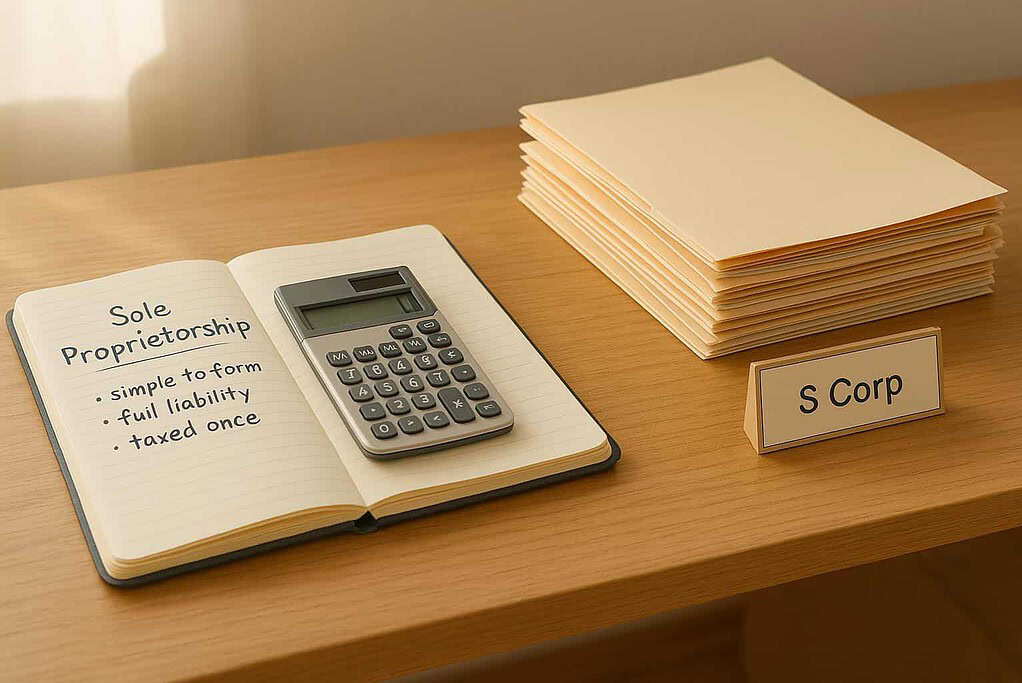
When starting a business, choosing between a sole proprietorship and an S Corporation (S Corp) affects taxes, liability, and growth potential. Sole proprietorships are simple and low-cost, but they expose personal assets to business risks and require paying self-employment tax on all profits. S Corps offer tax savings by splitting income into salary and distributions and protect personal assets, but they involve more paperwork and compliance.
Key Takeaways:
- Sole Proprietorship: Easy to set up, full control, but personal liability and higher self-employment tax.
- S Corp: Tax-efficient and protects personal assets, but requires more administrative work and costs.
Quick Tip: Consider switching to an S Corp when your net income exceeds $40,000–$60,000 annually or if you need liability protection for growing risks.
Quick Comparison: Factor Sole Proprietorship S Corporation (S Corp)
For small, low-risk ventures, a sole proprietorship works well. For growing businesses with higher income or risk, the benefits of an S Corp can outweigh the added complexity.
Sole Proprietorship Details
Main Features of a Sole Proprietorship
A sole proprietorship stands out for its simplicity and ease of setup. There’s no formal registration process or federal fees required to get started. In many cases, you’re officially in business the moment you start earning money. However, depending on your location, you might need to secure local business licenses or permits.
With a sole proprietorship, you’re in complete control. Every decision – whether it’s setting prices, choosing clients, or managing daily operations – is entirely up to you. There’s no board of directors, no partners to consult, and no shareholders to answer to. Plus, all the profits go directly into your pocket.
For tax purposes, you can use your Social Security Number, but many opt to get an Employer Identification Number (EIN) to simplify banking and professional dealings. This structure is particularly well-suited for freelancers, consultants, independent contractors, small retail businesses, and service providers like photographers, tutors, and handymen. While straightforward, this setup comes with specific tax and liability considerations.
Tax and Liability Rules
Sole proprietors enjoy the benefit of pass-through taxation, which means business income is reported on your personal tax return using Form 1040, Schedule C. However, all profits are subject to self-employment tax. This streamlined approach eliminates the need for a separate business tax return, making the accounting process less burdensome.
That said, self-employment tax can be a significant expense. As of 2025, the rate stands at 15.3%, which includes 12.4% for Social Security and 2.9% for Medicare, applied to your net earnings. This amount is in addition to your regular income tax. Unlike S Corporation owners, sole proprietors must pay self-employment tax on every dollar of profit.
Liability is another critical factor. As a sole proprietor, you bear unlimited personal liability for any business debts or legal issues. This means your personal assets – like your home, car, or savings – are at risk if your business faces financial trouble or legal challenges.
Growth Limitations
While sole proprietorships are ideal for their simplicity, they often face hurdles when it comes to growth. Expanding the business or securing external funding can be difficult. According to the U.S. Bureau of Labor Statistics, 20% of sole proprietorships fail within their first year, and 50% don’t make it past five years. Investors and lenders are often hesitant to work with sole proprietorships, viewing them as higher-risk ventures.
Additionally, the single-owner structure limits your ability to bring on partners or issue stock, which can make scaling the business a challenge. Despite these obstacles, sole proprietorships remain the most common business structure in the U.S., accounting for over 70% of all businesses. They’re an excellent choice for testing out business ideas and generating initial income before transitioning to a more complex structure as the business grows.
S Corporation Details
Main Features of an S Corp
An S Corporation (or S Corp) is a more structured business setup compared to a sole proprietorship. Named after Subchapter S of the Internal Revenue Code, this structure offers the dual advantage of corporate liability protection and avoiding double taxation. However, these benefits come with stricter compliance requirements.
S Corps are limited to 100 shareholders, all of whom must be U.S. citizens or resident aliens. They can only issue one class of stock, ensuring all shareholders have equal rights to distributions and voting power. Additionally, S Corps cannot be owned by other corporations, LLCs, partnerships, or non-resident aliens.
Tax Benefits
One of the key perks of an S Corp is its tax structure. It allows for pass-through taxation, meaning the business itself doesn’t pay corporate taxes. Owners can split their income between a reasonable salary – subject to 15.3% payroll taxes – and dividends, which are exempt from self-employment tax. This setup can potentially reduce overall tax liability.
For instance, imagine a consultant earning $70,000 annually. They could allocate $35,000 as salary (subject to payroll taxes) and the remaining $35,000 as dividends. This approach could save them roughly $5,355 in taxes. However, the IRS requires that salaries be reasonable and in line with market standards for similar roles.
While these tax savings are appealing, they come with the trade-off of more administrative responsibilities, as outlined below.
Required Paperwork and Filings
To elect S Corp status, you must file IRS Form 2553 after forming your corporation or LLC. Once established, S Corps are required to file Form 1120S annually, which is the S Corp tax return. They must also issue K-1 forms to shareholders, detailing their share of the company’s profits or losses. These filings are generally due by March 15th each year.
Beyond federal filings, S Corps must maintain meticulous records. This includes holding annual shareholder meetings, keeping minutes, and maintaining corporate records. State requirements often include filing annual reports and paying associated fees. For example, California imposes a minimum annual tax of $800.
Operating as an S Corp also demands strict financial record-keeping. This includes maintaining separate business bank accounts, tracking all expenses, documenting distributions, and keeping detailed payroll records. Neglecting these requirements can lead to the loss of S Corp status – and with it, the associated tax benefits.
Sole Proprietorship vs. S Corp: Direct Comparison
Comparison Table
When weighing the choice between a sole proprietorship and an S Corp, it’s crucial to understand how they differ across key business aspects. Here’s a side-by-side comparison to help clarify:
| Factor | Sole Proprietorship | S Corporation (S Corp) |
|---|---|---|
| Ownership Structure | Owned and managed by one individual | Can have up to 100 shareholders, with ownership represented by stock |
| Personal Liability | Unlimited personal liability – personal assets are at risk for business debts | Limited liability protection – shareholders’ personal assets are generally shielded |
| Taxation | Pass-through taxation; all profits are subject to around 15.3% self-employment tax | Pass-through taxation; owners must pay themselves a reasonable salary (subject to payroll taxes), while distributions avoid self-employment tax |
| Tax Deductions | Standard business deductions | May qualify for a 20% Qualified Business Income (QBI) deduction on profits after salary |
| Compliance Requirements | Minimal – no need for annual meetings or extensive recordkeeping | Requires annual filings, corporate recordkeeping, and shareholder meetings |
| Setup Costs | Low startup costs with minimal paperwork | Higher costs due to incorporation fees (typically $50–$500) and annual state filings |
| Growth Potential | Limited – cannot issue stock, making it harder to raise capital | Greater – can issue stock, attracting investors more easily |
| Business Credibility | Often seen as less formal | Generally viewed as more credible due to its formal corporate structure |
| Ownership Transfer | Challenging – business is closely tied to the owner | Easier through share transfers |
The table illustrates several key differences, particularly in taxation. For instance, if your business earns $70,000 in profit, as a sole proprietor, you’d pay self-employment tax on the entire amount. On the other hand, with S Corp status, you could pay yourself a $35,000 salary (subject to payroll taxes) and take the remaining $35,000 as distributions, potentially saving over $5,000 in taxes annually.
While S Corps offer notable tax advantages, they come with additional administrative responsibilities. Their formal structure, ability to issue stock, and limited liability protection make them appealing for businesses looking to grow or attract investors.
In contrast, sole proprietorships are better suited for smaller, low-risk ventures where simplicity and minimal costs are priorities. As your business expands, the benefits of an S Corp – like tax savings and greater access to capital – may outweigh its added complexities. This comparison provides a foundation for exploring which structure aligns best with your business goals.
sbb-itb-ba0a4be
Factors to Consider Before Making the Switch
Switching from a sole proprietorship to an S Corp is a big decision that hinges on financial and operational factors. Understanding these considerations can help you determine if the move is right for your business.
Income Levels and Business Growth
Your annual profit is one of the most important factors to evaluate. S Corps typically make financial sense when your business consistently earns between $40,000 and $60,000 in net profits each year. Below this range, the tax savings may not outweigh the added administrative costs and compliance requirements.
Here’s why income matters: as a sole proprietor, you pay self-employment tax on your entire profit. With an S Corp, you can split your income into a salary (subject to payroll taxes) and distributions (which avoid self-employment tax). This split can lead to significant tax savings, especially as your profits grow.
Business growth is another key consideration. If you’re planning to hire employees, bring on investors, or expand operations, an S Corp structure offers benefits that a sole proprietorship cannot. For example, an S Corp can have up to 100 shareholders, making it easier to raise capital and bring in partners. This flexibility becomes increasingly valuable as your business scales beyond what you can manage solo.
Need for Liability Protection
Tax advantages aside, liability protection is another major factor. As your business grows, so do the risks. Sole proprietors are personally responsible for business debts and legal claims, which can put personal assets like your home or savings at risk. On the other hand, an S Corp provides limited liability protection, keeping your personal assets separate from your business liabilities.
This protection is especially important if you’re entering larger contracts, working with more clients, or operating in a field with higher litigation risks. For instance, a growing e-commerce business might face product liability claims or disputes that could threaten personal wealth. Similarly, professionals like consultants, contractors, and freelancers often switch to an S Corp for the peace of mind that comes with separating personal and business finances, even if the tax benefits are modest.
Ability to Handle More Paperwork
Switching to an S Corp also means taking on more administrative responsibilities. Unlike a sole proprietorship, an S Corp requires detailed record-keeping, annual meetings, state filings, and payroll management. The IRS also keeps a close eye on S Corps, particularly when it comes to the "reasonable salary" requirement for owner-employees.
You’ll need to file Form 1120-S annually, maintain accurate financial records, and process payroll correctly. Some states add additional layers of complexity. For example, California imposes a minimum $800 annual tax on S Corps, regardless of income, which can reduce the financial benefits for smaller businesses.
If managing these tasks feels overwhelming, you’ll need to invest in professional support. Tools like BusinessAnywhere can simplify S Corp compliance by offering services like tax filings, bookkeeping, and ongoing administrative support.
Ultimately, you need to be honest about your capacity to handle the added paperwork. If you’re already stretched thin managing day-to-day operations, the administrative demands of an S Corp might cause more stress than they’re worth. However, if you have the resources – or are willing to invest in professional help – the benefits of switching to an S Corp can often outweigh the extra effort as your business grows.
How to Switch from Sole Proprietorship to S Corp
Switching from a sole proprietorship to an S Corp can be a smart move, especially when considering the advantages of tax savings and liability protection. The process involves creating a new legal business entity and officially electing S Corp tax treatment with the IRS. Here’s a breakdown of the steps involved.
Steps to Form a Business and Elect S Corp Status
To start, you’ll need to establish a legal entity since S Corp status is a tax designation, not a business structure. This means registering your business as either an LLC or a Corporation. To do this, file the necessary Articles of Organization or Incorporation with your state. Filing fees vary by state, ranging from $50 to $500.
Next, secure an Employer Identification Number (EIN) from the IRS. This unique number is essential for opening business bank accounts and handling payroll. The good news? Applying for an EIN directly through the IRS is free.
Once your business entity is set up, file IRS Form 2553 to elect S Corp status. This form must be signed by all shareholders and submitted within two months and 15 days of the start of the tax year to take effect for that year. Missing this deadline could delay your S Corp tax benefits until the following year.
You’ll also need to finalize your corporate governance by preparing documents such as an Operating Agreement or Corporate Bylaws. Additionally, appoint a registered agent with a valid U.S. address to handle official correspondence.
Most states allow you to complete business registration online, with processing times ranging from a few days to as little as two business days if you opt for expedited filing. The exact timeline depends on the state and the filing method you choose.
Once these steps are completed, you’ll be ready to operate as an S Corp. If all this sounds overwhelming, there are services available to make the process easier.
How BusinessAnywhere Simplifies the Process
BusinessAnywhere offers a streamlined, all-in-one solution for entrepreneurs looking to transition to an S Corp. Designed with remote business owners and digital nomads in mind, their platform handles everything from entity formation to S Corp election, all from a single, user-friendly dashboard.
Their business registration service covers the entire process of forming an LLC, Corporation, or PLLC. They even offer a $0 formation option, where you only pay the state filing fees, making the transition more budget-friendly.
For the S Corp election, BusinessAnywhere provides a dedicated service for $97, which includes preparing and filing IRS Form 2553. Their team ensures all documents are accurate and submitted on time, helping you avoid costly mistakes or missed deadlines.
In addition to these services, BusinessAnywhere includes a free year of registered agent service with business registration. After the first year, this service costs $147 annually and includes a U.S. legal address, privacy protection, and compliance reminders to help you maintain your S Corp status.
The platform also offers a virtual mailbox service, giving you a professional U.S. business address with unlimited mail scanning and global forwarding. Plans for this service start at $20 per month. Their ongoing company maintenance service ensures compliance with requirements like annual reports, state filings, and the Beneficial Ownership Information (BOI) report mandated by federal law.
What makes BusinessAnywhere stand out is its 100% remote setup. Everything – from forming your entity to managing compliance – can be done online, without the need for office visits or physical paperwork. It’s an ideal choice for digital nomads and international entrepreneurs looking to establish and maintain a U.S. business seamlessly.
Conclusion
Summary of Main Differences
Deciding between a sole proprietorship and an S Corp boils down to three key factors: taxes, liability protection, and administrative complexity.
When it comes to taxes, sole proprietors pay self-employment tax on their entire business income. On the other hand, S Corp owners can reduce their tax burden by splitting their income into a salary and distributions.
Liability protection is another major distinction. Sole proprietors face the risk of having personal assets – like their home or savings – used to cover business debts or legal claims. S Corps, however, create a legal barrier between the business and the owner’s personal assets, offering greater protection from most business-related liabilities.
The trade-off lies in administrative demands. Sole proprietorships are straightforward, requiring minimal paperwork and often just basic local permits. In contrast, S Corps come with more responsibilities, such as filing separate tax returns, holding annual meetings, processing payroll, and maintaining detailed corporate records.
Choosing What Works for Your Business
With these differences in mind, the best choice for your business depends on your unique circumstances. Think about your income, risk exposure, and future growth plans. Income level is a significant factor – many professionals suggest that once your net income surpasses $40,000–$50,000 annually, the tax savings from an S Corp could outweigh the added administrative work.
Your risk tolerance is equally important. If your business carries high liability risks or you have personal assets to protect, the added security of an S Corp might justify the extra effort. An S Corp can also provide more flexibility for growth, attracting investors, or even selling the business down the road.
Administrative capacity should also guide your decision. Managing an S Corp means staying on top of compliance, payroll taxes, and corporate record-keeping. If you prefer a simpler setup or your business generates modest income, the ease of a sole proprietorship might suit you better.
It’s worth noting that your decision isn’t set in stone. Many entrepreneurs start as sole proprietors to test their business idea with minimal hassle, then transition to an S Corp as their business grows and becomes more established.
Working with a CPA can help you analyze your tax situation and identify potential savings, while a business attorney can assess liability risks and compliance needs. Their expertise can help you make an informed decision that protects your interests and optimizes your finances.
Ultimately, there’s no universal answer. Your choice should reflect your business’s current needs, future goals, and how much complexity you’re comfortable managing. This decision lays the groundwork for your business’s future success and stability, so choose the structure that best aligns with your financial situation and long-term vision.
FAQs
What are the tax advantages of switching from a sole proprietorship to an S Corporation?
One standout tax advantage of an S Corporation is its potential to lower self-employment taxes. As an S Corp owner, you can allocate yourself a reasonable salary, which is subject to payroll taxes. The rest of the business profits, however, can be distributed as dividends, which are not subject to self-employment tax. This setup often leads to notable tax savings when compared to a sole proprietorship, where every dollar of profit is subject to self-employment taxes.
On top of that, S Corporations allow for deductions on certain business expenses, like health insurance premiums for owners. They also offer more room for strategic tax planning. That said, it’s crucial to work with a tax professional to determine if the S Corp structure fits your unique financial and business objectives.
What’s the difference in liability protection between a sole proprietorship and an S Corporation?
When it comes to liability, a sole proprietorship leaves you completely exposed. As the owner, you’re personally accountable for every debt, obligation, or legal issue tied to the business. If things go south – whether through financial trouble or lawsuits – your personal assets, like your home or savings, could be on the line.
On the other hand, choosing an S Corporation adds a layer of protection. It creates a legal boundary between your personal assets and the business itself. This means your personal finances are generally shielded from business-related liabilities, giving you more security as your business expands.
When should I switch from a sole proprietorship to an S Corporation for my growing business?
Deciding when to move from a sole proprietorship to an S Corporation often depends on how your business is growing and your financial objectives. If your business is consistently turning a profit and you’re looking for ways to save on taxes while gaining personal liability protection, it might be time to consider this shift.
An S Corporation offers potential tax advantages by allowing you to divide your income between a reasonable salary and dividends, which can lower self-employment taxes. On top of that, it creates a clear legal boundary between your personal and business assets, which can protect you if your business faces lawsuits or debts. That said, S Corporations do come with more formalities, like filing annual reports and keeping detailed corporate records.
If you’re unsure whether this is the right move for your business, it’s a good idea to talk to a tax professional or legal advisor. They can help you assess your situation and guide you toward the best choice for your business’s future.