

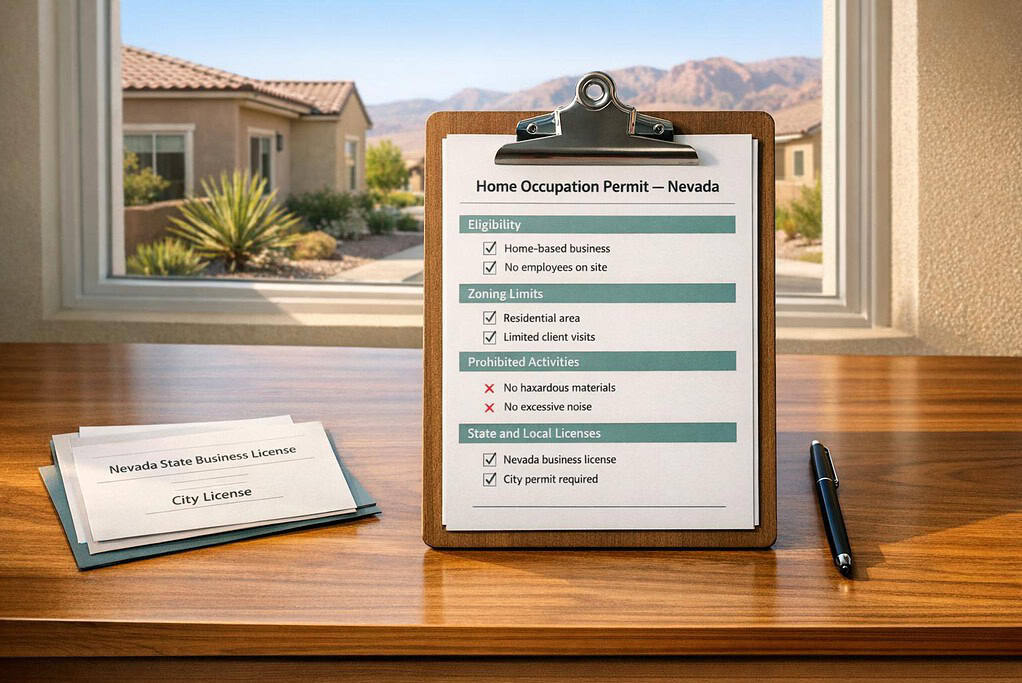
If you plan to run a business from home in Nevada, you’ll need a home occupation permit to comply with local laws and zoning rules. This permit ensures your business activities don’t disrupt the residential nature of your neighborhood. Here’s what you need to know:
- What It Is: A zoning approval allowing business operations from your residence while keeping it primarily residential.
- Why You Need It: Operating without this permit can lead to fines or legal issues. It also defines limits like space usage (max 25% of your home or 1,000 sq. ft.).
- Who Needs It: Most home-based businesses, from tutors to online sellers, must have both a Nevada State Business License and a local home occupation permit.
- Rules Vary by Location: Each city or county has its own requirements. For example, Clark County uses a tiered system based on business activity, while Carson City may not require a planning permit for some businesses.
- Prohibited Activities: Certain businesses, like motor vehicle servicing or adult entertainment, cannot operate from home. Activities causing noise, odors, or vibrations outside your property are also banned.
To apply, secure a Nevada State Business License via SilverFlume, complete local applications, and provide required documents like property owner authorization and tax registration. Fees range from $45 to $50, depending on your location.
Always check local rules to ensure compliance and avoid delays in getting started.
Who Needs a Home Occupation Permit in Nevada?
Types of Home-Based Businesses That Require a Permit
If you’re running a home-based business in Nevada, you’ll need to secure a state business license. This applies to a variety of businesses, whether you’re a tutor, bookkeeper, photographer, or selling handmade items from home. Essentially, if your home business generates revenue and you live in Nevada, a local permit is also required.
Additionally, if your business employs anyone who works within Nevada – even if you’re not the one doing the work – a license is mandatory. For businesses without a physical location, you can use your registered agent’s address for licensing purposes.
It’s important to note that local permits are not a substitute for a state business license – you need both. Let’s take a closer look at how permit requirements can vary depending on your location.
How Requirements Differ by City and County
Nevada doesn’t have a universal home occupation permit. Instead, each city and county sets its own rules, meaning requirements can vary significantly depending on where you live.
Take Clark County, for example – it uses a tiered system to determine permit requirements based on your business activity. Here’s a breakdown of how urban businesses are categorized:
| Criteria | Exempt (Urban) | Minor Permit (Urban) | Major Permit (Urban) |
|---|---|---|---|
| Max Nonresident Employees | 0 | 2 | 3 |
| Max Customers per Day | 0 | 6 | 12 |
| Accessory Structure Use | None | Up to 400 sq. ft. | Up to 900 sq. ft. |
| On-site Retail | None | Incidental only | Incidental only |
| Min. Lot Size | None | None | 10,000 sq. ft. |
Source: Clark County Code Section 40.260.100 [1]
Where your home is located – whether in an urban growth boundary or rural area – also affects the rules. For instance, rural zones often have different limits on accessory structure use and customer traffic. To figure out the specific requirements for your address, the Nevada SilverFlume New Business Checklist is a helpful tool to get started.
Eligibility and Restrictions for Home-Based Businesses
Basic Eligibility Requirements
If you’re planning to run a home-based business in Nevada, there are some key criteria to meet. First, your home must serve as your primary residence, and any business activities should remain secondary to its residential use. This means your property must still look and function like a home – not a commercial space. Structural changes that alter this residential character are strictly off-limits.
For licensing purposes, there’s an income threshold to consider. If your net earnings don’t exceed 66⅔% of Nevada’s average annual wage for the previous calendar year, you may not need a state business license. However, filing IRS Schedule C, E, or F automatically classifies you as a business under state law. This classification often prompts entrepreneurs to compare business structures to find the most tax-efficient setup. With these basics covered, let’s move on to what activities are prohibited for home-based businesses.
Activities Not Allowed in a Home-Based Business
Even if you meet the eligibility requirements, some business activities are outright prohibited to maintain the residential nature of your home. For example, in Clark County, you cannot operate adult entertainment businesses, automotive recycling facilities, or establish new motor vehicle servicing facilities from your home. Retail sales are also heavily restricted – only incidental sales are allowed, like selling shampoo at a home hair salon.
Additionally, any activity that creates noticeable effects outside your property is banned. This includes things like strong odors, excessive light or glare, dust, smoke, vibrations, or equipment that interferes with nearby radio, TV, or electrical systems. Discharging liquids or gases into septic systems in violation of regulations is also not permitted.
Common Local Restrictions to Know
Local rules for home-based businesses can vary significantly depending on whether you’re in an urban or rural area. Here’s a quick comparison of how restrictions differ in Clark County:
| Feature | Urban Area | Rural Area |
|---|---|---|
| Motor Vehicle Servicing | Prohibited for new facilities | Allowed as a major business |
| Max Sign Size | 2 sq. ft. | 6 sq. ft. |
| Max Accessory Structure | 400–900 sq. ft. | 1,000–5,000 sq. ft. |
| Heavy Equipment | Generally prohibited | Allowed (varies by permit) |
| Min. Lot Size (Major Permit) | 10,000 sq. ft. | 2.5 acres |
Source: Clark County Code Section 40.260.100 [1]
Understanding these local restrictions can help you stay compliant and avoid any surprises as you set up your home-based business.
How to Apply for a Nevada Home Occupation Permit
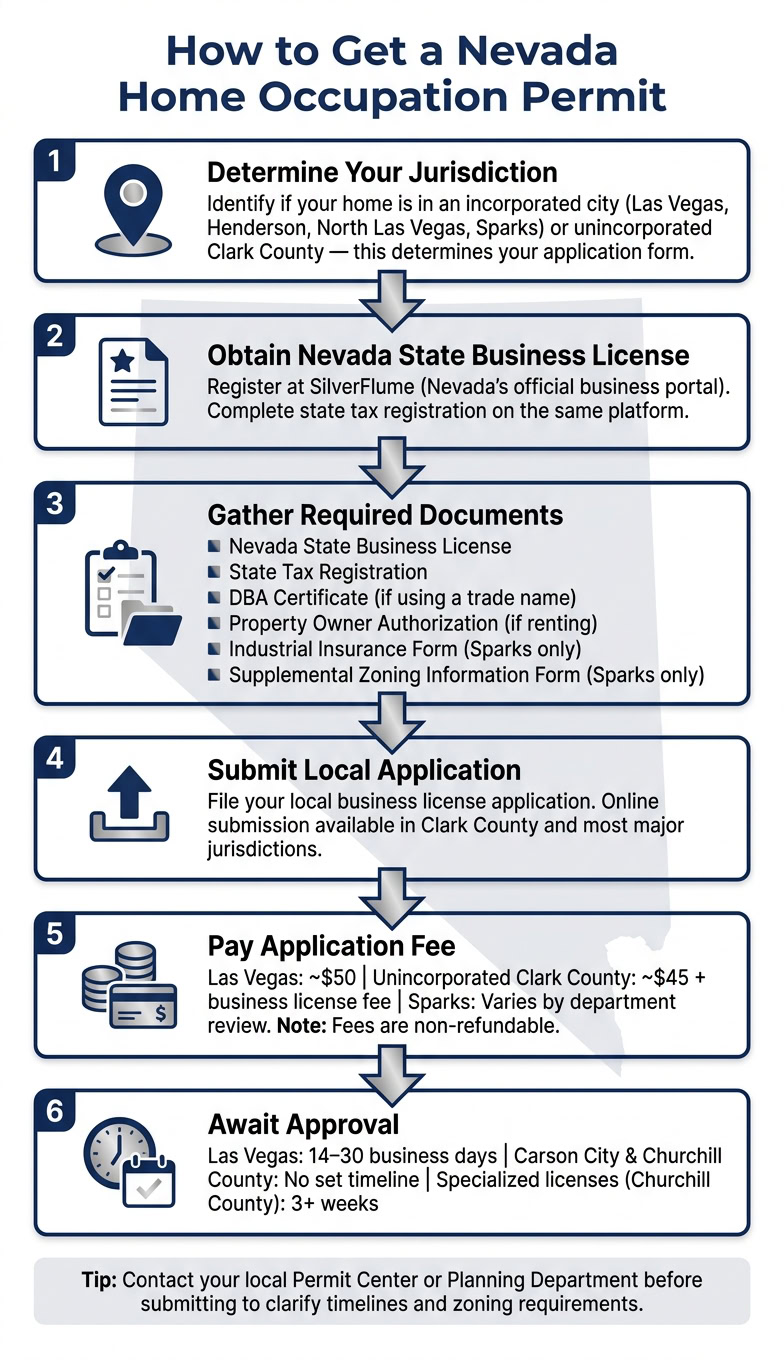
Steps to Get Your Permit
First, confirm whether your home is located in an incorporated city – like Las Vegas, Henderson, North Las Vegas, or Sparks – or in unincorporated Clark County. This determines which application form you’ll need.
Once you’ve identified your jurisdiction, follow these steps:
- Get Your Nevada State Business License and Complete State Tax Registration
Before applying locally, secure your Nevada State Business License through SilverFlume. You’ll also need to complete your state tax registration on the same platform. - Submit Your Local Application
File your local business license application. If you’re using a business name other than your legal name, include a DBA certificate. Contractors may need to complete a Multi-Jurisdictional Supplemental form. Many jurisdictions, including Clark County, offer online submission options.
Documents You Need to Apply
Having the right documents ready can speed up the process. While requirements vary by jurisdiction, most Nevada localities typically ask for the following:
| Document | Details |
|---|---|
| Nevada State Business License | Obtain this through SilverFlume |
| State Tax Registration | Required by the Nevada Department of Taxation |
| Fictitious Firm Name (DBA) Certificate | Needed if operating under a name other than your legal name |
| Property Owner Authorization | Required if you’re renting your home |
| Industrial Insurance Form | Required in Sparks, even for businesses without employees |
| Supplemental Zoning Information Form | Necessary in Sparks to confirm compliance with residential zoning |
Some types of businesses, like food preparation or child care, may require additional reviews or forms from agencies like the Health or Fire Departments.
Application Fees and Costs
The cost of your permit depends on your location and business type:
- Las Vegas: The standard permit fee is usually around $50.00.
- Unincorporated Clark County: Expect a one-time application fee of about $45.00, along with a separate business license fee based on your business category.
- Sparks: Fees vary depending on departmental reviews, such as those from Fire, Environmental Control, or Health. Contact the Sparks Business License Division for a precise estimate.
Keep in mind that application fees are non-refundable, even if your application is denied or incomplete. Don’t forget to budget for additional costs, like DBA filing fees with the County Clerk’s office and state-level registration fees through SilverFlume.
sbb-itb-ba0a4be
Local Permit Rules Across Nevada
Side-by-Side Comparison of Local Rules
The rules for home occupation permits in Nevada change depending on where you live. For example, the process in Las Vegas isn’t the same as in Carson City or Churchill County. Here’s a quick breakdown of how the requirements differ across these areas:
| Requirement | Las Vegas | Carson City | Churchill County |
|---|---|---|---|
| State Business License | Required (SilverFlume) | Required (SilverFlume) | Required (SilverFlume) |
| Local Business License | Required | Required | Required |
| Home Occupation / Planning Permit | Varies by use | Not required | Home Business Permit required |
| Sign Permit | Required | Required; size based on zoning district | Regulated by local standards |
| Zoning Verification | Required | Handled by Planning Division | Handled by Public Works, Planning & Building |
Carson City has a unique approach. If your business meets the criteria outlined in Section 18.05.045 of the Municipal Code, you don’t need a specific planning permit for home-based businesses. However, you’ll still need a local business license.
Churchill County’s rules are a bit more complex. If your home is in a residential zone outside Fallon city limits, you’ll need a Home Business Permit, which is tied to your business license. But if your home office is within Fallon city limits, you’ll first need a City of Fallon license before applying for the county license.
How Long Approval Takes by Location
Permit requirements aren’t the only thing that varies – processing times do too, which makes it essential to understand the local licenses and permits required in your area.
For instance, Las Vegas processes home occupation permits within 14 to 30 business days. If you have a specific launch date in mind, make sure to account for this timeline when planning.
Carson City and Churchill County don’t have set timelines for standard home occupation permits. However, specialized licenses in Churchill County, like those for liquor sales or peddlers, require at least three weeks for processing. If your application involves more than a basic home business permit, expect delays.
The best way to avoid surprises is to contact your local Permit Center or Planning Department before submitting your application. This lets you clarify timelines, address zoning concerns, and avoid costly delays.
Conclusion and Key Takeaways
Key Points to Remember
Starting a home-based business in Nevada comes with specific requirements. First, you’ll need a state business license obtained through SilverFlume, along with local permits from your city or county. Skipping either step can lead to issues, including the risk of having your permits revoked.
There are also restrictions on how much of your home can be used for the business – no more than 25% of your residence or 1,000 square feet, whichever is less. Your home must remain your primary residence, and your business activities cannot create detectable noise, odors, vibrations, or electrical interference at the property line. Violating these rules could result in losing your permit.
Some businesses aren’t allowed to operate from home, including those involving on-site retail (beyond incidental sales), adult entertainment, or automotive recycling. Local regulations can differ significantly, so requirements in rural areas won’t necessarily match those in cities like Las Vegas. Always check with your local Planning Department or Permit Center to ensure you’re meeting all the necessary rules before applying.
These details highlight the challenges of navigating Nevada’s licensing process, but there’s a way to make it easier.
How BusinessAnywhere Can Help

Nevada’s licensing system can feel overwhelming, but BusinessAnywhere simplifies the process. They offer services like U.S. business registration, registered agent support, compliance assistance, and annual filings – all accessible through a single online platform. Whether you need an EIN, help with annual reports, or a virtual address to protect your home address, everything is available remotely and on demand.
FAQs
Do I need a home occupation permit if I only sell online?
In Nevada, whether you need a home occupation permit for selling exclusively online depends on local regulations. In some areas, you might not need one if your business is limited to using a desk, phone, or computer, with no customer visits or deliveries. However, cities like Las Vegas typically require permits for home-based businesses. They also enforce rules regarding customer activity, signage, and the types of products or services you can offer.
How do I find my city or county’s home occupation rules?
To figure out the rules for running a home-based business in your area, start by visiting the New Business Checklist on the Nevada SilverFlume portal. Since regulations vary depending on your location, it’s a good idea to reach out directly to your local planning department, building office, or county clerk’s office. They can provide details about zoning laws and any permits you might need.
Don’t forget to check your property’s covenants, conditions, and restrictions (CC&Rs). These private agreements could include extra rules that affect your ability to operate a business from home.
What gets a Nevada home occupation permit denied?
If you’re seeking a home occupation permit in Nevada, it’s important to know that certain factors can lead to a denial. For instance, your business might not comply with residential zoning rules or could fall under prohibited activities. Common issues include employing staff on-site, generating high levels of customer traffic, displaying signage, or operating in restricted industries such as auto repair, food preparation, weapons sales, beauty salons, or emergency services. Additionally, businesses that produce noise, smoke, or other disturbances are required to operate in commercially zoned areas instead.