


Yes – many startup costs are deductible, but you usually can’t deduct all of them at once. If your business is now active, you may be able to deduct up to $5,000 in startup costs and up to $5,000 in organizational costs, then spread the rest over 15 years (180 months). But once each bucket goes over $50,000, that first-year deduction starts to shrink.
Here’s the short version:
- Startup costs cover pre-opening items like research, ads, training, and setup
- Organizational costs cover forming the business, like state filing and legal paperwork
- Capital assets like equipment follow different tax rules
- The 180-month amortization starts when the business begins doing business
- Good records matter: keep dates, amounts, purpose, and proof of payment
- Your filing path depends on your tax setup, such as Schedule C, Form 1065, or Form 1120-S
A simple example: if you have $8,000 in eligible costs, you may deduct $5,000 now and amortize $3,000, which is about $16.67 per month. If eligible costs hit $55,000, the upfront deduction can drop to $0 for that bucket.
| Cost Type | What It Covers | Basic Tax Treatment |
|---|---|---|
| Startup costs | Pre-opening business prep | Up to $5,000 now, rest over 180 months |
| Organizational costs | Entity formation costs | Up to $5,000 now, rest over 180 months |
| Capital assets | Equipment and other long-term property | Capitalize, then depreciate under separate rules |
If you’re close to the $50,000 mark, timing can change your Year 1 tax break. That’s why I’d track startup and organizational costs separately from day one.
Startup costs vs. organizational costs: what the IRS says
To figure out whether startup costs are deductible, you first need to label the expense the right way. The IRS treats startup costs and organizational costs under two different rules: IRC Section 195 and IRC Section 248. Put simply, the tax treatment depends on which bucket the expense falls into.
Both categories may qualify for a first-year deduction of up to $5,000, with the rest amortized over 15 years (180 months). Some expenses are flat-out excluded, though. That includes personal expenses, IRS penalties, traffic fines, and lobbying costs.
| Feature | Startup Costs (IRC §195) | Organizational Costs (IRC §248) |
|---|---|---|
| Primary focus | Costs incurred before operations begin | Costs of forming the legal entity |
| Examples | Market research, pre-launch ads, employee training, launch-stage software costs | State filing fees, legal fees for bylaws or operating agreements |
| First-year deduction | Up to $5,000 (subject to $50,000 phaseout) | Up to $5,000 |
| Amortization period | 15 years for amounts over $5,000 | 15 years for amounts over $5,000 |
Once you’ve sorted each expense into the right category, the next job is simple in theory: decide what you can deduct now and what needs to be spread out over time.
Startup costs: research, pre-launch ads, training, and setup
Startup costs are the expenses you rack up while getting the business ready to open. These are costs that would normally count as ordinary and necessary business deductions if the company were already up and running. Common examples include market research, competitor analysis, pre-opening ad campaigns, employee training before launch, and launch-stage software costs.
Think of these as the costs of getting to the starting line. You’re not fully operating yet, but you’re spending money to get there.
Organizational costs: legal formation fees, state filings, and governing documents
Organizational costs are more narrow. They cover what it takes to legally create the business entity. Typical examples include formation-related legal fees, state filing fees, and legal fees for drafting an operating agreement or corporate bylaws.
This is less about getting the business ready to sell and more about getting the business legally set up on paper.
Keep your formation records in one place from day one. It makes tax prep far less messy. BusinessAnywhere centralizes formation documents, registered agent records, and EIN records for easier tax prep. Clean records now make the later amortization schedule a lot easier to handle.
sbb-itb-ba0a4be
What you can deduct now and what must be amortized over 15 years
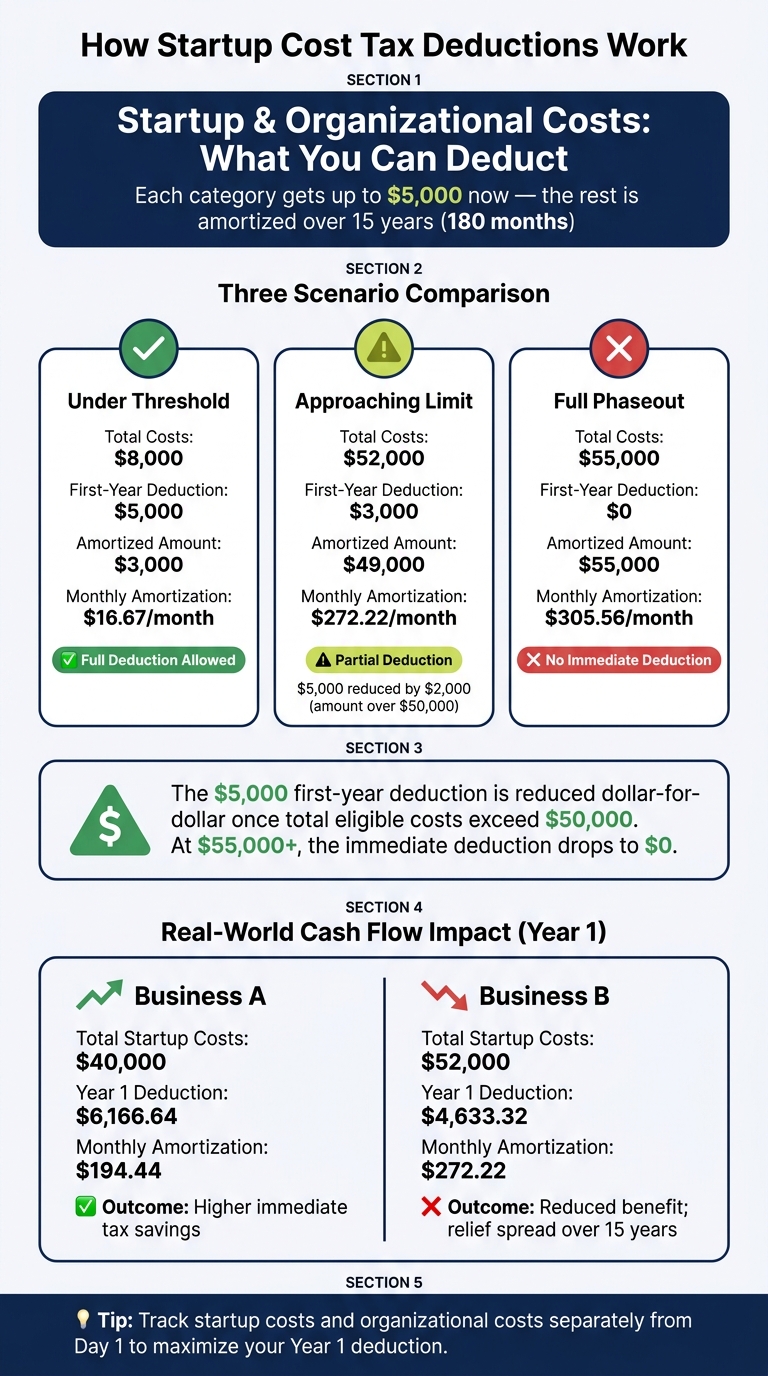
Startup Cost Tax Deductions: $5K Rule, Phaseout & Amortization Explained
Once you sort a cost into the right bucket, the next step is pretty simple: can you write it off now, or do you have to spread it out over 15 years?
Eligible startup costs and organizational costs can each qualify for up to a $5,000 first-year deduction. Anything left over gets amortized over 180 months, starting in the month the business opens.
How the $5,000 first-year deduction and $50,000 phaseout work
Here’s where the math starts to matter.
That $5,000 deduction gets reduced dollar for dollar once your total eligible costs go over $50,000. So the closer you get to that line, the more your first-year write-off shrinks.
A simple rule of thumb: take the immediate deduction first, amortize what remains, and capitalize assets that don’t fit the startup or organizational cost rules.
| Scenario | Total Costs | First-Year Deduction | Amortized Amount | Calculation |
|---|---|---|---|---|
| Under threshold | $8,000 | $5,000 | $3,000 | Full $5,000 allowed; $3,000 amortized over 180 months ($16.67/month) |
| Over threshold | $52,000 | $3,000 | $49,000 | $5,000 reduced by $2,000 (the amount over $50,000); $49,000 amortized ($272.22/month) |
| Full phaseout | $55,000 | $0 | $55,000 | Deduction reduced to zero; entire amount amortized over 180 months |
If your pre-opening costs are creeping toward $50,000, keep a close eye on them. A few extra bills can chip away at that upfront deduction faster than people expect.
Comparison table: immediate deduction, amortization, or capitalization
Not every pre-opening expense gets the same tax treatment. Some can be deducted right away, some must be spread across 180 months, and some need to be capitalized instead.
| Expense | Category | Tax Treatment | IRS-Based Reason |
|---|---|---|---|
| Market research | Startup cost | Immediate (up to $5,000 limit) / Amortize remainder | Investigative expense incurred before the business opens |
| Legal formation fees | Organizational cost | Immediate (up to $5,000 limit) / Amortize remainder | Costs to legally create the entity (LLC or corporation) |
| Pre-launch advertising | Startup cost | Immediate (up to $5,000 limit) / Amortize remainder | Promotional costs incurred before the business is active |
| Employee training | Startup cost | Immediate (up to $5,000 limit) / Amortize remainder | Preparing staff for operations before the launch date |
| Software setup | Startup cost | Immediate (up to $5,000 limit) / Amortize remainder | Technology infrastructure configured before launch |
| Large equipment | Capital asset | Capitalize / Depreciate | Long-term assets subject to separate depreciation schedules |
Once the category is set, the next step is making sure each expense is documented well enough to support both the deduction and the amortization schedule at tax time.
How amortization, tax forms, and recordkeeping work in practice
Amortization starts when your business begins operations. From there, take the remaining amount and divide it by 180 to get the monthly deduction. So if you have $3,000 left after the first-year deduction, your write-off is $16.67 per month for 15 years.
After you run the numbers, the next step is reporting that deduction on the tax return that matches your S Corp vs LLC tax benefits.
| Entity Type | Primary Tax Form | Where Deduction Flows |
|---|---|---|
| Single-Member LLC | Form 1040, Schedule C | Reduces business income on Schedule C |
| Multi-Member LLC | Form 1065 | Passes through on Schedule K-1 |
| S-Corporation | Form 1120-S | Reported on Form 1120-S; passes through to shareholders |
Filing the deduction is one part of the job. The IRS also wants records that back up the date, purpose, and amount of each expense.
What records to keep for pre-opening expenses
Pre-opening deductions usually come down to two things: timing and business purpose. If your records are weak, a deduction that looked fine on paper can turn into a problem fast. Keep the transaction date, vendor, amount, business purpose, and proof of payment.
It also helps to keep a clear launch timeline. In plain English, you want a paper trail that shows when the business was formed and when it actually started doing business. Track these three dates:
- Your official formation date
- The date operations began
- The date of your first customer transaction
That timeline helps show when the 180-month amortization period begins. Startup costs are deductible only if the business can show the expense happened before opening and was tied to the business. Hold on to these records for at least seven years.
Using BusinessAnywhere to organize formation and compliance records
BusinessAnywhere puts formation, EIN, registered agent, mailbox, and compliance records in one place, which makes tax prep easier. It also gives you a clearer view of how much of your startup spending cuts this year’s tax bill. When those records are easy to find, cash flow planning gets a lot less messy, and you’re less likely to get hit with a bigger tax bill than you expected.
Cash flow planning: using startup cost rules to avoid tax surprises
Once the deduction rules are clear, the next issue is timing. Prelaunch spending can put pressure on cash flow because you pay those costs upfront, while much of the tax break comes later. That gap matters, especially when you’re trying to protect cash in the first year.
Here’s the big budgeting point: if your pre-opening costs are getting close to $50,000, it often makes sense to hold off on any non-essential purchases until after launch.
The numbers below show how the phaseout affects Year 1 tax relief for two businesses that open in the middle of the year.
| Business A | Business B | |
|---|---|---|
| Total Startup Costs | $40,000 | $52,000 |
| Immediate Year 1 Deduction | $5,000 | $3,000* |
| Remaining Balance to Amortize | $35,000 | $49,000 |
| Monthly Amortization (180 months) | $194.44 | $272.22 |
| Total Year 1 Deduction | $6,166.64 | $4,633.32 |
| Cash Flow Effect | Higher immediate tax savings; more capital preserved in Year 1 | Reduced immediate benefit; tax relief delayed over 15 years |
*Calculation: $5,000 − ($52,000 − $50,000) = $3,000.
This is why cost tracking matters so much. It’s not just about keeping tax records tidy. It also helps you budget with fewer surprises. Track startup costs and organizational costs separately so your Year 1 deductions don’t drop more than you expect.
FAQs
When does a business officially count as active for amortization?
A business becomes active for amortization once it starts serving customers or bringing in revenue. That’s the point where the pre-opening phase ends, and those costs stop being treated as startup or organizational expenses.
From that date forward, similar costs are usually handled as regular operating expenses under a different set of tax rules. Write down and keep proof of your exact start date, because that’s when the 180-month amortization period starts.
Which pre-opening costs are not deductible as startup or organizational expenses?
Not every pre-opening cost makes the cut. Capital expenditures – like equipment, land, or buildings – can’t be written off all at once. Instead, you recover those costs over time through depreciation.
A few other costs don’t qualify either. Personal expenses are out. So are fines, penalties, and lobbying costs.
Once the business starts active operations, those costs are no longer treated as startup costs. At that point, they fall under the tax rules for regular operating expenses.
How should I handle startup costs if I never launch the business?
If you never launch the business, you usually can’t deduct those expenses as startup or organizational costs. Under IRS rules, those deductions are meant for businesses that actually begin active operations.
If the venture never officially launches, those costs are usually treated as personal expenses and are not tax-deductible. For your specific situation, consult a qualified tax professional.