
Corporation bylaws are the internal rules that outline how a corporation operates. They establish the structure for decision-making, define responsibilities of officers and directors, and set procedures for meetings, voting, and more. Unlike the Articles of Incorporation, which are filed with the state to legally form the corporation, bylaws are private documents that govern internal operations.
Here’s why bylaws matter:
- Legal Compliance: Many U.S. states require corporations to have bylaws to protect the corporate veil, which separates personal and business assets.
- Operational Clarity: Bylaws define roles, responsibilities, and processes, reducing confusion and disputes.
- Investor and Bank Requirements: Lenders and investors often request bylaws to ensure proper governance.
- Flexibility: Bylaws can be amended internally, unlike Articles of Incorporation, which require state filings for updates.
Key components include defining leadership roles, shareholder and board meeting protocols, stock management, and amendment procedures. Drafting bylaws early ensures smooth operations and legal protection, even for remote or virtual businesses.
Bylaws are essential for creating a structured framework that supports efficient governance and safeguards your corporation’s legal standing.
What Are Corporation Bylaws?
Corporation bylaws are the internal rules that outline how a corporation operates. Think of them as the company’s playbook, detailing who makes decisions, how meetings are conducted, the responsibilities of officers, and the processes for voting and transferring stock.
"Corporate bylaws serve as your corporation’s internal constitution and establish the fundamental rules and procedures that govern how your business operates." – Allison DeSantis, J.D., Senior Director of Product Counsel, LegalZoom
Unlike the Articles of Incorporation – which are filed with the state to officially create the corporation – bylaws are private documents. They aren’t submitted to the Secretary of State but are legally binding contracts between the corporation, its shareholders, directors, and officers. This distinction ensures that the corporation’s internal governance is separate yet critical to its legal foundation.
By customizing your bylaws, you can tailor key aspects like the size of your board, how often meetings are held, and the voting requirements to fit your specific business needs.
Following your bylaws is also essential for protecting your limited liability status. When you adhere to these rules, you show that your corporation operates as a distinct legal entity. This is crucial for maintaining the corporate veil, which safeguards your personal assets from business debts and liabilities. Additionally, banks, investors, and lenders often require a copy of the bylaws as proof that your corporation is well-organized and professionally managed.
sbb-itb-ba0a4be
Bylaws vs. Articles of Incorporation: Key Differences
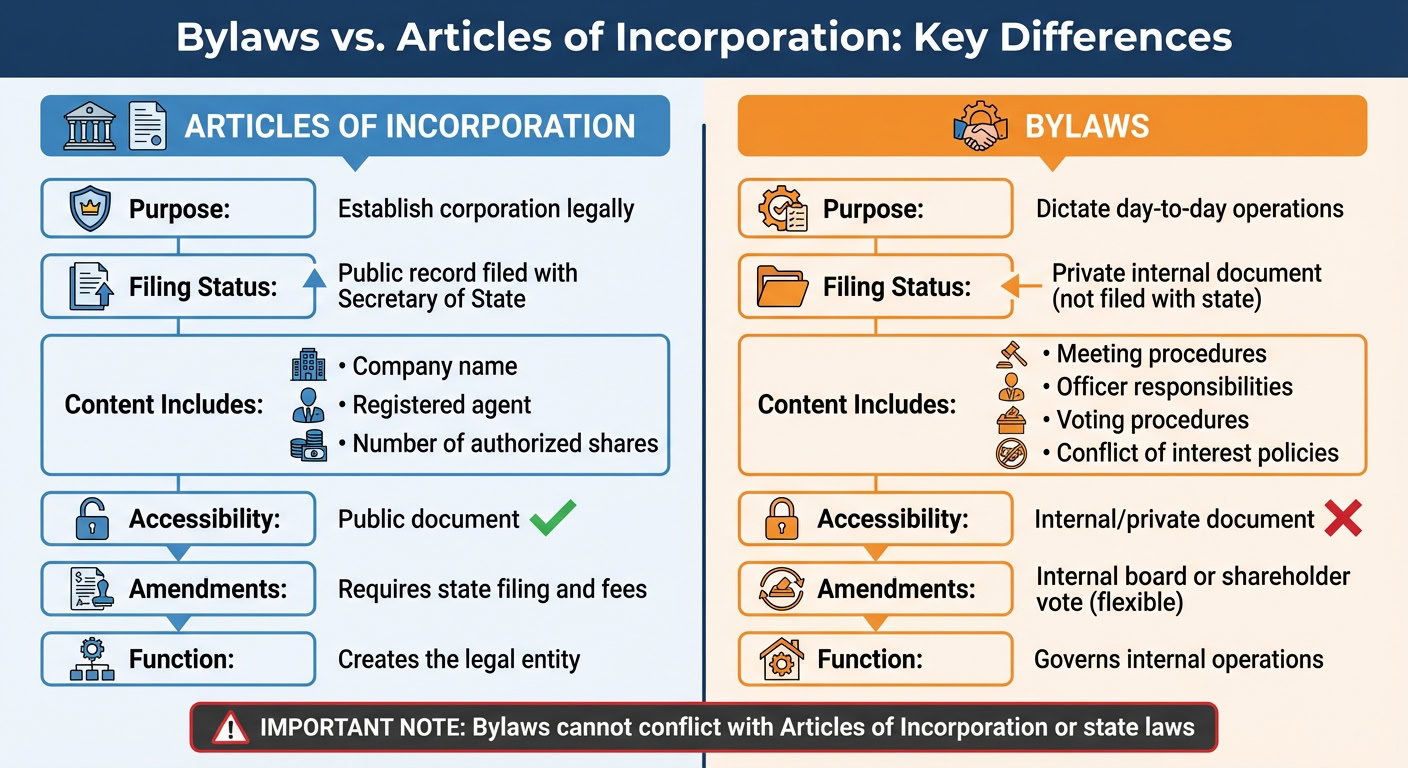
The Articles of Incorporation establish your corporation legally, while bylaws dictate how it operates day-to-day. These two documents serve very different purposes, and understanding their roles is crucial.
"The articles of incorporation is a document filed with the state to establish the corporation… The corporate bylaws are an internal legal document that goes into much more detail." – Jade Yeban, Esq., FindLaw
The Articles of Incorporation are public records filed with the Secretary of State. They include essential details like your company’s name, the registered agent, and the number of authorized shares. (See our checklist for choosing the right registered agent to ensure your filing is handled correctly.) In contrast, bylaws are private, internal documents that outline the corporation’s governance. These cover specifics like how meetings are conducted, the responsibilities of officers, voting procedures, and policies on conflicts of interest.
It’s important to note that bylaws can’t conflict with the Articles of Incorporation or state laws. For example, if the Articles specify a certain number of directors or stock classifications, the bylaws must align with those terms.
Another key distinction lies in how changes are made. Updating the Articles of Incorporation requires filing amendments with the state and paying associated fees. On the other hand, bylaws are more flexible – they can usually be amended internally through a board or shareholder vote. Even in states where bylaws aren’t mandatory, drafting them is still critical to safeguard your corporate veil and ensure smooth operations.
When and How to Create Corporation Bylaws
Draft your corporation’s bylaws either during or right after filing your Articles of Incorporation. Typically, the incorporators prepare the initial draft, and the board of directors formally adopts them during their first meeting.
"The process of creating bylaws usually happens along with, or soon after, the articles of incorporation." – Jane Haskins
To get started, gather key details like your corporation’s name, principal address, and the names of the initial directors. Use this information to outline your organizational structure. Specify how many directors there will be, define the roles of key officers, and clarify shareholder voting rights. Establish dates for annual meetings, including notice periods, and draft stock-related provisions such as share issuance rules, transfer guidelines, and amendment procedures, including the voting thresholds required for changes.
Once the bylaws are drafted, the board of directors must approve them by vote during their first meeting. This approval should be documented in the corporate minutes. Afterward, have your corporate secretary certify the bylaws – banks and investors often require proof of this certification. Keep the original bylaws at your corporation’s principal place of business. In some states, like California and New York, this is a legal requirement.
Even if your state doesn’t require bylaws, they’re a smart move. They help protect your corporate veil and establish clear governance from the start. Plan to review and update them every five years to ensure they reflect your company’s growth and any regulatory changes.
With the bylaws in place, you’re ready to dive into their essential components.
Key Components of Corporation Bylaws
Bylaws are the backbone of your corporation’s governance, laying out the rules for operations and decision-making. They cover everything from leadership roles and meeting protocols to stock management and amendment procedures. These guidelines not only ensure smooth functioning but also help protect your corporation’s legal standing and reduce internal conflicts. For instance, most states require that a quorum for shareholder meetings represent over 50% of the corporation’s stock. Your bylaws should clearly define these thresholds, along with voting rules and notice periods – commonly set between 10 and 60 days before a meeting.
For smaller corporations, you might want to include a clause allowing decisions to be made without a formal meeting, using written consent instead. Below, we’ll break down the key elements that make up effective bylaws.
Organizational Structure and Offices
Start by defining your corporation’s leadership framework. This begins with the board of directors – specify the number of members, their qualifications, term lengths, and how they are elected or removed. Some states, like California and Utah, have specific rules about board sizes depending on the number of shareholders.
Next, outline the officer roles. Most corporations appoint a President/CEO to oversee daily operations, a Secretary to handle records and meeting minutes, and a Treasurer/CFO to manage finances and ensure tax compliance.
"The officers of a corporation are the agents through which the board of directors acts. The board makes the decisions and designates the officers to execute them." – Wolters Kluwer
To maintain leadership consistency, consider staggered board terms, where only part of the board is up for election each year. Also, include a conflict of interest policy requiring directors and officers to disclose any financial ties to businesses interacting with the corporation.
Shareholder and Board Meetings
Meeting protocols are a cornerstone of corporate governance. Your bylaws should spell out the timing and structure of shareholder and board meetings. For example, setting an annual shareholder meeting on a fixed date simplifies planning. Include notice requirements, typically 10 to 60 days in advance, and allow shareholders to waive notice if they attend without formal notification.
Quorum requirements are another essential detail. Most states require that a majority of shares be represented at a meeting, though some allow this threshold to drop as low as one-third. For board meetings, a majority of directors is usually necessary. Your bylaws should also cover proxy voting, enabling shareholders to appoint someone to vote on their behalf, and consider allowing electronic meetings and voting for remote participants.
With meeting protocols in place, the next focus is on managing stock ownership and transfers.
Stock Ownership and Transfers
Your bylaws should outline the different classes of stock – such as common versus preferred or voting versus nonvoting – and the rights tied to each, including voting power, dividend entitlements, and rights during liquidation. Specify how shares are issued, whether through certificates or electronic records, and assign responsibility for overseeing this process.
If your corporation wants to control stock ownership, include transfer restrictions. For instance, shareholders might be required to offer their shares to existing owners before selling to outsiders, or board approval might be needed for transfers. Be sure to also include procedures for replacing lost or destroyed stock certificates and establish a record date system to determine which shareholders are eligible to vote or receive dividends.
Amendments and Dissolution
Your bylaws should clearly define how they can be amended. Specify whether this authority lies with the board, shareholders, or both, and set the voting threshold – whether a simple majority or a supermajority (commonly 66% or 75%). Some states have stricter requirements; for example, Iowa requires 90% written consent from voting shareholders for amendments, while Kentucky requires 80%.
Include provisions for corporate dissolution as well, detailing who can initiate the process, the required vote, and how remaining assets will be distributed after debts are settled. While no one wants to think about dissolving their business, having these rules in place can prevent confusion and legal disputes if the need arises.
Finally, consider adding indemnification clauses to protect directors and officers from personal liability for actions taken in good faith on behalf of the corporation. This protection can be a strong incentive for attracting qualified leaders to your organization.
Why Corporation Bylaws Matter for U.S. Businesses
Bylaws are the backbone of legal protection and operational efficiency for businesses. Whether you run a traditional office or a fully remote company, they protect personal assets, simplify decision-making, and demonstrate legitimacy to banks and investors. Here’s why they hold such importance for U.S. businesses today.
Meeting Legal Requirements
In most U.S. states, corporations are required to establish and maintain bylaws as part of their legal obligations. While states like California, Nevada, and Colorado don’t explicitly mandate them, skipping this step can leave your business vulnerable to legal risks.
Bylaws are essential for defining your corporation as a distinct legal entity. Without them, creditors or litigants could "pierce the corporate veil", potentially putting your personal assets at risk to cover business debts. Additionally, in the absence of bylaws, your business may default to state governance rules that might not align with your operational needs. Attorney Andy Kaiser from The Kaiser Law Firm, P.C., emphasizes:
"Failure to comply with this corporate formality creates the risk that you could lose your limited liability protection, giving your creditors access to your company’s assets".
Bylaws are also critical for practical matters like opening a C Corp bank account or securing loans. Banks and lenders often require them during the application process. For instance, New Jersey corporations follow statute N.J.S.A. § 14A:2-9, while California businesses must comply with the California Corporations Code.
Once legal requirements are met, bylaws also enhance how your business operates internally.
Creating Clear Operating Procedures
Bylaws aren’t just about compliance – they provide a framework for smooth governance and conflict resolution. They clearly outline the roles and responsibilities of officers, from the CEO managing daily operations to the CFO handling finances, which helps prevent overlap and ensures accountability.
"Bylaws provide a road map for running your business… When an issue arises, bylaws can provide clear guidance, minimizing disagreements over how the business will be run."
– Jane Haskins, Esq.
This clarity becomes even more crucial when disputes arise. Bylaws can outline procedures for resolving conflicts, handling voting ties, or addressing conflicts of interest, reducing the likelihood of costly litigation. For smaller businesses that need to act quickly, provisions like "action without a meeting" allow decisions to be made through written consent, eliminating the need for frequent formal meetings.
As more businesses embrace remote work, updating bylaws to reflect virtual operations is becoming increasingly important.
Adapting Bylaws for Remote and Virtual Businesses
Remote and virtual businesses face unique challenges, but bylaws can address these effectively. For companies operating without a central office, it’s vital to include provisions that authorize participation in meetings via video or conference calls, as well as procedures for electronic notifications and digital voting.
Entrepreneurs using platforms like Business Anywhere to manage their U.S. corporations remotely can rely on well-drafted bylaws to ensure legal compliance. By specifying how directors and shareholders can participate remotely and cast votes electronically, you can maintain proper corporate formalities while operating without a physical location.
Conclusion
Corporation bylaws act as the backbone of your business, functioning like an internal constitution that outlines how your company operates and safeguards your assets. By clearly defining internal processes, these bylaws play a critical role in maintaining the corporate veil, which protects your personal assets from business liabilities.
Whether you’re opening bank accounts, securing financing, or resolving disputes, strong bylaws signal effective governance. They create a structured framework that avoids operational hiccups and reinforces the legitimacy of your corporation. This ties back to earlier discussions about the importance of governance and legal protection.
For businesses operating remotely or virtually, including provisions for electronic meetings and digital voting is essential. These updates allow you to maintain proper corporate formalities even without a physical office space. As noted in the section on key components, tailoring your bylaws for remote operations adds much-needed flexibility. Think of your bylaws as a living document – review and update them every five years to ensure they stay aligned with your business’s needs. This adaptability helps your bylaws grow alongside your company.
Well-crafted bylaws do more than just keep you compliant; they help you avoid costly disputes and eliminate confusion. They lay a solid foundation for your business to thrive and achieve long-term success.
FAQs
Why are corporation bylaws essential for protecting limited liability?
Corporation bylaws play a key role in safeguarding the limited liability that shields business owners’ personal assets. These bylaws establish clear guidelines for corporate operations, detailing roles, responsibilities, and decision-making processes. By doing so, they help maintain the company’s status as a distinct legal entity.
This distinction is crucial for preventing the corporate veil from being pierced – a situation that could leave owners personally responsible for business debts or legal troubles. Thoughtfully written bylaws not only meet legal standards but also reinforce the boundary between personal and business affairs.
What is the difference between corporate bylaws and Articles of Incorporation?
When setting up and managing a corporation, Articles of Incorporation and corporate bylaws play distinct roles.
The Articles of Incorporation are a legal document filed with the state to formally establish the corporation. They include essential details such as the corporation’s name, its purpose, the registered office location, the share structure, and the names of the initial directors. Once filed, these Articles become part of the public record.
On the other hand, bylaws are an internal document that governs the corporation’s day-to-day operations. Unlike the Articles, bylaws are private and not submitted to the state. They spell out the rules for key processes like electing board members, holding meetings, assigning officer duties, voting procedures, and handling stock transfers. Because bylaws are internal, they can be updated more easily by the board or shareholders without needing to file changes with the state. This makes them a more adaptable tool for managing the corporation’s internal affairs.
While both documents are critical, they serve very different purposes in the life of a corporation.
What should be included in a corporation’s bylaws?
Corporation bylaws serve as the internal rulebook for how a business is run and managed. They lay out essential details like the company’s name, main office location, purpose, and fiscal year. They also define the management structure, including the number of directors, their qualifications, how they are chosen, their terms of service, and their compensation.
The bylaws also clarify the roles and duties of officers – such as the president, secretary, and treasurer – detailing how they are appointed and the extent of their authority. They establish procedures for meetings, covering notice requirements, voting rules, quorum standards, and record-keeping expectations. Other critical aspects include rules for issuing and transferring shares, handling conflicts of interest, and the process for making amendments to the bylaws. These guidelines not only ensure compliance with legal requirements but also create a solid framework for efficient operations, which is particularly valuable for small or virtual businesses.