


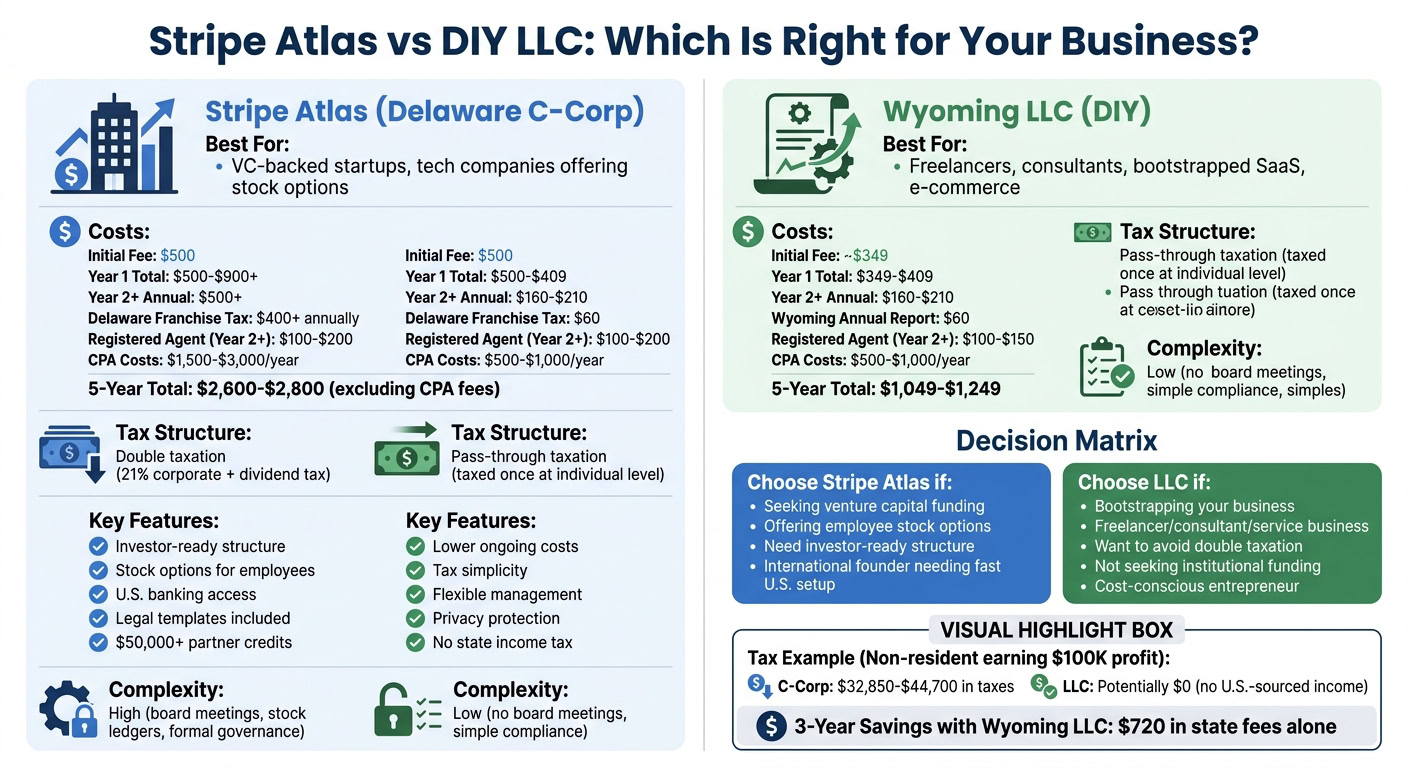
Choosing between Stripe Atlas and forming your own LLC depends on your business goals. If you’re seeking venture capital, Stripe Atlas sets up a Delaware C-Corp – a preferred structure for investors. It costs $500 upfront and includes U.S. banking, legal templates, and compliance tools, but comes with ongoing fees like Delaware franchise taxes ($400+) and CPA costs ($1,500–$3,000 annually).
For freelancers, consultants, or bootstrapped businesses, forming an LLC independently is often cheaper and simpler. LLCs use pass-through taxation, avoiding the double taxation of C-Corps. For example, a Wyoming LLC costs about $60 annually, with much lower tax preparation fees ($500–$1,000).
Quick Overview:
- Stripe Atlas: Ideal for startups seeking funding, offering C-Corp setup, banking, and compliance tools for $500.
- LLC: Best for self-funded businesses, offering lower costs, tax simplicity, and flexibility.
| Feature/Cost Stripe Atlas (C-Corp) DIY LLC (e.g., Wyoming) | ||
|---|---|---|
| Initial Fee | $500 | ~$349 |
| Ongoing State Fees | $400+ (Delaware taxes) | $60 (Wyoming) |
| Taxation | Double taxation | Pass-through |
| CPA Costs (Annual) | $1,500–$3,000 | $500–$1,000 |
| Investor Appeal | High | Limited |
Stripe Atlas is best for VC-backed startups, while LLCs suit cost-conscious entrepreneurs focused on profits without external funding.
What Stripe Atlas Offers: Features and Costs
What You Get with Stripe Atlas
Stripe Atlas helps entrepreneurs set up a Delaware C-Corporation or LLC for a one-time fee of $500. This fee covers state filing costs, the application for a federal tax ID (EIN) for non-residents, and the first year of registered agent services. The process is designed to be quick and efficient.
In addition to forming the business, Stripe Atlas provides a set of standardized legal documents. These include bylaws, operating agreements, and intellectual property assignment templates, all created with input from top law firms like Cooley and Orrick. The service also automates the filing of the 83(b) tax election.
For international founders, Stripe Atlas offers access to U.S. banking through Mercury and immediate Stripe payment processing. This means you can start accepting payments even before receiving your EIN, which typically takes 1–2 weeks for non-U.S. residents. The package also includes over $50,000 in partner credits from companies like AWS, OpenAI, and Carta, as well as up to one year of free Stripe payment processing on your first $100,000 in transactions [8].
Importantly, U.S. residency isn’t required. More than 75,000 companies have already taken advantage of Delaware’s well-established corporate framework [2].
With these features in mind, let’s dive into the costs associated with Stripe Atlas.
Stripe Atlas Cost Breakdown
While the initial $500 fee covers the formation process, there are additional ongoing costs to consider. Starting in the second year, Delaware franchise taxes and registered agent fees come into play. Here’s how the costs break down:
| Cost Component | Year 1 | Year 2+ (Annual) |
|---|---|---|
| Stripe Atlas Fee | $500 | $0 |
| Registered Agent | Included | $100 |
| DE Franchise Tax (LLC) | $400* | $400 |
| DE Franchise Tax (C-Corp) | $400+* | $400+ |
| Total (LLC) | $500–$800 | $400 |
| Total (C-Corp) | $500–$900+ | $500+ |
*Note: Delaware franchise taxes depend on the formation date. Taxes are not prorated, so even if you form your company on December 31, you’ll owe the full year’s tax [1].
Beyond these fees, maintaining compliance with tax regulations is your responsibility. This often requires hiring a CPA, which typically costs between $1,500 and $3,000 per year. Factoring in these professional services, the estimated total cost for a Stripe Atlas entity over three years ranges from $3,100 to $4,600.
When evaluating Stripe Atlas, it’s essential to compare these costs against the expenses and effort involved in forming an LLC independently.
Forming Your Own LLC: Overview and Benefits
Why Choose an LLC?
A Limited Liability Company (LLC) offers some clear perks compared to the C-Corporation structure often associated with Stripe Atlas. One major advantage is pass-through taxation. With this setup, profits are taxed only at the individual level, which can result in significant savings. For example, a non-resident founder earning $100,000 in profit without U.S.-sourced income could pay $0 in U.S. federal income tax under an LLC. In contrast, the same income under a C-Corp could incur federal taxes ranging from $32,850 to $44,700. This tax efficiency can make LLCs a compelling choice, especially for those wary of the double taxation that comes with C-Corps.
LLCs also offer unmatched flexibility in ownership and operational structure. The operating agreement can be tailored to suit nearly any business model. Whether it’s dividing profits, assigning management roles, or outlining decision-making processes, LLCs allow for customization without the strict rules of corporate bylaws or mandatory board meetings. This is particularly appealing for freelancers, consultants, SaaS businesses, and self-funded ventures that don’t plan to seek venture capital.
“Delaware LLCs have the benefit of being simple to form, extremely flexible (with few restrictions on management and governance arrangements), and more familiar to parties you will interact with.” – Orrick, Global Tech Law Firm [2]
LLCs also protect personal assets while keeping compliance requirements straightforward. Unlike C-Corps, LLCs don’t demand formal board meetings, detailed minutes, or complex stock structures. Additionally, if your business sees losses in its early years, those losses can often offset other personal income, potentially lowering your overall tax bill or even resulting in a refund [2].
LLC Formation and Maintenance Costs
Now that the benefits are clear, let’s break down the steps and costs of forming an LLC on your own. Compared to Stripe Atlas, forming an LLC can be far more economical, especially if you pick the right state. Here’s a quick look at some state-specific costs:
- Wyoming: $100 state filing fee ($103.75 online) and a $60 annual report fee [10].
- New Mexico: $50 formation fee with no annual state fees.
- Montana: $35 filing fee and no annual fees through 2027.
To get started, you’ll need to file Articles of Organization with your state’s Secretary of State, appoint a registered agent (costing $100–$200 annually), obtain an EIN from the IRS (which can often be done quickly via phone for authorized third parties), and draft an operating agreement. If you form your LLC in one state but operate in another, you’ll need to register as a “foreign” LLC in your home state, which comes with minimal additional fees [2].
First-year costs for a Wyoming LLC typically range between $349 and $409 when using a formation service. By comparison, forming a Delaware C-Corp through Stripe Atlas costs $500 to $900 or more. Over five years, a Wyoming LLC’s total costs hover around $1,049 to $1,249, while a Delaware C-Corp through Stripe Atlas can rack up $2,600 to $2,800 – excluding the $1,500 to $3,000 annual CPA fees that C-Corps often require.
For international founders, it’s worth noting that foreign-owned LLCs must file Form 5472 and a pro-forma 1120 tax return each year, even if the business has no U.S. income. The penalty for missing this filing is steep: $25,000. However, even with this requirement, managing an LLC remains simpler and less expensive than maintaining a C-Corp for businesses that don’t need the added complexity.
This cost breakdown highlights how forming an LLC can be a budget-friendly alternative to Stripe Atlas for many entrepreneurs.
Stripe Atlas vs LLC: Key Differences
C-Corp vs LLC: Structure and Tax Differences
The primary distinction between Stripe Atlas and an LLC comes down to the type of business entity they create. Stripe Atlas sets up a Delaware C-Corporation, not an LLC.
C-Corporations are structured to issue shares of stock and follow a formal governance system. Shareholders elect a board of directors, who then appoint officers to manage the company. This setup also requires maintaining records like stock ledgers and conducting board meetings and annual resolutions [10]. On the other hand, LLCs are owned by members who hold membership units. LLCs are much simpler to manage, as a single individual can oversee the entire operation without the need for formal boards or meetings [10].
Taxation is another major difference. C-Corporations face double taxation: a flat 21% tax on corporate profits, followed by taxation on dividends. Non-resident owners may also face additional withholding taxes of 15–30%. LLCs, however, use pass-through taxation, meaning profits are taxed only once at the individual level.
“Professional investors overwhelmingly prefer investing in C corporations versus investing in LLCs.” – Patrick McKenzie, Stripe [2]
This preference is largely because C-Corporations can offer stock options to employees and issue preferred shares to investors, making them attractive to venture capitalists. However, for entrepreneurs who don’t plan to raise institutional funding, the additional complexity and costs of a C-Corp may not be worth it.
These differences in structure and taxation significantly influence the overall costs and operational requirements of choosing Stripe Atlas versus forming an LLC on your own.
Cost Comparison: Stripe Atlas vs Wyoming LLC
The structural differences between a Delaware C-Corp and an LLC translate into notable cost disparities. Below is a breakdown of the two-year costs associated with each option:
| Cost Item | Stripe Atlas (Delaware C-Corp via Atlas) | Wyoming LLC (Specialist-led) |
|---|---|---|
| Formation Fee | $500 | $349 |
| Year 1 State Tax/Fee | $300 (Franchise Tax) | $60 (Annual Report) |
| Year 2 State Tax/Fee | $300 | $60 |
| Year 2 Registered Agent | $100–$200 | $100–$150 |
| Total 2-Year Cost | $1,200–$1,300 | $569–$619 |
Note: The table does not include annual CPA fees, which can range from $1,500 to $5,000 for C-Corp Form 1120 filings. A Wyoming LLC offers significant tax advantages, including no corporate income tax, no personal income tax, and no franchise tax [10]. In contrast, Delaware imposes a minimum annual franchise tax of $400, regardless of a company’s revenue.
Both options require annual filings, but compliance complexities vary. Foreign-owned LLCs must file Form 5472 and a pro-forma 1120, with penalties of up to $25,000 for non-compliance. Meanwhile, C-Corps need to manage quarterly payroll taxes and maintain detailed stock records.
One tip to save on costs: Incorporating a Delaware C-Corp before December 31 triggers franchise tax for the entire year. Waiting until January 1 can help avoid this extra expense [1].
sbb-itb-ba0a4be
When to Use Stripe Atlas vs Forming Your Own LLC
Who Should Use Stripe Atlas?
Stripe Atlas is ideal for founders aiming to secure venture capital. If you’re working with a US-based VC firm or pitching to institutional investors, incorporating as a Delaware C-Corp is often non-negotiable. In fact, 94% of venture-backed startups choose this structure [7].
“Professional investors overwhelmingly prefer investing in C corporations versus investing in LLCs.” – Patrick McKenzie, Stripe Atlas [2]
This platform is also a great fit for tech startups planning to offer stock options to US-based employees. Delaware C-Corps provide a clear legal framework for ISOs (Incentive Stock Options) and NSOs (Non-Qualified Stock Options), something LLCs cannot effectively offer [2].
International founders benefit significantly from Stripe Atlas’s fast and integrated setup. For a one-time fee, it grants immediate access to US banking and payment systems, cutting down on weeks of administrative tasks. This is especially useful for founders in over 140 countries who need quick entry into the US market [5][12].
One critical note: make sure to file the 83(b) election within 30 days of receiving founder stock to avoid hefty tax consequences [7][11].
For entrepreneurs prioritizing cost savings and simpler compliance, however, forming an LLC might be the better route.
When an LLC Makes More Sense
For freelancers, consultants, and service-based entrepreneurs, an LLC often offers better financial advantages. With pass-through taxation, you avoid the double-taxation issue entirely. For example, a non-resident freelancer earning $100,000 in profit could owe $0 in US taxes with a properly structured LLC (assuming no US-sourced income). In contrast, a C-Corp owner might face taxes ranging from $32,850 to $44,700.
Solo SaaS founders and e-commerce sellers who plan to bootstrap also benefit from the LLC structure. The lower costs and pass-through taxation make this setup appealing. For example, a Wyoming LLC costs about Wyoming LLC costs about $1,049–$1,249 over five years,049–Wyoming LLC costs about $1,049–$1,249 over five years,249 over five years, compared to $2,600–$2,800 for a Delaware C-Corp through Stripe Atlas. LLCs also have simpler compliance requirements – no quarterly payroll filings, stock ledgers, or board meetings.
LLCs are especially practical if you’re not seeking institutional funding. While VCs tend to favor C-Corps, if you’re building a profitable business funded by revenue or angel investors who don’t require a specific structure, the tax savings and reduced administrative complexity make an LLC the smarter choice [2].
Delaware C-Corp vs Wyoming LLC: State Comparison
Stripe Atlas focuses exclusively on forming Delaware C-Corps, without offering an LLC option. To determine if this aligns with your business needs, it’s important to understand how Delaware C-Corps stack up against Wyoming LLCs. This comparison sheds light on how your choice of entity and state affects costs and governance.
Delaware stands out for legal clarity. The state’s specialized Court of Chancery and extensive corporate case law make it a top choice for over 90% of venture-backed startups. Delaware C-Corps have a structured setup with boards of directors, officers, and formal stock ledgers, which institutional investors expect [2]. However, this structure comes with a $300 minimum annual franchise tax and requires formal board meetings and detailed record-keeping [4].
Wyoming focuses on affordability and privacy. With an annual report fee of just $60 and no state income tax, Wyoming offers a cost-effective alternative [4]. Wyoming LLCs don’t require public disclosure of member names and operate under flexible operating agreements, avoiding the rigid governance that C-Corps demand. Over three years, Wyoming’s lower fees can save you about $720 compared to Delaware.
Tax treatment is another key difference. Delaware C-Corps are subject to 21% federal corporate tax on profits, and shareholders face additional taxes on dividends – resulting in double taxation. Wyoming LLCs, on the other hand, use pass-through taxation, where profits are taxed only once at the individual level [4]. For example, a non-resident earning $100,000 with no U.S.-sourced income might owe $0 in federal taxes with a Wyoming LLC. In contrast, a Delaware C-Corp could face tax bills ranging from $32,850 to $44,700.
Foreign-owned businesses must also navigate IRS compliance. Both entities require filing Form 5472 alongside Form 1120 annually, with penalties for non-compliance reaching $25,000 per year [4]. Tax preparation costs differ as well: C-Corp tax returns (Form 1120) typically cost between $1,500 and $5,000 when prepared by a CPA, while LLC filings range from $500 to $1,000 [4].
Delaware C-Corps are ideal for founders seeking institutional funding, while Wyoming LLCs suit bootstrapped businesses prioritizing low costs and tax simplicity. By weighing these state-specific factors alongside compliance and cost considerations, you can better decide which structure aligns with your goals.
Conclusion: Choosing the Right Option for Your Business in 2026
Deciding between Stripe Atlas and forming an LLC boils down to one key question: Are you planning to raise venture capital? If you’re armed with a term sheet, aiming to join a VC accelerator like Y Combinator, or planning to issue stock options to U.S. employees, Stripe Atlas is tailored to meet those needs. It sets you up with a Delaware C-Corp – precisely what investors expect – complete with standardized governance and stock-based ownership structures [13]. With over 100,000 founders already using Atlas, it’s one of the quickest ways to become investor-ready [5].
For everyone else – freelancers, SaaS creators, e-commerce entrepreneurs, or bootstrapped businesses – an LLC often makes more sense. Its pass-through taxation avoids the double taxation that comes with C-Corps, where profits are taxed at a 21% corporate rate and again on dividends. For example, forming a Wyoming LLC costs just $60 per year, compared to Delaware’s $300 franchise tax, potentially saving you $720 over three years. Over five years, total costs with a Wyoming LLC might range from $1,049 to $1,249, compared to $2,600–$2,800 with Stripe Atlas.
“For the majority of international founders – freelancers, SaaS builders, e-commerce sellers – a US LLC is the right entity type, not a C-Corp..
The tax savings can be dramatic. A non-resident earning A non-resident earning $100,000 in profit could face taxes00,000 in profit could face taxes between $32,850 and $44,700 under a C-Corp structure, but potentially $0 with an LLC if there’s no U.S.-sourced income. Additionally, filing taxes for a C-Corp often requires a CPA, costing $1,500 to $5,000 annually, while LLC tax filings usually range from $500 to $1,000.
If you’re uncertain about your funding plans, starting with an LLC offers flexibility – you can always convert to a Delaware C-Corp later if investors require it [2]. On the other hand, if you’re already pursuing venture capital, Stripe Atlas eliminates weeks of setup time, getting you operational in just 3–5 business days [13].
FAQs
Should I use Stripe Atlas?
Stripe Atlas could be a strong fit depending on your business goals. It’s particularly appealing for startups aiming to secure venture capital. Why? It establishes a Delaware C-Corp, which is the structure most investors prefer, and streamlines the process by including integrated banking and access to Stripe’s payment platform.
However, if you’re a freelancer, running a small business, or not planning to pursue VC funding, forming an LLC might be a better option. LLCs often come with lower costs and simpler compliance requirements, which can be especially beneficial for international founders.
Can I convert an LLC to a Delaware C-Corp later?
Yes, you can convert an LLC to a Delaware C-Corp, but it involves creating a new corporation and transferring the LLC’s assets and ownership to it. This process is necessary because LLCs and C-Corps are fundamentally different legal entities with unique structures and requirements.
What taxes and filings apply if I’m a non-U.S. founder?
Non-U.S. founders setting up a Delaware C-Corp via Stripe Atlas need to navigate U.S. federal and state tax requirements. This includes filing annual franchise taxes and federal income tax returns. While LLCs provide pass-through taxation, they still require federal filings. Additionally, non-resident founders may need to submit extra forms like IRS Form 5472, adding to the complexity of U.S. tax compliance for international entrepreneurs.