


Passive income is fully taxable for U.S. citizens, even when living abroad. Unlike earned income, it doesn’t qualify for the Foreign Earned Income Exclusion (FEIE). This guide explains how passive income – like dividends, rental income, royalties, and crypto earnings – is taxed globally, highlights double taxation risks, and offers strategies to reduce tax burdens.
Key Points:
- U.S. taxes worldwide income, including passive income, regardless of residency.
- Passive income is subject to double taxation in many cases unless mitigated by tax treaties or the Foreign Tax Credit (FTC).
- Tax residency rules (e.g., the 183-day rule) and the type of tax system (residence-based or territorial) in your chosen country matter greatly.
- Proper business structures, like LLCs or S-Corps, and accurate record-keeping can simplify compliance and reduce taxes.
Takeaway: Digital nomads must navigate complex tax rules, stay compliant, and use tools like tax treaties, FTCs, and strategic residency choices to manage passive income taxes effectively.
Tax Residency Rules for Digital Nomads
Tax Residency vs. Immigration Status
A common misstep among digital nomads is assuming that digital nomad visas provide tax exemption. In reality, a visa only grants legal permission to stay in a country; it doesn’t affect your tax residency. Once a country considers you a tax resident, you’re typically taxed on your worldwide income. This includes earnings from dividends, rental properties, and capital gains – regardless of where they originate. As Tax Exodus explains:
"A digital nomad visa is an immigration document, not a tax exemption. Staying 183+ days on a nomad visa will usually make you a tax resident of that country."
Jett Fu, a cross-border entrepreneur, further highlights the risks:
"The gap between where you believe you are taxed and where countries’ rules say you are taxed is one of the most dangerous blind spots in cross-border operations."
Grasping the difference between immigration status and tax residency is key to navigating the rules that determine where you owe taxes.
Common Residency Tests and How They Work
Countries use various methods to decide if you owe them taxes. Here are some of the most frequently applied residency tests:
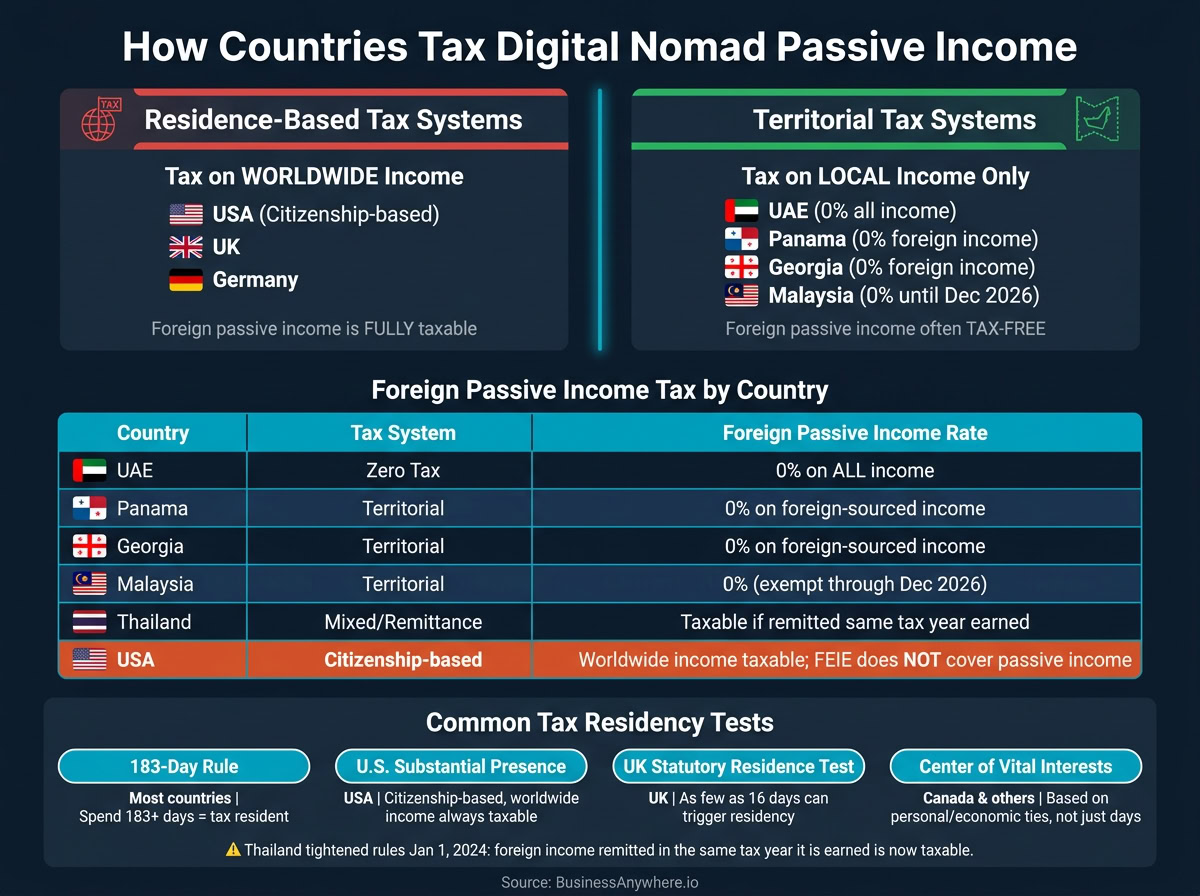
- 183-Day Rule: If you spend 183 days or more in a country, you’re usually considered a tax resident. Some countries calculate this based on the calendar year, a rolling 12-month period, or their specific tax year.
- U.S. Substantial Presence Test: The U.S. taxes citizens on their worldwide income, regardless of where they live. Along with Eritrea, it’s one of the few nations taxing based on citizenship rather than physical presence.
- UK Statutory Residence Test: This test looks at "sufficient ties" to the UK, such as having family, a local address, or UK-based employment. In some cases, spending as few as 16 days in the UK can establish tax residency.
- Center of Vital Interests: This approach examines personal and economic connections to determine residency. For example, Canada doesn’t rely on a fixed number of days but instead evaluates the strength of your ties to the country.
It’s important to note that just staying under the 183-day limit in a country doesn’t necessarily mean you avoid tax obligations back home. Countries like Australia, Canada, and the UK may still consider you a resident until you formally establish residency elsewhere and sever significant ties.
Once you’ve determined your tax residency, the next step is understanding how different tax systems treat your passive income.
Source-Based vs. Residence-Based Taxation
After tax residency is established, countries apply different rules to your income, depending on whether they follow a source-based or residence-based taxation system.
- Residence-based systems, used by nations like the U.S., UK, and Germany, tax worldwide income simply because of your residency.
- Territorial (or source-based) systems, found in places like Panama, Georgia, and the UAE, only tax income earned within their borders. Foreign-sourced income, such as dividends or rental income from overseas properties, is generally exempt from local taxes.
This distinction makes territorial-tax jurisdictions attractive to digital nomads with substantial passive income. Below is a comparison of how different countries treat foreign-sourced passive income:
| Country | Tax System | Foreign Passive Income Treatment |
|---|---|---|
| UAE | Zero tax | 0% on all income |
| Panama | Territorial | 0% on foreign-sourced income |
| Georgia | Territorial | 0% on foreign-sourced income |
| Malaysia | Territorial | 0% on foreign income (exempt through December 2026) |
| Thailand | Mixed/Remittance | Taxable if remitted in the same tax year as earned |
| USA | Citizenship-based | Worldwide income taxable; FEIE doesn’t cover passive income |
Thailand, for example, recently tightened its rules. Starting January 1, 2024, foreign income remitted within the same tax year it’s earned is now taxable, closing a widely used loophole.
The key takeaway? Your choice of tax residency directly impacts how your passive income is taxed. Opting for a territorial-tax jurisdiction can significantly reduce or even eliminate local taxes on foreign-sourced income – provided you can prove your residency is legitimate.
sbb-itb-ba0a4be
How Different Types of Passive Income Are Taxed
This section breaks down how various forms of passive income are taxed, with a focus on the impact of tax residency rules. Tax treatment varies depending on the type of income, its source, and your tax residency status. Here’s a closer look at the key categories of passive income and their tax implications.
Investment Income: Dividends, Interest, and Capital Gains
For U.S. citizens abroad, investment income is fully taxable by the IRS since the Foreign Earned Income Exclusion (FEIE) applies only to earned income. As American Pacific Tax clarifies:
"The Foreign Earned Income Exclusion does not apply to unearned income such as dividends or capital gains."
Here’s how different types of investment income are taxed:
- Interest and non-qualified dividends: Taxed at ordinary income rates (0% to 37%).
- Qualified dividends and long-term capital gains: Taxed at reduced rates of 0%, 15%, or 20%, based on taxable income.
- High earners: An additional 3.8% Net Investment Income Tax (NIIT) applies if modified adjusted gross income exceeds $200,000 (single filers).
Foreign mutual funds or ETFs often trigger punitive Passive Foreign Investment Company (PFIC) taxation and require complex reporting through Form 8621. To avoid this, U.S.-domiciled funds are generally a safer choice.
For nomads in territorial tax countries like Panama or Georgia, foreign-sourced dividends and interest are often taxed locally at 0%. However, the Foreign Tax Credit (FTC) is essential to offset U.S. federal tax obligations on such income.
Real Estate Rental Income
Rental income, whether from U.S. or foreign properties, is classified as passive income by the IRS and does not qualify for the FEIE. This means U.S. citizens must report it on their worldwide tax return. Mike Wallace, CEO of Greenback Expat Tax Services, explains:
"The Foreign Earned Income Exclusion (FEIE) does not apply to unearned income. Your foreign dividends, rental income from U.S. properties, and pension payments are all fully taxable by the IRS."
However, rental income offers several deductions, such as:
- Mortgage interest
- Property management fees
- Repairs
- Depreciation
These deductions can result in a "paper loss", reducing taxable rental income. Under IRC §469, rental losses are considered passive and can only offset other passive income. That said, if you actively manage your rental property, you may deduct up to $25,000 in rental losses against ordinary income annually. This benefit phases out for adjusted gross incomes above $100,000 and disappears at $150,000.
For digital nomads owning foreign properties valued over $200,000 (single taxpayers), FATCA reporting is required via Form 8938.
Royalties and Licensing Income
Royalties from books, patents, software licenses, or music are taxed as ordinary income for U.S. citizens abroad. The country where the royalties originate may also impose withholding taxes. For instance, the U.S. enforces a 30% withholding tax on U.S.-source royalties paid to non-resident aliens. Tax treaties can reduce this rate, and the Foreign Tax Credit helps avoid double taxation.
Semi-Passive Income from Online Businesses
Income from digital products, SaaS, or affiliate programs is taxed based on your involvement:
- Actively managed income: Classified as earned income and may qualify for the FEIE.
- Truly passive income: Does not qualify for the FEIE.
Active business income is also subject to self-employment tax (15.3% on net earnings up to the Social Security wage base). Structuring your business as an S-Corp can help reduce this tax burden.
Crypto and DeFi Passive Income
For U.S. citizens abroad, cryptocurrency staking rewards and DeFi yields are taxed as ordinary income at their fair market value upon receipt. Selling or exchanging crypto triggers capital gains tax:
- Short-term gains: Taxed at ordinary rates if held under a year.
- Long-term gains: Taxed at 0%, 15%, or 20% depending on income level.
High earners may also face the 3.8% NIIT, and the FEIE does not apply to crypto earnings. In territorial tax countries, crypto income sourced outside the country may be locally tax-free, but U.S. citizens are still liable for federal taxes.
Additionally, holding crypto in foreign accounts exceeding $10,000 at any time requires FBAR filing. Non-willful violations can lead to penalties of up to $16,536 per violation. Understanding FBAR exemptions for international entrepreneurs can help you determine if you are required to file.
How to Avoid Double Taxation on Passive Income
Double taxation – when the same income is taxed by both the source country and your home country – poses a significant challenge for nomads. Fortunately, there are two key tools to help mitigate this issue: tax treaties and the Foreign Tax Credit (FTC).
How Tax Treaties Work to Reduce Double Taxation
Tax treaties, officially referred to as Double Taxation Avoidance Agreements (DTAAs), are agreements between two countries that decide which one has the right to tax certain types of income. By 2025, there will be over 5,100 such treaties worldwide, including 68 income tax treaties involving the U.S..
For passive income, these treaties reduce withholding tax rates at the source. Without a treaty, the U.S. typically imposes a 30% withholding tax on dividends, interest, and royalties for non-residents. Treaties often lower these rates significantly, as shown below:
| Country | Dividends | Interest | Royalties |
|---|---|---|---|
| United Kingdom | 15% | 0% | 0% |
| Germany | 15% | 0% | 0% |
| Japan | 10% | 10% | 0% |
| China | 10% | 10% | 10% |
| Netherlands | 15% | 0% | 0% |
Indicative U.S. treaty-reduced withholding rates for 2026 [11][13].
However, for U.S. citizens, most treaties include a "Saving Clause", which allows the IRS to tax its citizens as if the treaty didn’t exist. This means U.S. nomads can’t rely solely on treaties to avoid U.S. taxes on passive income – they must also use the Foreign Tax Credit.
"A tax treaty is a legal document where every word matters. This is not a DIY financial plan." – BASTA Croop
To claim reduced treaty rates on U.S.-source income, non-U.S. persons must file Form W-8BEN with the withholding agent. If the treaty position overrides U.S. domestic law, it must also be disclosed on Form 8833.
How the Foreign Tax Credit Helps
The Foreign Tax Credit complements treaty benefits by allowing a dollar-for-dollar offset against U.S. taxes for foreign taxes already paid. This credit is claimed on Form 1116, which is filed with your Form 1040.
The IRS categorizes income into separate "baskets." Passive income – such as dividends, interest, rental income, royalties, and capital gains – falls under the Passive Category Income basket. Credits from this basket can’t offset taxes on other types of income and must be calculated separately.
The FTC is limited by the following formula:
FTC Limit = U.S. Tax Liability × (Foreign Source Taxable Income ÷ Worldwide Taxable Income)
If the foreign taxes paid exceed the U.S. tax liability on that income, the excess credits can be carried back one year or carried forward for up to 10 years.
"The Foreign Tax Credit is not an unlimited dollar-for-dollar offset. The IRS limits the credit to the amount of U.S. tax you would owe on your foreign-source income." – WhereNext
It’s also worth noting that U.S. treaties don’t apply to state-level taxes. States like California and New York can still tax foreign passive income even if a federal treaty reduces your tax. To avoid this, consider establishing residency in a no-income-tax state – like Florida or Texas – before moving abroad.
Common Scenarios and Solutions
Scenario 1: U.S. Citizen in Germany with Dividend Income.
A U.S. citizen living in Germany may face local taxes on dividend income that exceed the treaty-reduced U.S. withholding rate. By filing Form 1116 for Passive Category Income, they can eliminate their U.S. federal tax liability and carry forward any excess credits.
Scenario 2: U.S. Nomad with Rental Income from Property in Spain.
A U.S. nomad earning rental income from a property in Spain must report this income on their U.S. tax return, as passive income doesn’t qualify for the Foreign Earned Income Exclusion. However, taxes paid to Spain can be claimed as a Foreign Tax Credit on Form 1116, reducing the U.S. tax owed.
Scenario 3: Nomad in a Territorial Tax Country (e.g., Panama).
In Panama, which taxes only locally sourced income, foreign dividends and interest are not subject to local taxes. However, a U.S. citizen is still liable for IRS taxes on this income. Since no foreign taxes are paid, there’s no credit to claim, and the full U.S. tax applies. In such cases, structuring investments through U.S.-based accounts and funds can help manage the tax burden.
Business Structures and Compliance Tools for Nomads
Managing passive income across different jurisdictions requires a well-thought-out approach to business structure and compliance. These decisions are crucial for staying on the right side of the law while optimizing your tax obligations.
Choosing the Right Business Structure for Passive Income
Your choice of business structure plays a big role in how your passive income is taxed, reported, and protected. For solo nomads, a Single-Member LLC (SMLLC) is often the go-to option. The IRS treats it as a "disregarded entity", which means your income flows directly to your personal tax return, eliminating the need for a separate corporate tax filing.
However, if your net income consistently exceeds $75,000–$80,000 annually, you might want to look into an S-Corp election. This setup allows you to divide your income between a reasonable salary and distributions, which can help reduce self-employment taxes on the distribution portion. Vincenzo Villamena, CEO of Global Expat Advisors, highlights the importance of choosing wisely:
"If you’re an American living abroad and working for yourself, picking the right business structure can make a big difference. It can save you on taxes, and also affects your banking, compliance, legal liability, and how easily you can get paid."
It’s important to note that a U.S. LLC isn’t a way to avoid taxes altogether. Instead, it’s a tool to help manage your income efficiently while addressing reporting requirements and liability protection. As Sarah Kuhlemann of Genki puts it:
"A US LLC is a tool. A very useful one. But it’s not a magic wand that makes your tax obligations disappear."
For non-U.S. residents, a U.S. LLC can be particularly useful for accessing American payment processors like Stripe and PayPal, as well as U.S. banking. If all your work is conducted outside the United States, you can avoid triggering U.S. federal income tax. Companies like BusinessAnywhere offer packages such as the Digital Nomad Kit, which includes LLC formation, EIN application, registered agent services, bank account setup, and a personalized tax strategy report. Prices start at $3,070 for U.S. citizens and $3,200 for non-U.S. individuals.
Once you’ve chosen the right structure, staying compliant requires meticulous record-keeping.
Record-Keeping Best Practices
Keeping accurate records isn’t just good practice – it’s essential for protecting yourself in case of an audit. The three key areas to focus on are travel dates, income and expenses, and foreign taxes paid.
- Travel Records: Keep a detailed log of every country you enter and exit, including exact dates. Supporting documents like boarding passes, passport stamps, and hotel receipts can help prove your residency status.
- Separate Accounts: Use a dedicated business bank account to avoid mixing personal and business funds. Combining the two can weaken your limited liability protection.
- LLC Transactions: If you own a U.S. LLC, every transaction – whether it’s a contribution, distribution, or reimbursement – must be documented. This is critical for Form 5472 compliance. Failing to file this form can result in a $25,000 penalty per year, even for inactive LLCs if formation costs or registered agent fees were paid by the owner.
As O&G Tax and Accounting succinctly puts it:
"U.S. tax might be $0, but reporting is not $0."
To simplify record-keeping, consider using tools like QuickBooks Online. Plans range from $30 to $200 per month and offer features like bank feed integration and digital receipt capture, making year-end reporting much easier.
With organized records, meeting filing deadlines becomes far more manageable.
Key Filing Deadlines and Obligations
Missing a filing deadline can lead to hefty penalties, so staying on top of these dates is crucial. Here are the most important deadlines for U.S.-connected nomads:
| Deadline | Form / Obligation | Who It Applies To |
|---|---|---|
| March 15 | Form 5472 + pro-forma Form 1120 | Foreign-owned U.S. LLCs |
| April 15 | Form 1040 (U.S. individual return) + FBAR (FinCEN 114) | U.S. citizens and residents |
| May 1 | Florida LLC annual report | Florida-registered LLCs |
| Ongoing | FATCA reporting (Form 8938) | U.S. persons with foreign financial assets above threshold |
The FBAR (Report of Foreign Bank and Financial Accounts) must be filed if your combined foreign financial accounts exceeded $10,000 at any point during the year. Keep in mind, this form is submitted directly to FinCEN, separate from your tax return.
If navigating these requirements feels overwhelming, a Tax and Residency Consultation could be a smart move. For $535, BusinessAnywhere offers a one-hour session to create a custom tax and residency plan tailored to your specific situation.
Key Takeaways for Nomads
Here’s a quick rundown of what digital nomads need to keep in mind when it comes to passive income taxation:
- Passive income – such as dividends, interest, capital gains, rental income, and royalties – doesn’t qualify for the Foreign Earned Income Exclusion (FEIE). Instead, the Foreign Tax Credit (FTC) can help reduce U.S. taxes by offsetting the amount of foreign taxes you’ve paid.
- Tax residency matters. It’s not about your passport or visa but where you establish formal residency. Without official residency, you risk issues like account closures or global tax claims. Choosing a territorial-tax country like the UAE, Panama, or Georgia can offer a strong legal framework for residency, though you should first consider whether to register your business in the US or abroad.
- U.S. citizens face unique challenges because of citizenship-based taxation. This means you owe federal taxes on your worldwide income, no matter where you live. Plus, you’ll need to comply with reporting requirements like FBAR, FATCA, and other global financial disclosures.
- Choosing the right business structure – such as a Single-Member LLC or an S-Corp – can make a big difference in simplifying tax compliance and improving tax efficiency. Keeping clear records, like travel logs, dedicated business accounts, and LLC transaction details, is crucial to staying audit-ready.
For those looking for a simpler way to manage their U.S. business obligations, BusinessAnywhere offers services like LLC formation, EIN applications, registered agent services, virtual mailboxes, and tax consultations. This all-in-one solution helps you stay on top of compliance, no matter where you are.
FAQs
How do I prove my tax residency as a digital nomad?
Proving tax residency requires keeping thorough records that demonstrate your physical presence and financial connections to a specific location. Maintain a detailed log of your travel dates, along with entry and exit records, to establish where you’ve spent your time. Additionally, gather evidence of a permanent home, such as a lease agreement or utility bills in your name.
To show economic ties, organize documents like invoices, payment receipts, and statements from local bank accounts. If you’re moving to a new country, make sure to secure a tax residency certificate and formally deregister from your previous country to minimize potential disputes or overlapping tax obligations.
When should I use the Foreign Tax Credit instead of tax treaties?
When it comes to managing taxes on income earned abroad, the Foreign Tax Credit and tax treaties aren’t an either-or choice – they actually complement each other. Here’s how it works:
First, use the tax treaty between the U.S. and the foreign country to identify the reduced tax rate you’re required to pay there. Once you’ve determined that rate, you can claim the Foreign Tax Credit for the amount you’ve paid – up to the treaty-specified rate.
However, if you end up paying more than the treaty allows, that extra amount isn’t eligible for the credit. In such cases, you’ll need to contact the foreign government to request a refund for the overpayment.
Will an LLC or S-Corp lower taxes on my “passive” online income?
Whether choosing an LLC or S-Corp saves you money on taxes depends on your location and how your business operates. For non-U.S. residents without a U.S. office or employees, a single-member LLC typically avoids U.S. federal income tax. On the other hand, U.S.-based earners might find an S-Corp election helpful in cutting self-employment taxes. However, this comes with the responsibility of following strict payroll rules and filing the necessary tax forms. For example, failing to file Form 5472 can result in penalties.