


If I had to sum it up in one line: Stripe is often harder at signup, while PayPal is often easier at signup but more likely to place holds later.
If I own a US LLC from outside the United States, I usually need the same core setup before either platform works well:
- An active US LLC
- An EIN
- A US business bank account in the LLC’s exact legal name
- A real business address
- My passport or other government ID
- My actual home address for personal checks
- A live website that clearly explains what I sell
The main mistake I see is simple: details don’t match. A small name mismatch, the wrong address type, or a bank account not in the LLC’s name can lead to reviews, delays, limits, or rejection.
Here’s the short version:
- Stripe usually checks more before approval
- PayPal often checks more after approval
- Stripe is often a better match for SaaS, subscriptions, and structured online sales
- PayPal can work well for one-time payments and buyer-familiar checkout, but holds and reserves are more common on newer accounts
- Order matters: form the LLC, get the EIN, open the bank account, then apply for payments
A key detail: PayPal may ask for the owner’s tax details, such as an ITIN or foreign tax ID. Stripe, by contrast, tends to focus more on whether the business, owner, bank account, and website all line up.
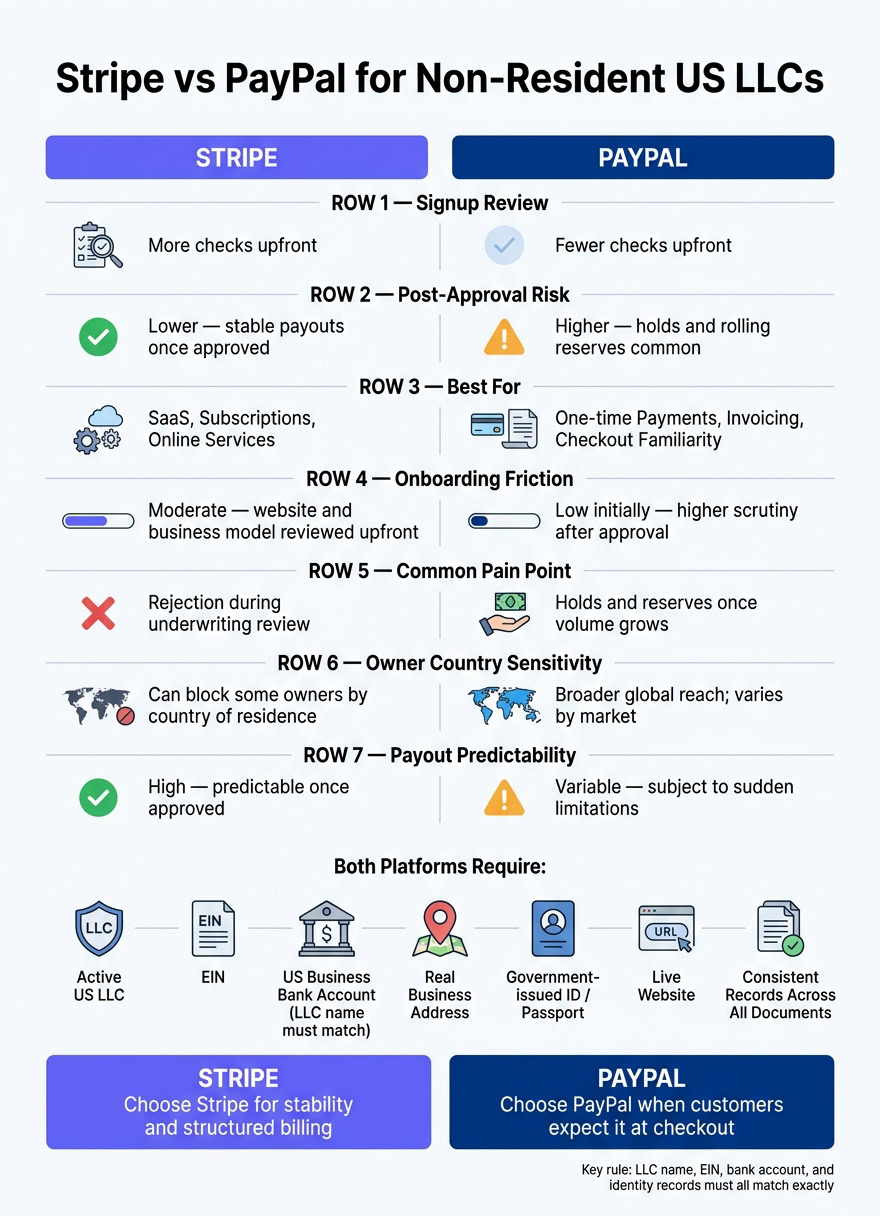
Quick Comparison
| Criteria | Stripe | PayPal |
|---|---|---|
| Signup review | More checks upfront | Fewer checks upfront |
| Post-approval risk | Lower once approved | Higher chance of holds or reserves |
| Best for | SaaS, subscriptions, online services | One-time payments, invoicing, checkout familiarity |
| Bank account match | Strict | Strict |
| Address checks | Strict | Strict, with more focus on personal address too |
| Owner country limits | Can block some owners by residence | Varies by market and review |
| Common pain point | Rejection during review | Limits after account starts processing |
My takeaway: if I want more stable payouts after approval, I’d lean Stripe. If I need PayPal because customers expect it, I’d prepare for extra reviews and possible limits once volume starts to grow.
That’s the core decision this article helps explain, alongside other top payment gateways for global SMBs.
sbb-itb-ba0a4be
Stripe for Non-Resident US LLCs: Eligibility, Documents, and Approval Risks
What Stripe Requires for a US LLC Account
Stripe mainly checks whether your LLC details, owner identity, and payout method match its records. For non-resident owners, approval often breaks down at the verification stage, not because the LLC itself can’t apply. Put simply: the issue usually isn’t basic eligibility. It’s whether Stripe can confirm the business fast and without red flags.
Stripe also reviews your website. If the site looks incomplete, vague, or missing key business details, that can trigger extra review.
How Stripe Verifies Foreign Owners and Company Details
Stripe verifies both the LLC and its owners. That means your company records, owner identity, bank account, and application details need to line up EXACTLY.
Even small mismatches can cause problems. A name that looks close but doesn’t match word-for-word, or details entered one way on the application and another way at the bank, can slow things down.
Common Stripe Problems for Non-Resident Owners
A few issues show up again and again:
- Using a mailbox or registered-agent address as the business address
- Entering an LLC name that doesn’t exactly match the bank account name
- Listing an owner country of residence that Stripe doesn’t support
That last point catches many people off guard. The LLC may be valid, but Stripe can still block approval based on the owner’s country of residence.
PayPal uses a different verification flow, but the same document-matching mistakes can still lead to delays.
PayPal for Non-Resident US LLCs: Eligibility, Verification, and Limitation Risks
What PayPal Requires for a US LLC Business Account
PayPal uses a verification setup similar to Stripe, but it tends to put more weight on personal tax details and account-limit reviews. Before approval, PayPal checks whether your LLC details and payout information line up with your records.
It may ask for documents like:
- Articles of Organization
- Operating Agreement
- IRS EIN letter, such as CP575 or 147C
Have these ready and easy to find. If PayPal asks for them, a slow response can turn a simple review into a headache.
How PayPal Handles Identity Checks and Tax Information
PayPal may review both your business details and the owner’s personal tax details during compliance checks. The EIN identifies the LLC, but PayPal may also ask for the owner’s tax ID.
For non-resident owners, that usually means an ITIN or a foreign tax ID instead of an SSN. PayPal may also request a government-issued photo ID, like a passport.
Use your actual home address for identity checks. A registered agent address or virtual mailbox usually won’t work here. This trips people up all the time because those addresses may be fine for LLC formation, but not for personal verification.
Common PayPal Holds, Reserves, and Account Limitations
New non-resident accounts often get extra review. PayPal may place temporary payment holds or set a rolling reserve, especially if a new account starts processing a sudden jump in sales without a clear business model or shipping history.
Limits can also happen when key account details change, or when something doesn’t match across your LLC formation documents, EIN letter, and linked bank account. As payment volume grows, PayPal may ask for more paperwork.
That gap shows up most clearly in the side-by-side comparison that follows.
Stripe vs. PayPal for Non-Resident US LLCs: Side-by-Side Comparison
The main difference comes down to when each platform checks risk. Stripe tends to do more of that work upfront. PayPal often feels easier at first, then adds more checks after approval. Once you’ve handled the setup pieces, the day-to-day question is simple: which one creates less friction for your business model?
Eligibility, Supported Countries, and Account Structure
Stripe links the account to your US LLC, so your country of residence usually matters less than the company itself. PayPal works in a similar way, but its post-approval risk review can vary more based on where the owner lives.
| Feature | Stripe | PayPal |
|---|---|---|
| Account basis | US LLC (entity-driven) | US Business account for LLCs; personal accounts vary by market |
| Supported owner countries | Specific list; check before applying | Broader global reach; varies by residence |
| Typical use cases | SaaS, e-commerce, online services | E-commerce, cross-border sales, invoicing |
LLC, EIN, Address, Bank Account, and Identity Requirements
This is where the gap starts to show, especially in how each platform handles address and identity fields. Both ask for similar core documents, but they use them a bit differently.
Stripe puts more weight on matching the business and owner identity details. PayPal does that too, but it often layers in address and tax checks as well. Many non-resident founders enter their actual home address outside the U.S. in the business location field, which makes accuracy here a big deal.
| Requirement | Stripe | PayPal |
|---|---|---|
| US LLC required | Yes | Yes |
| EIN required | Yes | Yes |
| US business bank account | Required for settlement | Required for withdrawals |
| Address sensitivity | High; business location must be real | High; business location must be real |
| Owner verification | Passport or government-issued ID | Passport or government-issued ID |
| Common document requests | EIN letter, company documents, ID | EIN letter, ID, proof of address |
Approval Friction, Account Risk, and Best Fit by Business Type
After approval, the bigger issue is what happens once payments start coming in.
Stripe’s onboarding friction is front-loaded. It reviews your website, business model, and industry during signup. If you clear that stage, payouts are often more stable.
PayPal’s initial signup is easier. But for new non-resident accounts, there’s a higher chance of rolling reserves, payment holds, and account limits once transaction volume picks up. That’s the trade-off: easier entry, but more uncertainty later.
| Risk & Approval Factor | Stripe | PayPal |
|---|---|---|
| Onboarding friction | Moderate; website and business model review upfront | Low initial friction; higher post-approval scrutiny |
| Common account limitations | Rejection during underwriting | Holds and rolling reserves on new accounts |
| Payout predictability | Stable once approved | Subject to sudden limitations |
| Best fit: subscriptions | Best for recurring billing | Limited |
| Best fit: invoicing | Best for recurring billing and structured billing | Best for simple invoices and one-time payments |
| Best fit: e-commerce / cross-border | Strong for e-commerce and subscriptions | Useful for cross-border sales, but reserve risk is higher |
If you’re focused on cross-border product sales or simple invoicing, PayPal can still work well. Just go in expecting the chance of holds early on, rather than treating them like a surprise.
Conclusion: How to Choose the Right Platform and Avoid Setup Mistakes
The gap between a smooth approval and account limits usually comes down to one thing: preparation. If your records line up and your paperwork is clean, you give payment platforms far less reason to stop, review, or flag your account.
The Minimum Checklist Before Applying
Before you apply, make sure you have:
- LLC formation documents: Filed Articles of Organization and a signed Operating Agreement
- EIN confirmation letter from the IRS: Do not apply until the IRS has issued the EIN letter
- US business bank account: An account in the LLC’s name
- Valid passport or government-issued ID for every owner
- Proof of residential address: A utility bill or similar document showing your actual home address
- A live website with clear product or service details
- Consistent records: Your company name, owner name, and address should match across your LLC documents, EIN records, bank account, and payment application
Use your actual home address for identity checks. Registered-agent and virtual-mailbox addresses are for compliance and mail only.
Once those records match, the decision is less about paperwork and more about how much friction you want upfront versus how much risk you can live with after approval.
How to Decide Between Stripe and PayPal
If your business needs more structured payment setup, especially for SaaS, e-commerce, or online services, Stripe is usually the better fit. Stripe tends to be stricter at the start, but once approved, it’s often easier to work with.
Use PayPal when your customers expect to see it at checkout and you can deal with possible holds or reserves.
Either way, the big three are accuracy, consistency, and a clean compliance foundation. Your LLC documents, EIN, bank account, and identity records should all tell the same story. When they do, both platforms have fewer reasons to flag your account.
FAQs
Can I use Stripe or PayPal without living in the U.S.?
Yes. You can use Stripe and PayPal without living in the U.S. if you set up a U.S. business entity, such as an LLC.
In most cases, you’ll need an EIN, a U.S. business bank account to receive payouts, and a valid U.S. business address for verification. You do not need to be physically present in the United States.
What documents do I need before applying?
Before you apply for a payment processor or a business account for your US LLC, get your paperwork in order first. It saves time and cuts down on back-and-forth.
Have these ready:
- Articles of Organization
- IRS EIN confirmation letter (CP 575 or 147C)
- Signed Operating Agreement
- Unexpired passport scan
- Proof of a US address
It also helps to prepare a plain-English summary of your business. Explain what you sell, how your business model works, and what kind of transaction volume you expect. That gives the provider a clearer picture of your company and can help prevent compliance problems and approval delays.
Why do Stripe or PayPal limit new LLC accounts?
Stripe and PayPal can limit or freeze new non-resident LLC accounts while they run identity and compliance checks.
Two common triggers are:
- No U.S. SSN, which can lead to requests for an ITIN
- Mismatches between your legal entity, EIN, and business registration address
Payment limits can also show up if your account has a sudden spike in transactions or a high dispute rate. The fix is usually simple in theory, even if it can be a hassle in practice: keep every document consistent, and ramp up payment volume slowly instead of all at once.