

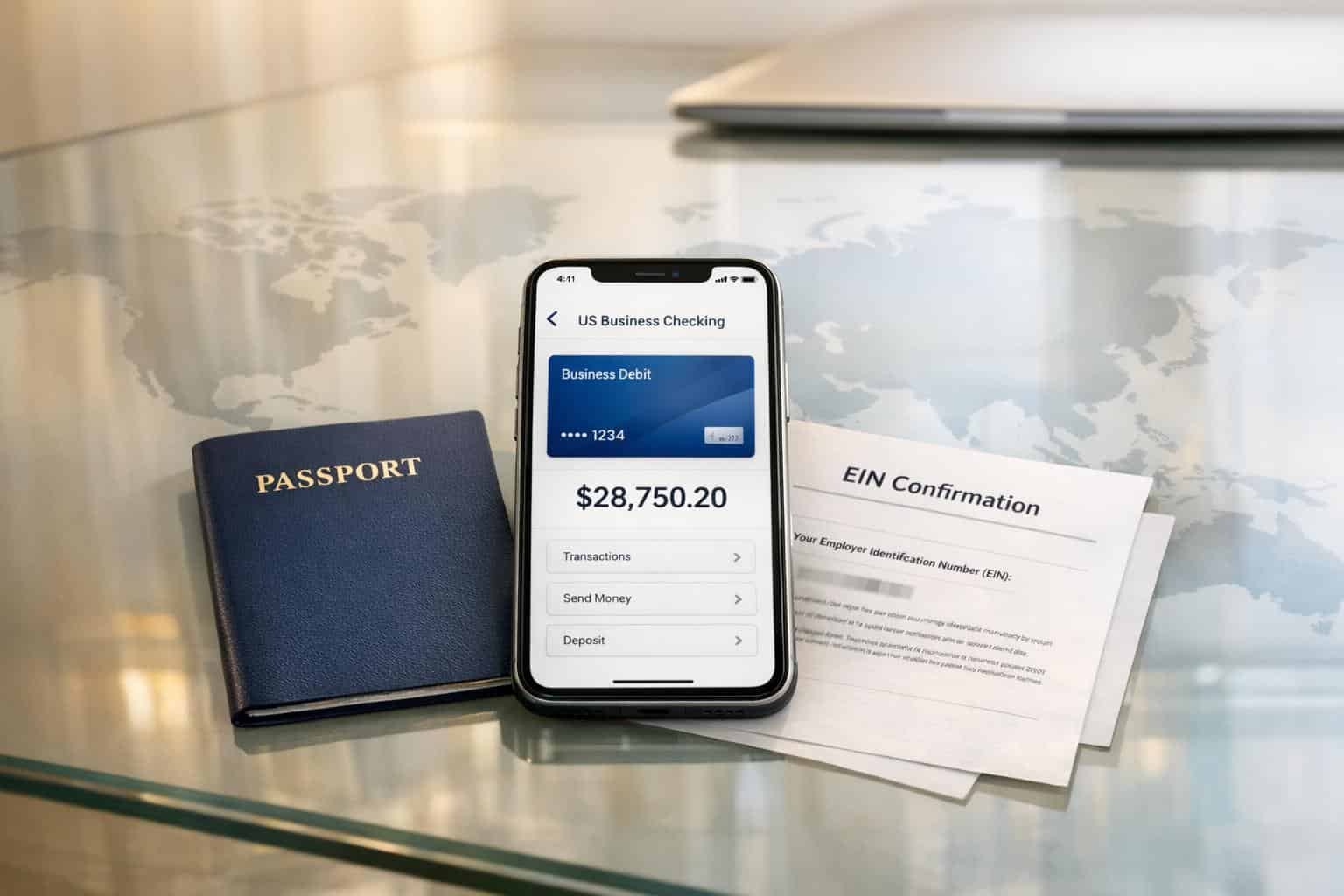
If you’re a non-resident entrepreneur, opening a US business bank account can seem impossible without a US address or Social Security Number (SSN). Traditional banks often reject applications due to strict regulations and outdated systems. But don’t worry – fintech platforms like Mercury, Relay, and Wise offer online solutions, making it easier for international founders to access banking services.
Here’s what you need to know:
- Why Banks Reject Non-Residents: Federal laws like the USA PATRIOT Act require identity and address verification, which most non-residents can’t meet. Traditional banks demand a physical US address and in-person visits.
- Documents You’ll Need: EIN confirmation, Articles of Organization, Operating Agreement, and a valid foreign passport.
- Top Fintech Options:
- Mercury: Ideal for tech startups, no monthly fees, and strong integrations with Stripe and PayPal.
- Relay: Offers up to 20 sub-accounts for better fund organization but prefers ITIN holders.
- Wise: Best for multi-currency transactions, supports 40+ currencies, and has a 92% approval rate.
- Payoneer: Great for freelancers and marketplace sellers.
- Airwallex: Tailored for Asia-based founders and high-volume transactions.
These platforms simplify the process, requiring only an EIN and passport, and eliminate the need for a US address or SSN. Choose the one that fits your business needs, prepare your documents, and apply online.
Why Traditional Banks Reject Non-Residents
If you’re a non-resident without a U.S. address or Social Security Number (SSN), walking into a Chase or Bank of America branch is almost guaranteed to end in rejection. Traditional banks consistently turn down business applications from non-residents due to a mix of federal regulations, outdated systems, and risk management policies that make it difficult – or outright impossible – to serve international founders.
Two key laws, the USA PATRIOT Act and the Bank Secrecy Act, require banks to verify every customer’s identity and conduct extra due diligence for foreign individuals. For big banks, this often means requiring an in-person visit to sign a physical signature card and providing proof of a U.S. residential address – something most non-residents simply don’t have. On top of that, many banks’ legacy systems can’t handle verifying foreign passports or international addresses. Instead of upgrading their infrastructure, they default to rejecting these applications outright. These strict requirements leave international founders with very few options.
As one industry expert puts it:
"Traditional giants (Chase, BoA, Wells Fargo)… almost always require a physical visit to sign the signature card. They hate virtual addresses." – Foreign Founder Team
The situation worsened in October 2024, when FinCEN fined TD Bank $1.3 billion for failing to comply with anti-money laundering regulations. This massive penalty sent shockwaves through the banking industry, prompting many institutions to tighten their Know Your Customer (KYC) policies even further. For banks, non-resident accounts are seen as high-risk and low-reward. These accounts often carry smaller balances but require costly international document verification.
Adding to the challenges, traditional banks won’t accept applications that list registered agent addresses, PO boxes, or UPS Store locations as the principal place of business. They demand a physical U.S. address backed by utility bills to prove the business is genuinely operating within the country. Without this, your application is disqualified – no matter how legitimate your business might be. These rigid policies highlight why so many non-residents are turning to fintech companies for their banking needs.
Required Documents for Opening a US Business Bank Account
To open a US business bank account as a non-resident, you’ll need to provide specific documents. These requirements come from federal Know Your Customer (KYC) and Anti-Money Laundering (AML) regulations, which apply to all US financial institutions. Preparing these documents in advance can help streamline the process and minimize the risk of delays or rejections.
The four main documents you’ll need are: an EIN confirmation letter, Articles of Organization or Incorporation, a signed Operating Agreement, and a valid foreign passport. Each plays a key role in verifying your business and your authority to manage the account. Let’s break down what each document entails.
EIN (Employer Identification Number)
The Employer Identification Number (EIN) is a nine-digit identifier issued by the IRS to recognize your business for tax purposes. Think of it as the business equivalent of a Social Security Number. A valid EIN is a non-negotiable requirement for opening a US business bank account.
Non-residents must submit Form SS-4 to the IRS by mail or fax, marking "Foreign" on Line 7b. This process usually takes around 2.5 to 3 months to complete. Once approved, the IRS will send you a CP575 confirmation letter. If you’re located abroad, it may take an additional 4 to 8 weeks for the letter to arrive. However, many fintech banks, such as Mercury or Wise, accept the IRS fax confirmation or a 147C verification letter instead, so you don’t have to wait for the physical CP575 letter.
Lost your original CP575? Contact the IRS at +1-267-941-1099 to request a 147C replacement. Remember, only official IRS documents with the IRS letterhead and signature will be accepted – screenshots or unofficial copies will be rejected.
Articles of Organization or Incorporation
The Articles of Organization (for LLCs) or Articles of Incorporation (for Corporations) are official state-issued documents that confirm your business is legally recognized in the US. These documents include details like the business name, formation date, registered agent, and state of incorporation.
It’s essential that the business name on your Articles matches exactly with the name on your EIN letter and bank application. Even small discrepancies can raise red flags and delay your application.
When submitting, use a high-quality color PDF scan at 300 DPI. Avoid using phone photos with poor lighting, shadows, or cropped edges, as these issues could result in rejection.
Operating Agreement
The Operating Agreement outlines your business’s ownership structure, management roles, and decision-making processes. It’s a critical document for banks, as it clarifies who has the authority to manage the account. Even single-member LLCs are typically required to provide this document.
Make sure the Operating Agreement is signed – either physically or electronically – by all members listed in your Articles of Organization. Banks often reject unsigned templates downloaded from the internet. The document should also clearly identify all beneficial owners (anyone with a 25% or greater ownership stake), as required by the Beneficial Ownership Information Reporting Rule. For multi-member LLCs, specify who is authorized to act on behalf of the company for banking purposes.
Government-Issued ID (Passport)
A valid, unexpired foreign passport is required for identity verification. It confirms your identity and nationality while allowing banks to comply with federal regulations, including international sanctions checks.
Submit a clear, high-quality color scan of the passport’s identification page, which includes your photo, full name, date of birth, and passport number. Black-and-white images or photocopies won’t be accepted.
If your LLC has multiple owners, each person with a 25% or greater ownership stake must provide their own passport. Note that individuals from countries under US sanctions – such as Iran, North Korea, Syria, and Venezuela – are typically ineligible to open US business accounts.
With these documents prepared, you’ll be ready to explore fintech banking options designed to simplify the process for non-residents.
5 Banking Options for Non-Residents Without a US Address or SSN
Once you’ve got your paperwork in order, the next step is finding a banking platform that works for you. Luckily, several fintech companies specialize in serving international entrepreneurs and founders.
Each platform has its own strengths, approval criteria, and fee structures. For example, Mercury Bank is a favorite among tech startups thanks to its sleek interface and payment processor integrations. Relay Financial offers the ability to create up to 20 sub-accounts, perfect for keeping funds organized. Wise Business stands out for its multi-currency features and competitive currency conversion rates. Payoneer is tailored for freelancers and marketplace sellers, while Airwallex is a go-to for Asia-Pacific founders and e-commerce businesses.
Approval rates also vary. Wise Business has an estimated 92% approval rate for non-residents, while Mercury’s approval rate stands at around 78%. Your decision will depend on factors like your location, the currencies you deal with, and how you intend to use the account.
Below, we’ve broken down the details of each option, including eligibility, application process, fees, and ideal use cases, to help you make the best choice.
Mercury Bank: Best for Tech-Savvy Founders
Mercury is a strong choice for tech startups and SaaS businesses launched by non-residents. It offers a modern platform, free domestic and international USD wires, and seamless integration with tools like Stripe and PayPal.
Eligibility and Requirements
To open a Mercury account, you’ll need a valid US LLC or C-Corporation and an EIN. No Social Security Number (SSN) or ITIN is required.
Mercury has strict address rules. While you can use your registered agent’s address as your "Legal Address", your "Physical/Operating Address" must be your actual residential address in your home country. Using a P.O. box, virtual office, or registered agent address for this field will lead to automatic rejection.
Additionally, Mercury excludes applicants from certain countries, including Afghanistan, Nigeria, the Philippines, parts of Ukraine, and Russia. If you’re from one of these regions, Wise Business could be a better fit. Having a functioning business website or LinkedIn company page can also boost your approval chances by showcasing your business’s legitimacy.
Application Process and Timeline
The entire process is completed online and takes about 15–20 minutes. You’ll need to upload documents like your EIN confirmation letter (CP 575 or IRS fax confirmation), Articles of Organization, Operating Agreement, and passports for all owners with a 25% or greater stake.
Applications are manually reviewed, with decisions typically issued within 1–5 business days. Make sure all your documents are complete and high-quality, as declined applications are permanently recorded.
Pros and Cons
Pros:
- No monthly fees or minimum balance requirements
- Free domestic and international USD wire transfers
- FDIC insurance up to $250,000 through partner banks
- Strong integrations with Stripe and PayPal
- User-friendly interface tailored for startups
- No need for a physical US presence
Cons:
- Strict address verification policies (no virtual office addresses allowed)
- Approval rate of 78%, lower than some alternatives
- Limited currency options (primarily USD)
- Must demonstrate US business activity within six months
- Prohibited countries list excludes several regions
If you need better fund organization, Relay Financial is an excellent alternative.
Relay Financial: Best for Multi-Account Management
Relay Financial’s standout feature is its ability to create up to 20 sub-accounts within a single business account. This makes it easy to organize funds by project, client, or expense category.
Eligibility and Requirements
Relay accepts applications from non-residents, but all beneficial owners must have an SSN or obtain an ITIN. If you don’t have an ITIN, contacting Relay support before applying is recommended. Required documents include your US LLC registration, EIN confirmation, Articles of Organization, Operating Agreement, and passports for all owners with 25% or greater ownership.
Application Process and Features
The application is completed online, involving document uploads and identity verification. Approvals typically take 1–5 business days. Once approved, you can immediately set up multiple sub-accounts, each with its own account number, making financial tracking and reconciliation easier.
Relay also integrates with accounting software like QuickBooks and Xero, helping automate transaction categorization and simplifying tax preparation.
Pros and Cons
Pros:
- No monthly fees for the basic plan
- FDIC insurance up to $3,000,000 through a sweep program with Thread Bank
- Up to 20 sub-accounts for better financial organization
- Integrates with accounting tools like QuickBooks and Xero
- No minimum balance requirements
Cons:
- Requires an SSN or ITIN for all beneficial owners
- Limited support for international payments
- Domestic wire transfers come with fees of $5–$10
- Less suitable for businesses operating exclusively outside the US
For those needing multi-currency capabilities, Wise Business is a strong contender.
Wise Business: Best for Multi-Currency Transactions
Wise Business (formerly TransferWise) offers a multi-currency account that acts as a global financial hub for businesses dealing in various currencies. While not a traditional US bank, Wise provides local banking details in over 10 countries, including the US.
Eligibility and Requirements
Wise Business has a high approval rate of about 92% for non-residents and supports currency conversions across 40+ currencies with transparent fees between 0.41% and 2.85%. This makes it a great option for founders from countries excluded by Mercury, like Nigeria and the Philippines.
To apply, you’ll need a registered business entity (a US LLC qualifies), an EIN, and valid identification. No SSN or ITIN is required. Unlocking US banking details (routing and account numbers) involves a one-time setup fee of $31.
Features and Fees
Wise allows you to hold and convert over 40 currencies at mid-market rates. It integrates with platforms like Stripe, PayPal, and Amazon, making international payments seamless. You can receive local banking details in regions like Europe (via SEPA), the UK (via Faster Payments), and the US (via ACH), helping you avoid international wire fees.
"For founders from Mercury-prohibited countries, Wise is often the primary banking solution, not a fallback." – Corporatee
Pros and Cons
Pros:
- High approval rate of approximately 92%
- Available to founders from countries excluded by Mercury
- Supports 40+ currencies with mid-market exchange rates
- No monthly fees
- No SSN or ITIN required
- Local banking details in over 10 countries
- Transparent, low-cost currency conversion (0.41%–2.85%)
Cons:
- $31 one-time fee to unlock US account details
- Funds are safeguarded in segregated accounts, not FDIC insured
sbb-itb-ba0a4be
How to Apply for Mercury Bank as a Non-Resident (Step-by-Step)
If Mercury seems like the right choice for your business, applying is a straightforward, fully online process. The entire application typically takes about 15–20 minutes, provided you have all your documents ready. Since Mercury manually reviews applications, it’s crucial to ensure all details and documents are accurate and complete to avoid delays or potential rejections.
Step 1: Gather Required Documents
Before starting your application, make sure you meet all the US business bank account requirements. Missing or incomplete paperwork is one of the most common reasons for delays or rejections.
Here’s what you’ll need:
- EIN Confirmation Letter: This must be the official confirmation from the IRS, such as the CP575 notice or the 147C verification letter. Screenshots or unofficial copies won’t be accepted.
- Articles of Organization: Provide the state-stamped or certified version of your formation documents.
- Operating Agreement: A signed copy that outlines your ownership structure is mandatory.
- Passport Scans: Clear, color scans of passports for all owners holding 25% or more ownership.
- Proof of Address: A recent utility bill or bank statement (issued within the last 90 days) for all major owners. If these documents are not in English, include a certified translation.
- Online Presence: A live business website or an active LinkedIn company page can improve your chances of approval.
All documents should be high-resolution PDFs (300 DPI, in color). Avoid blurry or poorly cropped images, as these can lead to immediate rejection. Double-check that all names, addresses, and company details match exactly across your documents.
Once everything is prepared, you’re ready to start the online application.
Step 2: Complete the Online Application
The application form will ask for basic details about your business, its ownership, and a description of what you do. Use the legal address listed in your formation documents, and include your actual residential address in the physical/operating address field.
When describing your business, avoid vague terms like "consulting" or "marketing services." Instead, provide a specific and concise explanation of your operations. For example: "We are a digital marketing agency serving US-based e-commerce brands, processing payments through Stripe."
Also, be sure to use a professional email address tied to your company’s domain (e.g., [email protected]) instead of generic providers like Gmail or Yahoo.
When uploading your documents, use clear and descriptive file names such as "ABC_LLC_Articles_of_Organization.pdf" to keep things organized.
Once the form is filled out, you can move on to submission.
Step 3: Submit and Wait for Approval
After submitting your application, Mercury will review it. You’ll typically receive an initial response or a request for additional information within 24–48 hours. Final decisions are usually made within 1–5 business days.
If Mercury asks for clarification or extra documents, respond promptly with exactly what they request. For example, one applicant reported receiving approval within 51 hours after submitting all required materials.
Upon approval, your account will be activated immediately, and you’ll gain access to a virtual debit card. Physical debit cards are shipped internationally and usually arrive within 2–3 weeks. If you need it sooner, expedited shipping is available (via DHL or FedEx) for about $30.
In the event of a rejection, reach out to Mercury support for clarification before attempting to reapply. In some cases, Mercury allows a second attempt, but this isn’t guaranteed. If reapplication isn’t possible, you might consider applying to Wise Business, which tends to have a higher approval rate for non-resident applicants.
Once your account is live, it’s a good idea to start with small transactions (between $100 and $1,000) before scaling up. This helps reduce the risk of triggering fraud alerts or account freezes. Mercury’s streamlined process makes it one of the best options for non-residents seeking a US business bank account without an SSN.
Comparison Table of Banking Options
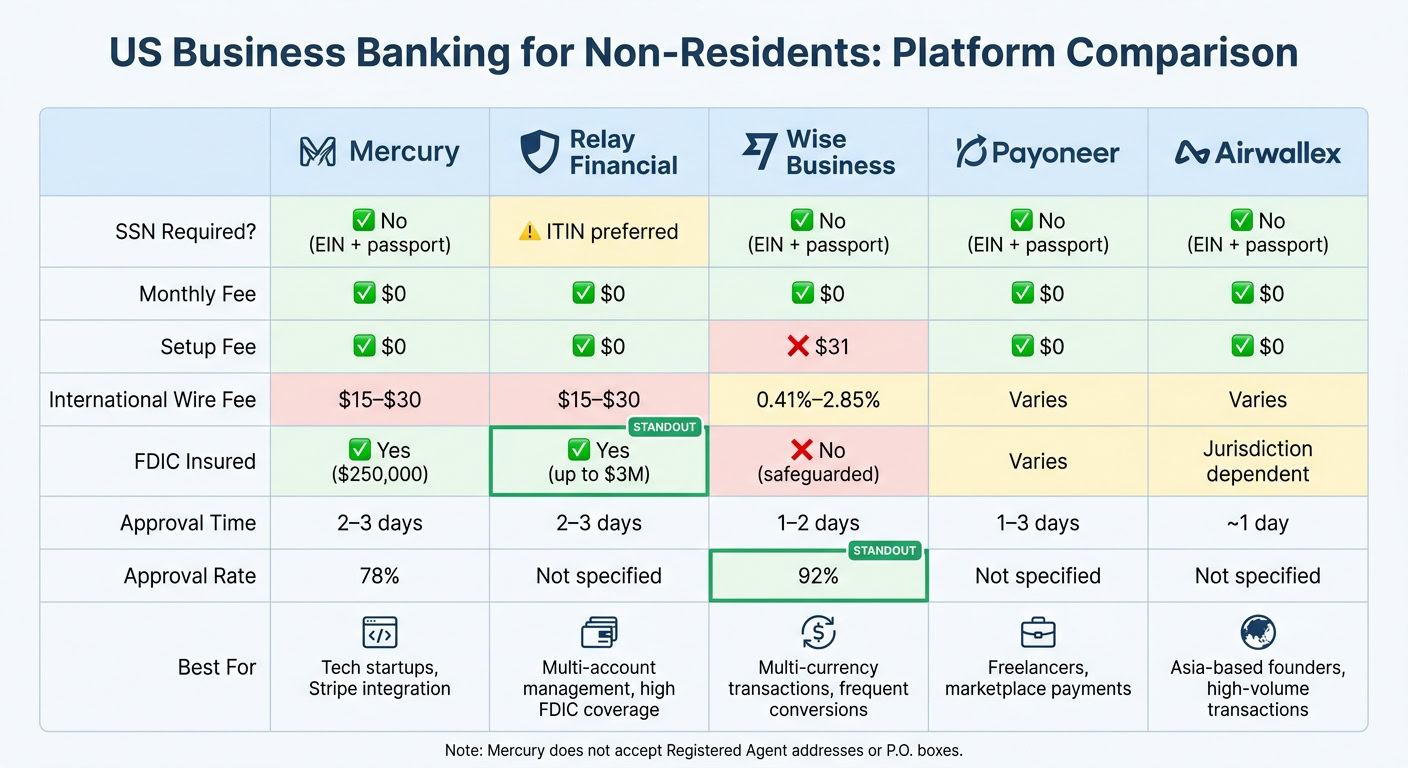
Pick a platform based on factors like fees, multi-currency support, and approval speed. Each of the five options below is tailored to meet the needs of different international founders. Understanding their distinctions will help you make a well-informed choice.
Here’s a quick-reference table summarizing the key details:
| Platform | SSN Required? | Monthly Fee | Setup Fee | International Wire Fee | FDIC Insured? | Best For |
|---|---|---|---|---|---|---|
| Mercury | No (EIN + passport) | $0 | $0 | $15–$30 | Yes ($250,000) | Tech-savvy founders; strong Stripe integration |
| Relay Financial | ITIN preferred | $0 | $0 | $15–$30 | Yes (up to $3M) | Multi-account management; high FDIC coverage |
| Wise Business | No (EIN + passport) | $0 | $31 | 0.41%–2.85% | No (safeguarded) | Multi-currency transactions; frequent conversions |
| Payoneer | No (EIN + passport) | $0 | $0 | Varies | Varies | Freelancers; marketplace payments (Amazon, Upwork) |
| Airwallex | No (EIN + passport) | $0 | $0 | Varies | Dependent on jurisdiction | Asia-based founders; high-volume transactions |
The table above highlights approval times, fee structures, and account features to simplify your decision-making. For frequent currency conversions, Wise Business is a solid choice; Mercury stands out for its strong US integration; Relay Financial offers excellent multi-account tools; Payoneer is perfect for freelancers; and Airwallex is ideal for Asia-based founders handling large transaction volumes.
One important note: Mercury does not accept Registered Agent addresses or P.O. boxes. You’ll need to provide your actual residential or business operating address.
Use this table as a guide to select the platform that aligns best with your business needs, then move forward with the application process detailed earlier.
Conclusion
Securing a US business bank account as a non-resident is no longer an insurmountable task. By aligning the right fintech platform with your business needs, you can set yourself up for smooth financial operations.
Platforms like Mercury, Relay, Wise, Airwallex, and Payoneer each offer distinct advantages. Mercury is ideal for tech startups and SaaS founders, with integrations like Stripe and tools geared for venture-backed growth. Wise Business stands out with a high approval rate (about 92%) and strong support for multi-currency transactions, making it a great entry point for international founders. Relay Financial caters to service-based businesses, especially those following the "Profit First" method, with its 20-account structure and $3,000,000 in FDIC insurance. Airwallex is a top choice for Asia-based e-commerce sellers, offering competitive foreign exchange rates across 60+ countries. Meanwhile, Payoneer remains a trusted option for marketplace sellers using platforms like Amazon or Upwork.
For added security and efficiency, consider using multiple accounts. A dual-layer strategy works well: pair a US fintech account like Mercury or Relay for domestic transactions with Wise or Airwallex for international transfers. This approach minimizes foreign exchange losses while safeguarding your funds. It’s also smart to avoid keeping all your money in one place – algorithm-managed fintech accounts can freeze unexpectedly, so having at least two accounts across different platforms ensures business continuity.
"Wise is best as your multi-currency + international transfer layer, not your only account. Use a US operating account (Mercury/Relay), then connect Wise to reduce FX leakage." – Foreign Founder Team
Keep in mind that a declined application is permanently recorded. Double-check all your documents and ensure your business address meets platform requirements. Start with small transactions ($1,000–$5,000) to build trust with compliance systems.
If the process feels overwhelming, services like BusinessAnywhere can assist with bank account setup, offering tailored support for international entrepreneurs navigating these complexities.
FAQs
Why do traditional U.S. banks reject non-resident applicants?
It is rarely about you personally. The USA PATRIOT Act and the Bank Secrecy Act require banks to verify every customer’s identity and run extra due diligence on foreign individuals. For the large banks that usually translates into an in-person visit to sign a physical signature card, plus proof of a U.S. residential address, which most non-residents simply do not have.
On top of the regulation, a lot of bank systems cannot verify foreign passports or international addresses at all. Rather than upgrade the infrastructure, they default to declining the application, which is why walking into a branch is almost guaranteed to end in a rejection.
What documents do I need to open a U.S. business bank account without an SSN?
Four, and they come from the federal Know Your Customer and Anti-Money Laundering rules that apply to every U.S. financial institution: your EIN confirmation letter, your Articles of Organization or Incorporation, a signed operating agreement, and a valid foreign passport.
Each one does a specific job. The first three establish that the business exists and that you have authority to operate the account; the passport establishes who you are. Having all four ready before you apply is the single biggest thing you can do to avoid delays and rejections.
Which banking platform is easiest for non-residents to get approved for?
On the approval numbers cited in this guide, Wise Business leads with an estimated 92% approval rate for non-residents, ahead of Mercury at around 78%. Approval rates move, so treat both as indicative rather than promised.
Ease of approval is not the only thing worth optimising for, though. Mercury suits tech startups because of its interface and payment-processor integrations, Relay Financial lets you run up to 20 sub-accounts if you need funds kept separate, Wise is the multi-currency option, Payoneer is built for freelancers and marketplace sellers, and Airwallex serves Asia-Pacific and e-commerce founders. Pick for how you actually move money, then check the approval odds.