

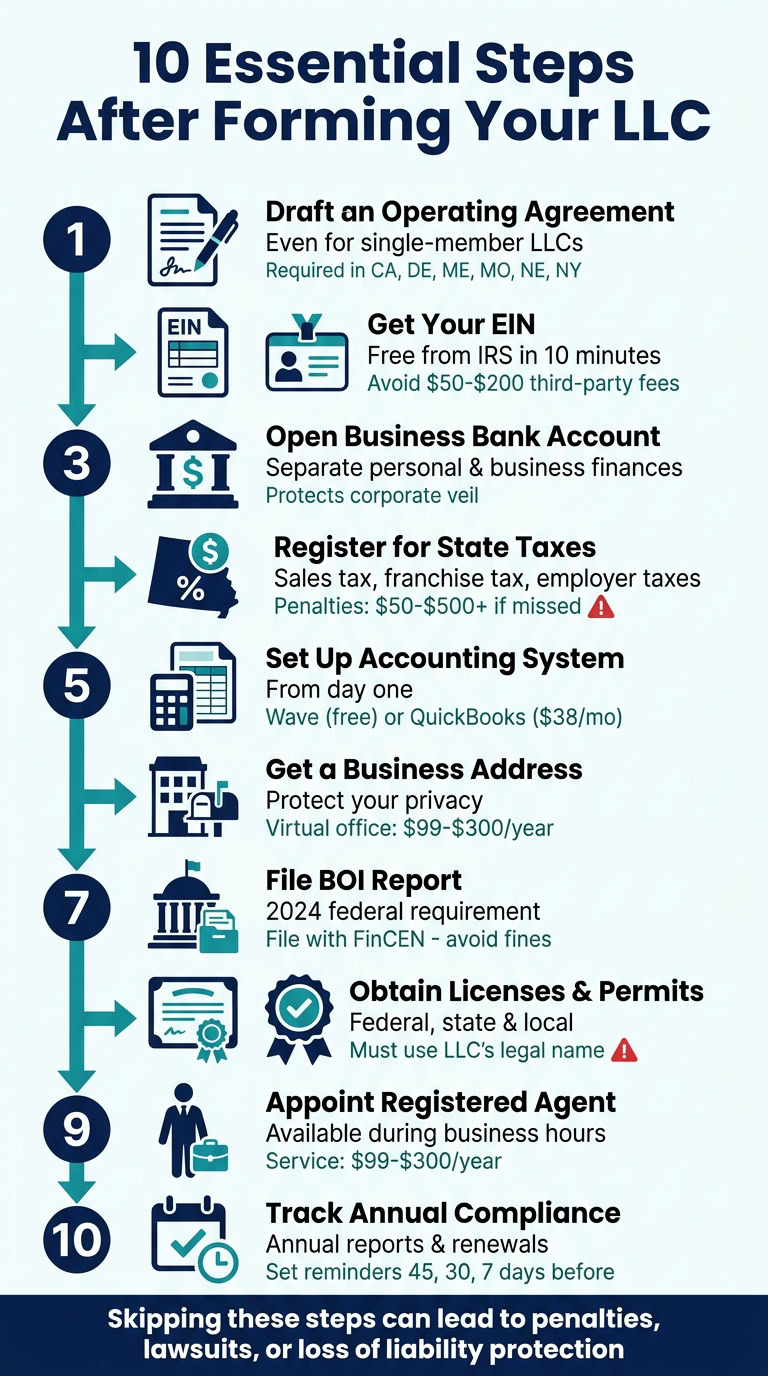
Starting an LLC is a big step, but it’s what you do after that counts. Many founders overlook critical post-formation tasks, which can lead to penalties, lawsuits, or even losing liability protection. Here’s a quick rundown of the 10 steps you need to take to keep your LLC compliant and running smoothly:
- Create an Operating Agreement: Even if it’s not required, it protects your assets and defines how your business operates.
- Get an EIN: Essential for taxes, opening a bank account, and protecting your personal identity.
- Open a Business Bank Account: Keeps personal and business finances separate to maintain liability protection.
- Register for State Taxes: Includes sales tax, employer taxes, and more, depending on your business type and location.
- Set Up an Accounting System: Helps track expenses, simplify taxes, and avoid financial mistakes.
- Get a Business Address: Keeps your home address private and adds professionalism.
- File a BOI Report: A new federal requirement to disclose ownership details for your LLC.
- Obtain Licenses and Permits: Check federal, state, and local requirements based on your industry.
- Appoint a Registered Agent: Ensures you don’t miss important legal notices.
- Stay on Top of Annual Compliance: File reports, pay taxes, and renew licenses to avoid penalties.
Skipping these steps can expose your business to unnecessary risks. Addressing them early ensures your LLC stays compliant and protects your personal and financial interests.
10 Essential Steps After Forming Your LLC Checklist
1. Draft an Operating Agreement (even for single-member LLCs)
An Operating Agreement is a legal document that lays out your LLC’s ownership structure, member responsibilities, and operational guidelines. Think of it as your LLC’s internal rulebook – it spells out how decisions are made, who has signing authority, and what happens if a member leaves. Even if you’re running a single-member LLC, having this document is crucial to clearly separate your personal assets from your business.
Without an Operating Agreement, your LLC is bound by your state’s default rules, which might not align with your business needs. More importantly, this document helps protect the corporate veil – the legal barrier that keeps your personal assets safe from business liabilities. Courts have sometimes treated LLCs without proper agreements as sole proprietorships, putting personal assets at risk.
Some states – California, Delaware, Maine, Missouri, Nebraska, and New York – require an Operating Agreement by law. Even if your state doesn’t, it’s smart to create one. You can use free or low-cost templates (usually $0–$50) or hire an attorney if your situation is more complex. When signing, make sure to do it correctly. For example, use "John Doe, as Authorized Member of Example LLC" instead of just your name to maintain liability protection.
It’s also important to update your Operating Agreement whenever you bring in new partners, adjust profit-sharing arrangements, or make significant changes to your business model. As Rocket Lawyer explains:
Setting out rules and expectations at the development of the LLC can avoid a lot of conflicts and headaches down the road.
Keep this document alongside your Articles of Organization and other key records. You might need it for audits, legal disputes, or even when applying for funding. Once your Operating Agreement is in place, the next step is securing your EIN to ensure compliance and open a business bank account.
2. Get your EIN (and how to do it fast)
An Employer Identification Number (EIN) works like a Social Security number for your business. It’s a unique nine-digit code the IRS uses to identify your LLC for tax purposes. If you have employees or multiple members in your LLC, an EIN is legally required. But even if you’re a solo founder, getting one is a smart move. Using an EIN on forms like the W-9 instead of your personal Social Security number can simplify banking and help safeguard your personal identity.
Here’s the best part: applying for an EIN is completely free and takes just about 10 minutes if you use the IRS online application system. Just make sure your LLC is officially approved by your state first, so the legal name matches what you submit to the IRS. The online system is available Monday through Friday, from 7 a.m. to 10 p.m. ET. Be cautious of third-party websites that charge fees – some ask for $50 or even over $200 for something you can easily do yourself at no cost on the IRS website.
Once you’ve got your EIN, keep it secure. You’ll need it for opening a business bank account, filing taxes, applying for licenses, and building business credit that’s separate from your personal credit score. If you’d rather not handle the process yourself, BusinessAnywhere’s EIN application service can take care of the paperwork, submission, and follow-up for a flat fee of $97. With your EIN secured, you’ll be ready to open a dedicated business bank account and keep your personal and business finances separate.
3. Open a dedicated business bank account
Setting up a business bank account is a crucial step in protecting your personal assets by keeping your LLC’s finances separate. Without this separation, courts might "pierce the corporate veil", potentially holding you personally liable for business debts or lawsuits, which is why understanding how to protect your personal assets is vital. This could put your personal savings at serious risk.
A dedicated account not only safeguards your personal finances but also enhances your business’s professionalism. It allows you to accept payments under your company’s name and makes tax preparation much easier by maintaining clear financial records.
What you’ll need to open the account:
- Your EIN (from step 2)
- Articles of Organization
- A government-issued ID
Some banks might also require a banking resolution, which is a document specifying who is authorized to open and manage the account. Many banks let you start the application process online in under 30 minutes, though final approval usually takes 1 to 3 business days. Once you’ve gathered your documents, the next step is choosing the right bank for your business.
Choosing the right bank:
- Online banks often offer $0 monthly fees and no minimum balance requirements, making them a good fit for freelancers or tech startups.
- Traditional banks, with fees ranging from $15–$30 per month, are better suited for businesses that handle cash deposits, such as brick-and-mortar stores.
After opening your account, link it to accounting software like Wave or QuickBooks to track every transaction from the start.
When signing documents, always use your name followed by your title, such as “John Doe, as Authorized Member of Example LLC,” to reinforce the legal distinction between you and your business. If you need help with the setup, check out our bank account opening service.
4. Register for State Taxes (Sales Tax, Employer Tax if Applicable)
Once your EIN and business bank account are ready, the next step is registering for state taxes. The requirements depend on your state, industry, and whether you have employees. To figure out which taxes apply to your business, check your state’s specific guidelines.
Here are some common tax registrations to consider:
- Sales Tax Permit: Also called a seller’s permit, this is necessary if you sell physical goods or taxable services.
- Franchise Tax: States like California impose this tax, with a minimum annual fee of $800, even if your business doesn’t turn a profit.
- Employer Taxes: If you hire employees, you’ll need to register for income tax withholding and unemployment insurance tax before processing payroll.
If your LLC operates in more than one state, you’ll also need to register as a foreign LLC in each state where you have a physical presence or conduct significant business activities.
To register, visit your state’s Department of Revenue website. Be prepared to provide your EIN, Articles of Organization, and business address. It’s also a good idea to set calendar reminders for important deadlines, like annual reports and estimated tax payments. Missing these deadlines can result in penalties ranging from $50 to over $500.
Skipping this step can have serious consequences. Failing to register for required taxes could lead to administrative dissolution of your LLC, personal responsibility for unpaid payroll taxes, and even the loss of your liability protection. If you’re unsure about your tax obligations, consult an accountant early to avoid costly mistakes.
5. Set up your accounting system from day one
Once your LLC is official, it’s crucial to establish your accounting system right away. Proper bookkeeping not only keeps your finances organized but also reinforces your LLC’s separate legal status. Mixing personal and business expenses or failing to maintain clear financial records could lead to courts "piercing the corporate veil" – essentially, disregarding your LLC’s liability protection.
An accounting system ensures you capture every deductible expense. Waiting until tax season to organize your books can be a costly mistake. You might lose receipts, forget transactions, and miss out on legitimate deductions. Plus, catching up on bookkeeping later can take 2 to 5 hours of manual work each month. At typical bookkeeper rates of $40 to $60 per hour, that’s $80 to $300 of wasted time and money. Jennifer Payne, Director of Entrepreneurial Strategy, puts it plainly:
Waiting until tax season to organize your books costs you deductions and sanity.
The good news? Setting up your accounting system is easier than it sounds. Start by selecting accounting software that integrates with your business bank account and credit card. Here are some popular options:
- Wave: A free option that’s great for freelancers and consultants.
- QuickBooks Simple Start: Costs $38/month and covers most small business needs.
- QuickBooks Plus: At $115/month, it’s ideal for tracking inventory or managing e-commerce operations.
- Xero: Starts at $25/month and offers strong cloud-based features for service businesses.
Once you’ve chosen your software, link it to your bank accounts so transactions import automatically. Set up an industry-specific chart of accounts to categorize revenue, operating expenses, and deductions. This automation minimizes data entry errors and gives you real-time insights into your cash flow and profitability. If you’re unsure how to get started, consider hiring an accountant early. As Olivia Brown explains:
An accountant you hire early can set up a smart system from the beginning. This prevents costly mistakes later.
Don’t forget to keep all your business records – receipts, bank statements, invoices – for 3 to 7 years, depending on the document type. Use digital storage to organize these records and schedule quarterly financial reviews. These reviews help you track performance, adjust your strategy, and avoid year-end surprises. By setting up a solid accounting foundation, you’ll save time, avoid IRS penalties, and ensure you’re capturing every deduction available.
6. Get a Business Address (Not Your Home)
Using your home address for your LLC comes with some serious drawbacks. First off, it exposes your privacy. When you file your LLC documents, your address becomes part of the public record, meaning anyone can find it online. This could lead to unwanted visits from competitors, solicitors, or even upset customers. Plus, legal notices can still show up at your home, regardless of whether you’re there to receive them.
Then there’s the issue of professionalism. A residential address might make clients or vendors question your business’s legitimacy. It could also raise red flags with banks when you’re opening a business account. And if you’re planning to claim a Google Business Profile to boost your visibility in local search results, having a proper business address can make a big difference.
Zoning laws are another hurdle. Many residential areas have strict rules against running businesses from home. If you don’t check your local zoning regulations, you could face fines or even be forced to move your operations elsewhere. It’s worth contacting your local government office to confirm whether your business activities are permitted at your home address.
The easiest way to solve these issues? Use a virtual office or a dedicated business address service. These services give you a professional street address (not a P.O. Box) where you can receive mail and legal documents. The cost typically ranges from $99 to $300 per year – a small investment for keeping your home address private and presenting a polished, professional image. This separation is also key for protecting your LLC’s liability shield. If personal and business details, like addresses, get mixed up, it could be used as evidence to pierce the corporate veil in court.
Once you’ve secured a business address, make sure to update it on all official documents, including your Articles of Organization, business bank account, and any permits. Keeping this consistent reinforces the separation between you and your business, which is essential for maintaining your LLC’s legal and financial protections.
sbb-itb-ba0a4be
7. File Your BOI Report with FinCEN (2024 Requirement)

Here’s something that often slips under the radar for new business owners: Starting January 1, 2024, the federal government requires filing a Beneficial Ownership Information (BOI) report. This mandate applies to anyone forming an LLC in 2024 or later. The report must be submitted to the Financial Crimes Enforcement Network (FinCEN), which operates under the U.S. Department of the Treasury. The purpose? To crack down on money laundering, fraud, and other financial crimes by identifying the actual individuals behind business entities. Think of it as an added layer of protection for your LLC against fraud and legal complications.
When filing, you’ll need to provide specific details, including the full legal names, current residential addresses, and ownership percentages for all business owners. If you run a single-member LLC, you’ll only need to report your own information. Rest assured, this data isn’t made public – it’s strictly accessible to law enforcement and authorized government agencies, so your privacy remains intact. Filing this report on time is critical to staying compliant and safeguarding your business.
You can file your BOI report for free through the official FinCEN BOI E-Filing website. To make the process smooth, ensure you’ve gathered all the necessary documents before starting the online application.
Don’t put this off – failing to file can lead to steep fines or even the administrative dissolution of your LLC. If there’s a change in your ownership structure, you’ll need to update the report immediately. It’s a good idea to set a calendar reminder so you don’t miss this important deadline. For extra peace of mind, services like BusinessAnywhere can assist with BOI report filing and send compliance alerts to keep you on track. Once your BOI report is filed, you’ll be one step closer to meeting all your post-formation compliance requirements.
8. Obtain necessary licenses and permits
Forming an LLC is just the beginning – it doesn’t automatically grant you permission to operate. Licenses and permits are required at the federal, state, and local levels, and missing even one can lead to fines or other penalties. The exact permits you’ll need depend on your industry and location.
If your business operates in a highly regulated field, start by checking federal licensing requirements. Industries like agriculture, alcohol, aviation, firearms, maritime, mining, radio/TV broadcasting, and transportation require federal permits. While most small businesses won’t need federal licenses, those in these sectors must apply through the appropriate federal agency before starting operations.
At the state level, the most common requirement is a seller’s permit (also referred to as a sales tax permit or vendor license). This is mandatory if you’re selling physical products or certain taxable services and must be in place before making your first sale. Additionally, professional services such as healthcare, real estate, accounting, or construction often require occupational licenses issued by the state. You can find specific details on your state’s Department of Revenue or Secretary of State website.
Local permits can be tricky to navigate. Many cities and counties require a general business operating license. If you’re opening a restaurant, for instance, you’ll need health department approvals and possibly a liquor license. Home-based businesses aren’t exempt either; many require a "home occupation permit" to meet zoning regulations. Always confirm local zoning rules before leasing a space or starting operations.
One important note: all licenses and permits must be issued in your LLC’s legal name, not your personal name. This ensures your liability protection remains intact. To stay compliant, set reminders for annual renewals to avoid penalties. Once you’ve secured the necessary licenses and permits, you can move forward with choosing the best registered agent service to complete your LLC’s post-formation checklist. If managing compliance deadlines feels overwhelming, services like BusinessAnywhere can help streamline the process and keep you on track.
9. Set up your registered agent properly
After setting up your business address, the next step is appointing a dependable registered agent. This person or service acts as your official point of contact for receiving legal documents and government correspondence. Every state mandates that your registered agent must have a physical street address (no P.O. Boxes allowed) and be available during regular business hours – typically 9:00 AM to 5:00 PM, Monday through Friday.
While you can choose to act as your own registered agent, it comes with some risks. You must be consistently available during business hours, as missing a legal notice – like a lawsuit – could result in a default judgment against your business. In such cases, you might lose the case without even having the opportunity to defend yourself, which could lead to serious financial repercussions.
Hiring a professional registered agent service, which usually costs between $99 and $300 per year, can save you from these headaches. These services ensure timely delivery of legal notices and help protect your privacy by using their address on state filings instead of yours. This is especially helpful if you want to keep your personal or home address off public records.
If your business operates in multiple states, it’s smart to select a registered agent service with nationwide coverage. This simplifies compliance across state lines. Additionally, these services often send reminders for important deadlines, like annual report filings. Missing these deadlines can result in penalties ranging from $50 to over $500, or even the administrative dissolution of your LLC.
For example, BusinessAnywhere offers a registered agent service starting at $147 per year, and they include the first year for free if you bundle it with their business formation services. This setup is a vital part of your LLC’s post-formation process, ensuring both compliance and peace of mind.
10. Understand Your Annual Compliance Obligations
Forming your LLC is just the first step – keeping up with annual compliance is what ensures your business stays protected. Most states require LLCs to submit annual or biennial reports, which updates essential details like your business address, ownership information, and registered agent status. Filing these reports usually costs between $10 and $100, depending on your state. However, missing the deadline can result in hefty penalties.
If you’re late, penalties can range from $50 to over $500. Worse, prolonged delays could lead to administrative dissolution, putting your personal assets at risk. Once dissolved, the state officially closes your business, stripping away your limited liability protection. In some cases, your business name might even be released, allowing another company to claim it.
Beyond these filings, don’t forget about other obligations like franchise taxes (e.g., California’s $800 fee, due by April 15), license renewals, and quarterly estimated taxes on pass-through profits. Staying on top of these requirements is just as critical as securing your EIN or setting up your accounting system. Keeping up with your filings ensures your LLC remains in "Good Standing", a status that banks and vendors often require to avoid complications like frozen accounts or rejected financing applications.
Here’s a word of caution from Jennifer Payne, Director of Entrepreneurial Strategy at StartupOwl:
"Missing a filing deadline can cost you your good standing status or trigger penalties." – Jennifer Payne
To stay ahead, set calendar reminders 45, 30, and 7 days before each deadline. Scheduling quarterly reviews with a CPA can also help you manage tax obligations effectively. For added convenience, services like BusinessAnywhere offer compliance alerts and annual filing assistance, helping you avoid costly mistakes and keep your LLC in good standing. Visit businessanywhere.io to simplify your compliance management and stay on track year after year.
Conclusion
Forming your LLC is just the beginning of your business journey. The 10-step LLC post-formation checklist is there to ensure your business remains secure and compliant. Overlooking even one step could expose you to issues like bank account rejections, IRS penalties, or state-imposed fines.
Thankfully, you don’t have to navigate these responsibilities on your own. Keeping your finances separate, maintaining detailed records, and staying on top of deadlines are crucial to safeguarding your corporate veil and ensuring your business stays in good standing. As Laura Schmidt, Senior Customer Service Representative at Wolters Kluwer, explains:
Meeting all post-formation requirements protects owners’ personal assets and keeps your company in good standing.
Taking proactive steps can make a big difference. For example, setting calendar reminders for annual reports, franchise taxes, and business license renewals can help you avoid costly errors. If you prefer to delegate, BusinessAnywhere offers services like registered agent support starting at $147 per year, compliance alerts, annual filing assistance, and BOI reporting – all conveniently managed through their dashboard at businessanywhere.io. By simplifying these tasks, you can focus more on growing your business.
To learn more about what to do after forming your LLC and to secure your business’s future, check out the compliance services available at businessanywhere.io.
FAQs
What’s the fastest order to complete these steps after forming my LLC?
The fastest way to get started is:
- Get your EIN: Apply directly through the IRS. It’s free, and the process only takes about 10 minutes. You’ll need this for setting up banking and handling payroll.
- Open a business bank account: Use your EIN to open a dedicated account for your business finances.
- Create an Operating Agreement: Outline the ownership structure and clarify responsibilities among members.
- Register for state taxes: Make sure you’re set up to handle sales tax, employer taxes, or any other state-specific requirements.
- File your BOI report: Starting in 2024, you’ll need to submit this mandatory report to FinCEN.
What happens if I mix personal and business money in my LLC?
Mixing your personal and business finances within your LLC can jeopardize the protection of your personal assets. This practice, known as commingling, can strip your LLC of its liability shield, leaving your personal assets vulnerable to business-related debts or legal claims. To safeguard your financial and legal standing, always use separate accounts for personal and business transactions.
How do I know if my LLC has to file a BOI report and when?
LLCs are required to submit a Beneficial Ownership Information (BOI) report if they meet the criteria of a "reporting company" as defined by FinCEN regulations. For LLCs established before March 26, 2025, the deadline to file is April 25, 2025. LLCs formed after March 26, 2025, must submit their report within 30 days of receiving registration confirmation. It’s important to review your LLC’s formation date and status to ensure you meet the correct filing requirements.