


If you work across state lines, understanding multi-state tax rules is critical to avoid penalties and double taxation. Here’s what you need to know:
- Day-One Tax Rules: States like New York, Alabama, and Pennsylvania require tax filings from the first day you earn income within their borders.
- Residency Issues: Aggressive states like California and New York may tax your global income unless you formally cut ties (e.g., changing state residency (e.g., updating voter registration or driver’s licenses)).
- Double Taxation: "Convenience of the employer" rules in eight states can result in taxes owed to two states for the same income.
- 2026 Updates: States like Kentucky, Oklahoma, and Louisiana have made changes to tax rates and structures starting January 1, 2026.
- No-Income-Tax States: Establishing domicile in states like Florida or Texas can help avoid state income taxes, but you’ll still owe taxes in states where you earn income.
To stay compliant, track your work locations, understand each state’s rules, and consider tools like BusinessAnywhere to manage filings and registrations efficiently. States are increasingly using digital data to enforce compliance, so maintaining accurate records is essential.
How States Tax Income
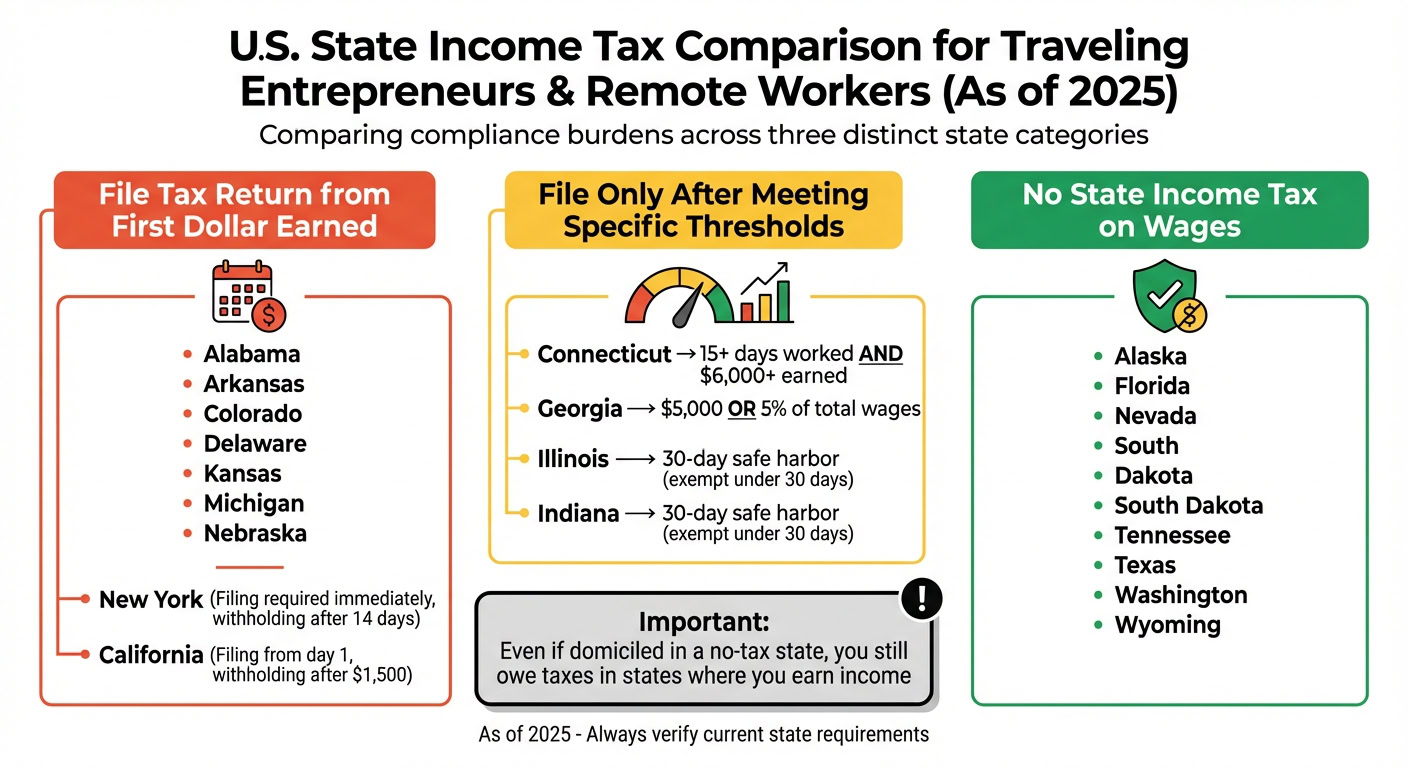
States have different ways of taxing income. Some require you to file taxes for any amount earned, even if it’s just for a single day of work, while others only impose taxes once you hit specific thresholds. Let’s break down how states approach income tax filing, from immediate obligations to threshold-based rules.
States That Tax from Day 1
Certain states, including Alabama, Arkansas, Colorado, Delaware, Kansas, Michigan, and Nebraska, require nonresidents to file a tax return if they earn any income within the state – even for one day. For instance, attending a client meeting in Alabama or hosting a workshop in Colorado could trigger a filing requirement. While enforcement for brief visits is often minimal due to administrative costs, it’s still essential to track your days accurately. Tools like BusinessAnywhere can make multi-state tax compliance easier.
States with Income or Time Thresholds
Some states offer a bit more leniency, setting thresholds based on income or the number of days worked. For example:
- California requires filing from the first day you work there, but withholding only starts once you’ve earned $1,500.
- Connecticut mandates filing if you work more than 15 days and earn over $6,000.
- Georgia uses an income threshold of $5,000 or 5% of your total wages.
- Illinois and Indiana provide a 30-day safe harbor, meaning you’re exempt from filing unless you work in the state for more than 30 days.
- New York requires filing immediately, but employers only start withholding taxes after you’ve worked more than 14 days.
Understanding the difference between filing obligations and withholding requirements is crucial, as they don’t always align. These varying rules highlight the importance of tracking where and how long you work to ensure accurate tax compliance.
States with No Income Tax
If you’re looking to avoid state income tax altogether, Alaska, Florida, Nevada, South Dakota, Tennessee, Texas, Washington, and Wyoming don’t tax wages. For frequent travelers or entrepreneurs, establishing domicile in one of these states can mean your worldwide income isn’t taxed by your home state. However, if you earn income in a state that does tax wages, you’ll still owe that state’s full tax rate, with no credit at home. For instance, if you’re domiciled in Florida but work on a project in California, you’d still owe California taxes on that income.
In states like Florida and Texas, applying for a homestead exemption on your primary residence can help solidify your domicile claim.
sbb-itb-ba0a4be
What Triggers Tax Filing Requirements
Grasping the factors that lead to tax filing obligations is essential for traveling entrepreneurs. The rules can vary depending on whether your business has a physical presence in a state or operates remotely. Two key concepts – physical nexus and economic nexus – play a major role in determining your tax responsibilities.
Physical Nexus vs. Economic Nexus
Physical nexus occurs when you or your employees are physically present and conducting business in a state. For individuals, even spending just one day working in a state can trigger nonresident tax filing requirements. For businesses, having an employee – such as a remote worker – based in a state establishes nexus. For instance, hiring a remote employee in Pennsylvania could create a tax obligation for your business.
On the other hand, economic nexus doesn’t rely on physical presence. This concept gained prominence after the Supreme Court’s Wayfair decision. It applies when a business surpasses specific economic nexus thresholds by state, regardless of whether anyone from the business has set foot there. While primarily affecting sales tax, economic nexus has reshaped how states approach taxing businesses that operate across state lines. This means you could owe taxes in a state you’ve never visited if your business activity meets the required thresholds.
Additionally, eight states enforce what’s known as the convenience rule as of 2025. Under this rule, if your business is headquartered in one of these states but you choose to work remotely from another state for personal convenience (rather than because your employer requires it), you might still owe taxes to the state where your business is based. Connecticut and New Jersey have "retaliatory" versions of this rule, applying it only to residents of states with their own convenience rules. For example, avoiding New York’s convenience rule while working remotely requires that your remote workspace meets strict criteria to qualify as a "bona fide employer office".
These factors – physical and economic nexus, along with convenience rules – shape when and where you’re required to file taxes. But there’s more to consider, such as withholding rules and reciprocity agreements.
Withholding and Reciprocity Agreements
As of January 1, 2025, there are 30 reciprocity agreements in place across 15 states and Washington, DC. Kentucky tops the list for the most agreements, while Michigan and Pennsylvania follow closely with six each.
To avoid unnecessary withholding, you’ll need to submit a reciprocity affidavit. Without this, your employer might withhold taxes for the wrong state, forcing you to file a nonresident return to claim a refund. Even in states without reciprocity agreements, credits are often available to offset taxes paid to another state. Some states – like Arizona, California, Indiana, Oregon, and Virginia – offer reverse credits, allowing nonresidents to reduce their home state tax liability.
However, convenience rules can complicate matters, potentially leading to double taxation by two states on the same income without a full credit. For entrepreneurs frequently working across multiple states, understanding these rules is critical. Tools like BusinessAnywhere can help you navigate and stay compliant with the varying filing and withholding requirements that come with operating in multiple locations.
How to Stay Compliant Across Multiple States
Navigating tax compliance across multiple states can be a challenge, especially when it comes to meeting deadlines and following state-specific rules. Missing a deadline or failing to register properly can result in penalties and unnecessary complications. That’s why understanding state-specific regulations and maintaining organized records is critical for smooth registration and compliance.
State Registration and Filing Deadlines
To remain compliant, you must register your business in any state where you establish a nexus. This applies if you have a physical presence like an office or warehouse, hire remote employees in that state, or meet specific revenue thresholds. For instance, in California, businesses must register if their sales exceed $500,000. Additionally, you’ll need to appoint the best registered agent service in each state to handle legal correspondence.
Pay close attention to filing deadlines, as they vary by state. While federal and most state tax deadlines fall on April 15, some states require quarterly filings. For example, Ohio and Oklahoma enforce quarterly withholding thresholds of $300. If you’re a U.S. citizen living abroad, you automatically receive an extension to file by June 15, with the option to request an additional extension to October 15 using Form 4868. Also, if you hold foreign bank accounts with a combined total exceeding $10,000 at any point during the year, you must file FinCEN Form 114 (FBAR) by April 15.
Keeping accurate records is non-negotiable. States like New York and California often rely on digital footprints – such as credit card transactions, phone usage, and GPS data – to confirm residency during audits. If you’re changing your domicile, update your driver’s license, voter registration, and vehicle registration in your new state as soon as possible. Also, close bank accounts and cancel memberships in your former state to establish a clear separation.
Using Digital Tools to Stay Organized
Once you’ve handled registration and filing, digital tools can simplify ongoing compliance. Consider using a spreadsheet or travel tracking app to log every border crossing, overnight stay, and work location. This documentation can protect you during audits and help you avoid being classified as a statutory resident, which often happens if you spend 183 days or more in a single state. Save digital copies of essential documents like boarding passes and receipts for added proof.
For traveling entrepreneurs, platforms like BusinessAnywhere offer solutions to streamline compliance. Their services include registered agent support, virtual mailboxes with unlimited mail scanning and forwarding, and compliance alerts – all accessible through a single dashboard. These tools can help you manage multi-state obligations efficiently.
Conclusion
Navigating multi-state tax obligations requires a solid grasp of filing triggers and compliance rules. Right now, only about 23% of mobile workers pay the additional state income taxes they’re legally required to. Meanwhile, states are ramping up enforcement efforts, using tools like credit card records, phone data, and GPS tracking to pinpoint where people actually work. One way to simplify this maze is by establishing a clear domicile in a no-income-tax state, such as Florida, Texas, or Wyoming. However, having the right documentation – like a driver’s license, voter registration, and utility bills – is critical if you face an audit.
Keeping detailed records is your strongest ally. If you’re employed in a "convenience of the employer" state, such as New York or Connecticut, make sure to document that your remote work arrangement is a business necessity rather than a personal choice. This distinction could shield you from paying taxes twice on the same income.
For entrepreneurs constantly on the move, juggling multiple state registrations, and meeting filing deadlines, platforms like BusinessAnywhere can be a lifesaver. They offer services like registered agent support in all 50 states, virtual mailboxes with unlimited mail scanning, and compliance alerts – all accessible through a single dashboard. These tools can ease the administrative strain and help you stay compliant across jurisdictions.
The takeaway is simple: staying ahead of compliance protects both your business and your finances. Stay organized, leverage digital tools, and address your multi-state obligations before they turn into costly audits.
FAQs
How can traveling entrepreneurs avoid paying taxes twice when working in multiple states?
To navigate the challenge of double taxation when working across multiple states, it’s essential to understand tax residency rules. States typically assess residency based on two factors: your domicile (your permanent home) and statutory residency (often determined by spending 183 or more days in a state or earning a specific amount of income there). If you qualify as a resident in more than one state, you’ll likely need to file a part-year resident return in the state where you established residency and non-resident returns in other states where you earned income. Thankfully, many states offer a tax credit for taxes paid to another state, which, when applied correctly, can help prevent double taxation.
Here are a few steps to make the process more manageable:
- Track your time and income for each state throughout the year to stay organized.
- Establish your domicile early and stay mindful of residency thresholds to avoid surprises.
- Allocate your income accurately to the states where the work was performed.
- Claim tax credits for taxes paid to other states when completing your resident return.
- Maintain detailed records such as travel logs, income statements, and any supporting documents in case of an audit.
For entrepreneurs looking for a smoother way to handle this, BusinessAnywhere provides tools to manage compliance, file state-specific returns, and even set up a business in tax-friendly states – all through an easy-to-use, remote platform.
What is the difference between physical nexus and economic nexus for state taxes?
When it comes to state taxes, businesses are typically evaluated through two lenses: physical nexus and economic nexus.
Physical nexus is straightforward – it’s tied to having a tangible presence in a state. This could include maintaining an office, owning property, operating a warehouse, or employing staff within the state. If your business checks any of these boxes, you likely have a tax obligation there.
Economic nexus, however, doesn’t hinge on physical presence. Instead, it’s determined by your business activity within a state. For example, if your sales exceed $100,000 or you process 200 or more transactions annually in a particular state, you may be required to pay taxes there – even if you’ve never set foot in that state.
The concept of economic nexus gained traction after the landmark 2018 South Dakota v. Wayfair case. This ruling allowed states to tax businesses based on their economic activity rather than their physical footprint. For entrepreneurs constantly on the move, this means you could owe taxes in states where you don’t have an office or employees, as long as your sales meet the defined thresholds. Meanwhile, traditional brick-and-mortar businesses are taxed based on where they physically operate.
How does the ‘convenience of the employer’ rule impact remote workers’ taxes?
The convenience of the employer rule allows some states to tax remote workers as if they were physically working in their employer’s office, even when they’re working from home in another state. This rule applies when remote work is done for personal convenience rather than because the employer requires it. States like New York, Pennsylvania, and Connecticut enforce this policy strictly, which can sometimes result in double taxation if your home state doesn’t provide a tax credit for payments made to another state.
To navigate these tax obligations, start by determining two key things: your tax residence (where you live and spend most of your time) and the source state (where your employer’s office is located). You might need to file a resident tax return in your home state and a non-resident return in the state where your employer is based. To stay ahead, maintain detailed records of where you work each day and seek advice from a tax professional. This can help ensure you file correctly, claim any credits you’re eligible for, and avoid unnecessary tax burdens. Careful planning is essential to managing multi-state tax responsibilities.