

If I want to form a US LLC from Pakistan, I need to do 3 steps in order: file the LLC, get the EIN, then apply for banking. If I change the company name, address, or owner details between those steps, I can run into delays or rejections.
Here’s the short version:
-
I file the LLC with the state first.
-
I use the approved state record to apply for an EIN with IRS Form SS-4.
-
I wait for the EIN before I start bank onboarding.
-
I keep the same LLC name, address, and owner details on every document.
-
I gather my passport, proof of address, formation papers, and Operating Agreement before I apply for banking.
A few numbers help set expectations:
-
State filing fees are often $50 to $200
-
Registered agent service is often $100 to $300 per year
-
IRS EIN phone help for foreign applicants is available at +1-267-941-1099
-
IRS phone hours listed in the article are Monday to Friday, 6:00 a.m. to 11:00 p.m. ET
What matters most is not just filing the LLC. It’s making sure the full paper trail matches from start to finish. That’s where many remote founders get stuck.
If I were reducing the whole process to one checklist, it would look like this:
-
Pick the state and LLC name
-
Appoint a registered agent
-
File Articles of Organization or Certificate of Formation
-
Prepare the Operating Agreement
-
Apply for the EIN
-
Collect bank-ready documents
-
Apply for a bank or fintech account
A quick view of the process:
|
Step |
What I do |
What must match |
|---|---|---|
|
1 |
File the LLC with the state |
LLC name, registered agent, business address |
|
2 |
Apply for EIN with Form SS-4 |
LLC name, formation date, responsible party details |
|
3 |
Apply for banking |
Formation record, EIN record, passport, address proof |
The main point: I should treat the approved LLC filing as the source record, then copy those details exactly into the EIN and banking steps.
That’s the full process in plain English, and the rest of the article breaks down each document and step.
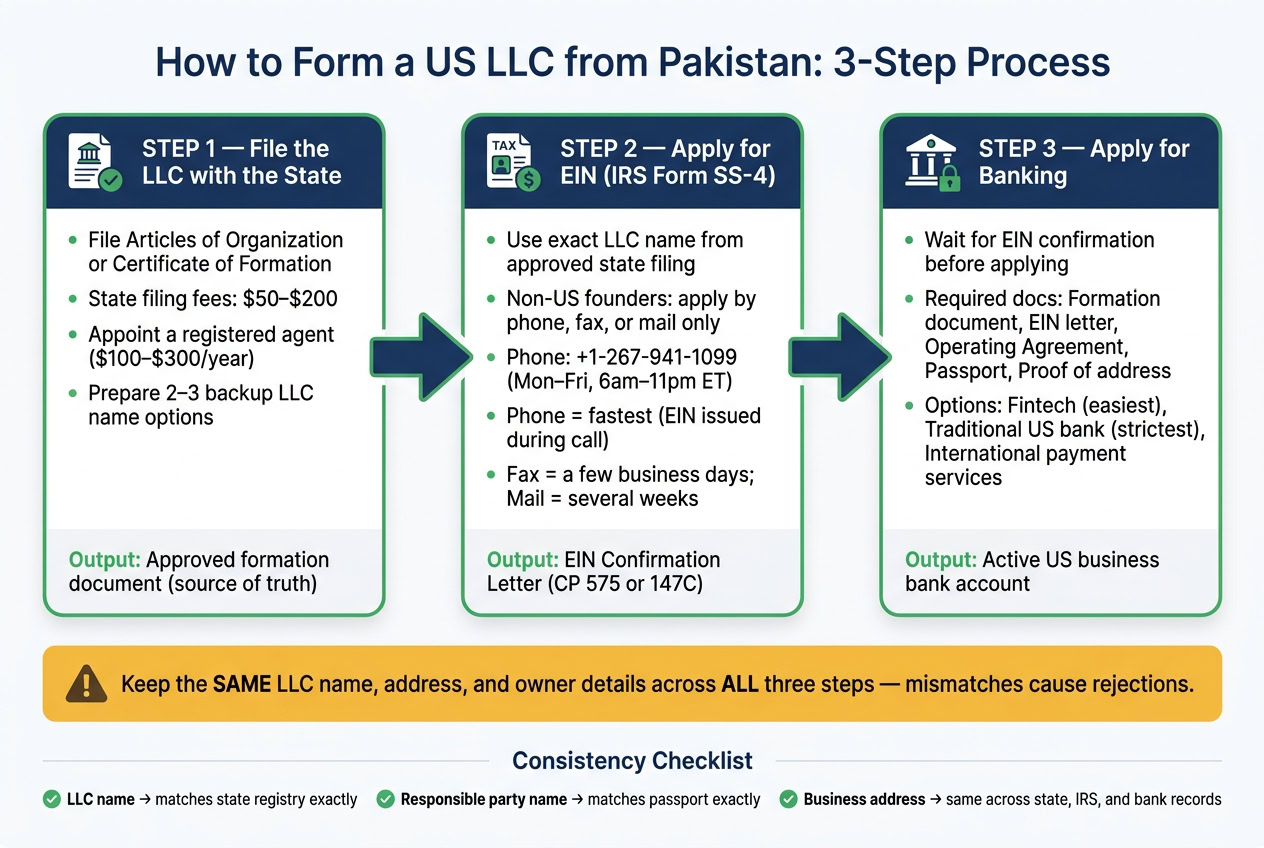
How to Form a US LLC from Pakistan: 3-Step Process
LLC formation documents and state filing requirements
Articles of Organization or Certificate of Formation
You’ll need to file the Articles of Organization or Certificate of Formation with your state filing office. Most states use Articles of Organization. Delaware and Texas use Certificate of Formation. Different name, same legal function.
A standard filing usually asks for:
-
Your LLC’s exact legal name
-
The name and physical street address of your registered agent in the formation state
-
Your principal office or business address
-
Your management structure
-
The organizer’s details
State filing fees usually range from $50 to $200. Registered agent services often cost about $100 to $300 per year. Once the state approves your LLC, use those exact formation details when you fill out Form SS-4 for your EIN.
It also helps to prepare two or three LLC name options before you file. Why? State databases will reject names that are already taken, and backup options can save you from a delay.
Where the Operating Agreement fits in
The Operating Agreement is not filed with the state. It stays in your internal records. Even so, banks, payment platforms, and compliance teams often ask for it during onboarding.
For a single-member LLC, the agreement should show the owner, 100% ownership, and management authority. For a multi-member LLC, it should spell out ownership percentages, voting rules, profit distribution, and exit terms. Banks and reviewers often check these points, so the details matter.
Draft the Operating Agreement right after – or at the same time as – the state filing. Later on, it may become part of the record set that banks and tax reviewers want to see.
Founder documents commonly needed during formation
The state filing itself does not require your passport. But your registered agent or service provider may ask for identity verification as part of their compliance process. In most cases, you should expect to provide a clear copy of your valid Pakistani passport and proof of address.
|
Document |
Filed with state? |
When it’s needed |
|---|---|---|
|
Articles of Organization / Certificate of Formation |
Yes |
At initial state filing |
|
Operating Agreement |
No |
Banking, tax setup, compliance reviews |
|
Registered agent information |
Yes (included in filing) |
At initial state filing |
|
Passport |
No |
Registered agent signup, banking KYC |
|
Proof of Pakistani address |
No |
Registered agent signup, banking KYC |
The registered agent’s address is used for the state’s registered office field, and that part is required. For the principal office or business address, many remote founders first use the registered agent’s address if the state allows it.
Pick your address structure before filing so your records match across documents. Then use those same details on Form SS-4.
Getting an EIN with IRS Form SS-4 as a non-US founder
Once the state approves the LLC, the next step is filing Form SS-4 to get the EIN. Your Employer Identification Number (EIN) is the LLC’s federal tax ID for U.S. tax reporting. You’ll want this in place before opening a bank account. If you’re a non-US founder without an SSN or ITIN, you can apply only by phone, fax, or mail using Form SS-4.[2][5][6]
What Form SS-4 asks for
Form SS-4 asks for basic details about your LLC, including its legal name, DBA, mailing address, formation date, entity type, member count, and business activity. Use the exact legal name and address shown on the approved Articles of Organization.
For entity type, select “Limited liability company (LLC)” and enter the number of members. For many Pakistan-based founders, that’s often “1.” Keep the business activity short and plain, like “software development” or “IT consulting.” Banks may compare your EIN record with your formation documents, so the details should match exactly.
After the form is filled out, pick the filing method that fits your location and how fast you need the EIN.
How non-US residents complete the responsible party section
On Form SS-4, the responsible party is the LLC owner or the person in control of the business. For a single-member LLC, that’s usually the founder. Enter the founder’s full legal name exactly as it appears on the passport.[3][4]
If the responsible party does not have an SSN or ITIN, follow the IRS instructions for that field. Do not put your registered agent, formation service, or lawyer as the responsible party.[1][3][4]
Supporting paperwork to gather before applying
Have these ready before you start:
-
Your approved Articles of Organization or Certificate of Formation
-
Your passport ID page
-
A mailing address you can rely on for IRS mail, such as a U.S. address you control or a registered agent address
For international applicants, the IRS phone line at +1-267-941-1099 can issue the EIN during the call. Fax usually takes a few business days, while mail can take several weeks. The line is open Monday through Friday, 6:00 a.m. to 11:00 p.m. Eastern Time.[5][6][7][8][9]
The most common holdup is a name mismatch. Copy the LLC name exactly as it appears on the formation document.
Remote banking options and account requirements for non-US LLC owners
Once the EIN is in place, bank onboarding usually comes next. For Founders in Pakistan, running a U.S. LLC from overseas often makes this the hardest part.
Why? Banks don’t just check whether your LLC exists. They check whether your documents match, whether your business story makes sense, and whether the people behind the company are clear.
Documents banks usually request for remote onboarding
Most remote onboarding applications ask for the same core set of identity and compliance documents. In most cases, you should expect to provide:
-
Formation proof
-
EIN proof
-
Passport ID
-
Address proof
Banks also usually ask for a short business summary. That summary should explain what you sell, who your customers are, which countries you work with, and your expected monthly volume. If the LLC is new, be ready to explain your source of funds.
If the company has more than one member, some institutions may also ask for a bank authorization letter. Banks often collect ID for beneficial owners and one control person as well. That’s how they confirm both ownership and control.
|
Compliance item |
What banks may request |
Why it matters |
|---|---|---|
|
Formation proof |
Articles of Organization / Certificate of Formation |
Confirms the LLC is legally registered |
|
EIN proof |
IRS EIN confirmation letter (CP 575 or 147C) |
Confirms the entity’s tax identity |
|
Identity |
Passport for foreign owners |
Verifies beneficial owners and the control person |
|
Address proof |
Utility bill, bank statement, lease, or government letter |
Confirms physical address and reduces mismatch risk |
|
Business description |
What the company does, customers, volume, source of funds |
Supports AML/KYC review |
Comparison of remote banking paths for non-US LLC owners
Remote banking usually falls into three main paths: fintech accounts, traditional U.S. banks, and international payment services.
Each path comes with a different level of identity checks, address expectations, and friction during onboarding. Some are more open to remote applicants. Others want more proof of a U.S. footprint.
|
Path |
Identity verification |
U.S. address expectation |
In-person visit |
KYC strictness |
|---|---|---|---|---|
|
Fintech accounts |
Passport and document verification; some may not require an SSN |
Expect a real U.S. business or mailing address |
No, for eligible applicants |
Moderate to strict |
|
Traditional U.S. banks |
Stricter identity and business checks |
More likely to expect a U.S. presence and a physical business address |
Often yes for non-residents |
Strict |
|
International payment services |
Varies by provider and country |
May accept a wider range of business profiles |
Remote |
Varies |
The best fit depends on how much U.S. presence your setup can show and how clean your paperwork is.
Common banking blockers for founders in Pakistan
Even a full document set can fail if the details don’t line up. That’s the part that trips people up.
The most common rejection triggers are:
-
Address mismatches
-
Thin business evidence
-
Using a registered-agent address when the bank wants a real operating address
If your Articles of Organization show one address, your IRS records show another, and your bank application shows a third, the compliance team will likely pause the file for manual review.
Founders in Pakistan should also expect sanctions screening as a normal part of onboarding. That alone doesn’t mean there’s a problem. But vague answers can slow things down fast.
Instead of writing “online business” or “consulting,” be specific. State what you sell, who pays you, and where your customers are. Before you submit anything, make sure every document says the same thing. That simple step can help you avoid manual review.
Final checklist: documents, sequence, and staying banking-ready
The order of steps after state approval
After state approval, the best move is to follow a clean sequence. If you rush the banking step too early, delays are common.
-
Receive your approved formation documents – the certified Articles of Organization or Certificate of Formation from the state.
-
Apply for the EIN using IRS Form SS-4.
-
Finalize and sign the Operating Agreement, confirming ownership percentages and who has signing authority. Banks often ask for this.
-
Assemble the required documents: formation document, EIN confirmation, Operating Agreement, passport, and proof of address.
-
Submit the banking application only after the EIN confirmation is in hand – not before.
How to keep records consistent across the state, IRS, and bank
Once the filing is approved, consistency matters more than speed.
Use the exact LLC name shown on the state approval as your source of truth. That means using the same name everywhere, including punctuation. The responsible party name on Form SS-4 should match the passport exactly. The address should also stay the same across the state filing, IRS records, and bank application.
Here’s a simple way to check each record before you submit anything:
|
Document |
Key consistency check |
Source of truth |
|---|---|---|
|
Articles of Organization |
Exact LLC name |
State registry |
|
IRS Form SS-4 |
Responsible party name |
Founder passport |
|
Operating Agreement |
Ownership % and signatory |
Internal records |
|
Bank application |
Business address |
Registered agent / utility bill |
|
Proof of address |
Founder’s personal name |
Utility bill / bank statement |
Keep formation documents, EIN confirmation, Operating Agreement, passport copies, and proof of address in one folder. It sounds basic, but this one habit can save a lot of back-and-forth with the bank.
Key takeaways for founders in Pakistan
Gather every document ahead of time, match names and addresses across all records, and wait for EIN confirmation before sending the banking application. After the account opens, keep an eye on annual reports and registered agent renewals.
FAQs
Do I need to travel to the U.S. to form the LLC?
No. You don’t need to travel to the United States to form an LLC.
You can handle the full setup from Pakistan, including filing your Articles of Organization and getting an EIN.
That said, banking is where things can vary a bit. Some old-school banks may ask you to show up in person. But many digital fintech platforms let you open and run a business account online.
You’ll also need a registered agent in the state where you form your LLC.
What address should I use for my LLC, EIN, and bank documents?
Use three separate addresses to cut down on delays and help stay compliant:
-
Registered agent address: for LLC formation and official state legal mail.
-
Business mailing address: a virtual mailbox or mailing service for general business mail and most IRS correspondence, including your EIN application.
-
Bank address: a verifiable physical address. Banks often reject registered agent addresses and virtual mailboxes, so confirm requirements with your bank.
Can I get an EIN without an SSN or ITIN?
Yes. You can get an EIN without an SSN or ITIN.
The catch is that the IRS online application asks for a U.S. tax ID. So if you’re applying from outside the United States, you’ll usually need to apply by mail or fax with Form SS-4 instead.
On line 7b, enter “Foreign” or “N/A”. That’s because the EIN is issued to the business, not to you as an individual. In plain English: a personal U.S. tax ID is not legally required.