

Yes – you can start a U.S. LLC from Nigeria without traveling, without a visa, and without an SSN. If I were doing it in 2026, I’d focus on 3 things first: pick the right state, set up the LLC the right way, and avoid filing mistakes that can cost $25,000 or more.
Here’s the short version:
- I can form the LLC 100% online from Nigeria
- Wyoming is usually the low-cost pick for solo founders
- A single-member LLC and a multi-member LLC follow different IRS filing rules
- I still need a registered agent, EIN, U.S. mailing address, and business bank account
- I may need to file a BOI report within 30 days
- Missing Form 5472 can trigger a $25,000 IRS penalty
- Nigeria may still tax my income because Nigerian residents are taxed on worldwide income
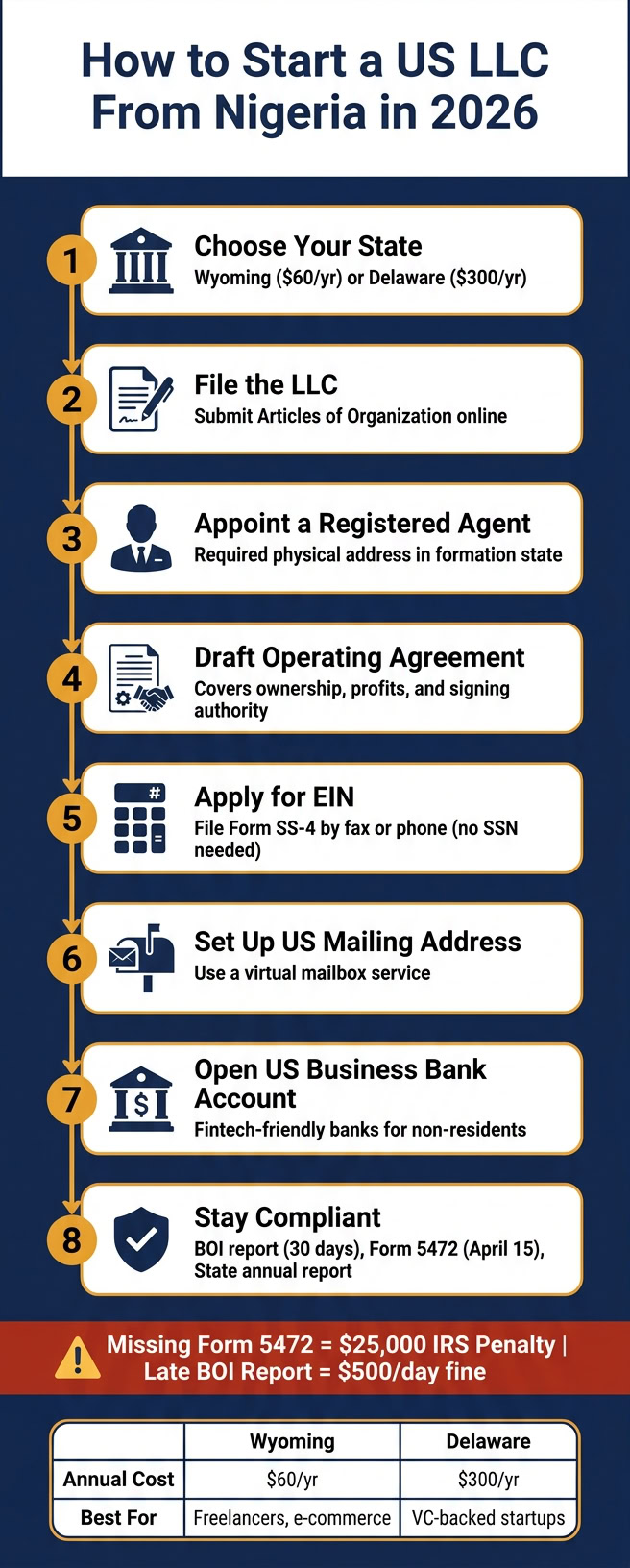
If I want the simple path, it looks like this:
- Choose Wyoming or Delaware
- File the LLC
- Get a registered agent
- Draft the operating agreement
- Apply for an EIN with Form SS-4
- Set up a U.S. mailing address
- Open a U.S. business bank account
- Track BOI, IRS, state, and Nigerian tax deadlines
Quick comparison
| Topic | Wyoming LLC | Delaware LLC |
|---|---|---|
| State filing fee | About $100 | $110 |
| Annual state cost | $60/year | $400/year |
| Best fit | Bootstrapped founders, freelancers, e-commerce | VC-style startups, more complex ownership |
| Privacy | High | High |
And here’s the tax split at a glance: LLC type Default IRS treatment Main U.S. filing
The main idea is simple: forming the LLC is the easy part. Staying on top of BOI, IRS, state, and Nigerian tax rules is what keeps the company in good standing.
Choose Your State, Ownership Structure, and Tax Position
Three choices set the direction early: where to form, who owns the LLC, and how the IRS treats it for tax purposes. Sort these out before you file anything.
Wyoming vs. Delaware: Which State Is Right for Your Business
For most Nigerian founders, Wyoming is the default pick. The reason is simple: cost.
Wyoming costs $60 per year to maintain, while Delaware costs $400 per year. That is a $240 yearly difference, which hits harder when the naira is weak. Wyoming also gives single-member LLCs explicit charging order protection.
Delaware is usually a better fit for venture-backed companies. In many of those cases, founders use a C-Corp instead of an LLC.
| Factor | Wyoming LLC | Delaware LLC |
|---|---|---|
| State filing fee | ~$100 | $110 |
| Annual cost | $60/year | $400/year |
| Member privacy | High (not on public record) | High (not on public record) |
| Creditor protection | Strong (explicit single-member protection) | Standard |
| Best use case | Bootstrapped startups, freelancers, e-commerce | VC-backed startups, complex equity structures |
Once you settle on the state, the next step is ownership.
Single-Member vs. Multi-Member LLC: Picking the Right Ownership Setup
A single-member LLC puts one person in full control. For IRS purposes, it is usually treated as a disregarded entity. In plain English, the LLC itself usually does not pay federal income tax. The owner reports the profit instead.
A multi-member LLC makes sense when you have co-founders. By default, the IRS treats it as a partnership. That means filing Form 1065 each year and issuing K-1s to each member.
No matter which setup you choose, the operating agreement matters. This is the document that spells out ownership, profit splits, management rules, and buyout terms. Banks and payment processors often ask for it, so it is not something to leave vague.
| Feature | Single-Member LLC | Multi-Member LLC |
|---|---|---|
| Control | Full control by one owner | Shared control and voting rights |
| US tax form | Form 5472 + pro forma Form 1120 | Form 1065 (partnership return) |
| Management | Usually member-managed | Member-managed or manager-managed |
That decision then shapes your tax filing path.
US and Nigerian Tax Rules: A High-Level Overview
On the US side, the key filing for a foreign-owned single-member LLC is Form 5472, filed with a pro forma Form 1120. Miss it, and the IRS can hit you with a $25,000 penalty for each year of non-compliance. Multi-member LLCs file Form 1065 instead, and each member gets a K-1.
On the Nigerian side, FIRS taxes residents on worldwide income. What matters most is where the business is managed and controlled, not where the LLC was formed. Since there is no US-Nigeria tax treaty, double taxation can happen. PITA Section 11 may offer limited relief for foreign taxes paid.
Before filing, keep these deadlines in view:
| Filing requirement | Authority | Deadline | Penalty for non-compliance |
|---|---|---|---|
| Form 5472 / pro forma 1120 | IRS (US) | April 15 | $25,000 minimum |
| BOI report | FinCEN (US) | 30 days from formation | $500/day |
| Annual report | State (e.g., Wyoming) | Varies by state | Administrative dissolution |
| Personal income tax | FIRS (Nigeria) | March 31 | Varies by Nigerian law |
With those choices locked in, the filing steps are much easier to handle.
How to Form Your LLC From Nigeria: Step by Step
Gather Your Name, Passport Details, Address, and Business Information
Once you’ve picked the state and ownership setup, it’s time to handle the paperwork.
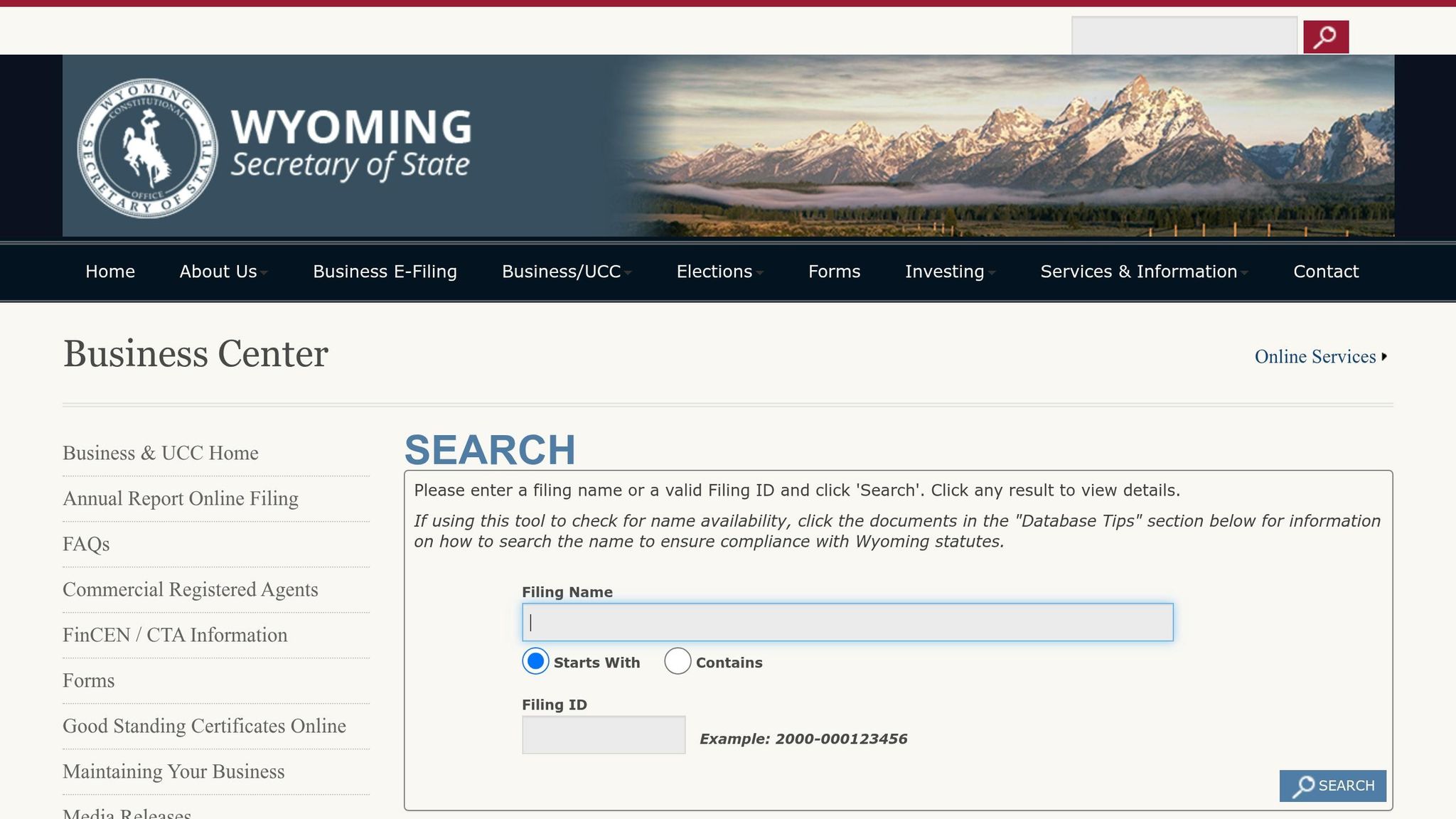
Before you file, pull together your LLC name, owner details, address, contact info, and a short 2–3 sentence description of what the business does. Check the state database first, and make sure the name ends with "LLC" or "Limited Liability Company".
Your Nigerian international passport is the main ID you’ll use for formation and banking. It also helps to have a recent utility bill or bank statement ready as proof of address for later banking and compliance steps.
| Document | Where It Comes From | What It’s Used For |
|---|---|---|
| Articles of Organization | State Secretary of State | Legal proof the LLC exists |
| EIN Confirmation (CP 575) | IRS | Required for banking and taxes |
| Operating Agreement | Founder or formation service | Proves ownership and management structure |
| International Passport | Nigeria Immigration Service | Identity verification (KYC) |
| Proof of Address | Utility provider or bank | Residency verification |
One small snag people run into: card payments. If your naira debit card doesn’t go through for an international charge, a USD domiciliary account card or virtual USD card can make it easier to pay state filing fees.
File the LLC and Appoint a Registered Agent
Every LLC needs a registered agent with a physical address in the formation state. That person or company receives legal and tax mail for the business. You can use your Nigerian home address as the Principal Office Address on the state form, but the registered agent must have a physical address in the state where you form the LLC.
State approval often takes a few business days, though timing depends on the state. When the filing is approved, save the approved Articles or Certificate of Organization right away. You’ll need those documents for your EIN application and bank onboarding.
Create the Operating Agreement and Internal Company Records
The operating agreement stays inside the company, but banks and payment processors often ask for it so they can confirm the company structure and see who is allowed to sign.
It also helps to keep a banking resolution that names the authorized signer on the account, along with membership certificates or other ownership records in your internal file.
For a single-member LLC, this document helps show the legal line between you and the business. For a multi-member LLC, it should spell out ownership percentages, how profits are shared, how decisions get made, and what happens if a member wants to leave.
At a minimum, the agreement should cover:
- Ownership percentages
- Management authority
- Capital contributions
- Profit distributions
- Signing authority
Keep your Articles, EIN letter, and operating agreement in one secure folder. U.S. banks and platforms may ask for them again later, not just during onboarding.
Once the LLC is approved, move straight to the EIN, U.S. address, and bank account.
sbb-itb-ba0a4be
Get Your EIN, US Address, and Business Bank Account
Once your LLC is approved, you have three jobs left: get an EIN, set up a U.S. mailing address, and open a business bank account.
How to Apply for an EIN Without an SSN
Your EIN is your LLC’s federal tax ID. If you don’t have an SSN or ITIN, you can’t use the online EIN assistant. Instead, file Form SS-4 by fax or phone. Use your Nigerian mailing address, enter FOREIGN on Line 7b, mark Line 9a as Other with Foreign-owned U.S. Disregarded Entity, and mark Line 10 as Started new business.
You can fax the form or call the IRS International line at +1-267-941-1099 for same-day processing. If you go the fax route, an online fax service is usually the easiest option, since physical fax machines aren’t common in Nigeria.
Wait until you have the EIN confirmation letter – CP 575 or the faxed confirmation – before you apply for a bank account. That step matters. Many fintech banks keep a record of declined applications, so it’s better to hold off until every document is in place.
Set Up a US Business Mailing Address With a Virtual Mailbox
You’ll also need a separate U.S. mailing address for IRS mail, bank debit cards, and day-to-day business communication. A virtual mailbox gives you a U.S. business mailing address, plus mail scanning, storage, and online access. BusinessAnywhere‘s virtual mailbox plans cover those needs.
After your mailing address is active, bank onboarding tends to go more smoothly because your documents look cleaner and more consistent.
Open a US Business Bank Account From Nigeria
Before you apply, make sure you have a professional website or landing page, and check that all of your documents match exactly. In most cases, you’ll need:
- Your approved Articles of Organization
- Your EIN confirmation letter
- Your signed Operating Agreement
Use your Nigerian home address as your physical address. Don’t use your registered agent address or virtual mailbox as your personal address.
Many remote founders go with U.S.-friendly fintech banks that work with non-resident LLC owners. Only fund the account after approval, using a Nigerian card or a transfer service.
Once the account is active, the next items are BOI filing, tax tracking, and annual state compliance.
BOI, Taxes, Annual Filings, Costs, and Ongoing Compliance
File BOI Reports and Keep Beneficial Ownership Details Current
Once your LLC is set up and your banking is underway, the next step is compliance with FinCEN, the IRS, and your state.
Most U.S. LLCs need to file a BOI report with FinCEN. You count as a beneficial owner if you own 25% or more of the company or control major decisions.
You’ll need to provide your legal name, date of birth, home address, and passport details. For LLCs formed after January 1, 2025, the BOI report is due within 30 days of formation. If ownership changes, or if an owner’s details change, that update must also be reported within 30 days.
Before you file, check FinCEN’s current filing status for your LLC at boiefiling.fincen.gov. Missing this step can lead to steep civil and criminal penalties.
What It Costs to Run a US LLC From Nigeria: State Fees, Tax Filings, and Annual Renewals
Now it’s time to plan for recurring costs.
Even foreign-owned single-member LLCs have annual IRS filing duties. Here’s a simple side-by-side budget view:
| Cost Category | Wyoming LLC | Delaware LLC |
|---|---|---|
| Annual State Fee | $60 (Annual Report) | $400 (Franchise Tax) |
| Registered Agent | $147/year | $147/year |
| Tax filing preparation | $700 | $700 |
| Virtual Mailbox | ~$100 | ~$100 |
| Total Est. Annual Cost | ~$1,007 | ~$1,247 |
When comparing Delaware vs Wyoming, Wyoming costs less year after year.
If you live in Nigeria, you still need to report LLC income under Nigerian tax rules.
Conclusion: A Clear 2026 Launch Plan for Nigerian Founders
At this stage, the job is simple in theory but easy to slip on in practice: stay on top of BOI, IRS, and state deadlines.
The full path looks like this: choose your state, file the LLC and appoint a registered agent, draft your Operating Agreement, apply for an EIN with Form SS-4, set up a U.S. virtual mailing address, open a business bank account, and then keep up with BOI reporting, IRS Form 5472, and your state’s annual renewal.
Clean records and on-time filings help you avoid penalties.
Founders in Asia follow the same core process. See our complete guide to starting a US LLC from Vietnam.
FAQs
Do I need to travel to the U.S. to start an LLC from Nigeria?
No. You can start a U.S. LLC from Nigeria without traveling to the United States.
You can handle the whole process remotely, including filing the formation paperwork, getting an EIN, and setting up a bank account.
In most cases, you’ll only need:
- A valid passport
- A Nigerian address
You do not need a U.S. visa, an SSN, or a physical presence in the U.S.
The process usually involves choosing a state, appointing a registered agent, and submitting the filings online.
Which is better for me: a single-member or multi-member LLC?
It depends on how your business is set up and where you want to take it.
A single-member LLC is often the better fit for solo founders. It’s simpler to run, and tax filing is usually easier because the IRS often treats it as a disregarded entity.
A multi-member LLC makes more sense if you plan to have multiple owners or investors. It allows for shared profits and shared decision-making, but it also usually brings more filing requirements.
If your main goal is simplicity and easy remote management, a single-member LLC is usually the better pick unless you need more than one owner.
What happens if I miss BOI or IRS filing deadlines?
Missing BOI deadlines can get expensive fast. Civil penalties can hit $500 per day, and criminal penalties can reach $10,000. In some cases, there’s also the risk of imprisonment.
IRS filing misses can sting just as much. For forms like Form 5472, a failure to file can trigger a $25,000 penalty for each year.