

If you co-own a business, a buy-sell agreement tells everyone what happens when one owner dies, gets disabled, divorces, retires, goes bankrupt, or wants out. I’d boil it down to 3 things: what event starts the buyout, how the ownership stake is priced, and how the money gets paid.
Without one, state rules may decide the result. That can mean heirs, ex-spouses, or creditors end up tied to the business. It can also mean fights over price, timing, and whether the company can even afford the buyout. For many owners, that risk is bigger than the legal fee to put terms in writing.
Here’s the short version:
- Trigger events: death, disability, retirement, divorce, bankruptcy, misconduct, or a voluntary exit
- Buyout structure: the company buys the shares, the other owners buy them, or both split the purchase
- Price: fixed price, formula, or appraisal
- Payment: life insurance, disability insurance, installments, cash reserves, or a loan
- Transfer limits: rules like a right of first refusal stop outside buyers from stepping in
- Updates: review the agreement each year and update fixed-price terms at least every 2 years
One point stands out: a business ownership transfer can involve 100% of one owner’s stake, but if the terms are old or missing, the people left behind may still have no clear path to close the deal. That’s why I’d treat this as a control document, not just a legal form.
Bottom line: a buy-sell agreement helps keep ownership with the people who were meant to run the business, gives the departing owner or family a payment path, and cuts down on disputes before emotions take over.
How a Buy-Sell Agreement Works in a Co-Owned Business
A buy-sell agreement sets the ground rules for what happens to an owner’s share after a trigger event. It answers four basic questions up front: Who can buy? When does the buyout happen? At what price? How does payment work? When those answers are in writing ahead of time, ownership changes are far less chaotic, and control stays inside the business. In most cases, the agreement covers trigger events, who can buy, valuation, payment terms, and limits on transfers.
The Main Parts Every Buy-Sell Agreement Should Cover
Every solid buy-sell agreement deals with the same core pieces.
The triggering events section lists the exact events that start the buyout process. The section on who has the right or duty to buy explains whether the company or the remaining co-owners may buy the departing owner’s interest, or whether they must.
Transfer restrictions matter just as much. Most agreements include a right of first refusal (ROFR). That means a departing owner has to offer their stake to the company or the current co-owners before trying to sell it to an outsider. The idea is simple: keep control in-house unless the current owners pass.
The agreement should also spell out valuation, payment terms, and how disputes get handled. Payment may happen as a lump sum, in installments, or through a mix of both. Many agreements also require mediation or arbitration before anyone files suit.
Just as important, a buy-sell agreement works alongside the LLC operating agreement or corporate bylaws. It doesn’t replace them. Those documents cover day-to-day governance, while the buy-sell agreement fills in the exit terms they often leave open. First, define the events that activate the agreement.
Why Co-Owners Should Set the Rules Before Problems Arise
Trying to negotiate a buyout while one owner is grieving a partner’s death, or while another is in the middle of a divorce, is a mess waiting to happen. Setting the rules ahead of time takes some of that heat out of the moment.
Without a formal agreement, co-owners can end up fighting over price, timing, and payment.
Setting terms early also helps protect day-to-day operations. If the buyout terms are already set, the business can keep moving during the transition instead of getting stuck while the owners argue over price or funding.
The next section breaks down the trigger events that activate a buy-sell agreement.
sbb-itb-ba0a4be
Trigger Events That Activate a Buy-Sell Agreement
A trigger event is the moment that starts the buyout process. The agreement should spell out each trigger and make it clear whether the buyout is required or optional.
Death, Disability, and Retirement
When an owner dies, a buy-sell agreement helps the family get a fair payout. At the same time, it keeps heirs from stepping into the business by default.
Disability is another common trigger. The agreement should define disability in plain terms so everyone knows when the buyout starts and what happens to the departing owner’s ownership interest.
Retirement is usually easier to plan for. Because of that, many agreements include notice rules and longer payment schedules. That gives the business time to fund the buyout without putting too much pressure on cash flow.
Once a trigger is clear, the next step is simple: who gets to buy, and under what terms?
Divorce, Bankruptcy, and Owner Exits
Divorce and bankruptcy can cause trouble if an ownership interest ends up with someone the other owners never picked. A buy-sell agreement helps stop that by giving the company or the remaining owners the first right to buy the interest.
If an owner wants to leave, that owner must first offer the stake to the company or the remaining owners before selling to an outsider.
Misconduct can also set off a forced buyout. This gives the business a way to protect itself from disruption. The agreement can require that owner’s interest to be bought out under terms already set ahead of time.
A clear buyout clause takes some of the emotion out of the process and keeps decisions tied to the agreement, not the moment.
With the trigger event in place, the agreement can turn to pricing the interest and paying for the buyout.
Buy-Sell Structures, Valuation Methods, and Funding Options
Once trigger events are in place, the agreement has to do three more jobs: set the structure, set the price, and show where the money will come from. That’s what keeps ownership inside the business when someone leaves.
Entity Purchase, Cross-Purchase, and Hybrid Agreements
In an entity-purchase agreement – also called a redemption agreement – the company buys back the departing owner’s interest.
In a cross-purchase agreement, the remaining owners buy the departing owner’s stake themselves.
In a hybrid agreement, the company and the remaining owners share the buyout. That split can help with cash flow, tax treatment, and control.
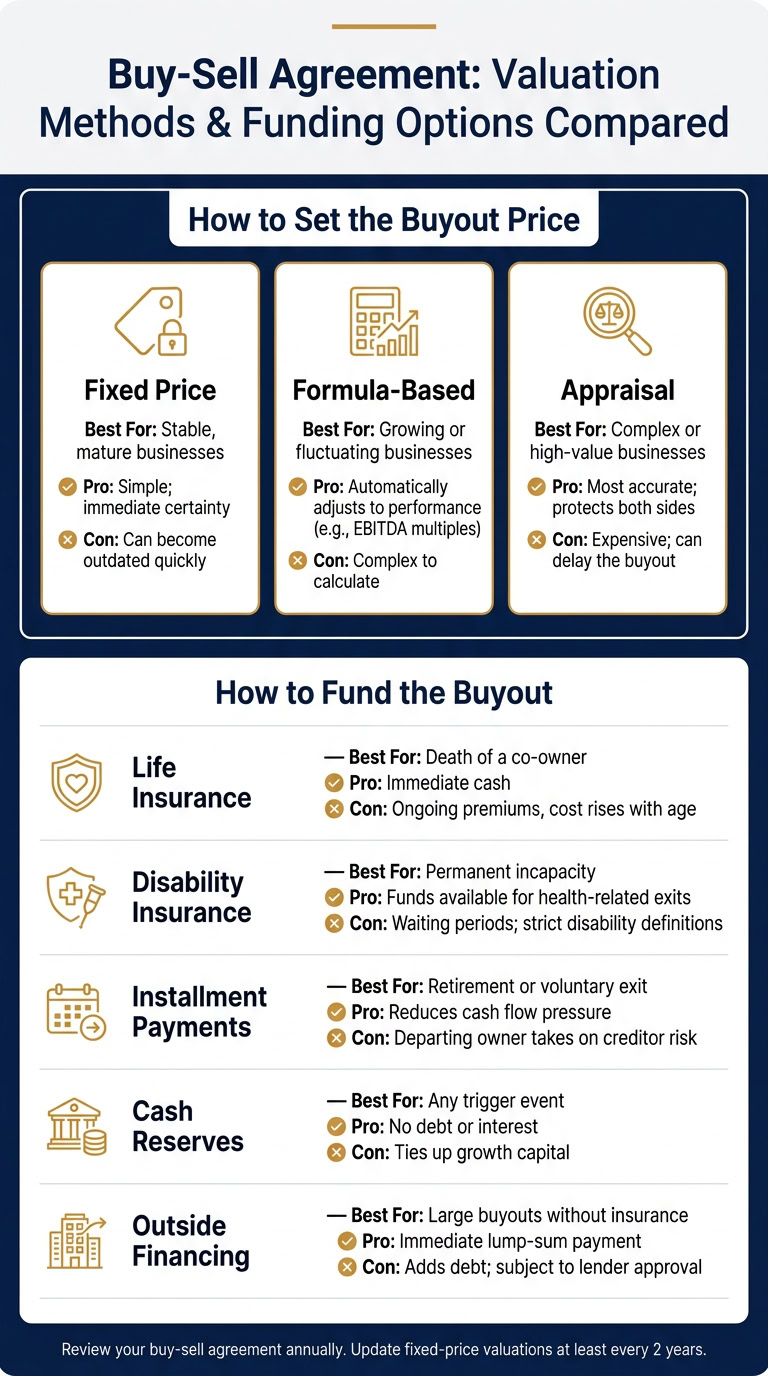
How to Set the Buyout Price
Valuation fights usually begin for one simple reason: the price in the agreement is old, unclear, or both.
There are three standard approaches:
| Valuation Method | Best For | Pros | Cons |
|---|---|---|---|
| Fixed Price | Stable, mature businesses | Simple to understand; provides immediate certainty | Can become outdated quickly if the business grows or contracts |
| Formula-Based | Growing or fluctuating businesses | Automatically adjusts to business performance, such as EBITDA or revenue multiples | Can be complex to calculate; may not capture all value drivers |
| Appraisal | Complex or high-value businesses | Often the most accurate; protects both sides from outdated figures | Expensive; can delay the buyout after a trigger event |
Here’s the short version: fixed prices work best for stable businesses, formulas work best when performance changes over time, and appraisals make more sense for complex or high-value companies.
How to Fund the Buyout
A buyout price on paper doesn’t help much if no one knows how to pay it.
| Funding Option | Best Used For | Pros | Cons |
|---|---|---|---|
| Life Insurance | Death of a co-owner | Provides immediate cash; protects company liquidity | Requires ongoing premium payments; cost increases with age |
| Disability Insurance | Permanent incapacity | Ensures funds are available for health-related exits | May have waiting periods or strict definitions of "disabled" |
| Installment Payments | Retirement or voluntary exit | Reduces immediate cash flow pressure | Departing owner takes on creditor risk; requires long-term interest payments |
| Cash Reserves | Any trigger event | No debt or interest costs; full control over funds | Ties up capital that could be used for business growth |
| Outside Financing | Large buyouts with no insurance | Allows for immediate lump-sum payment | Subject to interest rates and lender approval; adds debt to the balance sheet |
Each funding method fits a different kind of exit and a different cash flow situation. Life insurance is often used when an owner dies. Disability coverage can handle permanent incapacity. Installment payments may work for retirement or a voluntary exit. Cash reserves give the business full control, while outside financing can cover a large buyout when insurance isn’t in place.
The next section covers transfer limits and updates that keep the agreement workable as the business changes.
Transfer Restrictions, Agreement Updates, and Next Steps
Even after you settle on price and payment, one big issue still needs to be nailed down: who can own the business.
That’s where transfer restrictions come in. These rules set clear limits on when an owner can sell their interest and who can buy it. Without them, ownership can drift in ways nobody planned.
A common rule is the right of first refusal. This means a departing owner has to offer their interest to the company or the other owners before selling it to an outsider. Some agreements go even further and use an absolute prohibition, which blocks any transfer unless every owner agrees. Another option is a mandatory buyout clause. That clause forces the interest back to the company after events like death, disability, divorce, or bankruptcy, so heirs or creditors don’t end up as co-owners.
| Restriction Type | How It Works | Primary Benefit |
|---|---|---|
| Right of First Refusal | Departing owner must offer their stake to the company or current owners before any outside sale | Keeps ownership in existing hands |
| Absolute Prohibition | No transfer can happen without unanimous owner consent | Gives owners maximum control over who can join |
| Mandatory Buyout | Ownership interest is bought back after a defined trigger event | Prevents heirs, ex-spouses, or creditors from becoming owners |
Put simply, these rules help keep ownership inside the group the owners agreed on. They also help avoid messy situations where heirs, ex-spouses, or creditors end up tied to the business.
The agreement also shouldn’t sit untouched in a file drawer. Review it every year, and update it after any owner change, major valuation change, or management change. If the agreement uses a fixed-price valuation method, that price should be updated at least every two years.
Before signing or amending the document, have a certified accountant and lawyer review the transfer rules, valuation method, and trigger events. That extra check helps make sure the agreement fits your state law and tax setup. The goal is simple: keep the document current so the buyout terms still match the business.
A buy-sell agreement won’t prevent hard moments. What it can do is keep those moments from throwing control into chaos. Put the transfer limits in writing, keep them current, and review them whenever ownership changes.
FAQs
Do I need a buy-sell agreement for an LLC?
Yes. A buy-sell agreement helps protect both the business and its members when an LLC member dies, retires, or leaves.
An operating agreement often doesn’t go far enough in those moments. Without a separate buy-sell agreement, state default laws may end up controlling valuation and ownership changes. That can create uncertainty fast.
A buy-sell agreement gives you more control over key details, such as:
- trigger events
- valuation rules
- transfer limits, such as a right of first refusal
In plain English, it sets the rules before things get messy.
Who pays for the buyout?
Usually, the company or the remaining owners pay. It depends on how the agreement is set up.
To ease pressure on cash flow, many businesses use life or disability insurance when an owner dies or becomes unable to work. In other cases, the agreement may rely on retained earnings, require personal contributions from the remaining owners, or allow payment as a lump sum or in installments.
How often should we update the agreement?
Review your buy-sell agreement every year so it stays in line with current ownership, management, and state law.
You should update it sooner when major changes happen. That includes:
- adding or removing members
- raising capital
- shifts in valuation
- changes in a member’s personal or financial situation
If the agreement uses a fixed-price method, update the valuation at least once every two years. Any amendment should be approved and signed by all members.