


Startups outside major tech hubs often face challenges like limited funding, mentorship gaps, and lack of infrastructure. Regional innovation hubs aim to address these issues by creating ecosystems where startups can access resources, build networks, and grow their businesses. Funded by initiatives like the CHIPS and Science Act, these hubs connect universities, local governments, investors, and industries to support entrepreneurs in underserved areas.
Here’s what these hubs offer:
- Funding Access: Help navigating grants (e.g., SBIR/STTR), nondilutive funding, and local investor connections.
- Mentorship: Tailored guidance through experienced advisors, Entrepreneurs in Residence (EIRs), and structured programs.
- Networking: Strategic introductions to corporate partners, universities, and potential customers.
- Infrastructure: Affordable office, manufacturing, and lab spaces, plus shared resources like prototyping equipment.
For startups, these hubs provide the tools to overcome barriers, reduce costs, and accelerate growth, especially in regions beyond Silicon Valley. For those just starting out, learning how to register a business in the US is the first step toward joining these ecosystems. Whether it’s securing a grant, finding a mentor, or accessing specialized facilities, regional hubs are reshaping the entrepreneurial landscape in the U.S.
What Are Regional Innovation Hubs?
Definition and Purpose
A regional innovation hub is a collaborative network that unites universities, local industries, government agencies, and economic development organizations within a specific area. The goal? To establish a lasting ecosystem where startups can tap into venture capital, research facilities, skilled talent, and technology transfer resources.
Unlike standalone programs or organizations, these hubs operate through a consortium model. Led by Regional Innovation Officers (RIOs), the hubs align efforts across various stakeholders to develop a unified business strategy for workforce training, technology commercialization, and infrastructure investment.
"Connectivity is a major challenge for entrepreneurs… who reside outside the nation’s innovation hotspots. These actors often find themselves without sufficient access to the innovation infrastructure." – Gregory Arcuri, Research Associate, CSIS
This collaborative structure allows hubs to take on many forms while addressing regional needs.
Types of Regional Innovation Hubs
Innovation hubs differ significantly from accelerators or co-working spaces, even though they may share some overlapping goals. Here’s a breakdown of how they compare:
| Type | Scope | What It Offers |
|---|---|---|
| Regional Innovation Hub | Comprehensive, regional ecosystem | Workforce training, research infrastructure, federal funding, corporate partnerships |
| Accelerator | Short-term program for startups | Market research, customer discovery, mentorship |
| Co-working Space | Physical workspace | Shared amenities, internet, desk space |
While accelerators and co-working spaces focus on specific, often short-term needs, hubs provide a more integrated and enduring support system. For instance, accelerators might function as part of a broader hub, offering focused services within the larger ecosystem.
Why Regional Hubs Matter Beyond Major Tech Cities
Regional hubs play a critical role in addressing the uneven distribution of resources that often leaves startups outside major tech centers at a disadvantage.
"America is bifurcating into two economies. High-technology centers have become dynamic and creative, while more conventional economic activity in rural and rust-belt communities is falling further behind." – Dr. John Hamre, President and CEO, CSIS
Federal initiatives and inclusive approaches are helping to bridge this gap. For example, the Texoma Semiconductor Tech Hub is introducing "fablets" (fabrication labs) for electronic design and semiconductor packaging in underfunded areas of Texas and Oklahoma. Similarly, the Tulsa Hub for Equitable & Trustworthy Autonomy has formed a governance structure led by groups like Black Tech Street, Cherokee Nation Aerospace & Defense, and Osage LLC to ensure diverse representation and access to resources.
As of October 2023, the U.S. Economic Development Administration has recognized 31 Tech Hubs. Among these, 61% have outlined plans to support inclusive entrepreneurship, and 81% prioritize technical job training. These efforts are helping to expand the innovation economy far beyond traditional tech hubs like Silicon Valley.
sbb-itb-ba0a4be
How Regional Innovation Hubs Help Startups Access Funding
Funding Barriers in Secondary Markets
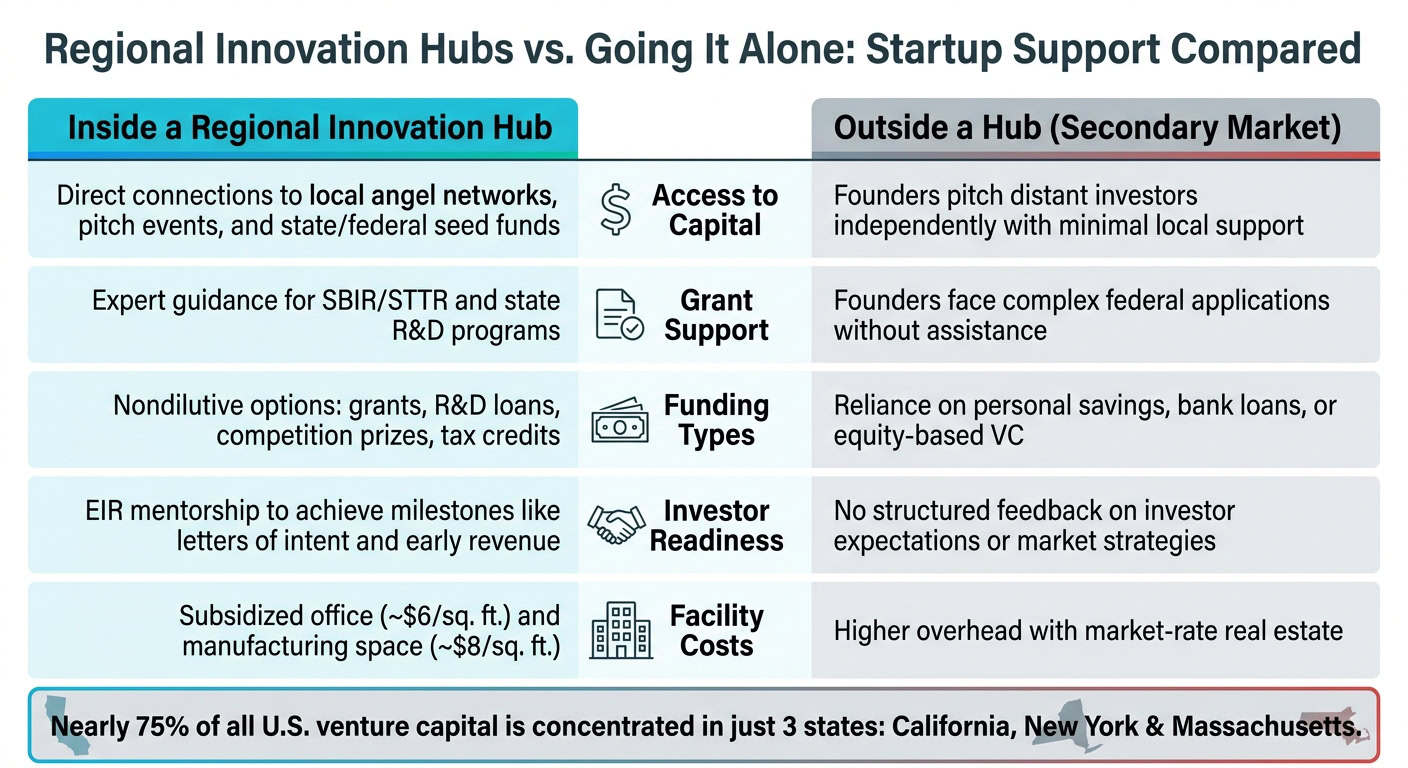
Securing funding outside of major tech hubs is no easy task. Nearly 75% of all U.S. venture capital is concentrated in just three states: California, New York, and Massachusetts. For entrepreneurs in regions like the Midwest, the South, or rural areas, this uneven distribution creates a daunting challenge. This is especially true for international founders learning how to start a business in the USA while navigating these regional funding gaps.
"While rural areas account for roughly 12 percent of U.S. employment, they receive less than 1 percent of venture capital investment nationwide." – Becca Freimuth, Director of Entrepreneurship, NCW Tech Alliance
The challenge isn’t solely about the scarcity of investors; it’s also about a lack of visibility. As Sebastian Penix, Entrepreneur Ecosystem Navigator at Central Indiana SBDC, explains: "Capital tends to flow toward places where strong companies, experienced founders, and deep support networks already exist… capital often follows strong ecosystems rather than serving as the starting point for them.". Without these ecosystem signals, founders in secondary markets often rely on cold pitches or their own limited resources to attract attention.
Regional innovation hubs are stepping in to tackle these barriers head-on, creating strategies that make funding more accessible.
How Hubs Open Doors to Funding
To address funding limitations, regional hubs don’t just connect founders with investors – they actively create the conditions that make startups more attractive to funding sources.
One of the most impactful tools these hubs offer is grant navigation. Dedicated advisors, including Entrepreneurs in Residence (EIRs), guide startups through the complex process of applying for federal programs like SBIR and STTR grants, as well as state-level funding opportunities. Federal grant applications can be overwhelming for early-stage founders, but hubs simplify the process through hands-on support. They also focus on nondilutive funding options – grants, R&D loans, competition prizes, and tax credits – that don’t require founders to give up equity. For startups in sectors like manufacturing, hardware, or energy, where R&D cycles are lengthy, this type of funding can be the difference between survival and failure.
Lucas King, Startup Program Manager at Brite Energy Innovators, highlights why this approach matters:
"A key signal for investors is any signs of revenue that the company may have… including letters of intent or having a product being sold on the market."
Regional hubs help startups achieve these critical milestones faster. For instance, in March 2026, LeapFast Manufacturing Inc., led by former NASA engineer Zach Courtright, relocated from Alabama to Youngstown, Ohio, to leverage the hub’s resources. With their support, the company secured $100,000 through an intellectual property proposal and landed a contract to develop its first prototype deposition system for large-scale additive manufacturing. This early progress significantly reduced the perceived risk for private investors.
On a larger scale, initiatives like the SBA’s Growth Accelerator Fund Competition (GAFC) have distributed 566 prizes totaling over $33 million since 2014, with individual awards ranging from $50,000 to $150,000. Similarly, the U.S. Department of Commerce has allocated about $504 million in implementation grants to 12 Tech Hubs to advance critical technologies nationwide. Regional hubs act as the bridge connecting startups to these resources.
Funding Support: Inside vs. Outside a Hub
The funding strategies offered by regional hubs provide clear advantages compared to startups operating in secondary markets. Here’s how the support differs:
| Feature | Inside a Regional Innovation Hub | Outside a Hub (Secondary Market) |
|---|---|---|
| Access to Capital | Direct connections to local angel networks, pitch events, and state/federal seed funds | Founders pitch distant investors independently with minimal local support |
| Grant Support | Expert guidance for SBIR/STTR and state R&D programs | Founders face complex federal applications without assistance |
| Funding Types | Nondilutive options like grants, R&D loans, competition prizes, and tax credits | Reliance on personal savings, bank loans, or equity-based VC |
| Investor Readiness | EIR mentorship to achieve milestones like letters of intent and early revenue | No structured feedback on meeting investor expectations or market strategies |
| Facility Costs | Subsidized office (~$6/sq. ft.) and manufacturing space (~$8/sq. ft.) | Higher overhead with market-rate real estate |
Startups within regional hubs gain a clear edge, from securing funding to reducing operational costs, making these hubs a game-changer for entrepreneurs in underserved areas.
Mentorship and Knowledge Sharing in Regional Hubs
Common Mentorship Gaps for Early-Stage Startups
Finding quality mentorship is a challenge, especially for startups outside major cities. A staggering 84% of founders say they struggle to access the guidance they need. But the problem isn’t just the lack of mentors – it’s also the relevance of the advice available. Generic tips on "how to build a business" don’t help a medtech founder navigate complex regulations or assist a hardware startup in tackling intellectual property issues.
David Carter, CEO of Innovation Factory in Hamilton, highlights this issue:
"The worst is them making mistakes they don’t even know are mistakes because they didn’t know to ask the question."
This is particularly true for first-time founders who are technical experts – engineers, scientists, or doctors. They may know their product inside and out, but the business side often feels completely foreign. Without structured guidance, the leap from having a great idea to building a sustainable company can feel insurmountable.
To address these gaps, regional hubs have rolled out mentorship programs tailored to meet specific needs.
Structured Mentorship Programs Hubs Offer
Regional hubs are stepping up with mentorship programs that go far beyond generic advice. These programs pair founders with mentors based on industry, stage of business, and unique challenges. A great example is the Metro Region Innovation Hub in Oregon, which launched a free two-month Mentor Program in April 2025 for tech startups in Washington, Clackamas, and Multnomah Counties. By directly compensating industry mentors, the program ensures founders receive dedicated, high-quality guidance.
Hubs also offer personalized support through initiatives like Hub Navigators, who provide one-on-one sessions tailored to local resources, and General Counsel Office Hours, which connect founders with legal experts on topics like intellectual property, AI strategy, and regulatory compliance.
Another innovative approach is the Entrepreneur-in-Residence (EIR) model. This program embeds experienced mentors in rural campuses and small business centers. In Western North Carolina, Jeff Kaplan of Venture Asheville is leading a pilot program that aims to support over 160 entrepreneurs in remote areas during its first year. Kaplan explains:
"The EIR program allows rural entrepreneurs to get advice, mentorship, and build a network across a distant and low-density area. By importing EIRs to rural communities, we can extend the network of Asheville."
These programs not only fill mentorship gaps but also solidify the role of hubs in tackling broader challenges faced by startups.
University and Corporate Partnerships
Regional hubs don’t operate in isolation – they thrive on partnerships with universities and corporations, which expand the resources available to startups. For example, Innovation Factory in Hamilton facilitated a connection between a local medtech startup and a major hospital, giving the startup access to an MRI machine for product testing. This resource, along with federal funding the hub secured, was critical to the startup’s progress.
Introductions made by hub directors carry a level of trust and credibility that cold emails simply can’t match. These connections are pre-vetted, ensuring that founders are ready for the opportunities presented – a layer of support no online tool or AI platform can replace.
The impact of mentorship is clear: 70% of mentored small businesses survive beyond five years, compared to just 35% of those without mentors. Additionally, 92% of small business owners credit mentors with directly influencing their growth and survival. For first-time founders in regional areas, the combination of structured hub mentorship, university resources, corporate partnerships, and professional services offers a reliable way to bridge the knowledge gap and build successful businesses.
Networking, Market Access, and Customer Connections
Networking Challenges Outside Major Hubs
Building strong networks is often a make-or-break factor for startups, especially those located outside major tech hubs. While funding and mentorship are vital, the absence of key connections with investors, corporate partners, and early customers can significantly slow progress. In fact, studies show that between 29% and 41% of small businesses with an active social media presence aren’t part of any formal professional network. This lack of connection can leave startups struggling to grow.
Researchers describe this as the "weak network problem." In many regional ecosystems, there’s a disconnect between universities and research institutions on one side and startups and investors on the other. Without a bridge linking these groups, founders miss out on critical opportunities like pilot programs, early adopters, and strategic introductions. Regional hubs aim to solve this by intentionally fostering these relationships.
How Hubs Facilitate Networking
Regional hubs do more than bring entrepreneurs together – they actively create opportunities for collaboration through a two-step process: "meeting" to initiate contact and "mating" to build strategic partnerships. Unlike co-working spaces, hubs are designed to forge meaningful, long-term connections that drive growth.
One key advantage hubs offer is what David Carter, CEO of Innovation Factory, calls reputational exchange:
"Technically, you’ll get the information [from AI tools]. But reputation has been taken out of it completely."
Introductions made by hubs carry credibility, which is especially valuable for early-stage startups that lack established revenue or recognition. This credibility can open doors that might otherwise remain closed.
Hubs also help startups overcome geographic limitations. For instance, a medtech startup requiring specialized chip infrastructure might be connected to a hub focused on that area, even if it’s in a different region. This kind of cross-regional linking transforms a local hub into a gateway to national resources.
The impact of these hubs is clear. Since 2010, Innovation Factory in Hamilton has supported over 3,600 businesses, helping them secure $220 million in investment and generate $468 million in revenue. Similarly, the Youngstown Innovation Hub for Aerospace & Defense projects an economic impact of $100 million to $162 million, along with the creation of 450 new jobs over three years.
Networking: Regional Innovation Hubs vs. Co-Working Spaces
The difference between hubs and co-working spaces lies in their purpose. Co-working spaces provide a place to work, while hubs focus on creating high-impact, strategic connections.
| Feature | Regional Innovation Hubs | Standard Co-Working Spaces |
|---|---|---|
| Primary Goal | Scaling businesses and accessing markets | Offering flexible workspaces and reducing costs |
| Networking Style | Structured brokering and reputational vetting | Organic interactions among tenants |
| Corporate Access | Direct matchmaking with corporate partners and contractors | Limited to tenant interactions |
| Market Entry | Soft-landing programs and corporate pilots | Workspace only |
| Mentorship | Structured programs with experienced advisors | Optional or community-driven advice |
| Strategic Reach | Cross-regional referrals and global connections | Local community focus |
For startups aiming to secure their first major customer or break into a new market, these differences can be game-changing. Hubs are purpose-built to help businesses navigate these challenges and achieve faster, more strategic growth.
How Hubs Address Space and Infrastructure Needs
Physical and Operational Challenges for Startups
For startups, finding the right physical space and operational support can be just as important as securing funding or mentorship. Early-stage companies often struggle to afford specialized labs, prototyping equipment, or manufacturing facilities. This lack of resources can force founders to relocate or put off resource-intensive projects, delaying progress.
This issue is even more pronounced in areas outside major tech hubs. In regions with fewer research and development (R&D) assets, startups often find themselves without local access to high-end infrastructure. For many, this leaves limited options to move forward effectively.
Facilities and Resources Hubs Provide
Regional innovation hubs step in to solve these problems by offering shared resources that individual startups could never afford on their own. Take the Youngstown Innovation Hub for Aerospace & Defense as an example. It’s transforming an old newspaper building into 100,000 square feet of manufacturing and office space, available for just $6–$8 per square foot. As Director Megan Malara puts it:
"The goal of the Innovation Hub is to help companies at the earliest stages get moving but also really to help our current manufacturers expand and accelerate their operations."
This isn’t just theoretical. LeapFast Manufacturing Inc., a startup co-founded by Zachary Courtright, took advantage of the Youngstown Business Incubator (YBI) to set up lab space at Tech Block Building #5. With grant support from YBI, they acquired critical equipment and landed a project to develop their first prototype deposition system for NASA and defense applications.
Another example comes from the Cambridge Innovation Center (CIC) in Massachusetts, which focuses on life sciences. Hosting over 300 biotech and life science organizations, CIC-affiliated startups have collectively raised more than $17 billion in venture capital since 2001.
But hubs aren’t just about physical space. They also provide administrative and operational support, including legal help with leases, accounting services, grant-writing assistance, and access to seasoned entrepreneurs who mentor founders through both technical and business hurdles. Connor O’Brien, a Research and Policy Analyst at the Economic Innovation Group, explains:
"Hubs are typically centered around economic development organizations… that make workforce development investments, provide mentorship and technical assistance to startup founders, and run testbeds for companies to experiment with low-volume production of new technologies."
This combination of resources and guidance forms a well-rounded support system for startups.
How Virtual Tools Complement Hub Resources
While physical facilities are critical, virtual tools add flexibility and help startups stay nimble. For instance, startups using hub facilities can maintain a virtual administrative presence with tools like BusinessAnywhere’s virtual mailbox and registered agent support. These services allow founders to operate with a legitimate U.S. business address, handle mail remotely, and meet state compliance requirements by choosing the best registered agent service – even if their main operations are based in a regional hub. This blend of physical and virtual resources ensures startups can focus on growth without getting bogged down by logistical challenges.
Choosing a Business-Friendly State with Regional Innovation Hubs
What to Consider When Selecting a State
After looking into the funding, mentorship, and infrastructure support offered by regional hubs, startups also need to evaluate the state environment that best complements these resources. Deciding where to register your business and where to operate are two closely linked decisions that can significantly impact your growth.
The goal is to match your startup’s industry with the hub’s focus. Each federally designated Tech Hub specializes in a specific field. For instance, Indiana’s Heartland BioWorks received $51 million to transform Central Indiana into a global leader in biotechnology and biomanufacturing, while Colorado’s Elevate Quantum secured $41 million to push advancements in quantum information technology for AI and healthcare. Choosing a state with a hub aligned to your industry provides access to specialized facilities, targeted federal funding, and a skilled workforce tailored to your needs.
Additionally, opt for states where hubs have received federal implementation grants under programs like the CHIPS and Science Act. These grants reflect strong commercialization strategies and established infrastructure.
Legal and Operational Flexibility for Startups
Here’s something many founders overlook: you don’t have to register your business in the same state where your hub operates. Some hubs serve multiple states. For example, Elevate Quantum spans Colorado and New Mexico, while SC Nexus supports both South Carolina and Georgia. This allows you to register your LLC or corporation in states like Delaware or Wyoming, which are known for legal and tax advantages, while still leveraging the physical resources of a hub in another location.
However, operating across states does come with added administrative challenges. Multi-state compliance can quickly become a headache. Platforms like BusinessAnywhere simplify this process by handling tasks like registered agent services, annual report filings, and offering a virtual mailbox. These tools help maintain a legitimate U.S. presence without the hassle of managing paperwork, letting you focus on maximizing the benefits of your hub’s ecosystem. Striking the right balance between legal benefits and operational strengths is key.
Balancing Tax, Legal, and Ecosystem Factors
No single state checks every box. The table below compares top Tech Hub states based on their ecosystem strengths and federal funding, helping you weigh your options.
| State | Tech Hub | Technology Focus | Federal Award |
|---|---|---|---|
| Indiana | Heartland BioWorks | Biotechnology & Biomanufacturing | $51 million |
| Illinois | iFAB Tech Hub | Precision Fermentation | $51 million |
| Ohio | Sustainable Polymers Hub | Sustainable Polymers | $51 million |
| Oklahoma | THETA Tech Hub | Autonomous Systems | $51 million |
| Wisconsin | Wisconsin Biohealth | Personalized Medicine | $49 million |
| Colorado | Elevate Quantum | Quantum Information Technology | $41 million |
| New York | NY SMART I-Corridor | Semiconductor Manufacturing | $40 million |
As U.S. Secretary of Commerce Gina Raimondo stated:
"Each of these consortia will help us ensure the industries of the future – and their good-paying jobs – start, grow, and remain in the United States."
Conclusion: What Regional Innovation Hubs Offer Startups
Regional innovation hubs create an ecosystem where startups can thrive by combining funding, mentorship, networking opportunities, and infrastructure. Take the South Haven Regional Business Hub in Michigan, for example. Between 2023 and 2025, it supported 89 small businesses, with an impressive 92% – or 82 of them – still operating by the end of 2025. These numbers highlight how impactful such hubs can be for startup survival.
"The results speak for themselves… We’ve found that the more a business works with us, the more likely they are to stay in business." – Elizabeth Bernhard, Executive Director, South Haven Regional Business Hub
The benefits go beyond survival rates. Startups gain access to competitive facility rates, nondilutive grants of up to $100,000, and structured 26-week growth programs – resources that are often out of reach for independent startups. For founders in less prominent markets, these hubs help level the playing field, offering advantages typically concentrated in coastal regions with higher venture capital activity.
While growth strategies take center stage, administrative tasks still demand attention. That’s where tools like BusinessAnywhere come in, simplifying back-office operations. Through a single dashboard, founders can handle business formation, registered agent services, compliance filings, and virtual mailbox management – all remotely. By reducing administrative headaches, these solutions allow entrepreneurs to focus on scaling their businesses.
When paired with the resources of a regional hub, streamlined operational tools can remove two of the biggest challenges startups face – limited access to resources and administrative burdens – enabling founders to channel their energy into growth.
FAQs
How do I find a regional innovation hub near me?
To find a regional innovation hub, start by visiting your state’s economic development websites. These sites often feature dedicated networks that can guide you. Additionally, check out resources like the U.S. Small Business Administration’s Regional Innovation Clusters (RICs) and the Economic Development Administration’s Tech Hubs directory for more options.
If you’re a remote business owner, platforms like BusinessAnywhere can be a game-changer. They help you maintain U.S. business registration and compliance while you explore and benefit from these local opportunities.
Do I have to relocate to use a hub’s funding and facilities?
Relocation needs vary depending on the hub you’re working with. For instance, Tampa’s support hub might require your business to have a local presence to qualify for certain microgrants. On the other hand, federal initiatives like the Minority Business Development Agency‘s Capital Readiness Program provide services across the country. It’s a good idea to consult the program’s navigator to verify whether local residency or on-site operations are part of the eligibility criteria.
Can I register my company in one state and operate in a hub in another?
Yes, it’s possible to register your business in one state while working from a regional innovation hub in another. To stay compliant with state laws, you’ll need a registered agent with a physical address in the state where your business is registered. Services like those provided by BusinessAnywhere can assist with this requirement. However, operating in a different state might also mean obtaining a foreign qualification and following extra compliance measures.