
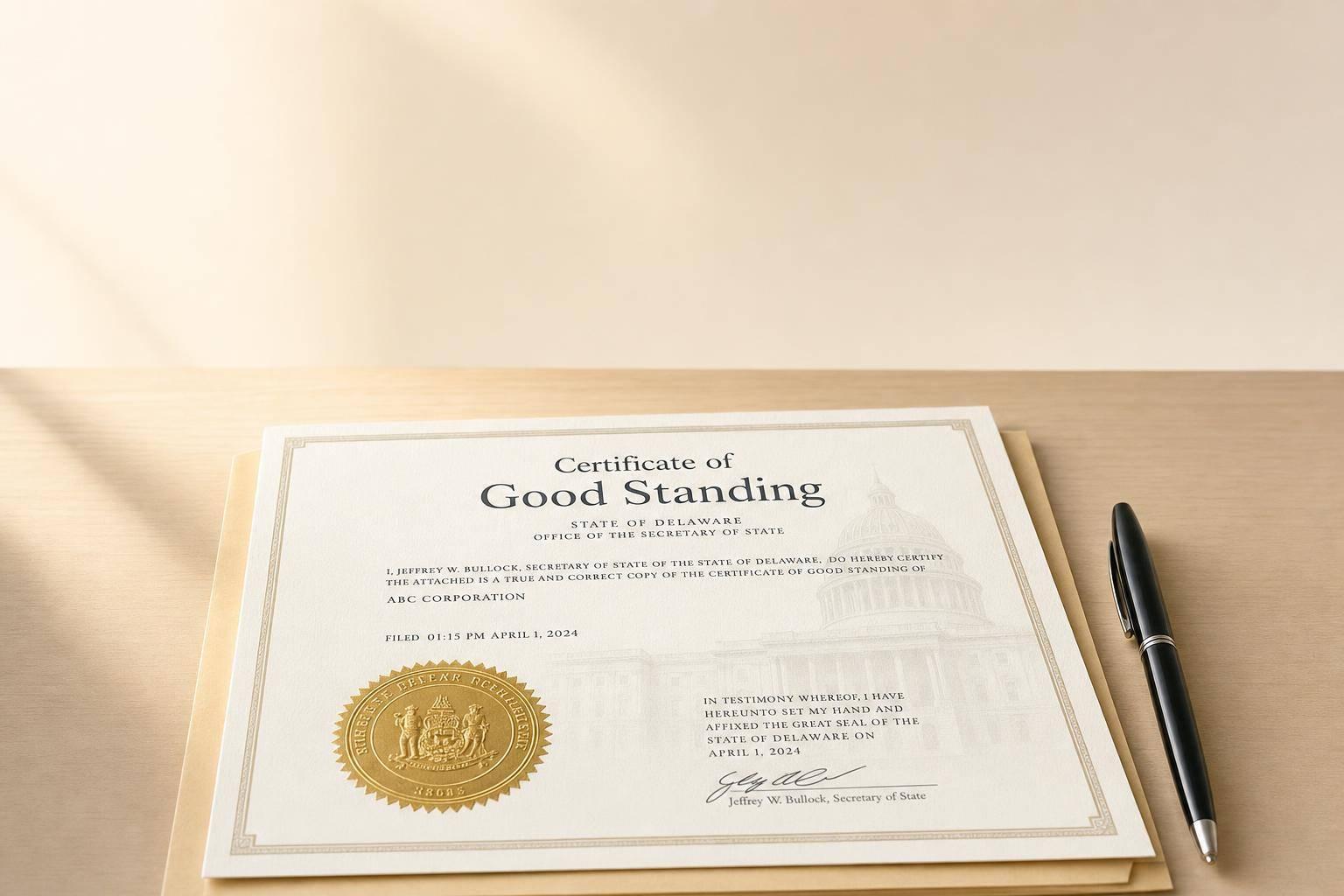
A Certificate of Good Standing is state proof that your business is active and up to date. If you need to open a bank account, get a loan, register in another state, or close a deal, you may be asked for one issued within 30 to 90 days.
Here’s the short version:
- I use this certificate to show a business is properly registered with the state
- It confirms annual reports, fees, and state tax items are current
- It does not show profit, credit, lawsuits, or local permits
- The document name changes by state, like Certificate of Status or Certificate of Existence
- In many states, I can order it online in minutes, but some states take 2 to 5 business days or more
- Costs vary from $0 in some states to $100 in others
If the business is suspended, dissolved, revoked, or delinquent, the state usually will not issue it. In that case, I need to file missing reports, pay balances due, fix registered agent issues, and wait for the record to show Active again.
For most readers, that’s the whole playbook: check status, fix any problems, order the certificate close to when you’ll use it, and watch the issue date.
What a Certificate of Good Standing Proves
A Certificate of Good Standing shows that your business legally exists in state records and is up to date on state-required filings, fees, and registered agent rules. In plain English, it shows compliance with state rules, not the health of the business itself.
That distinction matters. This certificate does not show your company’s finances, credit, profit, or whether it’s dealing with legal disputes. It also doesn’t confirm local city or county permits, professional or occupational licenses, or whether the business has lawsuits or liens against it. Think of it as proof that the business is in line with state filing rules, not a full checkup of the company.
Who Issues It and What Information Appears on It
The office that issues the certificate is usually the Secretary of State, Department of State, or Division of Corporations, depending on the state. In Wisconsin, for example, the issuing office is the Department of Financial Institutions.
Most certificates include the same basic details:
- Legal business name and entity type, such as an LLC or corporation
- Formation or authorization date
- State-assigned entity file number
- A formal statement showing active, good standing, or existence status
- The issue date
- Official state seal and the signature of the Secretary of State or another authorized officer
A lot of banks, lenders, and state agencies treat the certificate as current for only 30 to 90 days from the issue date. So timing isn’t a small detail here. If you need the certificate for a filing, loan, or account review, order it close to the date you’ll actually use it.
How Different States Name This Document
States don’t all use the same label for this document. That can trip people up fast, especially when they search a state filing site and don’t see the words “good standing.”
| State | Official Document Name |
|---|---|
| Alabama, Delaware | Certificate of Good Standing |
| California, Florida, Illinois | Certificate of Status |
| Georgia, Indiana, Oregon | Certificate of Existence |
| Pennsylvania | Certificate of Subsistence |
| Connecticut | Certificate of Legal Existence |
| Alaska | Certificate of Compliance |
When you search on your state’s website, use the exact name that state uses. For instance, California calls it a "Certificate of Status".
Next, review when banks, lenders, and state agencies usually ask for a recent copy.
sbb-itb-ba0a4be
When You May Need a Certificate of Good Standing
A Certificate of Good Standing shows that your business is up to date with state rules. Because of that, outside parties often ask for it before they move forward with a major transaction. This comes up a lot during financing, multi-state expansion, and deal-making.
Opening a Bank Account or Applying for Financing
Banks and lenders often require a Certificate of Good Standing before they’ll open a business checking account, approve a loan, or set up a line of credit. They use it to verify that the business is current with state filing and fee requirements. In most cases, it’s smart to order a fresh copy close to your application date.
This same request can come up when your company is growing into a new state or getting ready to complete a major contract or sale.
Registering in Another State or Closing a Business Deal
If you want to register in another state, that state will often ask for a current certificate from your home state before it issues a Certificate of Authority.
You may also need a current certificate for major contracts, commercial leases, licensing agreements, and investor due diligence. Buyers and investors often request it to check that there are no unpaid state fees or overdue reports.
| Scenario | Why It’s Requested |
|---|---|
| Banking & Finance | To open accounts, secure loans, or set up payment processing |
| State Registration | To register in another state and obtain authority to operate there |
| Real Estate | To sign or renew commercial leases and complete closings |
| Insurance & Licensing | To support insurance or license applications |
| Business Sales | To support buyer due diligence before a sale |
If you’re working toward a time-sensitive closing or funding round, request the certificate early. State processing times can range from a few minutes online to more than a week by mail.
How to Qualify for and Get a Certificate of Good Standing
Check That Your Business Is Eligible Before You Order
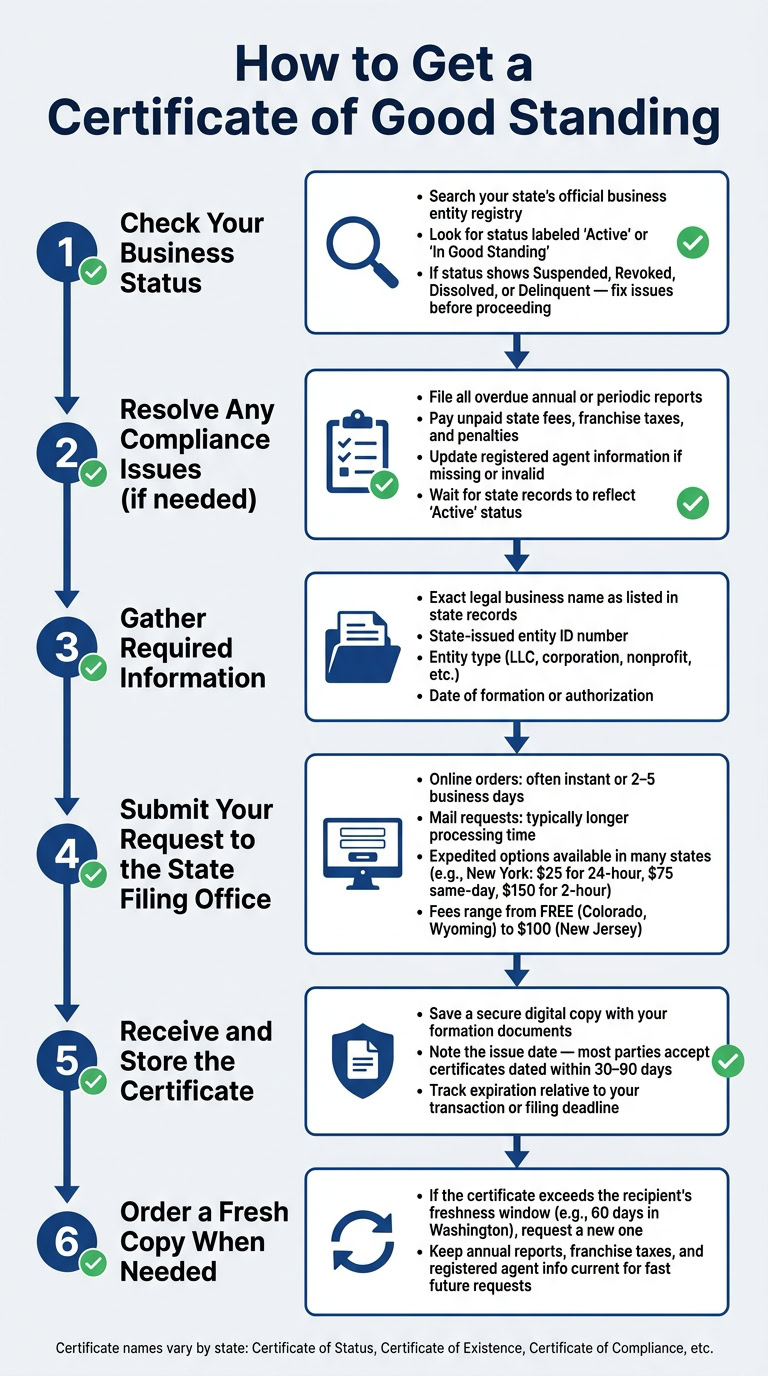
Before you place an order, make sure your business is properly registered with the state and fully up to date on compliance. If anything is out of line, the state usually won’t issue the certificate.
Most states expect four things:
- All annual or periodic reports are filed and current
- All state fees, franchise taxes, and late penalties are paid in full
- Your entity status is Active
- A registered agent is on file with the state
If your status shows as suspended, void, dissolved, or delinquent, that can stop the request.
The quickest way to check is through your state’s official business entity search tool. For example, you can perform a California business entity search to verify your status. Find your company name and look for a status like Active or In Good Standing. If you see anything else, deal with that first. Otherwise, the state will likely reject your request.
How to Request the Certificate from the State Filing Office
Once your business status is active and current, request the certificate from the state office that keeps entity records. In many states, you can do this online. Some states still send sealed copies by mail.
Have this information ready:
- Your exact legal business name as listed in state records
- Your state-issued entity ID number
- Your entity type such as LLC, corporation, or nonprofit
- Your date of formation or authorization
- Your delivery details
- Whether you need expedited processing
Processing time depends on the state and the delivery method. Online orders are often issued right away or within 2 to 5 business days, while mailed requests usually take longer. If you’re working against the clock, expedited service can help. In New York, for example, the state charges $25 for 24-hour service, $75 for same-day service, and $150 for 2-hour service.
Fees vary a lot from state to state. Colorado and Wyoming issue certificates at no cost, while New Jersey charges up to $100. Here are some common state fees.
| State | Document Name | State Fee |
|---|---|---|
| California | Certificate of Status | $5 |
| Colorado | Certificate of Good Standing | Free |
| Delaware | Certificate of Good Standing | $50 |
| Florida | Certificate of Status | $8.75 (Corp) / $5 (LLC) |
| New York | Certificate of Status | $25 |
| Texas | Certificate of Good Standing | $15 |
| Washington | Certificate of Existence | $20 |
How to Store the Certificate and Track Its Age
A Certificate of Good Standing shows your business’s status on the date it was issued, not the date you hand it over. That detail trips people up all the time. Washington state, for example, requires foreign entities registering there to submit a certificate dated within 60 days of filing.
Store the certificate in a secure digital folder along with your formation records, such as your articles of organization. Before a big filing, loan, or deal, check the issue date and make sure it still fits the other party’s freshness rule. If it falls outside that window, order a new one.
It also helps to track annual report deadlines, state fees, and franchise tax due dates so you can get a fresh certificate fast when needed. Keep a calendar for your annual report due dates, filing fees, and tax deadlines. If the certificate gets too old before a transaction closes or a filing goes through, request another copy.
What to Do If Your Business Is Not in Good Standing
How to Fix Past-Due Filings, Fees, and Registered Agent Issues
If your business is not in good standing, fix that status before you order a certificate.
This process is called reinstatement. The best way to handle it is simple: check the state record first, then fix each filing and payment problem one by one.
- Check the state record – Search your state’s Secretary of State business registry by entity name or ID. Look for status labels like "Suspended", "Revoked", "Dissolved", or "Delinquent." Missing periods in the filing history can point to what’s overdue.
- File overdue reports and pay all balances – Send in every missing annual or biennial report. Then pay any unpaid fees, franchise taxes, and penalties.
- Update registered agent information – If your agent resigned or the address on file is no good, file the paperwork to name a new agent with a valid physical address in the state.
- Wait for the state to update the record – After you file reinstatement paperwork, give the state time to process it. Only order a new certificate after the record shows Active or Good Standing. Online filings often update faster than paper forms, but timing still varies by state.
Some states also ask for a separate "Application for Reinstatement" on top of the missing reports. So before you send anything in, check your state’s Secretary of State website and make sure you have the right forms.
Keep Your Business Compliant and Ready to Prove It
To avoid this headache again, keep your annual reports, franchise taxes, and registered agent records up to date. That way, when you need a certificate, you can request it right away instead of scrambling to fix a lapse first.
Track annual report due dates, franchise tax deadlines, and agent renewals so nothing slips through the cracks.
Once your compliance is current, the certificate is ready to request again.
FAQs
Does every state issue this certificate online?
No. In many states, you can request and get this certificate online, and that’s often the fastest route. But that isn’t the case everywhere.
Some states still require paper forms, in-person visits, or even faxed requests. Others may send a physical copy by mail instead of giving you a PDF to download. Your best move is to check your state’s business portal for the latest request and delivery options.
Can I use an old certificate for a bank or loan application?
Usually, no. Banks, lenders, and other third parties often want a recently issued certificate because a business’s compliance status can change fast. A missed filing or an unpaid fee can be enough to change it.
The exact validity period depends on the state, but many certificates are treated as current for about six months. If your certificate is out of date, it may be rejected. So it’s usually best to get a fresh official certificate.
What if my business status is inactive or suspended?
If your business status is inactive or suspended, you can’t get a Certificate of Good Standing until you fix the compliance issues.
The usual reasons are pretty straightforward: missing annual reports, unpaid taxes or state fees, or failing to keep a valid registered agent on file. To get back to active status, you’ll need to file the required paperwork and pay any reinstatement fees.
Once the state updates your status to active, you can request the certificate.