


If I run a one-person handyman business, an LLC can help protect my home, savings, and personal bank account – but only if I set it up right and keep business money separate.
Here’s the short version:
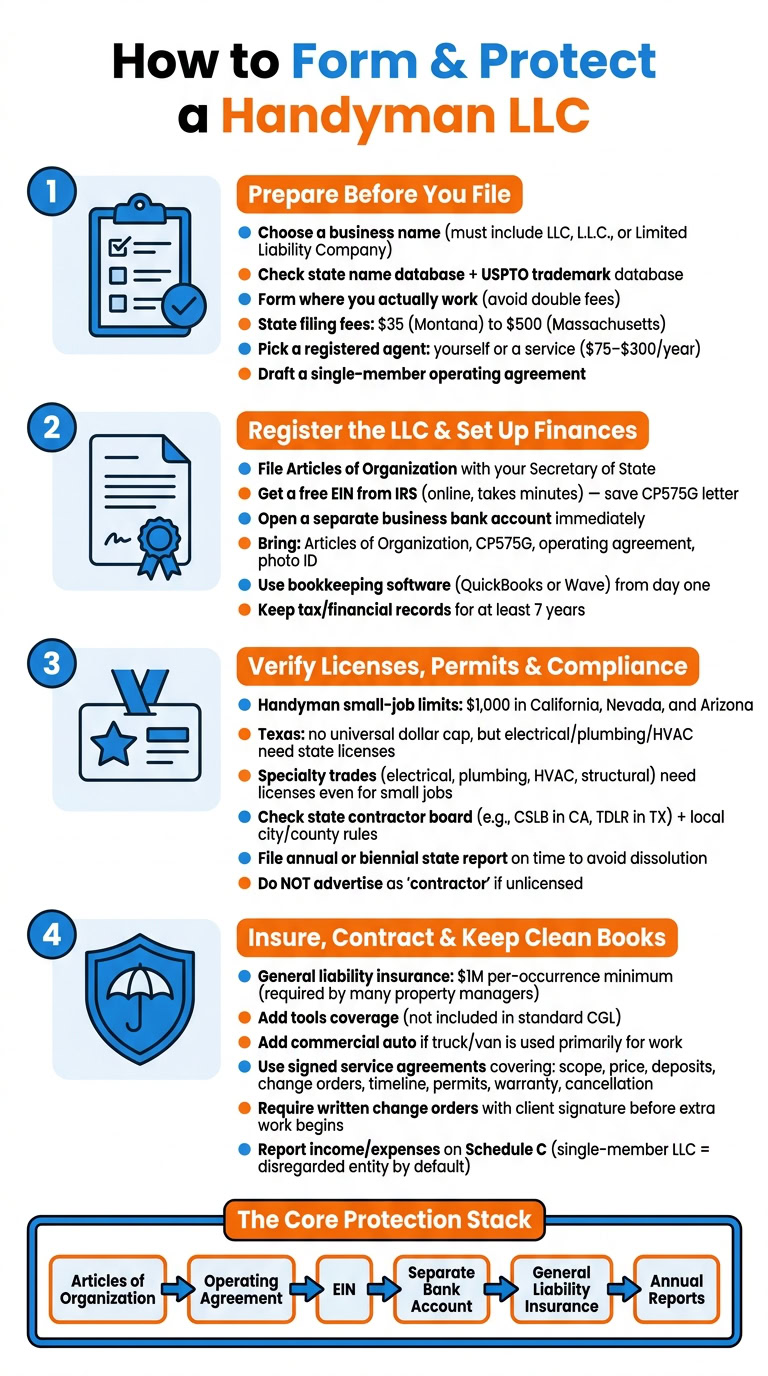
- I form the LLC in the state where I work
- I file Articles of Organization
- I get a free EIN from the IRS
- I open a separate business bank account
- I check state and local license rules
- I carry general liability insurance
- I use written service agreements and clean bookkeeping
- I file the state’s annual or biennial report on time
A few numbers stand out. State LLC filing fees can range from $35 to $500. Registered agent service often costs $75 to $300 per year. Many property managers want at least $1 million per occurrence in general liability coverage. And in states like California, Nevada, and Arizona, small-job handyman limits can be as low as $1,000 before contractor license rules may apply.
The big point is simple: an LLC is only one layer. I still need insurance, contracts, licenses, and separate records to back it up. If I mix personal and business funds or sign jobs in my own name instead of the LLC’s name, that protection can weaken.
Quick comparison
| Option | Liability | Taxes | Setup | Best fit |
|---|---|---|---|---|
| Sole proprietorship | My personal assets are at risk | Schedule C on my personal return | Very little setup | Small side work with more personal risk |
| Single-member LLC | Personal and business liability are usually separated | Schedule C by default; other tax elections may be possible | State filing, reports, bank setup | Solo handyman who wants a legal wall between self and business |
So if I want the plain answer, it’s this: form the LLC, separate the money, verify license limits, insure the work, and keep paperwork clean from day one.
sbb-itb-ba0a4be
Step 1: Prepare the LLC Before You File
Before you file anything, get the core details in place. These early choices help protect your liability shield and make it easier to keep the LLC in good standing.
Choose a Business Name and Formation State
Your business name needs to include "LLC", "L.L.C.", or "Limited Liability Company." It also can’t already be in use by another business in your state. Start with your Secretary of State’s name database before you get attached to a name. Then check the USPTO trademark database so you don’t run into trouble with an existing brand. If the name is open, grab the matching domain right away.
For the state of formation, the simple rule is this: form where you actually work. If you set up the LLC in another state but run the business from home, you’ll usually still need to register as a foreign LLC in the state where you work. That often means paying two sets of fees instead of one. State filing fees range from $35 in Montana to $500 in Massachusetts.
Once the name is set, the next call is deciding who will receive official mail for the LLC.
Pick a Registered Agent and Draft an Operating Agreement
Every LLC needs a registered agent. This can be a person or a service, but they must have a physical street address in the formation state and be available during business hours to accept legal papers and government mail.
You can list yourself as the registered agent. Plenty of owners do. But there’s a trade-off: your home address goes on the public record. A registered agent service usually costs $75 to $300 per year and helps keep your personal address off that record.
The other document to line up before filing is the operating agreement. For a solo handyman, this is mostly an internal paper, but it still matters. It helps show that the business is separate from your personal finances, and it gives banks and state agencies a clear record of who owns the LLC. Banks often ask for it when you open a business checking account, and it can matter later if you elect S-corp tax status.
For most solo handymen, a basic single-member operating agreement will do the job.
With the name, registered agent, and operating agreement ready, you’re set up for the next step: filing the Articles of Organization and getting an EIN.
Step 2: Register the LLC and Set Up Business Finances
File Articles of Organization and Get an EIN
Once your business name, registered agent, and operating agreement are in place, file the Articles of Organization with your state’s Secretary of State office. This is the document that officially forms your LLC. In most states, you’ll need to include the LLC name, principal business address, registered agent name and address, management structure, and the organizer’s signature. Filing fees depend on the state.
After the state approves your LLC, apply for an EIN through the IRS. It’s free, and the online application usually takes just a few minutes. An EIN helps keep the LLC separate from you as a person and makes it much easier to open business banking. Save the IRS confirmation letter, CP575G, with your main business records.
Open a Business Bank Account and Organize Records
Open a separate business bank account as soon as your LLC is approved. Using the same account for personal and business money can weaken the LLC’s liability shield.
To open the account, bring:
- Your stamped Articles of Organization
- The IRS CP575G confirmation letter
- Your signed operating agreement
- A valid photo ID
Some banks may also ask for a local business license if your city requires one.
Once the account is open, run all business income and expenses through it. A business credit card can also help keep material purchases separate, which saves a lot of hassle later.
For recordkeeping, keep your formation papers, EIN letter, operating agreement, signed contracts, receipts, and insurance documents in one place, like a cloud folder or document dashboard. Tax and financial records should be kept for at least seven years, so it’s smart to set up that system from the start. You can also connect your bank feed to bookkeeping software like QuickBooks or Wave so income and expenses are tracked automatically instead of pieced together at tax time. Clean records help with taxes, insurance claims, and liability protection.
Once your banking and records are separate, verify the handyman licenses, contractor rules, and local permits that apply in your area.
Step 3: Check Licenses, Permits, and Ongoing Compliance
Once your LLC is filed and funded, the next step is simple: figure out what work you can legally do. An LLC gives you a separate legal entity. It does not give you permission to perform repair work. Before you take paid jobs, check your state and local licensing rules.
Verify Handyman Limits, Contractor Licenses, and Local Permits
Most states put limits on handyman work based on job value and trade type. Go over either limit, and you’ll usually need a contractor license.
California, Nevada, and Arizona each use a $1,000 small-job exemption. Texas does not have a universal dollar cap at the state level, but electrical, plumbing, and HVAC work still need separate state licenses no matter the job size.
Electrical, plumbing, HVAC, and structural work usually need a specialty license, even for small jobs.
If a job needs a building permit, a licensed contractor usually has to pull it. Start with your state contractor board’s website first. For example, check California’s CSLB or Texas’s TDLR. Then contact your local city or county building department, because local rules often stack on top of state rules.
Many cities and counties also require a general business license or home occupation permit that is separate from state LLC registration. And this part matters: advertising yourself as a “contractor,” or using a business name that suggests you’re licensed when you’re not, is a legal violation in states like California.
Handle Annual Reports, Registered Agent Updates, and Tax Status
Most states require an annual or biennial report to confirm your company’s basic details and registered agent information. Miss the deadline, and you could face late fees or even administrative dissolution. The easiest way to stay on top of it is to track the due date based on your formation date.
If your registered agent’s address changes, update the state right away.
A single-member LLC is taxed as a pass-through by default. If your profits start to make the numbers worth a closer look, review an S-corp election with a tax professional.
Once licensing and compliance are handled, the next layer is insurance, contracts, and bookkeeping.
Step 4: Protect the Business With Insurance, Contracts, and Bookkeeping
Carry General Liability, Tools Coverage, and Vehicle Protection
Once your license is set, the next layer is pretty simple: insurance, solid paperwork, and clean books.
An LLC helps separate your personal life from the business. But it doesn’t pay claims on its own. That’s where insurance comes in.
General liability (CGL) is the starting point. It covers third-party bodily injury and property damage claims. Many property managers and general contractors want to see at least a $1 million per-occurrence limit.
Tools coverage protects your own equipment if it’s stolen or damaged. Standard general liability policies usually don’t cover your tools.
Commercial auto insurance starts to matter when your truck or van is used mainly for work. A personal auto policy will often exclude that kind of use or limit coverage in a big way.
Here’s the basic breakdown:
| Setup | What It Protects | What Remains Exposed | Typical Use Case |
|---|---|---|---|
| LLC alone | Personal assets (home, savings) from business debts | Property damage claims, tool theft, vehicle accidents | Brand new solo operators |
| LLC + General Liability | Liability protection for third-party injury and property damage claims | Stolen tools, work vehicle damage, job-site injury | Standard handyman performing minor repairs |
| LLC + Broader Insurance | Liability plus tools and commercial vehicle protection | Workmanship claims may still be excluded | Established pros with expensive tools and a dedicated work truck |
Use Signed Service Agreements, Clear Invoices, and Separate Books
Insurance handles accidents. Contracts handle the job itself: scope, price, timing, and payment.
A signed agreement is your contract. Your service agreement should spell out the scope, materials, price, deposits, change orders, timeline, permit responsibility, warranty, and cancellation terms. That includes a written change order showing the new cost, the schedule impact, and the client’s signature before any extra work starts. That paperwork also helps show the business, not you as an individual, took the job.
Clear, itemized invoices matter too. They cut down on confusion and make payment issues easier to sort out.
For bookkeeping, use a separate business bank account and a tool like QuickBooks or Wave to track income and expenses and keep records ready for tax time. By default, the IRS treats a single-member LLC as a disregarded entity, so you report income and expenses on your personal return using Schedule C. When your books are clean, filing Schedule C is a lot less painful. Good records also make annual reports and tax filing much easier.
If you teach rather than repair, see our guide to starting a tutoring business LLC, which covers background checks, licensing and insurance.
Conclusion: The Basic Protection Stack for a Solo Handyman
After formation and compliance, the part that matters most is how you run the business day to day. A solo handyman business doesn’t need a complicated setup. It needs a simple protection stack: form the LLC, keep business money separate, stay compliant, and insure the work.
An LLC can protect your personal assets, but only if you keep the corporate veil in place. In plain English, that means you must treat the LLC like a separate business, not like your personal wallet.
The core stack is:
- Articles of Organization
- Operating agreement
- EIN
- Separate bank account
- General liability insurance
- Annual reports
The order matters too. Form the LLC first. Then separate the finances. After that, verify licensing. Then add insurance and contracts before you take the first job.
FAQs
Do I need an LLC for part-time handyman work?
No. You do not have to form an LLC to do part-time handyman work. You can work as a sole proprietor without filing state formation paperwork.
That said, many people still choose an LLC for one main reason: it creates a separate legal entity between you and the business. In plain English, that separation can help protect your personal assets if the business runs into debt or gets hit with a lawsuit.
There’s one catch. That protection usually depends on you treating the business like a business. You need to keep business and personal finances separate and follow the proper formalities.
Can I lose LLC protection if I use my personal bank account?
Yes. Using your personal bank account for business can commingle funds, and that can weaken or even wipe out your LLC’s liability protection.
Here’s the problem: if you mix business and personal money, a court may decide the line between you and the LLC isn’t clear. Once that happens, creditors may be able to go after your personal assets.
The safer move is simple: keep all business income and expenses in a separate business bank account.
When does a handyman job require a contractor license?
A contractor license is usually required once a job goes over your state’s dollar limit, which is often $500 to $2,500.
You may also need a license when the work calls for a building permit. That often includes structural work, roofing, gas lines, or trade jobs like electrical, plumbing, and HVAC.
Rules change from one state to the next, and sometimes from one city to another. So before you take on paid work, check the rules in your area.
One more thing: forming an LLC does not give you the authority to work as a licensed contractor.