

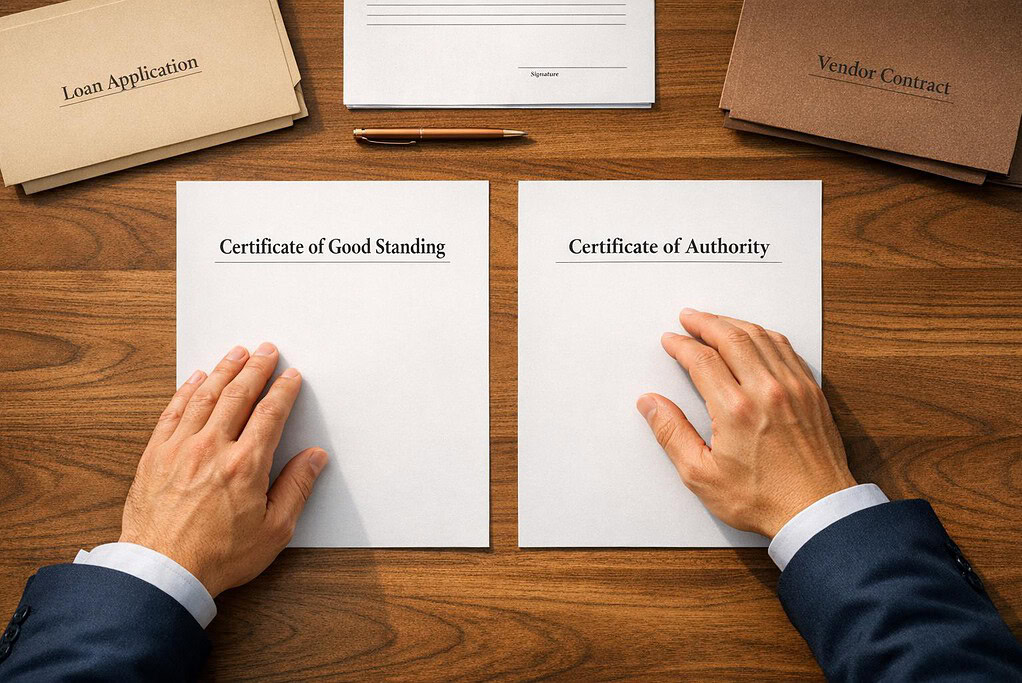
When running a business in the U.S., two important documents often cause confusion: the Certificate of Good Standing and the Certificate of Authority. Here’s the difference:
- **Certificate of Good Standing**: Verifies your business is compliant with its home state’s requirements (e.g., filings, taxes, fees). It’s often needed for loans, contracts, or opening bank accounts.
- Certificate of Authority: Grants legal permission to operate in a state other than where your business was formed, a process known as foreign qualification. It’s required for activities like opening an office or hiring remote employees in another state.
Quick Comparison
| Feature | Certificate of Good Standing | Certificate of Authority |
|---|---|---|
| Purpose | Confirms compliance in home state | Authorizes operations in another state |
| Issued By | Home state’s Secretary of State | Target state’s Secretary of State |
| Usage | Loans, contracts, bank accounts | Expanding or hiring in new states |
| Validity | Typically 30–90 days | Active with ongoing compliance |
| Cost | $5–$100 | Varies by state, often higher |
Both certificates are essential for compliance, depending on your business activities. If you’re expanding, you’ll often need both – starting with the Certificate of Good Standing to apply for the Certificate of Authority.
What is a Certificate of Good Standing?
Definition and Purpose
A Certificate of Good Standing is an official document issued by the state, typically through the Secretary of State. It verifies that your business is properly registered, up-to-date on fees, and compliant with all required filings. Essentially, it confirms your business is active and meeting its legal obligations.
Depending on the state where your business is registered, this certificate might go by other names. However, it’s only available to formally registered entities like LLCs, corporations, and limited partnerships. If you operate as a sole proprietorship or general partnership, you likely won’t need or qualify for one, as these business types don’t typically register with the state.
This document plays an important role in various business activities.
Common Use Cases
A Certificate of Good Standing is often required when businesses:
- Open a business bank account
- Apply for loans
- Enter into major contracts
- Bid on government projects
- Set up payment processing systems for credit and debit cards
- Register to operate in another state, a process called foreign qualification (learn more here)
Certificates usually need to be recent, and the time frame for validity depends on the requesting party or state. Here’s a breakdown of certificate age requirements by state:
| Certificate Age Requirement | States |
|---|---|
| Less than 30 days | Arkansas, Michigan, Vermont |
| Less than 60 days | Arizona, Hawaii, Indiana, Maryland, Missouri, Oregon, Wisconsin |
| Less than 90 days | Connecticut, Florida, Georgia, Iowa, Kansas, Louisiana, Ohio, Utah |
| Less than 6 months | California, Delaware, North Carolina |
| Less than 1 year | New York, Virginia, West Virginia |
Understanding when you’ll need this certificate is just one part of the process. Knowing how to get it is equally important.
How to Obtain One
To secure a Certificate of Good Standing, your business must meet a few key requirements:
- File all annual reports
- Pay any franchise taxes owed
- Ensure an active registered agent is on file
If any of these are incomplete, your application will likely be denied.
Once you’ve confirmed compliance, you can request the certificate through your state’s issuing agency. This is often the Secretary of State’s office, but it varies by location. For example, in Maryland, it’s handled by the Department of Assessments and Taxation; in Virginia, by the State Corporation Commission; and in Wisconsin, by the Department of Financial Institutions. Most states allow you to make the request online, by mail, or in person.
The cost for obtaining a certificate is usually modest. For example:
- California: $5
- Texas: $15
- New York: $25
- Delaware: $50 for a short-form certificate or $175 for a long-form version
A few states, including Colorado, Utah, and Wyoming, even provide the certificate for free.
It’s important to monitor the expiration date of your certificate, especially if a lender or other organization has specific requirements. Regularly checking your status with the Secretary of State can help you stay ahead of compliance issues and ensure your documentation is ready when needed. This proactive approach keeps your business running smoothly and supports its growth.
sbb-itb-ba0a4be
What is a Certificate of Authority?
Definition and Purpose
A Certificate of Authority (COA) is an official document issued by a state that allows a business, considered a "foreign entity" outside its home state, to legally operate within its borders. This process, called foreign qualification, ensures the business is recognized by the new state. Without a COA, a business might be unable to file or sustain a lawsuit in that state’s courts, though it can still defend against legal actions. Unlike a Certificate of Good Standing, which confirms your business’s compliance in its home state, the COA establishes your legal ability to operate in other states. Operating without this document can create hidden risks, as noted by one compliance expert:
"Operating in a state without proper foreign qualification doesn’t just create a technical violation, it builds an invisible layer of liability." – File Business
The COA may also be referred to as an Application for Authority, Application for Registration, or Application to Transact Business.
When is it Required?
Not every business activity outside your home state necessitates a COA. Minor actions, like occasional emails or phone calls to clients in another state, might not require one. However, establishing a regular presence in a state typically does.
| Activity | Likely Requires COA? |
|---|---|
| Opening a physical office or store | Yes |
| Hiring a remote employee | Yes (due to payroll tax nexus) |
| Regularly meeting clients in person | Yes |
| Bidding on state government contracts | Yes |
| Occasional email or phone correspondence | No |
| Isolated, non-recurring transactions | No |
One common scenario that catches business owners off guard is hiring remote employees. As Andy White of Filejet explains:
"Even one remote employee in another state can create a ‘payroll tax nexus,’ triggering the need for a COA."
If your business activities meet the criteria for requiring a COA, you’ll need to take the following steps to obtain one.
How to Obtain One
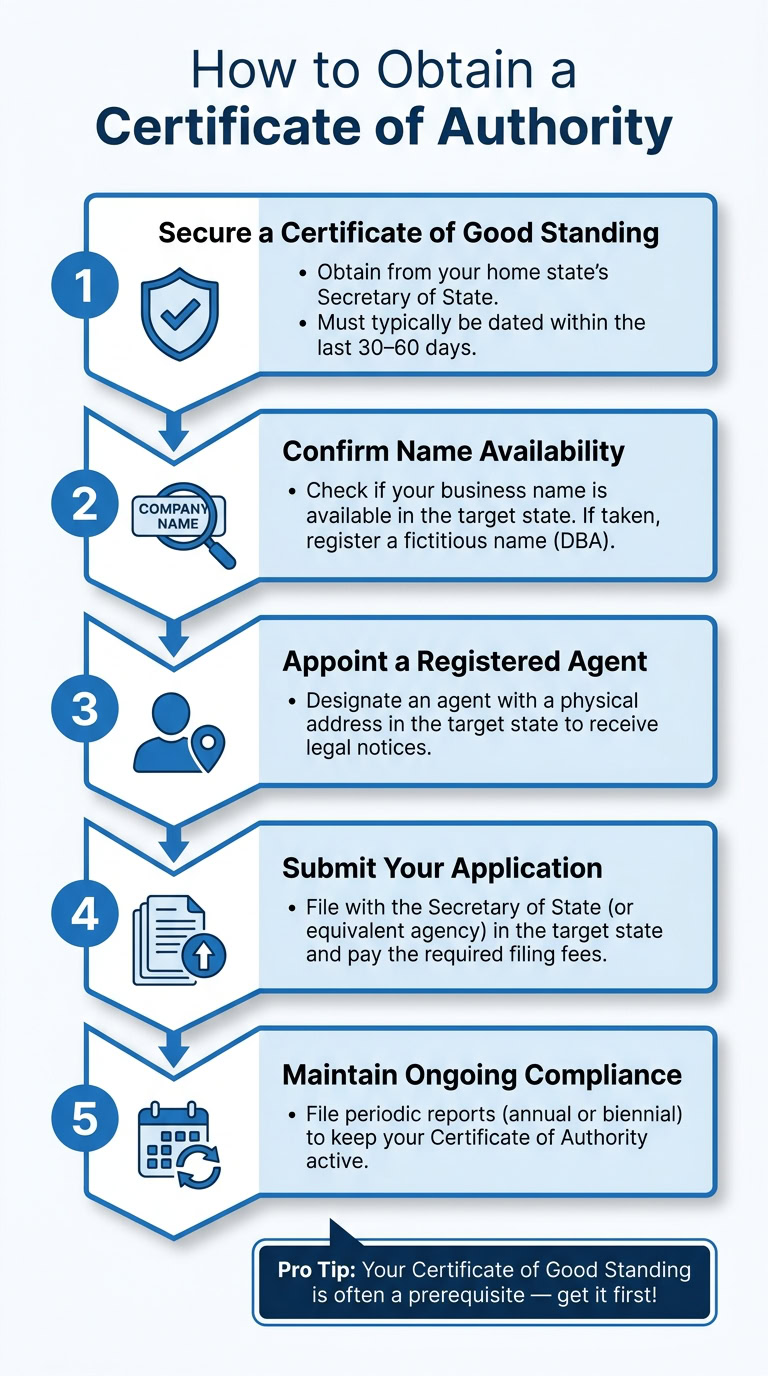
- Secure a Certificate of Good Standing from your home state, as most states require this document.
- Confirm name availability in the state where you plan to operate. If your business name is already in use, you might need to register a fictitious name (also called a DBA) in that state.
- Appoint a registered agent with a physical address in the target state. This individual or service will handle legal notices on your behalf.
- Submit your application to the Secretary of State (or equivalent agency) in the target state, along with the necessary filing fees.
- Maintain compliance by filing periodic reports – most states require annual or biennial updates to keep your COA active.
For more details about the role of a registered agent in this process, check out our guides on what a registered agent does and how to register your business in another state.
Certificate of Good Standing vs. Certificate of Authority: A Side-by-Side Comparison
Let’s break down how these two certificates are alike and where they differ, helping clarify their roles in business compliance and expansion.
Similarities
Both documents are issued by state authorities, often the Secretary of State or a similar agency. They’re not just one-and-done tasks – keeping either certificate valid requires staying on top of state obligations like filing reports and paying fees. In some cases, you might even need both. For instance, the Nationwide Multistate Licensing System (NMLS) often asks for a Certificate of Good Standing from your home state alongside a Certificate of Authority for the state where you’re applying for licensure.
Note: If you’re using a Certificate of Good Standing to apply for a Certificate of Authority, it typically needs to be dated within the last 30–60 days. Submitting an outdated certificate could slow down the process.
Differences
The key difference lies in their purpose. A Certificate of Good Standing focuses on your business’s compliance within its home state, while a Certificate of Authority allows your business to legally operate in a different state.
| Feature | Certificate of Good Standing | Certificate of Authority |
|---|---|---|
| Purpose | Verifies compliance in your home state | Authorizes operations in another state |
| Issued by | Secretary of State in your home state | Secretary of State in the state where you want to operate |
| When it’s needed | To confirm good standing within your home jurisdiction | For expanding operations beyond your home state |
| What it proves | Your business meets tax, reporting, and fee requirements | Your business is registered to operate in another state |
| Filing fee | $5–$100, depending on the state | Varies by state, often higher than Good Standing fees |
| Validity | Often valid for 30–60 days for official use | Active as long as compliance is maintained |
Practical Tips for Managing Both Certificates
How to Decide Which Certificate You Need
Are you proving compliance, or are you requesting permission?
The type of certificate you need depends on the situation. If a bank, lender, or contract partner requires proof that your business is in good standing with its home state, you’ll need a Certificate of Good Standing. However, if you’re conducting regular operations in a state where your business isn’t registered, you’ll need a Certificate of Authority. In some cases – like applying for a license through the NMLS – you might need both. Often, the Certificate of Good Standing is a necessary step before applying for a Certificate of Authority.
| Situation | Certificate Needed |
|---|---|
| Applying for a business loan | Certificate of Good Standing |
| Opening a bank account | Certificate of Good Standing |
| Signing a major contract | Certificate of Good Standing |
| Expanding operations to a new state | Certificate of Authority |
| Hiring employees in another state | Certificate of Authority |
| Applying for a state business license | Often both |
Once you know which certificate applies, the key is to ensure it remains valid through consistent compliance efforts.
How to Stay Compliant Across States
Keeping your certificates valid isn’t a one-and-done task – it requires ongoing attention to compliance.
Each certificate comes with its own requirements for staying current. Validity periods can range from as short as 30 days in some states to as long as a year in others. To avoid any lapses, maintain a compliance calendar to track when renewals or updates are due. This is especially important for meeting lender or licensing board requirements, which often demand up-to-date documentation.
"Maintaining good standing isn’t just about avoiding penalties. It keeps your company operationally ready – able to open accounts, close deals, and move quickly when opportunities arise." – Ramp
A compliance calendar can help you stay organized by tracking annual report deadlines, fees, and renewal dates for all states where your business operates. Pair this with a centralized digital folder to store critical documents – like essential business formation documents, past annual reports, and current certificates. When a bank or licensing board requests proof, you’ll have everything at your fingertips, saving time and reducing stress.
For added convenience, tools like BusinessAnywhere can simplify the process. Their compliance alerts and registered agent services ensure you never miss a deadline, whether you’re managing a single LLC or operating in multiple states.
Conclusion
Understanding the purpose of each certificate is crucial for protecting your business and ensuring smooth growth. A Certificate of Good Standing confirms your compliance with state regulations in your home state, while a Certificate of Authority allows you to legally operate in another state. Mixing these up – or missing a renewal deadline – can lead to serious consequences, like stalled loans, blocked contracts, or even fines. While costs are typically low and vary by state, staying on top of renewal periods is critical for avoiding unnecessary setbacks.
"A Certificate of Good Standing validates the legitimacy of your business." – Alex Kehayias, Founder, Mosey
Managing compliance means keeping track of deadlines, fees, and regulations in every state where your business operates. While it might seem straightforward when working in one state, the complexity grows as your business expands. Tools like BusinessAnywhere make this process easier with features like automated reminders, registered agent services for multiple states, and a centralized dashboard. With proper management and a clear understanding of these certificates, you can ensure compliance and support your business’s interstate growth seamlessly.
FAQs
Do I need both certificates to expand into another state?
Yes, you generally need both. A Certificate of Good Standing verifies that your business meets all requirements and is in compliance with the laws of its home state, establishing its legitimacy. On the other hand, a Certificate of Authority grants your business the legal right to operate in a different state. These two documents work together, ensuring your business remains compliant in both your home state and the new state where you plan to expand.
What happens if I operate in another state without a Certificate of Authority?
Operating in a different state without a Certificate of Authority can lead to your business being classified as unauthorized. This could expose you to fines, penalties, or even legal challenges. Beyond that, your business may lose the ability to enforce contracts or pursue legal claims in that state, which can disrupt operations and create compliance headaches.
How can I tell if my out-of-state activity triggers a Certificate of Authority?
If your business operates in another state, you might need a Certificate of Authority. This is often required when your activities in that state go beyond occasional transactions. Examples include:
- Running an office
- Hiring employees
- Owning property
- Engaging in consistent business transactions
However, one-off activities like filing a lawsuit or sporadic transactions typically don’t trigger this requirement. To be sure about your specific situation, review the regulations of the state in question or seek legal advice.