

If your LLC moves, I’d update more than one record right away. In most cases, I need to handle the state filing first, then IRS Form 8822-B within 60 days, and then update banks, tax accounts, licenses, and mail systems.
Here’s the short version:
- I first figure out which address changed: principal office, mailing, or registered office.
- I then file the right state form. That might be an amendment, annual report update, Statement of Information, or a registered agent/office change.
- After the state record posts, I send Form 8822-B to the IRS.
- Then I update state tax agencies, local permits, banks, payment processors, insurers, vendors, and USPS forwarding.
- Last, I save proof that each update was filed and posted.
Why does this matter? Because a missed address update can lead to lost tax mail, missed legal notices, late fees, or even loss of good standing. And the IRS deadline is clear: 60 days for Form 8822-B.
The main idea is simple: I don’t treat an LLC address change like a small admin task. I treat it like a compliance checklist with three parts:
- State records
- IRS and tax records
- Banking, licensing, and mail records
If I complete all three, my LLC’s records stay aligned and mail keeps going to the right place.
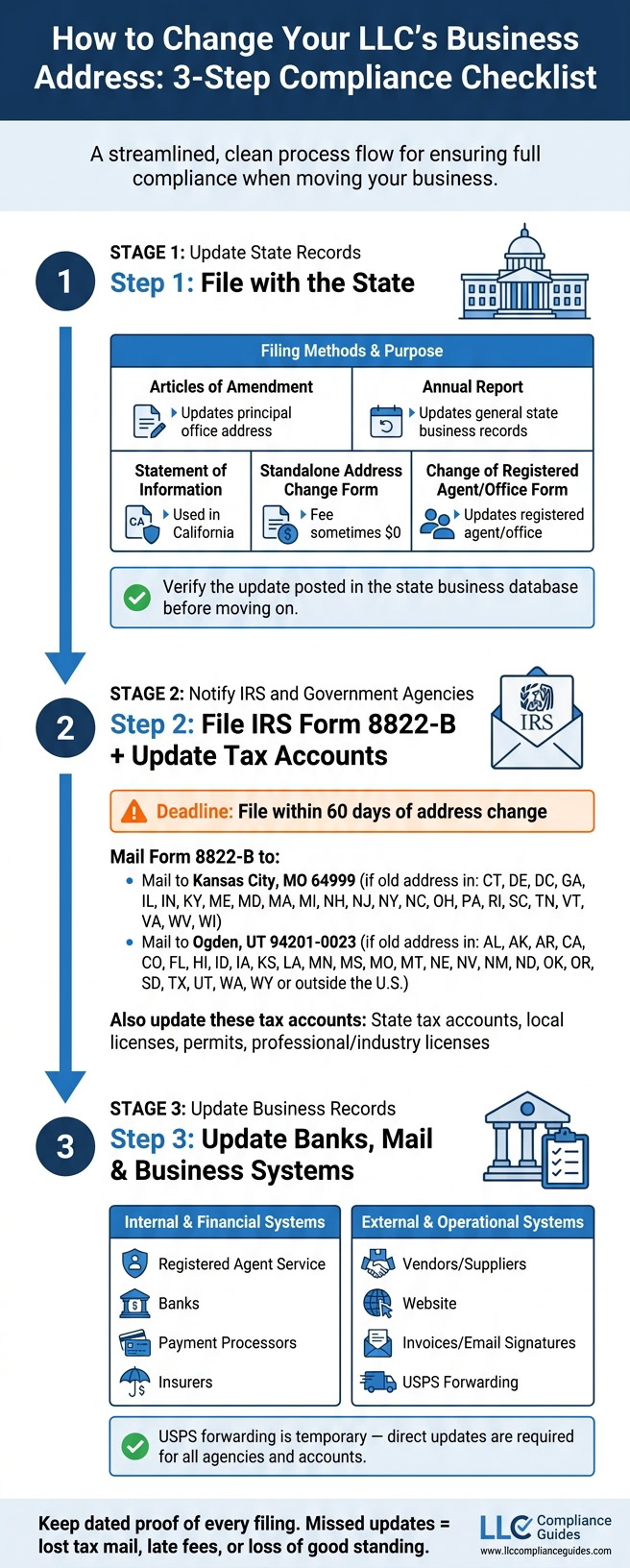
Step 1: Update your LLC address with the state
Find the right state form for your address type
Once you know which address changed, update the state record first. Start by checking your LLC record on your Secretary of State or corporations division website. Look at the address field that changed, then use the filing your state ties to that field.
In many states, you’ll use Articles of Amendment to change the principal office address listed in your Articles of Organization. Some states let you make that change through your annual report or a Statement of Information, which California uses. Others want a separate address-change form if the update happens outside the annual report window. If you’re changing your registered agent or registered office, that usually calls for a different form.
Before you file, review your operating agreement and see whether member or manager approval is required.
Submit the filing, pay the fee, and confirm the update posted
Most address-change filings ask for the same core details:
- Your LLC name
- The exact address change
- The effective date
- A signature from an authorized member or manager
Fees depend on the state and the filing type. Articles of Amendment usually come with a state filing fee. A standalone address-change form may cost $0 in some states. And if you update the address through your annual report, the change may be included in the standard report fee.
After the state processes the filing, search your LLC record in the state business database and make sure the new address appears there. In plain English: don’t assume it went through just because you submitted it. Verify the update in the state database.
Comparison table: common state filing methods for LLC address changes
These are the filing paths most LLCs run into.
| Filing Method | What It Updates | Typical Data Required | Fee Commonly Charged? |
|---|---|---|---|
| Articles of Amendment | Principal office address in the original Articles of Organization | LLC name, original filing date, new address, effective date, authorized signature | Yes |
| Annual Report | General state business records including principal and mailing addresses | Current address, member/manager names, registered agent info | Yes (included in annual fee) |
| Statement of Information | Periodic state records, used in California, covering principal office and mailing address | Entity number, principal office address, mailing address, officer/member info | Yes (often lower than amendments) |
| Standalone Address Change Form | Specific principal or mailing address fields only | Old address, new address, authorized signer name | Varies (sometimes $0) |
| Change of Registered Agent/Office | Registered agent name and/or registered office address | New agent name, new registered office address, agent consent | Yes (often a smaller fee) |
Once the state record posts, move on to the IRS and your other business records.
Step 2: Notify the IRS and update other government records
Once the state filing posts, update the IRS record linked to your EIN. If you miss this step, tax notices and other official mail may still go to your old address.
How to use IRS Form 8822-B to update your business address
Use IRS Form 8822-B to tell the IRS about a new mailing address, business location, or responsible party. File it when your IRS records no longer match your current business address. You should file Form 8822-B within 60 days of the address change.
Enter your LLC’s legal name and EIN exactly as they appear in IRS records. Then add your old mailing address, your new mailing address, and your new business location. An authorized signer must sign and date the form.
Send the form to the IRS center based on the state tied to your old address.
| Old Business Address State | Mail Form 8822-B To |
|---|---|
| CT, DE, DC, GA, IL, IN, KY, ME, MD, MA, MI, NH, NJ, NY, NC, OH, PA, RI, SC, TN, VT, VA, WV, WI | Internal Revenue Service, Kansas City, MO 64999 |
| AL, AK, AR, CA, CO, FL, HI, ID, IA, KS, LA, MN, MS, MO, MT, NE, NV, NM, ND, OK, OR, SD, TX, UT, WA, WY, or outside the U.S. | Internal Revenue Service, Ogden, UT 94201-0023 |
Keep a copy of the completed form and write down the exact date you mailed it. That small step can save a headache later if you need to check on it. If you want a status update, call the IRS business line at 800-829-4933. After that, move on to any state or local tax or licensing account that still shows the old address.
Update state tax accounts, local licenses, and permit records
After the IRS, update every tax and licensing record that sends mail to your LLC. Each account has to be updated on its own, or you could miss tax notices, bills, or license renewal mail.
Start with your state tax agencies. If your LLC has a sales tax permit, franchise tax account, or state income tax account, update the address through that agency’s online portal or by contacting the agency directly. Then update any city and county licenses or permits with the office that issued them.
Also update any professional or industry licenses with the board that issued them.
sbb-itb-ba0a4be
Step 3: Update your registered agent, banks, and business mail systems
Once the state and IRS records are done, the next job is to line up the records your bank, vendors, and service providers use. A lot of LLC owners handle the state filing and stop there. Then old bank records, account profiles, or internal files keep pointing to the wrong place, which can lead to missed notices.
Update registered agent records if your registered office changed
A registered office must be a physical in-state street address staffed during business hours. A P.O. box does not qualify.
If your change involves the registered office, not just your principal or mailing address, file the right state update first. Then make sure your operating agreement or member resolutions match that filing.
If you use a professional registered agent service, update the address in your account dashboard too. That helps the provider keep sending compliance notices and legal mail to the right place.
After that, go through every financial and vendor account that still shows the old address.
Update banks, payment processors, insurers, vendors, and customer-facing documents
Next, update your banks, card processors, insurers, and other service providers. Keep each account in sync so you don’t run into verification issues or miss notices.
It’s also smart to update anything customers or outside partners might see, including:
- Your website
- Invoices
- Email signatures
- Vendor records
That way, everyone sees the same current address.
How USPS forwarding and a virtual business address fit into your address change
USPS forwarding can help while mail is still in transit to the old address, but it doesn’t replace direct updates with agencies, banks, and vendors.
A virtual business address can give remote owners a steady mailing address and mail scanning. That’s useful if you move often or run the business from different places. But there’s one catch: a virtual mailbox is not a registered agent address.
Final checklist: verify every address update and stay compliant
Use this checklist to make sure every record now shows your new address.
Compliance tracking table: where your LLC address must be updated
Use the table below to confirm each update was filed, posted, and saved.
| System or Agency | Address on Record | Confirmation Received |
|---|---|---|
| Secretary of State | Principal / Registered Office | Stamped copy |
| IRS (Form 8822-B) | Mailing / Location | Portal confirmation |
| Registered Agent | Registered agent service | Updated record |
| State Tax Accounts | Tax Mailing | Portal confirmation |
| Local Licenses / Permits | Business Location | Updated record |
| Banks | Billing / Business | Updated record |
| Payment Processors | Business profile | Portal confirmation |
| USPS / Mail Systems | Forwarding Address | Forwarding confirmation |
| Insurers | Policy and billing | Policy endorsement |
| Vendors / Suppliers | Shipping / Billing | Updated record |
| Internal Records | Operating agreement, website, invoices | Current versions on file |
Check the state record before you close the file. If the new address shows there, you’re in good shape. Once every line is filled in, your LLC records, notices, and billing accounts should all point to the same place.
Key points to review before you move on
Before you wrap this up, confirm these three items:
- Use separate filings for principal, mailing, and registered office changes.
- Update the registered agent record separately when legal-notice mail changes.
- Keep IRS and state filing copies with dated proof of submission.
FAQs
Do I need to change my LLC address with the state before the IRS?
Generally, yes. Start with the state, because that sets your official business record.
Once the state has processed the change, notify the IRS by filing Form 8822-B within 60 days of changing your business mailing address or location.
These are two separate compliance steps, and both help keep your LLC in good standing.
What happens if I forget to update my LLC business address?
Failing to update your LLC’s business address can create serious legal and financial problems.
If you don’t notify the IRS with Form 8822-B within 60 days, you may face penalties.
And that’s only part of the risk. An old address can cause you to miss tax documents, government notices, or even lawsuits. That can snowball into default judgments, fines, loss of good standing, or even administrative dissolution.
Can I use a virtual address for my LLC?
Yes. You can use a virtual address for your LLC as a professional mailing address for general business mail, banking, and branding.
But it can’t be your registered agent address. An LLC must keep a physical street address in the state where it was formed so it can receive service of process and other official legal documents.
When you pick a provider, look for one that is CMRA-registered and gives you a real street address.