

If you own an LLC, setting aside too little for taxes can leave you short by thousands of dollars. In most cases, I’d start with 25% to 30% of net profit for a default LLC and 15% to 20% for an LLC taxed as an S corporation. Your final number depends on self-employment tax, federal income tax, state income tax, profit level, and how your LLC is taxed.
Here’s the short version:
- Single-member LLCs usually need to cover (which can be taxed as S corporations) self-employment tax + federal income tax + state tax
- Multi-member LLCs usually face the same issue, but each member pays tax on their share
- S corps often need a lower set-aside because only salary faces payroll tax, not distributions
- If you expect to owe $1,000 or more, the IRS usually wants quarterly estimated payments
- For many owners, the safest move is to transfer a set percentage from each payment into a separate tax account
A fast example: if your LLC earns $100,000 in net profit, federal self-employment and income taxes alone can land around $26,000 to $27,000, before state tax. That’s why a rough “save whatever is left in April” plan usually fails.
| LLC tax setup | Common starting set-aside |
|---|---|
| Single-member LLC | 25%–30% |
| Multi-member LLC | 25%–30% |
| LLC taxed as S corp | 15%–20% |
The main idea is simple: I’d pick a starting percentage, automate transfers, and adjust it when profit, deductions, or tax status change.
What Taxes Your LLC Income May Trigger
The right set-aside comes down to one thing: which taxes apply to your LLC profit.
For most LLC owners, that means setting money aside for:
- Self-employment tax
- Federal income tax
- State income tax, if your state has one
Those are the main taxes your reserve needs to cover.
Default LLC Taxation: Sole Proprietorship or Partnership
A single-member LLC reports business income on Schedule C as part of the owner’s personal tax return. A multi-member LLC files an informational return, Form 1065, and gives each member a Schedule K-1 that shows their share of the profit. If the owners work in the business, they generally pay self-employment tax on that profit.
That self-employed status means self-employment tax sits on top of regular income tax. Then federal income tax applies at graduated rates from 10% to 37%, based on total taxable income after deductions. Most states also tax income, though there are several states with no income tax. Wyoming and Florida, for example, have no state income tax.
This is where a lot of LLC owners get tripped up. They look at profit and think only about income tax, but self-employment tax can take a big bite too. That’s why default LLCs often need a bigger reserve than S corps, as seen in the S corp vs LLC tax benefits comparison.
LLCs Taxed as S Corporations
An LLC can choose S corporation tax treatment by filing IRS Form 2553. With that election, the owner becomes an employee of the business and must pay themselves a reasonable salary. Under default LLC taxation, business income is usually subject to self-employment tax. Under S corp taxation, income is split between salary and distributions. The salary is subject to payroll tax, while the distributions are not.
That split changes the math in a big way. It also helps explain why reserve percentages can look so different from one LLC to another – and why the next step is turning profit into a set-aside amount that works in practice.
sbb-itb-ba0a4be
How Much Should You Set Aside for LLC Taxes?
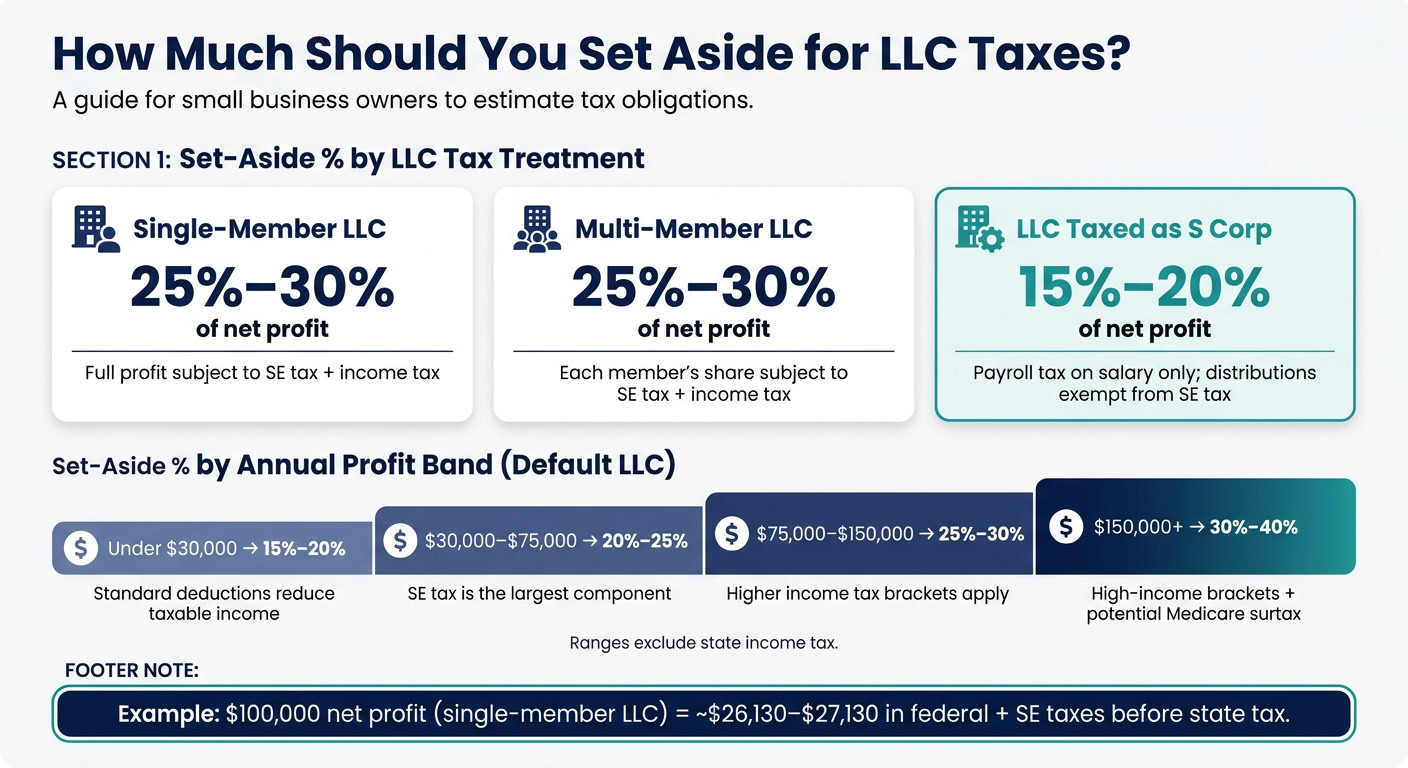
Your tax setup and net profit give you a good starting point for your tax reserve. Once you know how your LLC is taxed, you can use the ranges below to estimate how much to set aside.
The 25% to 30% Range for Most Default LLCs
If your LLC is taxed as a sole proprietorship or partnership, a common starting point is 25% to 30% of net profit.
When 15% to 20% May Apply for an LLC Taxed as an S Corp
If your LLC is taxed as an S corp, start with 15% to 20%. Then adjust based on how much you pay yourself in salary and how much total profit the business earns.
Set-Aside Ranges by Tax Treatment and Profit Level
The tables below can help you narrow down your reserve percentage.
By LLC Tax Treatment
| Tax Treatment | Primary Tax Exposure | Typical Set-Aside Range |
|---|---|---|
| Single-Member LLC | Full profit subject to SE tax + income tax | 25% – 30% |
| Multi-Member LLC | Each member’s share subject to SE tax + income tax | 25% – 30% |
| LLC Taxed as S Corp | Payroll tax on salary only; distributions exempt from SE tax | 15% – 20% |
By Annual Profit Band (Default LLC)
If you want a quick estimate, use this table.
| Annual Profit | Estimated Federal Tax Reserve | Notes |
|---|---|---|
| Under $30,000 | 15% – 20% | Standard deductions reduce taxable income |
| $30,000 – $75,000 | 20% – 25% | SE tax is the largest component |
| $75,000 – $150,000 | 25% – 30% | Higher income tax brackets apply |
| $150,000+ | 30% – 40% | High-income brackets and potential Medicare surtax |
These ranges do not include state tax. So if your LLC shows $100,000 in net profit, a single-member LLC may owe about $26,130 to $38,130 in federal and self-employment taxes before state tax.
How to Calculate Your Set-Aside and Quarterly Payments
A Simple Calculation Starting with Net Profit
Start with the percentage range from the last section, then check it against your actual net profit. That gives you a rough number first, and then a more grounded estimate.
For a single-member LLC with $100,000 in annual net profit and a single filer return, it can look like this:
- SE tax: $100,000 × 92.35% × 15.3% = ~$14,130
- Adjusted gross income (AGI): $100,000 − $7,065 (half of SE tax deduction) = $92,935
- Taxable income: $92,935 − $15,000 (standard deduction) = $77,935
- Federal income tax: ~$12,000–$13,000 depending on deductions and bracket
- Total annual federal tax: ~$26,130–$27,130
- Monthly reserve: ~$2,177–$2,260
That monthly reserve isn’t just a tax-season cushion. It also needs to cover your quarterly estimated payments.
How Estimated Quarterly Payments Work
If you expect to owe $1,000 or more in federal taxes for the year, the IRS usually expects you to make estimated quarterly payments. Each payment covers a set stretch of income. For 2026, the due dates are:
| Quarter | Income Period | Due Date |
|---|---|---|
| Q3 | Jun 1 – Aug 31 | September 15, 2026 |
| Q4 | Sep 1 – Dec 31 | January 15, 2027 |
This is why your reserve matters all year long, not just in April. To avoid an underpayment penalty, you generally need to pay at least 90% of your current-year tax or 100% of your prior-year tax. If your prior-year AGI was over $150,000, the bar moves to 110% of last year’s tax.
Pay too little, or pay late, and penalties can show up. Not fun.
If your income goes up or down during the year, update your payments to match what you’re actually earning. That simple habit can save you from a nasty surprise later.
Tools That Make the Estimate Easier
IRS tax estimator tools can help you dial in your yearly tax estimate. For payment scheduling, the Electronic Federal Tax Payment System (EFTPS) lets you set up all four quarterly payments ahead of time.
If your income is uneven during the year, there’s another option. The annualized income installment method using IRS Form 2210, Schedule AI, lets you base each quarterly payment on what you earned in that quarter instead of splitting your yearly estimate into four equal payments.
Once you land on a number, automate the transfer. That way, the reserve stays put instead of getting eaten up by day-to-day spending. The next step is turning that estimate into a separate savings habit.
Build a Tax Savings System and Adjust It as Income Changes
Use a Separate Tax Savings Account and Automatic Transfers
Once you know your set-aside percentage, put it on autopilot so the money is reserved before you have a chance to spend it.
This part matters more than people think. A reserve only works when it stays separate from your operating cash. If tax money sits in the same account as the rest of your business funds, it’s way too easy to treat it like money you can use.
Keep tax money in a separate account as soon as a client payment comes in. Then transfer your set percentage right away. That one habit makes a big difference.
A separate tax savings account helps you:
- keep tax funds off-limits
- avoid mixing tax money with day-to-day business cash
- make quarterly payments with less stress
When to Adjust Your Reserve Percentage
After your system is up and running, check it again when your tax situation changes.
That can happen after a major jump or drop in profit, an S corp election, a move to a state with income tax, or a big deduction like a SEP-IRA or Solo 401(k). Any of those can change how much you should be setting aside.
Conclusion: Start with a Working Percentage and Refine Over Time
Start with a percentage that works, automate the transfers, and update it as your income changes.
FAQs
Should I save taxes from gross income or net profit?
Save for taxes based on net profit – not gross income and not your personal draw. Net profit is your total revenue minus ordinary business expenses.
That distinction matters more than a lot of people think. You can leave money sitting in your business account and still owe income tax and self-employment tax on the full net profit. The IRS doesn’t care whether you moved that cash to your personal account.
Using net profit as your baseline helps you set aside the right amount and avoid ugly cash-flow surprises later.
What if my LLC income changes during the year?
If your income shifts during the year, run the numbers again before each quarterly payment. That simple habit can help you avoid underpayment penalties. Look at your year-to-date revenue and expenses, then estimate what you’re likely to earn for the rest of the year.
If your income comes in waves or swings a lot, you may want to use the annualized income installment method on Form 2210, Schedule AI. Another option is the safe harbor rule, which uses a percentage of your previous year’s tax liability.
How do I know if an S corp election lowers my tax reserve?
An S corp election can cut your tax reserve by changing how self-employment taxes work. With a default LLC, you pay 15.3% self-employment tax on all of your net profit.
If you elect S corp status, only your reasonable salary gets hit with payroll taxes. The rest of the profit, when taken as distributions, is generally not subject to those taxes. That can lower the amount you need to set aside for federal taxes.