
No – you do not need your own U.S. address to form an LLC as a non-resident.
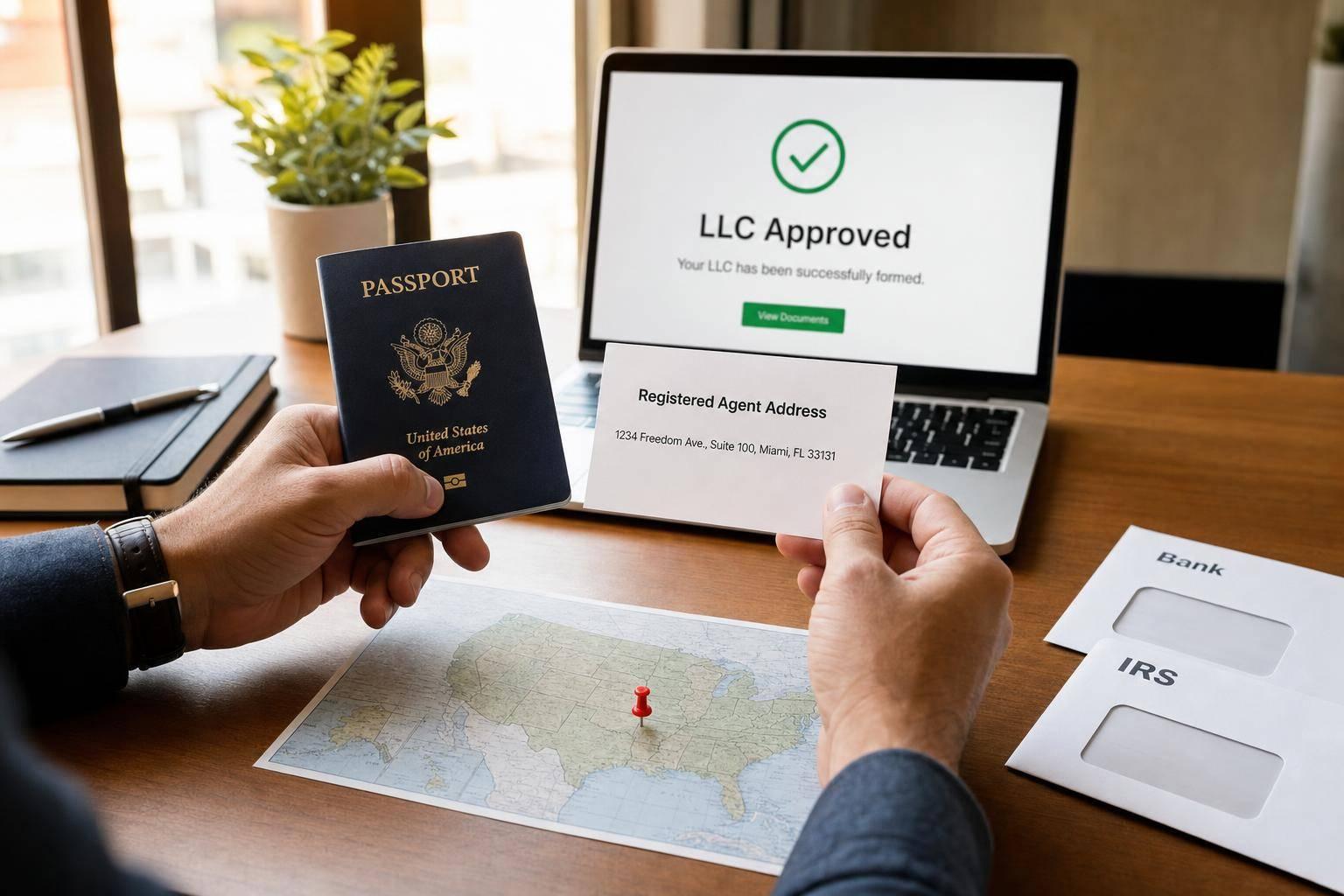
What you do need is a registered agent with a physical street address in the state where you form the LLC.
Here’s the short version:
- Your personal address can be outside the U.S.
- Your EIN can often be tied to your foreign home address (see how to get an EIN as a non-resident)
- Your registered agent address must be in the state
- Your bank may still ask for a U.S. business street address
- Missing Form 5472 can cost at least $25,000 per year if foreign owners hold 25% or more
This topic gets confusing because people mix up state filing rules, IRS rules, and bank rules. They are not the same thing.
A simple way to think about it:
- The state wants a registered agent
- The IRS may accept your foreign address
- Banks and payment processors often want more
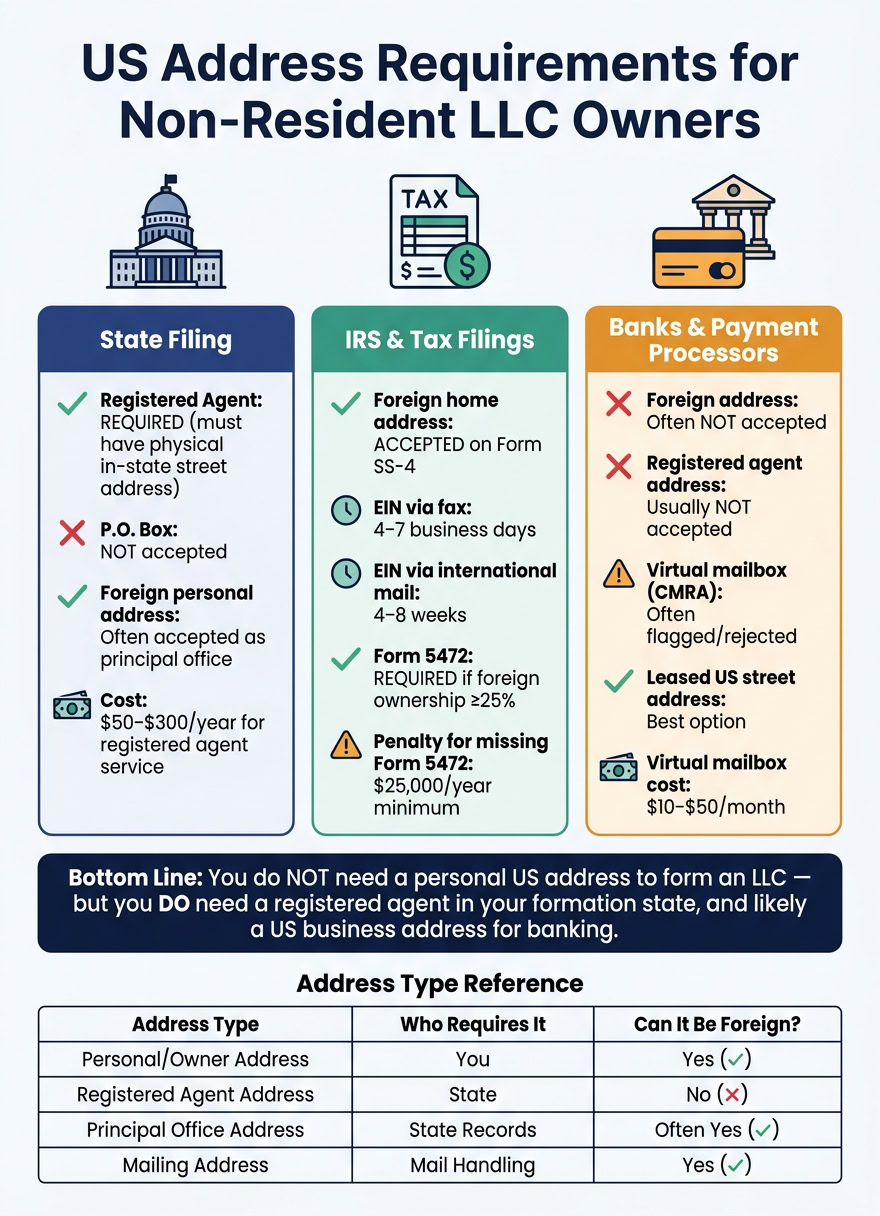
| Address type | Who uses it | Can it be foreign? |
|---|---|---|
| Personal/owner address | You | Yes |
| Registered agent address | State | No |
| Principal office address | State records | Often yes |
| Mailing address | Mail handling | Yes |
So if I had to sum up the whole article in one line, it would be this: you can form the LLC without your own U.S. address, but you may still need a U.S. mailing or business address later for banking, payments, or mail.
What States Require When You Form an LLC
When you file Articles of Organization, states usually ask for two things: a registered agent and one or more business addresses.
Registered Agent Address: The One US Address You Cannot Skip
Every LLC must name a registered agent with a physical street address in the state where you form the LLC. That address is where legal notices and government mail go. A P.O. box doesn’t count, and someone must be there during business hours to accept documents.
A registered agent service usually costs $50 to $300 per year. That can meet the state’s filing rule. But it doesn’t always meet the needs of the IRS, banks, or payment processors.
Principal Office Address: How State Rules Differ
The principal office address is the business address a state may ask for on your formation documents. In most states, a foreign principal office address is fine. But some states still want a street address for business records, so it’s smart to check your state’s filing form before you submit anything.
For non-residents, here’s the main thing to know: the state needs a registered agent address, not always a personal U.S. address. After that, the issue shifts from state filing to federal tax, banking, and mail handling.
When a Foreign Address Works and When a U.S. Address Is Needed
A foreign address can be enough for the IRS. But when you move into banking, payments, and day-to-day LLC setup, things change fast. In many cases, you’ll still need a U.S. street address.
EIN and IRS Filings: Using Your Home-Country Address Correctly
The IRS does not require a U.S. address to get an EIN. If you’re a non-resident, you can list your foreign home address on Form SS-4, and the IRS will send the CP575 to that address.
Timing matters here. International mail can take 4 to 8 weeks, while fax filing often gets you an EIN in 4 to 7 business days. If you’re trying to open a bank account or get approved by a payment processor fast, that gap can be a big deal.
There’s another rule you can’t ignore. If foreign persons own at least 25% of the LLC, the company must file Form 5472 every year, even if it had no income. Miss it, and the minimum penalty is $25,000 per year.
So yes, your home-country address can work on the IRS side. The next issue is whether that same address will pass checks for banking and compliance mail.
Banking, Payment Processors, and Compliance Mail
This is where many founders hit a wall. A foreign address may be fine for the IRS, but banks and payment processors often want a U.S. business street address. They may also reject P.O. boxes and even registered agent addresses.
Why does this trip people up? Because address matching matters. If your LLC records, EIN details, and bank application don’t line up, approval can stall.
A virtual mailbox can help fill that gap. It gives you a U.S. street address for business mail, and it usually costs $10 to $50 per month.
That’s the point where the choice between a registered agent, a virtual mailbox, and your home address starts to matter.
sbb-itb-ba0a4be
Choosing the Right Address Setup as a Non-Resident
Registered Agent vs. Virtual Mailbox vs. Your Home Address
Once you know what the state, the IRS, and banks will accept, picking an address setup gets much simpler.
Here’s how the main address options line up with the key parts of running an LLC: Step Registered Agent Address Virtual Mailbox (US) Foreign Home Address
Most virtual mailboxes are classified as Commercial Mail Receiving Agencies (CMRAs). That matters because many banks look at CMRA addresses as a red flag during account opening. In plain English: a virtual mailbox may work for mail, but it often won’t solve your banking problem. Some banks want a leased U.S. street address instead.
Common Non-Resident Scenarios and the Address Each One Needs
The best setup depends on what you want the LLC to do.
| Scenario | Minimum Setup | Recommended Next Step |
|---|---|---|
| Freelancer forming a US LLC from abroad | Registered agent + foreign home address | Add a virtual mailbox for invoices and client-facing credibility |
| E-commerce seller opening a US account | Registered agent + virtual mailbox | Consider a leased U.S. office address if a platform requires a verifiable U.S. street address |
| Real estate investor holding rental property through a US LLC | Registered agent | Use the property address as the physical business location |
The freelancer setup is usually the easiest for those managing operations from abroad. The registered agent covers the in-state rule, and a foreign home address is often fine on IRS Form SS-4. A virtual mailbox is mostly about handling invoices and giving you a cleaner mailing setup.
For e-commerce sellers, things can get trickier. Many platforms ask for a verifiable U.S. business address. A virtual mailbox may be enough at first, but if the address gets flagged as a CMRA, you may need to lease a U.S. office address.
For real estate investors, the setup is often more direct. The registered agent covers state compliance, and the property address can often be used as the physical business location.
How BusinessAnywhere Covers the Address and Compliance Pieces

If you’d rather keep all of this under one roof, BusinessAnywhere can handle LLC formation, registered agent service, virtual mailbox, EIN filing, and annual compliance. That also includes Form 5472 preparation for foreign-owned LLCs. Missing that filing can trigger a $25,000 penalty per year.
Conclusion: What Address You Actually Need Before You File
It comes down to which kind of address you’re talking about.
If you’re a non-resident, you do not need a U.S. address to form or own an LLC. But you do need a registered agent with a physical street address in your formation state.
For IRS filings, you can use a foreign address. Banking is where things get trickier. A registered agent address is not a stand-in for a business address, and many banks want a physical U.S. business address that isn’t marked as a CMRA. In practice, a U.S. business address or mail forwarding address is often needed for banking, payment processors, and day-to-day business mail.
So before you send in your LLC filing, line up the address with the rules for your state, the IRS, and your bank. Also check whether your state allows a foreign principal office address before you file.
FAQs
Can I use my registered agent address for my bank account?
Usually, no. A registered agent address is only meant for official government and legal mail, like lawsuits or tax notices.
Banks usually want a separate business or physical address for verification and compliance. If you use a registered agent address, there’s a good chance the bank will reject it, so it’s better to use a dedicated business address instead.
What if my state does not accept a foreign principal office address?
If your state doesn’t accept a foreign principal office address, you can often use your professional registered agent’s address or a third-party virtual business address to satisfy the filing requirement.
Keep these address roles separate. A registered agent must have a physical in-state address for legal notices, but that address may not be accepted for business, banking, or platform verification.
Do I need Form 5472 if my LLC has no income?
Yes. If your single-member LLC is owned by a non-US resident, you still have to file Form 5472 even if the LLC had no income.
That filing rule applies whether the business made money or not. Miss the deadline, and the penalty can be $25,000 – even if the LLC was inactive or owed no tax.