
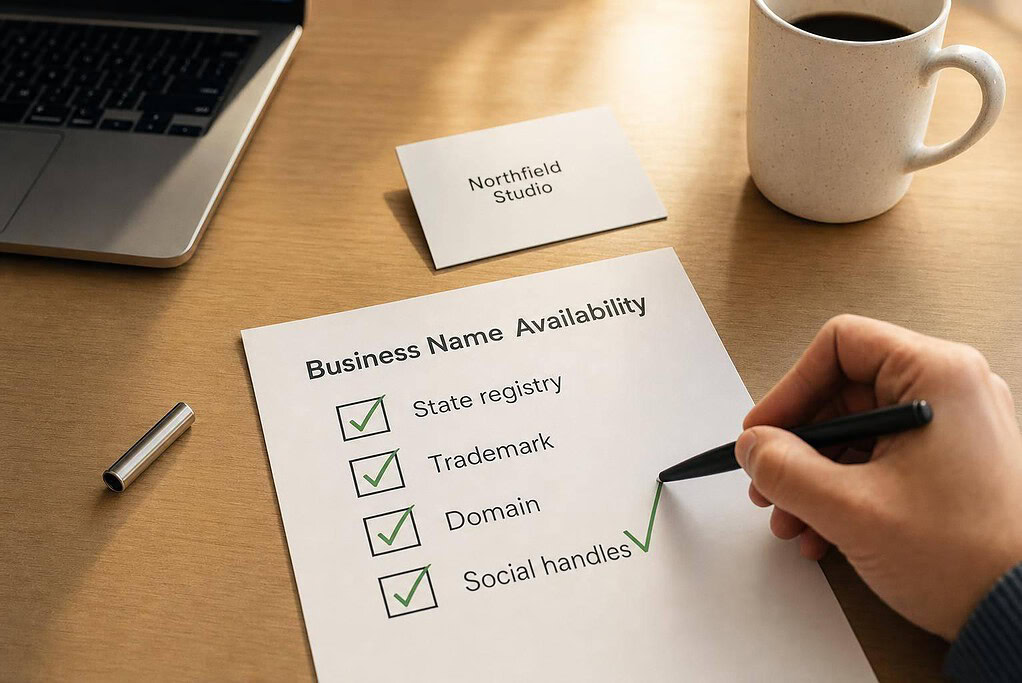
A business name is only usable if it clears four checks: your state registry, trademark search, domain search, and social handle search. If it fails one, it can still cost you time, filing fees, and a brand reset later.
Here’s the short version:
- I’d start with 10 to 20 name ideas
- Cut names that are generic, hard to say, hard to spell, or too narrow
- Keep 3 to 5 finalists
- Check them in this order:
- State business database
- USPTO trademark records
- Domain availability
- Social media handles
- Save screenshots, dates, and search terms
- Recheck everything right before filing
A lot of founders mix up three name types:
- Legal entity name: your LLC or corporation name
- DBA: the public name you use if it differs
- Brand name: the name customers see
Those names can match. But they don’t have to. And approval in one place does not mean approval everywhere else.
| Check | What it tells me | What it does not tell me |
|---|---|---|
| State registry | Whether my entity name may be fileable in that state | Whether I’m clear on trademark issues |
| USPTO search | Whether a similar federal mark may block use | Whether my LLC name is open in my state |
| Domain search | Whether I can buy the web address | Whether I own name rights |
| Social search | Whether matching handles are open | Whether I can claim the name as a brand |
A clear name does more than sound good. It should be easy to say, easy to remember, and easy to use online. And if I plan to grow, I’d avoid names tied too tightly to one city, one product, or one service.
One last point: even small changes like adding “LLC,” switching word order, or using another spelling may not solve a conflict. That’s why I’d screen the name before I spend money on logos, signs, or a website.
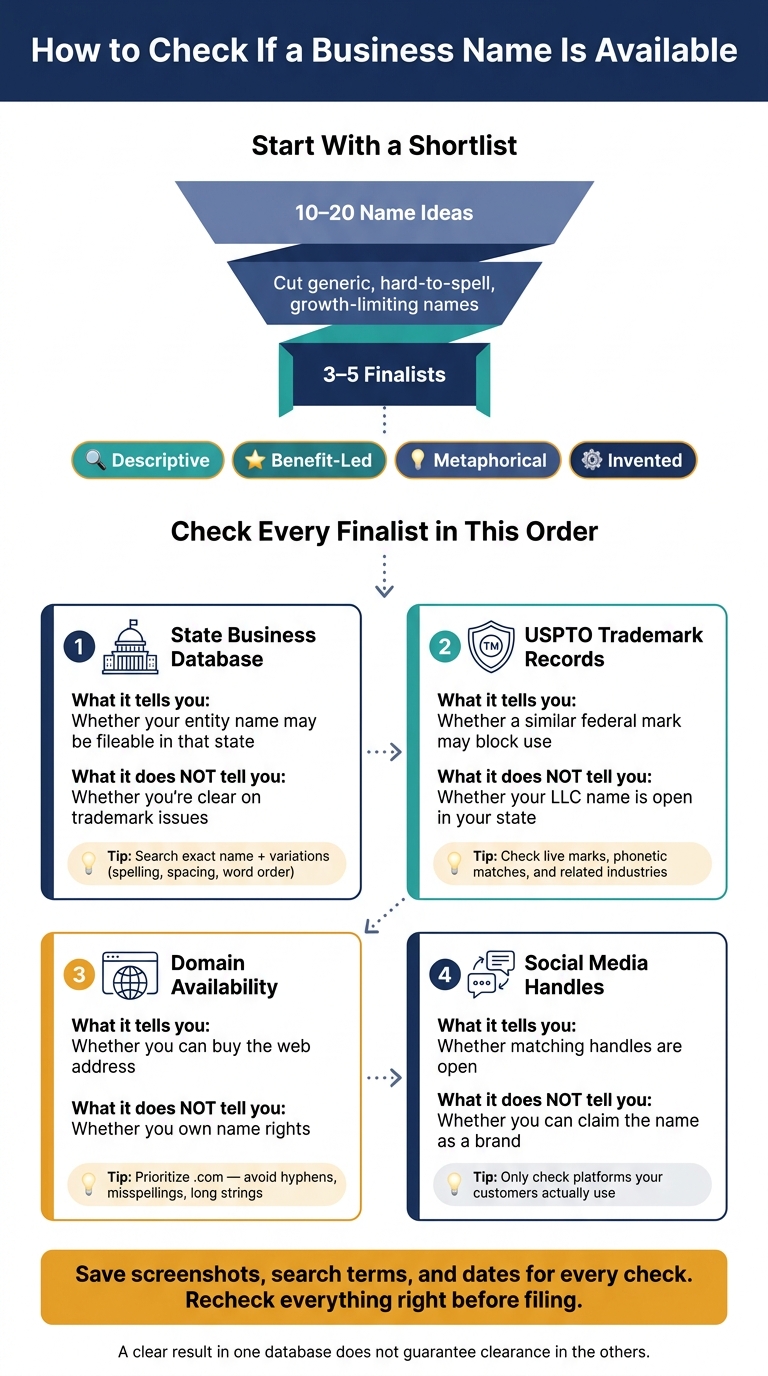
How to Check If a Business Name Is Available: 4-Step Process
Build a Shortlist of Names You Can Actually Use
Start by coming up with 10 to 20 name ideas, then trim the list hard. The point isn’t just to find something original. You need a name you can register, protect, and use without headaches later.
Try a few naming angles so the list doesn’t feel one-note:
- Descriptive names
- Benefit-led names
- Metaphorical names
- Invented names
It’s smart to ask customers, partners, or team members for input. More eyes can help. But keep one person in charge of tracking every idea so nothing gets lost and the list stays clean. Then use the criteria you set earlier to screen ideas fast.
Cut Names That Will Cause Problems Later
Once you have a raw list, be ruthless. Some names look good at first glance, then turn into a mess once you try to use them in the market. Cut anything that creates friction or boxes the brand in later.
Cut purely generic names first. "Best Plumbing Services" is hard to stand out with in search results and hard to protect as a trademark. A descriptive piece can still work if it’s paired with something that stands apart. "Cedarline Plumbing" is much easier to identify than "Quality Plumbing."
Test every name out loud. Say it to someone who hasn’t seen it written down. Then ask them to spell it and repeat it a few minutes later. If people can’t say it, spell it, or remember it fast, cut it. Simple test, big payoff.
Cut names that limit future growth. "Brooklyn Cupcakes" makes sense if you’re staying local and only selling cupcakes. It can become a burden if you expand across the U.S. or add catering and cookies. "Northstar Baking" gives you more room. Same idea with product-based names: "iPhone Repair Pros" becomes a problem the minute you start fixing Android devices.
Check for problematic meanings. Run each option through a web search, image search, and a quick language check for your audience. This matters even more for invented names, acronyms, and word combinations. What sounds clever in a brainstorm can land very differently in public.
After that first round of cuts, put the survivors next to each other and compare them directly.
Score Your Finalists with a Simple Comparison Table
After the cuts, keep 3 to 5 finalists. Only score the names that made it through the first screen. Give each one a score from 1 to 5 across five criteria. For Legal Safety, a score of 5 means lower risk, so you want that number to be high.
| Candidate | Clarity (1–5) | Memorability (1–5) | Industry Fit (1–5) | Growth Potential (1–5) | Legal Safety (1–5) | Total |
|---|---|---|---|---|---|---|
| Cedarline Plumbing | 5 | 4 | 5 | 4 | 3 | 21 |
| QuickFix Pipe Pros | 4 | 4 | 5 | 3 | 2 | 18 |
| Blue Oak Home Services | 3 | 4 | 4 | 5 | 4 | 20 |
Use the table to rank names, not to confirm availability. Once you have 3 to 5 finalists, check if the business name is taken across state records, trademark databases, domain searches, and social searches.
sbb-itb-ba0a4be
How to Check Legal Availability in the Right Order
Once you have a short list of finalists, check each name in a set order. The goal is simple: weed out legal problems first before you spend time on logos, messaging, or brand design.
Search Your State’s Business Entity Database First
Start with your state’s official Secretary of State website, or the matching business registry in your state. Search the full name exactly as you plan to use it.
If the database lets you, also check active businesses and recently dissolved ones. And don’t assume that adding LLC, Inc., or a similar ending makes the name different enough. Many states ignore those endings when they compare names.
Go a step further and search variations too:
- Different spellings
- Spacing changes
- Punctuation changes
- Abbreviations
- Different word order
Save the date, your search terms, and screenshots for every search. It sounds a little tedious, but if there’s a dispute later, that paper trail can help.
Before you settle on a finalist, review your state’s restricted words list. Terms like "Bank", "Trust", "Insurance", "University", or "Engineer" often need extra licensing, paperwork, or agency approval before they can appear in a business name. Professional entities such as law firms, medical practices, and accounting firms may also follow separate naming rules. In some cases, they must use a specific entity type, such as a professional LLC or professional corporation. An online result that says a name is "available" is only a first pass; the filing office makes the final call when it reviews your filing.
If the name clears the state registry, move straight to trademark screening.
Search the USPTO to Spot Trademark Conflicts
A name can clear your state registry and still run into trouble with a federally registered trademark. That’s why the next stop is the USPTO database.
Begin with the exact wording. Then widen the search in a systematic way. Look for phonetic matches, singular and plural versions, abbreviations, alternate spacing, and names with a similar overall meaning. The USPTO does not look only at exact spelling. It compares marks by appearance, sound, and overall impression.
When you find a result that looks close, check:
- Whether the mark is live or dead
- Who owns it
- When it was filed
- What goods or services it covers
Put the most attention on live marks in related industries. A similar mark tied to a totally different product may be less of a problem. But "related" can stretch farther than people expect. Goods and services may be treated as related if they reach the same buyers, use the same sales channels, or seem to come from the same source.
Don’t brush off dead marks. A canceled or abandoned registration may still point to common-law rights in an active market. After the USPTO search, do a plain web search using the name in quotation marks. Then check industry directories, marketplace listings, and social profiles to spot active business use without a federal registration.
That’s why these checks can’t be lumped together. Each one answers a different legal question.
What Each Name Check Actually Covers
Each search covers a different type of right and a different place. A clean result in one database doesn’t say much about the others.
| Name type | What it covers | Where to check | Nationwide rights? |
|---|---|---|---|
| Legal entity name | The formal registered name of your LLC, corporation, or other entity | State Secretary of State or equivalent registry | No – limited to that state’s entity records |
| DBA / trade name | The public-facing name when it differs from your legal entity name | State, county, or city office depending on local law | No – does not create trademark rights |
| Federal trademark | A brand identifier tied to specific goods or services | USPTO database + common-law web search | Federal registration can create broader rights for the covered mark and goods or services |
| Domain name | Your website address (e.g., example.com) |
Domain registrar or registry lookup | No – owning a domain does not establish trademark ownership |
| Social media handle | Your account username on a specific platform | Each platform’s search tools | No – availability on one platform creates no rights elsewhere |
Use these checks to rule out conflicts before you move on to domain and handle searches.
Check Domain Names and Social Media Handles
After state and USPTO clearance, make sure the name also works online. Focus on your 3 to 5 finalists, not every name on your brainstorming list. At this stage, you’re testing the name where people will actually see it.
How to Pick a Domain Without Weakening Your Brand
Start with a short .com if you can. It’s the easiest version for people to remember, say out loud, type, and share.
If the exact .com is gone, don’t force a messy fix. A small, clear tweak is usually the better move. Adding a familiar descriptor – "GetHarborHome.com", "HarborHomeCo.com," or "HarborHomeServices.com" – keeps the main brand name in place without making people guess what to type.
Skip domains that create friction, like:
- hyphens that are awkward to say out loud
- abbreviations that make the name harder to read
- intentional misspellings
- long domains that invite typos on a phone
Also, look at the name as one lowercase string before you buy it. A name that looks fine in title case can turn into something odd when the spaces disappear.
Before you pay, check the renewal price, not just the first-year sale price. Review transfer fees, privacy options, and auto-renew settings too. And make sure the domain is registered in the owner’s account, with full access to the login details.
Once the domain looks workable, move on to the platforms that matter most.
Check Social Handles on the Platforms You Will Actually Use
Only check the platforms your customers use. There’s no point chasing every app if your audience only lives on two or three.
A few common examples:
- A local service business may care most about Google Business Profile and Facebook.
- A visual consumer brand may need Instagram and TikTok.
- A professional-services firm should pay close attention to LinkedIn.
- A content-led business should lock down YouTube early.
A free domain by itself doesn’t solve the problem. Next, search each platform directly for the exact name and close variations. If a handle is already taken, open the profile and review the name, activity, location, and industry. That gives you a better sense of whether there’s a real conflict or just a similar account in another space.
An inactive account is not automatically up for grabs. Every platform has its own rules, and most won’t hand over dormant handles just because you ask. If the exact handle isn’t open, pick one clear version and use it everywhere that matters – something like @HarborHomeCo or @HarborHomeServices – then write it down so your team stays consistent.
Save screenshots and dates for each search. Names can disappear fast, and a dated record can help if a dispute shows up later. These checks help you secure a name that works across search, email, and social profiles. Once you’ve secured your digital presence, you should take steps for protecting your business name through formal registration.
Choose Your Final Name and Get Ready to Register It
With the screening done, it’s time to make the final call.
Use a Final Decision Worksheet Before You File
Put your 3 to 5 finalists into one comparison table. Score each name using the checks you already ran, then decide from a single view.
| Finalist | State Result | USPTO Risk | Domain Status | Social Handles | Brand Fit | Decision |
|---|---|---|---|---|---|---|
| Northstar Home Co. | Available | Low risk | .com available |
Core handles available | Strong | Choose |
| Northstar Homes | State conflict; not usable as-is | Medium – similar marks found | .com premium |
Some key handles taken | Strong | Hold/Investigate |
| Summit Property Group | Unavailable | High – similar mark | Available | Available | Acceptable | Reject |
Keep the ratings consistent. Use Low, Medium, or High for trademark risk, and Strong, Acceptable, or Weak for brand fit.
This helps you pick the name you can register, use, defend, and grow with.
Before you register anything, save your screenshots, search terms, dates, and notes in one dated folder. Name availability can change fast, so run the key checks one more time right before you submit.
Next Steps After You Pick a Name
Once one finalist comes out on top, lock it down.
Start by filing the LLC or corporation with your state filing office. If your public-facing name is different from your legal entity name – for example, an LLC called "Riverbend Ventures LLC" that does business as "Riverbend Design Studio" – file a DBA (trade name) with the required state, county, or city office. A DBA records the name you operate under; it does not create standalone protection.
Then buy the main domain and claim matching handles on the platforms your business will use. After that, set up branded email and update your customer-facing materials. If this name will sit at the center of your brand for years, file a federal trademark application.
Conclusion: Pick a Name That Is Clear, Available, and Built to Last
After you register the name, use it the same way everywhere.
Run the checks in order, document what you find, and choose the finalist that holds up in legal filings, online, and in day-to-day use. Go with the name that is clear, available, defensible, and ready to use.
FAQs
What if my LLC name is available but the trademark isn’t?
If your LLC name is open for registration but already trademarked, you could still run into legal trouble. Filing an LLC name with the state gives you state-level name protection. It does not give you federal trademark rights.
The safest move is to pick a different name, make clear changes so people won’t confuse the two, or talk with a trademark attorney to find out whether the mark clashes with how you plan to use the name.
Do I need a DBA if my brand name is different from my legal business name?
Yes. If you plan to operate under a name that’s different from your legal business name, you’ll usually need to register a DBA.
A DBA, which is also called a trade name or fictitious name, lets you do business under a different name while keeping your legal entity name the same. The rules vary by state, and in many cases, registration happens at the county or city level.
Should I buy a domain and claim social handles before I file?
Yes. Once you confirm that your preferred business name is available, lock down your domain name and social media handles before you file your formal business formation documents.
Doing this helps protect brand consistency, keeps someone else from taking your name online, and makes it easier to keep everything aligned as you move ahead with legal registration.