

Most startups should pick the funding option that puts the least strain on cash flow while still covering the job. In plain terms: use a loan when you can support monthly payments, go after a grant when your business fits narrow program rules, and bootstrap when you can start small with your own cash or early customer revenue.
Here’s the short version:
- Business loans give you money upfront, but you repay principal, interest, and fees
- Grants usually don’t need repayment, but they are hard to qualify for and often move slowly
- Bootstrapping gives you full control, but your own savings and income are at risk
- Your best choice depends on timing, cash-flow strength, eligibility, funding amount, control, and personal risk
- Federal Reserve survey data in the article shows 66% of firms used personal savings or money from friends and family over the prior five years
- The article also notes that 48% of financing applicants did not get the full amount they asked for, and 82% of small business failures are tied to cash-flow problems
If I were deciding, I’d ask five things first:
- How much money do I need?
- How soon do I need it?
- Can the business cover repayment each month?
- Do I meet the rules for loans or grants?
- How much personal financial risk can I take?
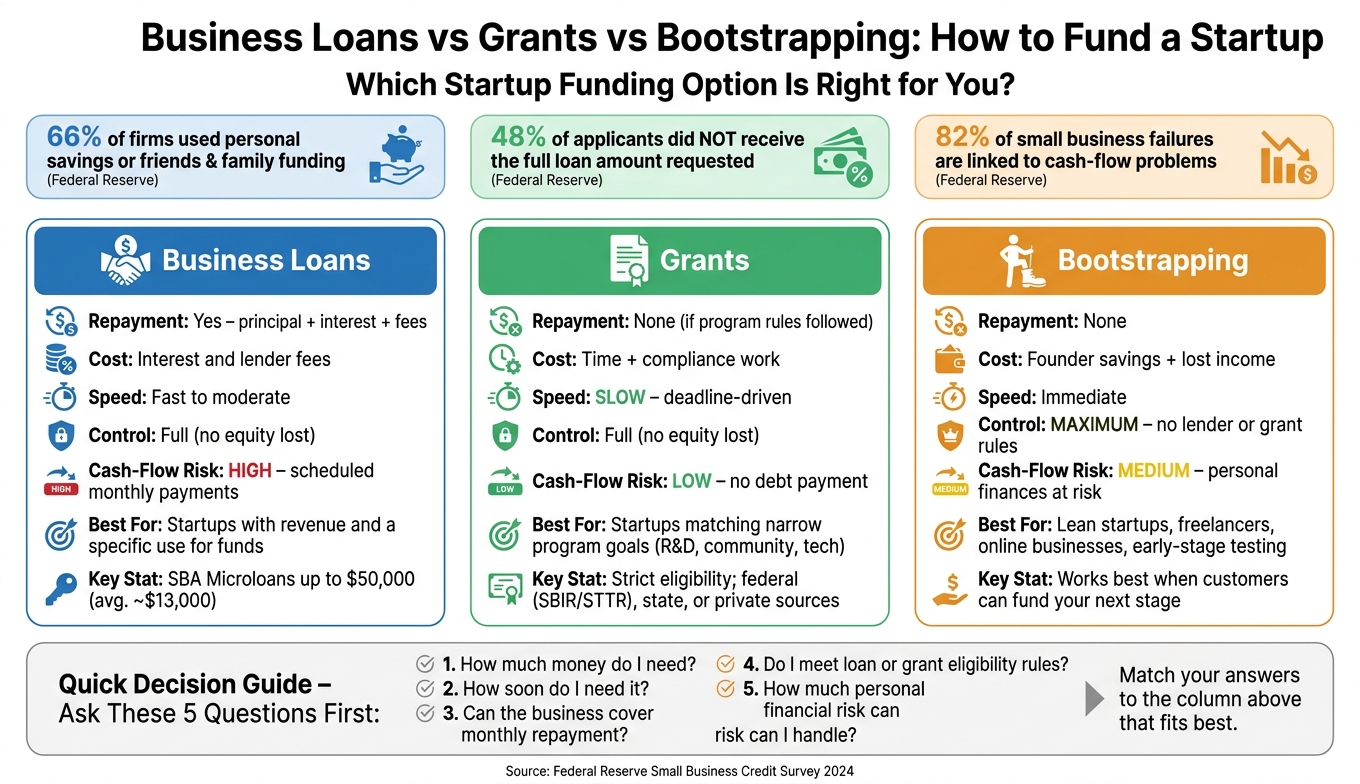
Business Loans vs Grants vs Bootstrapping: Startup Funding Comparison
Quick Comparison
| Option | Repayment | Cost | Speed | Best for | Main risk |
|---|---|---|---|---|---|
| Business loan | Yes | Interest + fees | Fast to moderate | Startups with revenue and a clear use for funds | Monthly payment pressure |
| Grant | No, if rules are followed | Time + compliance work | Slow | Startups that match a narrow program goal | Low odds, strict limits |
| Bootstrapping | No | Savings, lost income, slower growth | Immediate | Lean startups deciding between bootstrapping vs venture capital | Personal cash risk |
Bottom line: I’d avoid picking based on what looks cheapest at first glance. The better move is to match the funding type to your stage, deadline, and ability to carry risk.
sbb-itb-ba0a4be
Business loans: upfront capital you must repay with interest
A business loan gives you money now, and you pay it back over time through fixed payments that cover principal, interest, and fees. What it costs in the end comes down to four things: how much you borrow, the interest rate, any fees, and how long you take to repay it.
For early-stage U.S. startups that don’t need a huge amount of cash, the SBA Microloan Program can be a good fit. It offers loans of up to $50,000, with the average loan landing around $13,000. These loans come from nonprofit, community-based intermediary lenders, not directly from the SBA. You can use the funds for working capital, inventory, supplies, furniture, fixtures, machinery, and equipment.
A small food business, for instance, might use a $13,000 microloan to pay for refrigeration equipment and its opening inventory. There’s one limit that matters: microloan funds usually can’t be used to pay off existing debt or buy real estate.
How lenders decide whether to approve a startup loan
Before approving a startup loan, lenders look at a few core things. They usually want to see your personal and business credit history, a clear business plan, projected cash flow, a clear use for the money, and a reasonable path to repayment. For SBA-backed programs, the business also needs to be for-profit, based in the U.S., and within the size rules that apply to the program.
This gets toughest at the idea stage. Lenders want proof that the business can bring in money, not just a pitch deck and a hopeful forecast. They look for signs like sales, margins, and repeat demand. That’s the same basic repayment-capacity test mentioned earlier.
If your startup already has some revenue, your case gets stronger. Bank statements, recurring customer invoices, and actual gross-margin data can all help show that the business has traction. Even then, getting the full amount you asked for isn’t a sure thing. A 2024 Federal Reserve Small Business Credit Survey analysis found that 48% of U.S. applicants did not receive the full amount of financing they requested through loans, lines of credit, or merchant cash advances.
That point matters. Getting approved for debt is one thing. Carrying the payment without choking your cash flow is something else.
Lenders may also ask for collateral, such as a home, vehicle, inventory, or other property, or they may require a personal guarantee. For SBA loans of $50,000 or less, lenders are generally not required under SBA guidance to take collateral, but a lender can still apply its own underwriting rules and personal guarantee terms.
When a loan makes sense and when it puts too much pressure on cash flow
A loan tends to make sense when the money has a direct job and a clear payoff. If you’re buying equipment that lets you produce more, stocking inventory tied to confirmed orders, or covering working capital for a business with steady customer payments, the numbers may work in your favor.
The check is pretty simple: compare the extra cash you expect the loan to help generate with the monthly payment, interest, fees, and a cushion for things not going to plan.
Debt gets risky when payments start before revenue is steady, or when the plan depends on fast growth that hasn’t been proven yet. That’s where founders can get into trouble. Common red flags include:
- Borrowing to cover repeat losses
- Having no cash reserve
- Basing repayment on upbeat sales forecasts without signed contracts or confirmed demand
It helps to pressure-test the loan before you sign anything. Run the numbers with delayed revenue and lower-than-expected sales. If the payment still works, that’s a much better sign.
| Factor | Business loan |
|---|---|
| Loan amount | Varies by lender and program; SBA microloans go up to $50,000, averaging about $13,000 |
| Repayment requirement | Fixed monthly principal-and-interest payments |
| Interest cost | Interest plus possible fees |
| Approval speed | Depends on lender review and documentation |
| Eligibility | For-profit U.S. business, SBA size standards where applicable, creditworthiness, repayment capacity, and permitted use of proceeds |
| Personal risk | Lender may require collateral or a personal guarantee |
| Best-fit startup stage | Early-revenue or established startups with predictable cash flow and a specific, return-generating use of funds |
If loan payments would put too much strain on your cash flow, or if you don’t qualify in the first place, grants are the next option to compare.
Grants: free money with narrow eligibility and slow timelines
A grant is money you don’t have to pay back, as long as you follow the program’s rules. That can cut costs and keep debt off your books. But there’s a catch: grants usually come with tight spending rules and slow, deadline-based timelines. That tradeoff matters most when the grant lines up closely with what your startup is building.
Grants are meant to support a specific public purpose. Because of that, they usually don’t work as general startup cash.
Where U.S. startup grants come from and who typically qualifies
Where a grant comes from usually tells you two things right away: who can apply and what the money can fund.
Federal programs like the Small Business Innovation Research (SBIR) and Small Business Technology Transfer (STTR) programs tend to back R&D. More specifically, they lean toward science- and technology-driven companies working to turn new technology into a product through agencies like the NIH, NSF, and DOD. State and local economic development agencies tend to focus on local growth. Their grants are often tied to job creation, regional industry goals, or business activity in underserved areas. Private foundations and corporations usually focus on mission-based work, with grant competitions built around certain industries, causes, or founder backgrounds.
Eligibility rules change by program, but most look at the same core filters:
- Location
- Entity type
- Business size
- Industry
- What the project is expected to deliver
And the work doesn’t stop once the money comes in. Reporting usually continues after funding.
How to check grant fit before spending time on an application
Start with eligibility. Make sure your business fits the grant’s location, size, and sector rules. Then look at the grant’s stated goal. If your project doesn’t clearly serve that goal, your application probably won’t be competitive. Simple as that.
This side-by-side view helps show when a grant’s rules may be worth the tradeoff.
| Factor | Grants | Business Loans | Bootstrapping |
|---|---|---|---|
| Repayment | None (if program rules are followed) | Required with interest | None |
| Ownership impact | None | None (usually) | None |
| Speed | Slow; deadline-driven | Fast to moderate (24 hours to 90 days) | Immediate |
| Spending restrictions | High (specific project goals only) | Moderate (focused on growth or ROI) | Limited by available cash |
| Reporting and compliance | High | Moderate (credit and financial checks) | Low |
If the grant doesn’t match your project, timeline, or compliance capacity, skip it. A bad-fit grant can eat up hours and leave you with nothing to show for it. If the fit or timing is off, self-funding is the next path.
Bootstrapping: funding your startup with savings and early customer revenue
If loans feel too risky and grants move at a snail’s pace, bootstrapping can keep things moving with money you already have access to. Bootstrapping, also called self-funding, means building your business with savings, income from a job, freelance work, customer deposits, pre-sales, and early profits. It tends to fit founders who don’t need a huge amount of capital upfront, can afford to wait for revenue, and want to stay away from debt.
This path works best when your startup can get to paying customers without a big spend at the start. Freelancers, consultants, agencies, digital product creators, and online businesses are strong fits. Take a freelance designer: they can begin with a laptop and software they already use, land a few fixed-scope clients, and put those early payments back into marketing. Money starts coming in fast because the work and the payment happen close together. That’s why bootstrapping is strongest for startups that can begin small and get paid fast.
On the other hand, a hardware startup or biotech company may need a lot of money before selling even one unit. In cases like that, bootstrapping by itself can be far more risky.
The biggest upside is control. You don’t have investor terms to work through, and you don’t answer to a lender. The downside is simple: your growth only goes as far as your cash does.
Practical ways to keep costs low while bootstrapping
The best cost control starts before you spend $1. Build an MVP that tests the main customer problem instead of paying for a fully loaded product. Presell before you scale so customer revenue can pay for the next step. And from day one, keep personal and business finances fully separate. Open a dedicated business checking account and track every owner contribution clearly. This is a core part of bookkeeping basics for entrepreneurs that ensures your records stay clean for tax season.
Set a personal funding cap. Keep an emergency reserve in place. Then add more money only after the business hits a revenue milestone.
The real downsides of self-funding a startup
Bootstrapping gives you control, but it also puts all the financial risk on your shoulders. If the business fails, that loss comes straight out of your savings. Slower cash growth also means slower hiring, slower marketing, and more work on the founder’s plate. You may end up doing sales, operations, and support yourself.
The biggest risk is being late to market. In capital-heavy sectors, spending one or two years saving enough to launch can leave you behind a competitor that used outside funding and got there first. Bootstrapping makes sense when customers can pay for your next stage. If they can’t, it’s smart to compare loans and grants based on speed, repayment, and eligibility.
| Factor | Bootstrapping | Business Loan | Grant |
|---|---|---|---|
| Out-of-pocket risk | High – founder supplies the money and may sacrifice income or savings | Business must repay principal and interest; personal exposure depends on guarantees and collateral | Lower financial risk, but failing grant conditions can create repayment or compliance problems |
| Cash-flow strain | No scheduled debt payment, but personal and business cash can become strained | Regular principal and interest payments can pressure early cash flow | No debt payment, but restricted funds may not cover all operating needs |
| Funding limit | Limited by founder resources and customer cash generation | Limited by qualification, repayment capacity, collateral, and lender policy | Limited by the grant program’s award size and eligible uses |
| Best-fit business types | Lean services, freelancing, online businesses, and demand-testing ventures | Businesses with predictable revenue and a clear repayment plan | Businesses or projects matching a narrow public, geographic, industry, research, or community purpose |
If self-funding won’t cover your launch costs, the next section compares loans, grants, and bootstrapping side by side.
Loans vs. grants vs. bootstrapping: how to pick the right funding path
After looking at each option by itself, the next move is simple: match the funding path to your startup’s timing, cash flow, and control needs.
Use this matrix to line up each option with your stage, cash needs, and repayment pressure.
| Factor | Business Loan | Grant | Bootstrapping |
|---|---|---|---|
| Repayment | Required with interest | None | None |
| Ownership and control | Founder keeps equity | No equity given up | Maximum control |
| Direct cost | Interest and fees | Application and compliance time | Founder savings and lost income |
| Speed | Fast to moderate | Slow | Immediate |
| Access requirements | Often based on credit, revenue, and time in business | Narrow, program-specific rules | None |
| Cash-flow pressure | High, because payments are scheduled | Low, because there’s no debt payment | Low scheduled pressure, but growth depends on revenue |
| Funding size | Varies by lender | Varies by program | Limited by founder resources |
| Main downside | Possible collateral or personal guarantee | Restricted use and reporting | Slower growth and personal financial risk |
The pattern here is pretty clear. Loans give you money faster, but they add payment pressure. Grants don’t create debt, but they can take time and come with strict rules. Bootstrapping gives you the most control, though it usually means moving at the pace your own money and revenue allow.
Which funding option fits each startup stage
Once you see the tradeoffs, the next step is matching them to where your startup stands today.
If you’re at the idea stage, bootstrapping usually makes the most sense. It lets you test demand first and avoid spending big before you know customers want what you’re building.
If your business already has early revenue and steady income, a business loan may fit a specific need, like equipment, marketing, or inventory. An SBA microloan can work well here, especially when you need targeted funding without taking on a huge fixed payment.
If your startup falls into a grant-friendly category, grants should move up your list. That’s most useful when your project clearly lines up with the program’s purpose, rules, and timeline.
Conclusion: choose the funding source your business can actually support
Pick the lowest-risk source that fully covers the need without adding debt or personal strain you could have avoided.
That means looking at a few plain questions: How much cash do you need right now? What do you qualify for? How fast do you need the money? And how much repayment pressure can your cash flow handle?
Go with the option that fits those facts, not the one that sounds best on paper. That matters because cash-flow problems are cited as the cause of 82% of small business failures.
FAQs
How do I know if my startup can handle loan payments?
Stress-test your financial plan by modeling a 30% revenue drop and checking whether you could still make your payments.
Loans come with fixed monthly payments, so line those repayment amounts up against your actual cash flow. Then review your profit and loss statement and cash flow statement to make sure you can cover the debt without putting day-to-day operations under strain.
What startups are most likely to qualify for grants?
Startups that tend to qualify for grants usually line up with the funder’s mission, target industry, or audience. In most cases, the best fit is a for-profit business with fewer than 500 employees that can show some proof it’s gaining traction, such as a prototype, test results, or other measurable outcomes.
Some startup types come up again and again in grant programs. These often include businesses in technology, biotech, manufacturing, agriculture, and clean energy. Grants also often favor companies led by women, veterans, or minorities, as well as startups based in rural or underserved areas.
When is bootstrapping too risky for a new business?
Bootstrapping gets risky when your business doesn’t have steady cash flow to cover day-to-day costs. It also gets risky when you’re pulling too much from personal savings just to keep the business running.
There’s another problem too: self-funding can hold back growth. If you don’t have enough runway to handle big upfront expenses, sudden market shifts, or short-term cash flow gaps, you can end up in a tight spot fast.