
A startup name should do 3 jobs: fit your brand, stick in memory, and clear legal and domain checks. If it fails one of those, it can slow down launch or force a rebrand later. And that fix can cost $50,000 to $500,000+.
Here’s the short version of how I’d handle it:
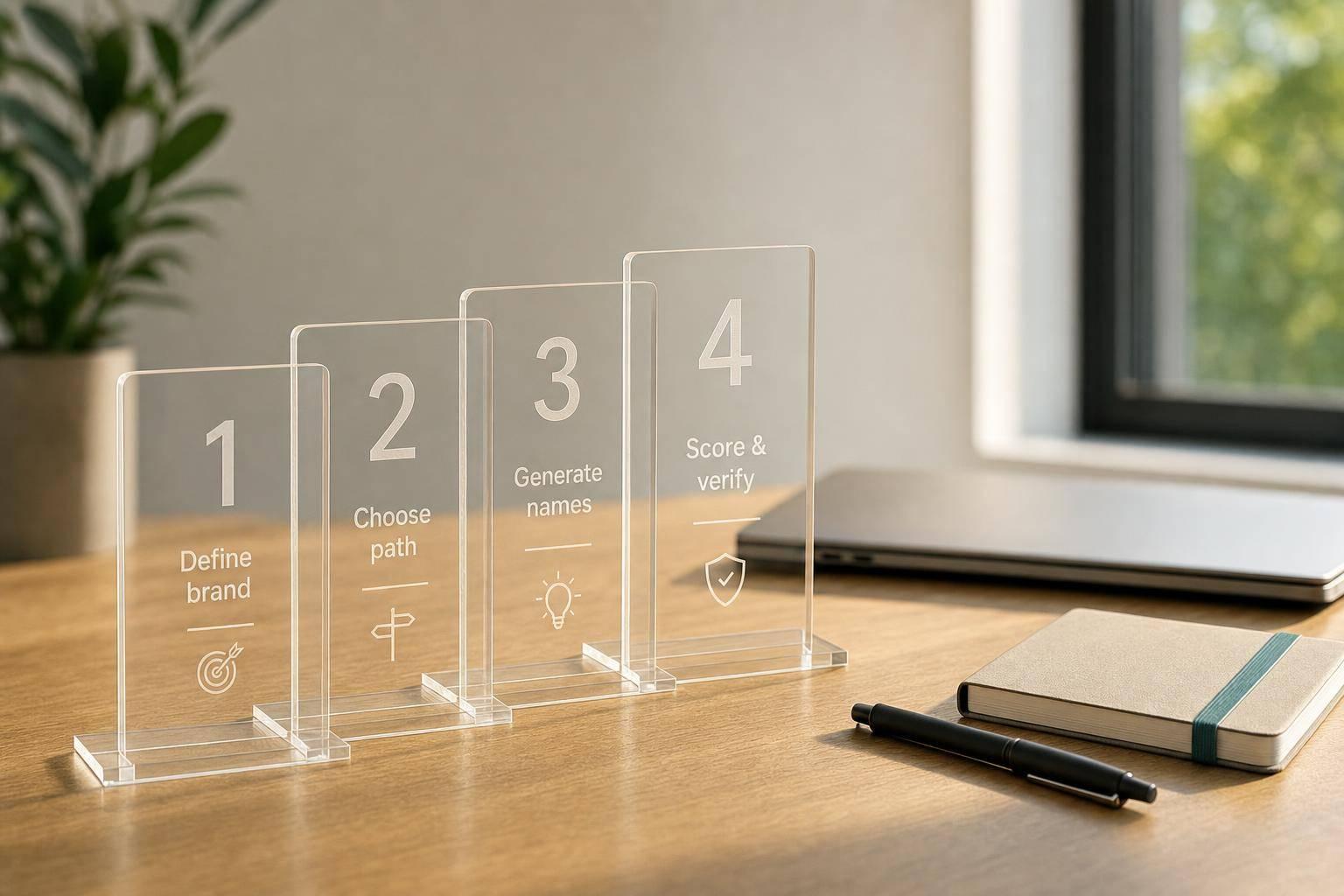
- I’d define the brand first: who it serves, what result it gives, and what tone it should carry
- I’d pick a naming path: descriptive, evocative, invented, or audience-focused
- I’d draft 50 to 100 options before cutting the list
- I’d score the best names on fit, recall, spelling, scale, and legal risk
- I’d check state records, USPTO records, domains, and social handles before filing
A few facts matter right away:
- State name reservations often cost $10 to $75
- DBA filings often cost $10 to $100
- A legal review for a close trademark case can run $500 to $1,500
- Many states require names to be distinguishable and limit words like Bank, Insurance, or University
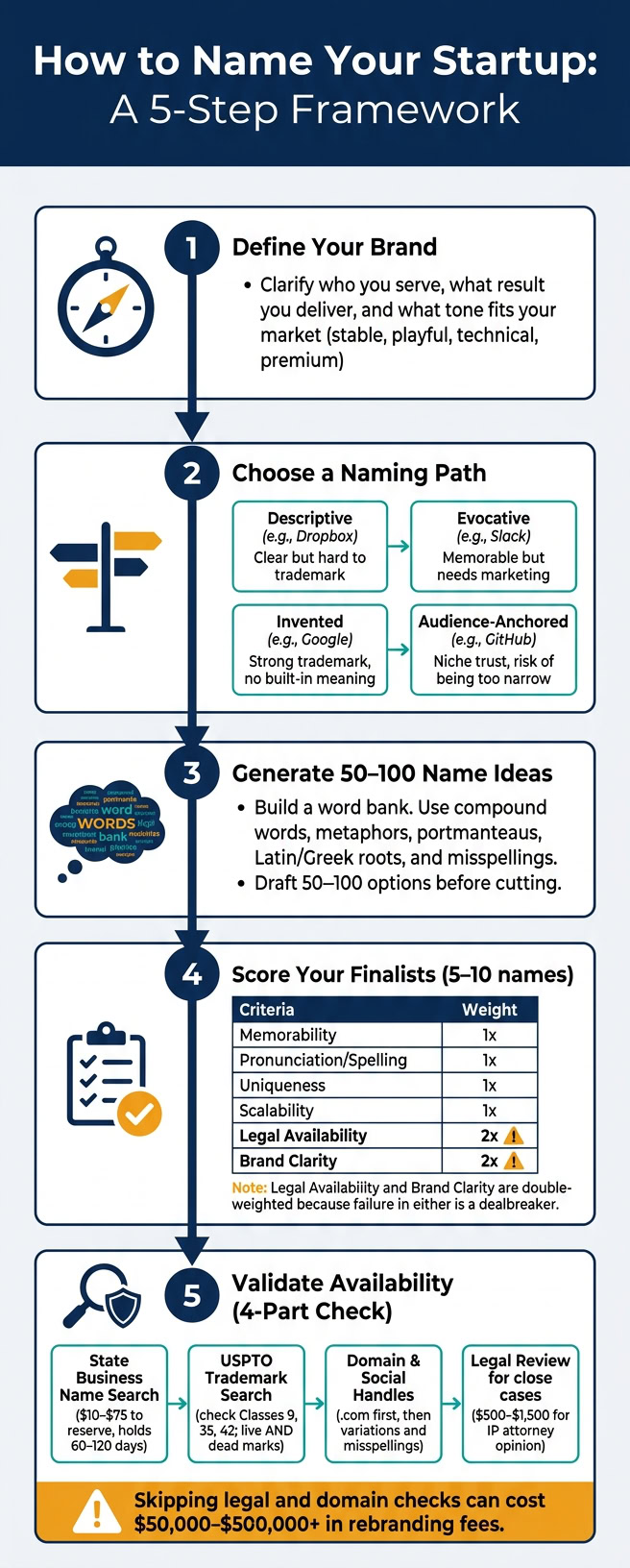
Quick comparison
| Naming path | What it does | Main risk |
|---|---|---|
| Descriptive | Says what the business does right away | Harder trademark path, less room to grow |
| Evocative | Suggests a feeling, result, or trait | Needs more brand work at the start |
| Invented | Uses a made-up word | Starts with no built-in meaning |
| Audience-focused | Speaks to a niche or user group | Can feel too narrow later |
My takeaway: the best startup names are not picked on instinct alone. I’d use a short process, score the finalists, then check whether the name is taken for filings, email, search, and daily use.
sbb-itb-ba0a4be
Clarify Your Brand Identity Before You Brainstorm
Start with a one-sentence offer: "We help [specific customer] get [specific outcome] in [timeframe] without [main pain]." That line gives you a simple gut check for every name you test. If a name doesn’t fit the promise, it probably doesn’t fit the business.
Next, define your positioning in one sentence too. This is the space your brand plans to own, so your name matches the company you want to build, not just what you’re selling today.
Tone matters just as much. A buyer in a corporate or regulated market will often respond better to a name that feels stable. A tech buyer may lean toward something that feels faster and more flexible. Your customer profile shapes the tone: stable, premium, playful, or technical. It also helps to pick the feeling you want the name to spark – reassuring, formidable, intelligent, or approachable – and use that as your brief when you compare options later.
One mistake shows up all the time: going too literal. A name like "City Home Goods" says exactly what the business does, but that can cause problems. It may be harder to trademark, and it can box you in if you want to grow into new places or add new product lines. That kind of weak fit can lead to costly fixes later. Suggestive or evocative names hint at a brand promise without spelling out the product, which gives you more room to grow. A good name should stretch far enough to cover new products, services, or markets without cornering the business later.
Amazon is a good example: it began in books but used a name that could stretch far beyond a single niche.
Before you open the floodgates on brainstorming, lock down the legal and digital limits. Know the rules early. The official name on formation documents needs an entity designator, a DBA is only a trade name, and state law requires names to be distinguishable. Many states also limit words like "Bank", "Insurance", or "University" unless you get special approval. If you’ll do business online or across state lines, check USPTO trademark records first, then grab the domain and social handles.
Use this brief to generate and rank name directions.
Build a Smart Naming Framework for Better Ideas
Before you start brainstorming, decide what kind of name you want. Your brand brief should point you toward the naming lane that fits your market and growth plan.
| Naming Direction | What It Does | Tradeoff |
|---|---|---|
| Descriptive | Says exactly what the company does, like PayPal | Clear right away, but harder to trademark a business name and less flexible over time |
| Evocative | Hints at a feeling or result, like Slack | Easy to remember and flexible, but needs more marketing to link the name to the product |
| Invented | Makes a new word or blend, like Google or Kodak | Strong trademark protection and better domain odds, but starts with no built-in meaning |
| Audience-anchored | Speaks to a specific niche, like Linear for software engineers | Can build trust fast within a niche, but may box you in later |
Pick one main direction first. Then generate ideas inside that lane. That simple move keeps the process focused and stops you from mixing very different name styles too early.
Next, build a word bank that fits your lane. Spend 10–30 minutes listing problem words, outcome words, and category roots tied to your chosen naming type. After that, expand the list with synonyms, antonyms, and metaphors. Then start combining service terms with benefit terms to come up with 50–100 name options before you shortlist.
1. Descriptive
If your brand needs instant clarity, start with the descriptive lane.
Descriptive names tell people what you offer right away. Think Dropbox or General Electric.
They’re easy to grasp, but they can be tougher to trademark because generic terms don’t stand out much on their own.
These five patterns help you keep that clarity while adding some distinction.
- Compound word – Join two real words into one, like Dropbox or Facebook. This can stick in people’s minds better than a plain generic term.
- Verb + Noun – Start with an action word, like ShipFast. This points to the result the user gets, not just the product category.
- Adjective + Noun – Match a modifier with a category word. The modifier shapes the tone while still keeping the name tied to what the business does.
- Root + suffix – Take a familiar root and add a functional “-er” ending, like Kickstarter or Framer. It tends to feel more like a brand than a plain noun.
- Short descriptive phrase – Use two or three words that spell out a specific use, like Stack Overflow. This is a strong fit for developer tools and B2B products, where search relevance can matter a lot.
Steer clear of names that trap you in one product or one location.
If that feels a bit too literal, move next to evocative names.
2. Evocative
Evocative names hint at a feeling, a payoff, or a personality instead of saying exactly what the product does. That makes them a strong fit for startups: they’re easier to remember, carry some emotion, and often give you more room on trademarks. Use this lane when you want a name that sticks without sounding plain.
Here are six evocative naming patterns worth testing:
- Metaphorical borrowing – Pull a word from nature, mythology, or physics that points to the trait you want. Amazon borrowed scale; Apple borrowed simplicity. The word already means something, and you give that meaning a new home.
- Short real words – Four- to five-letter real words like Stripe, Figma, and Loom feel clean and easy to remember.
- Sound symbolism – Hard sounds can feel precise and strong. Softer sounds can feel smooth and easy.
- Portmanteau – Blend two words into one new name that carries both ideas. TripActions became Navan, blending "navigate" and "avant", to signal broader scope.
- Tone-matched real words – Match the tone of the name to the buyer. More serious for enterprise. Lighter for consumer.
- Linguistic roots – Latin or Greek roots can signal authority or technical credibility. The "-ium" suffix in Pentium borrows scientific weight without being literal. This pattern works well for health, finance, and infrastructure products.
Say the name out loud in a sentence. If it sounds off or feels clunky, skip it.
If these still don’t feel different enough, move to invented names.
3. Invented
When descriptive or evocative names start to feel crowded, invented names give you more room to work with on trademarks.
Invented names are made-up words with no earlier meaning – think Google, Xerox, or Kodak. They sit in one of the strongest categories for trademark protection, but there’s a tradeoff: they don’t come with built-in meaning. You have to build that meaning over time through marketing. This path makes sense when you need a name that can get through trademark checks, grow with the business, and still feel like it’s yours.
Here are six practical ways to build an invented name:
- Sound-built word – Build a word from scratch with sounds that match your brand. George Eastman chose "Kodak" because the letter "K" felt sharp and decisive, and the word was easy to pronounce in any language.
- Latin or Greek roots – Pair a classical root with a modern ending to make a word that feels established and new.
- Word blend – Fuse words into one. Vercel blends "versatile", "accelerate", and "excel" to communicate speed and flexibility in a single invented word.
- Intentional misspelling – Take a real word and change the spelling to make it stand out more. Lyft is a common example of this approach.
- Added suffix – Add a suffix that hints at your industry without spelling it out. The "-ium" ending, as in Pentium, can signal scientific credibility and performance.
- Foreign-sounding construction – Build a word with sounds from another language to suggest a certain trait. Häagen-Dazs was invented entirely in the Bronx using deliberate Northern European phonetics to communicate premium quality to American consumers.
Before you lock one in, run the "Spell-Back" test: say it to five people and ask them to spell it back. If three or more spell it correctly after hearing it once, it passes. then check business entity records and major languages to make sure the name doesn’t carry negative or embarrassing meanings before launch.
After that, score your best options for clarity, memorability, and fit.
4. Audience-anchored
When your audience is specific, say so. You can name them outright or hint at them in the brand itself. This approach works best when a narrow audience is a strength, not a weakness. The key is simple: match the name to the customer profile you defined earlier.
Here are six ways to build an audience-anchored name:
- Founder-based: Use your own name to signal personal credibility and accountability. Ford and Tesla both built brand equity from the founder’s identity. This tends to work well for creator-led businesses, professional services, and luxury brands.
- Role-specific descriptor: Refer to the user’s job title or daily function directly. Names like WorkOS or MailTracker tell a specific professional, "This is for you."
- Community-based term: Root the brand in a specific tribe or subculture. GitHub spoke straight to developers already using Git, and Kickstarter did something similar for creators.
- Explicit niche name: State the niche directly. A name like Monster Fish Keepers makes the audience plain from the start.
- Technical shorthand: Use jargon or shorthand that only your target audience will pick up on. Names like "v0" or "Cursor" give developers that insider feel.
- Geographic anchor: Tie the name to a place to build local trust right away. A name like Austin Home Goods signals a regional focus.
The main risk here is going too narrow too soon. That’s why it helps to lean suggestive instead of purely descriptive. LandlordLedger, for example, points to the audience and the result without trapping you in a single feature.
Use these audience cues to come up with name options, then score each one for clarity, memorability, and fit.
Filter Your Best Name Ideas With a Simple Scoring Checklist
After brainstorming, trim the list with a scorecard. Most teams end up with 50–100 raw name ideas across descriptive, evocative, invented, and audience-anchored paths. The job here is simple: cut that down to 5–10 finalists. Use the same grid across all four naming lanes so you’re judging each option by the same standard.
A weighted scoring grid helps you make the call with less guesswork. Score each finalist from 1 to 5 across seven criteria:
- memorability
- pronunciation
- spelling simplicity
- relevance
- uniqueness
- scalability
- fit for U.S. customers
Then give Legal Availability and Brand Clarity a 2x multiplier. Why? Because if you can’t use the name legally, or customers can’t say it or spell it without help, it’s dead on arrival.
Here’s what that grid looks like in practice:
| Criteria | Weight | Name A | Name B | Name C |
|---|---|---|---|---|
| Memorability | 1x | (1–5) | (1–5) | (1–5) |
| Pronunciation/Spelling | 1x | (1–5) | (1–5) | (1–5) |
| Uniqueness | 1x | (1–5) | (1–5) | (1–5) |
| Scalability | 1x | (1–5) | (1–5) | (1–5) |
| Legal Availability | 2x | (1–5) | (1–5) | (1–5) |
| Brand Clarity | 2x | (1–5) | (1–5) | (1–5) |
| Total Weighted Score | – | Sum | Sum | Sum |
Run a live pronunciation test too. Say each name to real people once, then ask them to spell it back. If they need you to repeat it or explain it, cut it.
You should also do a plain usability check. Ask:
- Does it fit LLC naming guidelines for a state filing?
- Does it work in an email address?
- Can it still work if the exact
.comisn’t available?
If the domain is taken, small modifiers like "get", "try", "use," or "hey" can give you a usable option. Then test the name in the places where it has to live every day: on a mailing label, in an email signature, and out loud on the phone. If it falls apart in a noisy room, that’s daily friction you can skip.
One red flag is worth calling out. By 2026, adding "-AI" to a generic noun can make the brand feel dated and a bit trend-chasing. Invented words and ownable common nouns tend to hold up better over time and give you more room to grow.
Next, verify the finalists with trademark, domain, and state-name searches. Understanding the importance of running a name search early can prevent costly rebranding later.
Validate Availability With U.S. Name-Checking Tools
After the scorecard, run each finalist through a four-step availability check. It usually takes about two hours, and it can save you from an expensive rebrand later.
Start with your state business-name search. Every Secretary of State office has a lookup tool, such as the New Jersey business entity search. Check whether your exact name – or something close enough to confuse people – is already registered in your state. In most states, you can also reserve a name for $10 to $75 and hold it for 60 to 120 days while you finish the formation process.
Next, search the USPTO trademark database. Head to USPTO.gov and look for exact matches and phonetic matches in your industry class. Pay close attention to Class 9, 35, and 42. A mark that looks or sounds similar in the same space can still block your filing or lead to a cease-and-desist. Check both Live and Dead marks. Dead marks can tell you why close names were turned down before, which gives you useful context.
Then check the domain and social handles. Look at the exact .com first. After that, review close variations and common misspellings. Then scan your main social platforms to see whether you can keep the handles consistent.
Finally, flag caution cases. If a name is close to an existing trademark in a related field, treat it as a caution case. Plan to spend $500 to $1,500 for an IP attorney’s opinion before moving ahead.
Once you choose the winner, use the same spelling for your legal entity name, DBA, domain, and social handles. If those don’t match, things can get messy fast – in compliance, in search, and during launch setup. Keeping everything aligned makes filing and setup much smoother.
Align the Final Name With Formation, Compliance, and Launch Needs
After availability, the next test is day-to-day consistency. Once you pick a name, that name becomes your legal identifier. Use the exact same spelling across formation documents, tax forms, contracts, invoices, leases, and bank records. Even small mismatches can lead to rejected filings, frozen accounts, and slowdowns.
If your marketing name is different from your legal name, file a DBA at the state or county level. DBA filings usually cost $10 to $100, depending on the state. And if you start doing business across state lines, there’s one more filing step to handle.
If you form in one state and operate in another, you must register as a foreign entity in the second state and run a new name check there.
Once the legal name is set, line up your address and mail trail around it. Use a registered agent service to keep your home address off public records, and use a virtual mailbox to send business mail to one place and keep it separate from personal records.
Conclusion
A strong business name needs to hold up in three places: legally, online, and over time. That’s why the process matters so much.
Use the framework: define the brand, generate options, score the shortlist, and check availability. Whether you picked descriptive, evocative, invented, or audience-anchored names, the same filters still apply.
If you skip legal and domain checks, you can slow down business formation and set yourself up for a rebrand later. And that kind of fix isn’t cheap. It can cost $50,000 to $500,000+. That’s the tradeoff: spend a little time now, or pay a lot more later.
A strong naming decision comes from a clear process. Choose the name that fits the brand, passes the checks, and still works as the business grows.
FAQs
How do I know which naming path fits my startup?
Start by defining your brand strategy before you brainstorm names. Get clear on your positioning, your target audience, the feeling you want the brand to leave behind, and how much space you want for future growth.
Then look at the main naming styles and weigh them against what you need: descriptive, invented, compound, metaphorical, or acronym. The right choice should fit your brand voice and hold up on a few basics: pronounceability, memorability, and trademark/domain availability.
What should I do if my top name fails a trademark or domain check?
If your top name fails a trademark or domain check, let it go. Pushing ahead usually isn’t worth the risk or the cost of changing your name later.
If there’s a trademark conflict in your industry class, pick another name. If the .com isn’t available, you can look at .co, .io, or .ai – but ONLY if the trademark is clear. And if a lot is on the line, talk to a trademark attorney before you decide.
Should my startup name match my legal business name exactly?
No. Your legal business name does not need to exactly match your startup brand name, even though the two often overlap.
In practice, they’re often a little different. State filing rules may require an entity designator like LLC or Inc.. And plenty of founders use a formal legal name for paperwork while using a cleaner, more brand-friendly name in public.
Either way, both names need to be distinct enough to avoid trademark conflicts and state registration rejections.