In most states, you do not need one special “cleaning business license.” You usually need a mix of filings: your business entity, an EIN, tax accounts, and a city or county license. Miss just one local step, and you can be set up with the state but still not ready to work.
Here’s the short version:
- No single national cleaning license exists
- Most states do not issue a cleaning-specific license
- Local licenses often matter more than state filings
- Texas and Pennsylvania stand out because cleaning services can trigger sales tax registration before your first invoice
- California and Florida stand out because city/county filings often do most of the work
- If you hire, you’ll usually need:
- an EIN
- state withholding
- state unemployment registration
- and, in many cases, workers’ comp
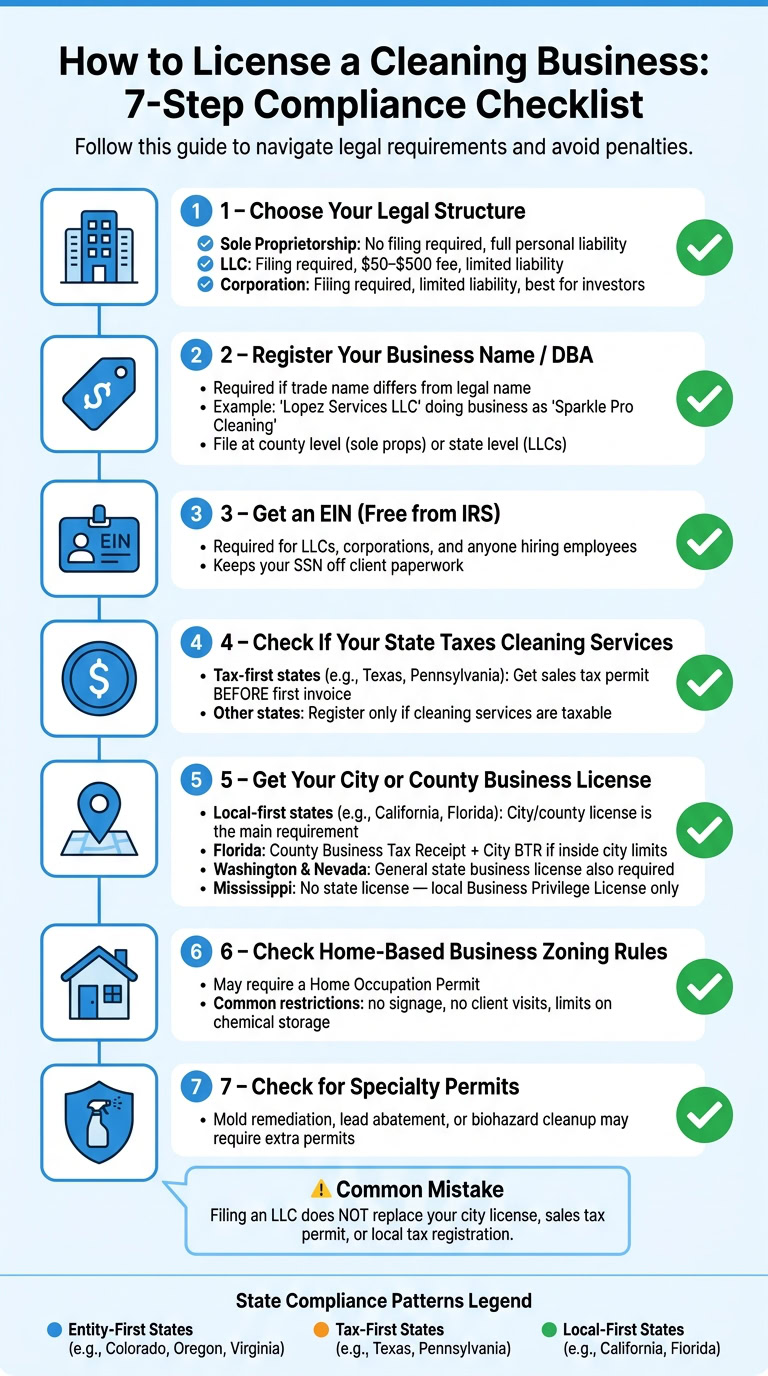
Put another way: if I were starting a cleaning company on August 6, 2026, I’d check 7 things first:
- My legal structure: sole proprietorship, LLC, or corporation
- My business name and any DBA
- My EIN
- Whether my state taxes cleaning services
- My city or county business license
- Home-based business zoning rules
- Extra permits for mold, lead, or biohazard work
The big risk is simple: many owners file an LLC, pay the state fee, and think they’re done. They’re not. In local-heavy states, that’s where mistakes start.
Quick Comparison
| State pattern | What I’d check first | Examples |
|---|---|---|
| Entity-first states | LLC/corp filing, DBA, employer accounts | Colorado, Oregon, Virginia, Vermont |
| Tax-first states | Sales tax permit before billing clients | Texas, Pennsylvania |
| Local-first states | City/county license, tax receipt, zoning | California, Florida |
| Mixed states | Entity filing plus local review | Most other states |
A few state notes stand out from the article:
- Washington and Nevada call for a general state business license
- Mississippi does not have a general state business license, so local filing does more of the work
- Florida often needs a county Business Tax Receipt and sometimes a city one too
- California may also trigger janitorial employer registration in some cases
Bottom line: if you want to launch your cleaning business the right way, following a proven cleaning service startup guide, start with the state filing, then check every city or county where you work. That two-step approach covers the gap that trips up a lot of new owners.
sbb-itb-ba0a4be
Baseline registrations every cleaning business should check first
Start with the filings most cleaning businesses need before you dig into state rules.
Choose your legal setup: sole proprietorship, LLC, or corporation
Your legal structure shapes two big things: taxes and personal liability.
A sole proprietorship is the default. There’s no formal state filing to set it up. If you start working under your own legal name, you’re in business. It’s the simplest path, but there’s a trade-off: if a client sues you, your personal assets are on the line.
An LLC tends to make more sense if you plan to grow, hire, or go after commercial jobs. It separates your business liability from your personal liability. LLC filing fees range from $50 to $500, depending on the state.
One point trips up a lot of new owners: forming an LLC does not replace a business license.
Your LLC is your legal entity. Your business license is your permission to operate in a given city or county. In many cases, you need both.
| Structure | Personal Liability | Formation filing required | Best For |
|---|---|---|---|
| Sole Proprietorship | Full exposure | No | Solo, low-risk, testing demand |
| LLC | Limited | Yes | Growing businesses, commercial work, hiring |
| Corporation | Limited | Yes | Complex ownership, outside investors |
Once you pick your structure, move on to the name, EIN, and tax registrations tied to it.
Register your business name, EIN, and tax accounts
After choosing your structure, take care of the registrations tied to identity and taxes.
If you work under any name other than your own legal name, you’ll likely need a DBA (fictitious business name). For example, if your legal name is John Rivera but you want to operate as BrightSpace Cleaning, a DBA is usually required. Sole proprietors often file this at the county level. LLCs also need a DBA if they want to use a brand name that doesn’t match the entity name on file. Before you submit anything, run a name availability search through your state’s business registry.
Next, get an EIN from the IRS. It’s free. You need one if you form an LLC or corporation, hire employees, or want to open a business bank account without using your Social Security Number. It also helps keep your SSN off client paperwork, which is just plain smart.
If you hire employees, register for:
- State employer withholding
- State unemployment insurance
You’ll usually do this through your state’s revenue or labor department.
If your state taxes cleaning services or product sales, get the needed sales tax or seller’s permit before you send invoices. Texas, for example, requires a sales tax permit for certain cleaning services. More on that in the state-by-state section.
Check local licenses before taking your first client
Local rules often decide whether you can open your doors legally. Even when there’s no state-level cleaning license – and in most states, there isn’t – your city or county will often require its own registration. In many places, that means a general business license or tax certificate.
If you run the business from home, check whether your city or county requires a home occupation permit. Most places allow home-based service businesses, but there are usually strings attached. Common limits include:
- Little or no signage
- No client visits to the home
- Limits on storing chemicals or equipment on-site
Skipping this step is a common compliance mistake. Check the city or county where your business is based, and also each place where you work on a regular basis.
Next, use the state patterns below to see whether your state leans more on entity registration, tax permits, or local licensing.
State-level compliance patterns to know before reading the 50-state list
Before you jump into the 50-state list, it helps to know which filing pattern your state tends to follow. That makes the process a lot less confusing.
Start with the pattern that fits your state. Then use the checklist below to confirm the exact filing steps.
States where entity registration is the main state requirement
In these states, the big state-level step is usually registering the business entity, along with any DBA filing or tax accounts you may need.
States like Colorado, Oregon, Virginia, and Vermont often fit this pattern.
States where a sales tax permit is a required step
In some states, sales tax registration comes first.
Texas is the clearest example. Cleaning services are taxable there, so operators must get a Texas Sales and Use Tax Permit before providing taxable cleaning services. Pennsylvania works in a similar way. Its official business portal says cleaning services are subject to sales tax and that a sales tax license is required.
If your state taxes cleaning services, separate labor and materials on invoices.
For states in this group, tax registration needs to happen before the first invoice.
States where local licensing carries the most weight
California and Florida are good examples of states where local rules matter more than a single statewide license.
In local-heavy states like California and Florida, there is no single statewide janitorial license for routine residential or commercial cleaning. In California, you form the entity with the Secretary of State, then check whether you need a city business tax certificate or other local business license. Some janitorial employers also have to register with the Labor Commissioner’s Office. In Florida, you register the entity first, then get county and, if needed, city BTRs.
The table below shows which pattern each state usually follows.
| State | Statewide Cleaning License | Typical State Filing | Typical Local Follow-Up |
|---|---|---|---|
| California | No | LLC/Corp with Secretary of State | City business tax certificate or local business license; janitorial employer registration if applicable |
| Texas | No | LLC/Corp + Sales and Use Tax Permit | City or county business license |
| Florida | No | LLC/Corp with Division of Corporations | County + city Local Business Tax Receipt (BTR) |
| Pennsylvania | No | LLC/Corp + Sales Tax License | Local business license where required |
| Washington | No cleaning-specific license; general state business license required | General state business license | City business license |
| Colorado | No | LLC/Corp with Secretary of State | City or county business license |
| Nevada | No cleaning-specific license; general state business license required | General state business license | City or county business license |
| Virginia | No | LLC/Corp with State Corporation Commission | Local business license |
So by the time you get to your state’s entry in the 50-state checklist, you’ll have a clearer idea of what deserves your attention first: entity registration, a tax permit, a local business license, or some mix of all three.
State-by-state cleaning business license checklist for all 50 states
Treat each row like a simple two-step check: handle the state filing first, then look at the city or county rules.
Northeast and Midwest states
This group mostly follows the same basic setup. In many cases, you’ll register your business entity first, then see whether your state taxes cleaning services, and after that check local licensing. Some places are pretty simple. Others, especially big cities, add another layer.
| State | Statewide Cleaning License | State-Level Baseline | Local Follow-Up |
|---|---|---|---|
| Connecticut | No statewide cleaning license | Entity registration; add sales tax permit if your cleaning activity is taxable | Check city/county business license requirements |
| Delaware | No statewide cleaning license | Entity registration; add state tax registration only if your state taxes cleaning services | Check city/county business license requirements |
| Illinois | No statewide cleaning license | Entity registration; add state tax registration only if your state taxes cleaning services | Check city/county business license requirements, especially in larger municipalities |
| Indiana | No statewide cleaning license | Entity registration; add state tax registration only if your state taxes cleaning services | Check city/county business license requirements |
| Iowa | No statewide cleaning license | Entity registration; add state tax registration only if your state taxes cleaning services | Check city clerk for local business license requirements |
| Kansas | No statewide cleaning license | Entity registration; add state tax registration only if your state taxes cleaning services | Check city/county business license requirements |
| Maine | No statewide cleaning license | Entity registration; add state tax registration only if your state taxes cleaning services | Check city/county business license requirements |
| Maryland | No statewide cleaning license | Entity registration; add state tax registration only if your state taxes cleaning services | Check city/county business license requirements |
| Massachusetts | No statewide cleaning license | Entity registration; add state tax registration only if your state taxes cleaning services | Check city or town clerk for local business certificate requirements |
| Michigan | No statewide cleaning license | Entity registration; add state tax registration only if your state taxes cleaning services | Check city/county business license requirements; requirements vary widely |
| Minnesota | No statewide cleaning license | Entity registration; add state tax registration only if your state taxes cleaning services | Check city/county business license requirements |
| Missouri | No statewide cleaning license | Register your entity; if hiring, open state withholding and unemployment accounts | Check city/county business license requirements |
| Nebraska | No statewide cleaning license | Entity registration; add state tax registration only if your state taxes cleaning services | Check city/county business license requirements |
| New Hampshire | No statewide cleaning license | Entity registration; add state tax registration only if your state taxes cleaning services | Check city/county business license requirements |
| New Jersey | No statewide cleaning license | Entity registration; add state tax registration only if your state taxes cleaning services | Check city/county business license requirements |
| New York | No statewide cleaning license | Entity registration; add state tax registration only if your state taxes cleaning services | Check city/county business license requirements, especially in New York City |
| North Dakota | No statewide cleaning license | Entity registration; add state tax registration only if your state taxes cleaning services | Check city/county business license requirements |
| Ohio | No statewide cleaning license | Entity registration; add state tax registration only if your state taxes cleaning services | Check city/county business license requirements |
| Pennsylvania | No statewide cleaning license | Residential and commercial building cleaning services are subject to sales tax and require a sales tax license | Check local municipality requirements |
| Rhode Island | No statewide cleaning license | Entity registration; add state tax registration only if your state taxes cleaning services | Check city/county business license requirements |
| South Dakota | No statewide cleaning license | Entity registration; add state tax registration only if your state taxes cleaning services | Check city/county business license requirements |
| Vermont | No statewide cleaning license | Entity registration; add state tax registration only if your state taxes cleaning services | Check city/county business license requirements |
| Wisconsin | No statewide cleaning license | Entity registration; add state tax registration only if your state taxes cleaning services | Check city/county business license requirements |
South and Mountain states
Here, the pattern is still pretty familiar: no statewide cleaning license in most states, but you may still need entity registration, tax registration, or both. Then comes the local step, which is where many cleaning businesses get tripped up.
| State | Statewide Cleaning License | State-Level Baseline | Local Follow-Up |
|---|---|---|---|
| Alabama | No statewide cleaning license | Entity registration; add state tax registration only if your state taxes cleaning services | Check city/county business license requirements |
| Alaska | No statewide cleaning license | Entity registration; add state tax registration only if your state taxes cleaning services | Check borough or municipality business license requirements |
| Arizona | No statewide cleaning license | Check transaction privilege tax registration, general business license, and any required regulatory permits | Check city/county business license requirements |
| Arkansas | No statewide cleaning license | Entity registration; add state tax registration only if your state taxes cleaning services | Check city/county business license requirements |
| Colorado | No statewide cleaning license | Entity registration; add state tax registration only if your state taxes cleaning services | Check city/county business license requirements |
| Florida | No statewide cleaning license | Register your entity with the Florida Division of Corporations | Obtain a county Business Tax Receipt, plus a city Business Tax Receipt if you operate inside city limits |
| Georgia | No statewide cleaning license | Entity registration; add state tax registration only if your state taxes cleaning services | Check city/county occupational tax certificate requirements |
| Idaho | No statewide cleaning license | Entity registration; add state tax registration only if your state taxes cleaning services | Check city/county business license requirements |
| Kentucky | No statewide cleaning license | Entity registration; add state tax registration only if your state taxes cleaning services | Check city/county occupational license requirements |
| Louisiana | No statewide cleaning license | Entity registration; add state tax registration only if your state taxes cleaning services | Check city or parish business license requirements |
| Mississippi | No general state business license | No general state business license exists | Obtain a Business Privilege License from your city or county clerk |
| Montana | No statewide cleaning license | Entity registration; add state tax registration only if your state taxes cleaning services | Check city/county business license requirements |
| Nevada | No statewide cleaning license | Entity registration; add state tax registration only if your state taxes cleaning services | Check city/county business license requirements |
| New Mexico | No statewide cleaning license | Entity registration; add state tax registration only if your state taxes cleaning services | Check city/county business license requirements |
| North Carolina | No statewide cleaning license | Entity registration; add state tax registration only if your state taxes cleaning services | Check city/county business license requirements |
| Oklahoma | No statewide cleaning license | Entity registration; add state tax registration only if your state taxes cleaning services | Check city/county business license requirements |
| South Carolina | No statewide cleaning license | Entity registration; add state tax registration only if your state taxes cleaning services | Check city/county business license requirements |
| Tennessee | No statewide cleaning license | Entity registration; add state tax registration only if your state taxes cleaning services | Check city/county business license requirements |
| Texas | No statewide cleaning license | Register for a Texas Sales and Use Tax Permit before providing taxable cleaning services | Check city/county business tax and license rules |
| Utah | No statewide cleaning license | Entity registration; add state tax registration only if your state taxes cleaning services | Check city/county business license requirements |
| Virginia | No statewide cleaning license | Entity registration; add state tax registration only if your state taxes cleaning services | Check city/county business license requirements |
| West Virginia | No statewide cleaning license | Entity registration; add state tax registration only if your state taxes cleaning services | Check city/county business license requirements |
| Wyoming | No statewide cleaning license | Entity registration; add state tax registration only if your state taxes cleaning services | Check city/county business license requirements |
West Coast and Pacific states
California, Oregon, Washington, and Hawaii put a lot of weight on local follow-up. So even when the state step looks light, the city or county where you work may have its own business license, tax registration, or home-based business rules.
| State | Statewide Cleaning License | State-Level Baseline | Local Follow-Up |
|---|---|---|---|
| California | No statewide cleaning license | Register your entity with the California Secretary of State. If the Janitorial Contractor Registration Act applies, file that registration | Most cities/counties require a business license or business tax registration; check home-occupation rules if you work from home |
| Oregon | No statewide cleaning license | Entity registration; add state tax registration only if your state taxes cleaning services | Check city/county business license requirements |
Common licensing mistakes and your final compliance checklist
After you match your state to the checklist above, use this section to catch the mistakes that still block a legal launch.
Mistakes that leave cleaning businesses without full legal compliance
Most compliance problems happen after formation, not before. In plain English: a business can be set up on paper and still miss the filings it needs to operate lawfully.
The same three areas cause most of the trouble: entity registration, tax permits, and local licensing.
An LLC does not replace a city license, sales tax permit, or local tax registration. So even if your business is fully formed, you can still be out of line in the places where you actually work.
That’s why you need to check every city and county where your crews operate, not just your home base. Miss one jurisdiction, and you could run into fines or contract issues.
Two other mistakes show up all the time.
First, some owners skip the DBA filing when their brand name doesn’t match their legal entity name. If your LLC is "Lopez Services LLC" but you market the business as "Sparkle Pro Cleaning," many states and counties require a fictitious business name filing. If you skip that step, you may run into trouble opening a bank account or dealing with checks and payments made out to the trade name.
Second, many people ignore home-business zoning rules. That can backfire fast. You might have all your state filings in place and still face local enforcement if your city, county, or HOA restricts home-based business activity.
Hiring creates another gap that catches growing companies off guard. Before your first payroll run, you need:
- an EIN
- a state employer withholding account
- state unemployment insurance registration
Depending on your state and how you staff the business, workers’ compensation coverage may also be required. And if you classify workers as independent contractors without meeting your state’s legal test, you take on serious audit and penalty risk.
Final launch checklist for legal setup in your state
Use these steps in order so you cover the state, local, and employer filings that cleaning businesses most often miss.
- Confirm your entity filing is complete.
- File a DBA only if your trade name differs from your legal name.
- Get an EIN.
- Set up state tax accounts – Register for a sales tax or vendor permit if your state taxes cleaning services. Open state employer withholding and unemployment insurance accounts if you are hiring.
- Check every city and county where crews work – Contact each jurisdiction’s business licensing or revenue office directly.
- Check home-business zoning rules – If you operate from home, review local zoning ordinances, confirm any HOA restrictions, and apply for a home occupation permit if required.
- Check whether specialty services such as mold remediation, lead abatement, or biohazard cleanup require extra permits.
FAQs
Do I need a license in every city where I work?
Maybe. You may need a separate license for each city or county where you offer cleaning services.
Here’s the key point: licensing usually depends on where you do the work, not just where your business is based.
So if you plan to serve a new area, check with that city’s clerk or business license office first. Local rules can change from one place to the next, and what works in one city or county may not be enough in another.
When do I need a sales tax permit for cleaning services?
You need a sales tax permit if your state taxes cleaning services or if you meet economic nexus rules in states where you do business.
The rules change from one state to another. States like Texas, Pennsylvania, New York, Hawaii, New Mexico, and South Dakota may tax services, so check with your state’s Department of Revenue or Treasury before your first sale.
Can I legally run a cleaning business from home?
Yes, you can legally run a cleaning business from home. But you still need to meet local rules.
You may need:
- A general business license
- A home occupation permit in some areas
That second permit often deals with zoning, noise, or traffic limits.
It’s also smart to check your lease or HOA rules. Then confirm the exact requirements with your city or county.