
Your first 100 customers usually come from direct outreach, referrals, local listings, and simple tracking, not from a perfect brand. If I were starting a new LLC today, I’d focus on five things: a clear offer, a narrow customer type, a basic online presence, daily outreach, and weekly numbers.
Here’s the short version:
- Start with one offer with a plain price, like $199 setup or $299/month
- Pick one narrow buyer group, not “small businesses”
- Talk to 10–15 people before pushing hard on marketing
- Set up Google Business Profile, a simple website, and LinkedIn
- Send personalized messages and ask for introductions
- Follow up 3–4 times instead of stopping after one note
- Ask for reviews early because 99% of U.S. consumers read reviews
- Test small ads at about $10/day only after an offer gets replies
- Track leads, calls, close rate, and CAC every week
A few numbers stand out. The article points to 5–10 reviews in month one, 25–50 personalized messages a day when you’re trying to land your first customers, and a 30%–50% close rate as a target in the early stage. It also notes that referred customers often stay longer and spend more over time.
In short: I’d get the LLC setup done, make the offer easy to buy, reach out every day, and double down on the channels that lead to calls and sales.
This article lays out that plan in a simple order so you can move from zero customers to a steady pipeline without wasting time on things that don’t bring in revenue.
1. Define your offer, your customer, and whether people will pay
Get three things locked down first: what you sell, who you sell it to, and proof that people will pay for it. When those are clear, you can test demand with actual prospects instead of guessing.
Write one clear offer with a straightforward price
A good offer fits into one sentence. It should spell out the result, the main deliverables, the turnaround time, and the price in U.S. dollars. For example: We set up and optimize Google Business Profiles for local service businesses, including verification and optimization, in 7 days for a $199 setup fee and optional $99/month for ongoing updates. That gives a stranger enough information to make a call fast.
Keep pricing simple. Fixed-fee packages work well when you deliver a defined outcome, like a $500 website audit or a $199 QuickBooks setup. Monthly retainers fit work that continues over time, as long as you can state what the client gets each month. A low-risk starter offer makes it easier for first-time buyers to say yes, and it often opens the door to higher-priced work later. Start with one or two fixed packages and one entry-level offer.
Pick a narrow target customer
The more specific you are, the easier outreach becomes. Define your ideal customer by industry, location, buyer type, and budget. A broad target like small businesses is too fuzzy. It makes messaging hard and pricing harder. A tighter target – say, helping single-location restaurants in Austin improve their online reputation for $199/month – makes it much easier to write a message that feels relevant, choose the right channels, and price the service with some confidence.
You should also decide early whether you’re selling B2B or B2C. B2B usually means fewer customers, larger contracts, and longer sales cycles. B2C usually means more customers, lower-priced purchases, and more dependence on volume and reviews. Go where buyers are easiest to reach and most likely to say yes.
Check that demand is real before scaling outreach
What people do matters more than what they say. Before you spend a lot of time on outreach, talk to 10–15 people who match your target customer. Ask what they do now to handle the problem, what they’ve paid for help in the past, and whether they’d consider spending $99–$199/month on a fix.
Then test a low-friction offer. Post it on LinkedIn or in a local community group and ask people to book a call or place a deposit to hold a spot. That’s a much better signal than polite interest.
Track the results in a simple Google Sheets file or a free CRM. Log:
- Lead name
- Contact info
- Source
- Stage: contacted, call booked, proposal sent, won, lost
- Deal value
If only a few qualified prospects take the next step, change the offer, the price, or the target before you do more outreach. Those numbers will tell you whether you need to adjust the offer or move on to building trust online.
Once the offer is validated, build a lean online presence that supports it. Using the right digital presence tools can help you centralize these early operations.
2. Build a lean online presence that earns trust
Once your offer is validated, build a lean online presence that helps strangers find you, check that you’re legit, and reach you fast. Start with the listings people use first when they want to see if a business is real.
Set up Google Business Profile and core directory listings
For most local businesses, Google Business Profile (GBP) should come first. It gets your business into Google Search and Maps, and it’s free. When you set it up, pick the most specific primary category you can. Residential cleaning service is better than Cleaning service. Add clear business hours and update them for holidays. If you go to customers instead of serving them at one location, list your service cities or ZIP codes instead of using a broad radius. Upload a few clear photos of your location, team, and finished work. Google says complete and accurate GBP information helps improve local ranking in Search and Maps.
After GBP, claim your listings on Yelp, Apple Maps, and Bing Places. The big rule across all four is NAP consistency. Your business Name, Address, and Phone number should match everywhere, right down to abbreviations and punctuation. A small address difference can make platforms treat them like separate listings. The easiest fix is to create one master reference document with your exact business name, address, phone, website URL, and hours, then copy and paste from that file into every directory. A single mismatch can weaken your local search visibility.
These listings don’t just help with search. They also work as proof when someone checks you out after a referral or a cold message. And people do check. More than 99% of U.S. consumers read online reviews before buying. Ask for a review after every completed job. Send a direct GBP review link and ask the customer to mention the exact service and result. A good early target is 5–10 reviews in your first month.
Once your listings are right, your website should match them and explain what you do in one clear message.
Build a simple website and LinkedIn presence
Your website only needs four pages to start:
- Home
- Services
- About
- Contact
Make the site mobile-friendly from day one. On the home page, add one proof block near the top. Open with a one-line headline that says what you do and who you do it for, then follow it with a clear call to action like Schedule a free 20-minute call. The Services page can show a few packages with plain descriptions and prices in USD, such as Starts at $299/month. The About page should include your relevant background and a photo. The Contact page should show your phone number, email, a simple form, and your expected response time, like We respond within one business day. Your contact info should be visible within three seconds of landing on any page.
The point of these pages is simple: turn interest from referrals, email, and DMs into booked calls. They’re not there just to look polished for the sake of it.
If your LLC is B2B-focused, LinkedIn matters a lot. Buyers spend roughly 83% of their buying research time on LinkedIn before they ever contact a vendor. Set up both a founder profile and a company page. Your headline should say who you help and what result you deliver. For example: Founder, Summit HR Consulting LLC – Helping growing tech startups build compliant HR systems. Your company page should include a short description, your website URL, a logo, and a few recent posts. Post once a week. A quick tip, a client result, or a common mistake in your space is enough to show the business is active and credible.
These assets give your outreach somewhere solid to send people. With them in place, you can start contacting your first 30 to 40 customers directly.
3. Get your first 30 to 40 customers through direct action
Your listings and site are live. Now the job is simple: turn that trust into calls.
The fastest path to your first 30–40 customers is direct outreach.
Start with your network and ask for introductions
Start close to home. Pull names from LinkedIn, your email, your phone, and last year’s calendar. Then sort them into a few groups: former coworkers, past clients, vendors, and community contacts. Aim for 50–100 names.
Put the people who already know you at the top of the list. Even if they’ll never buy from you, they may know someone who will. That’s the point.
Don’t post one big launch update and hope it lands. Send individual messages instead. Keep each one to 5–7 sentences. Mention how you know the person, briefly say what your LLC does and who it helps, and end with a clear ask for 1–2 introductions to people who fit the problem. That works much better than a vague “just launched my business” note. Warm referrals tend to convert much better than cold outreach.
On calls, make this a habit: ask who else deals with this problem and should hear from you.
Offer referral incentives and follow up consistently
Once a few early customers come in, give them a reason to send others your way. Keep the incentive simple. A $25 credit, a free add-on service, or a bonus month for each new paying client can do the job.
For example, a local bookkeeping LLC might say: Refer a client who signs a 3-month engagement and get $50 off your next invoice.
Tie the reward to completion. In plain English, the referred contact should pay at least one invoice before the reward goes out. That helps protect your margin.
Track each referral in a basic Google Sheet. Include:
- Referrer’s name
- Referred contact
- Date introduced
- Channel
- Status
- Whether the reward was delivered
Review the sheet twice a week.
For referred leads, use a steady follow-up rhythm: reach out on day one, send a nudge on days 3–4, and do one final check-in on days 10–12 if there’s still no reply. When someone converts, send a short thank-you note to the referrer and confirm the incentive: Thanks again for introducing [Name] – they just signed up, and we’ve added your $25 credit to your next invoice. That small step reinforces the habit and makes another referral more likely.
Run targeted email and LinkedIn outreach
Once warm contacts start moving, branch out with targeted email and LinkedIn outreach.
For prospects outside your warm network, use a simple five-part message structure: a specific opener that shows relevance, a problem statement tied to their situation, a concise offer, a credibility line, and one clear next step. Here’s the B2B consulting LLC example from the source:
I saw that your team at [Company] recently expanded into [area]. Many small teams in [industry] struggle to keep [specific process] organized without adding headcount. My LLC, [Name], helps [niche] handle [process] so they can [benefit] – I’ve spent 7 years doing [relevant work] and recently helped [client type] reduce [metric] by [result]. Would you be open to a 15-minute call next week?
Make it easy for prospects to check you out. Send them to your GBP, your website, and your LinkedIn profile so they can verify you fast. For email, follow up on day 1, again on days 4–5, then on days 10–12 and 14–18. On LinkedIn, send one follow-up 3–5 days after connecting, one more 7–10 days later, then stop unless they engage.
A few details matter more than people think. Use a real sender name, a valid physical mailing address, and a clear opt-out line. Keep the message plain and direct. It also helps to show your registered LLC name in your email signature – for example, [Your Name], Founder, [LLC Name], a [State] LLC – and use a domain-based email address like [email protected]. In B2B, prospects often look for these signals before they agree to a call.
Use the table below to decide which channel to work next.
| Channel | Effort | Cost | Speed | Early-Stage Conversion Pattern |
|---|---|---|---|---|
| Referral Requests | Low | Very low (incentive-based) | Medium | High trust, high close rate; limited by network size |
| Email Outreach | Medium | Low | Fast | Moderate per-contact; scales with list quality |
| LinkedIn Outreach | Medium | Low | Fast | Higher response rates in B2B; depends on profile credibility |
sbb-itb-ba0a4be
4. Widen your reach with local visibility, social content, and small paid tests
After direct outreach, it helps to add channels that keep working in the background. The goal here is simple: get in front of more people, build trust, and keep leads coming in. Once those pieces are in place, you can push distribution a bit more with local visibility and a few low-cost tests.
Use local networking, partnerships, and review platforms
Local events can open the door to conversations with both prospects and referral partners. Chamber of Commerce mixers, coworking meetups, small business groups, and local SBA or SCORE events put you in front of people who already like supporting nearby businesses. That can make a big difference. When consumers know a business is a chamber member, they are 49% more likely to think favorably of it and 80% more likely to purchase from it in the future.
Don’t show up and wing it. Go in with a target: five real conversations and two follow-up calls booked. Bring 10 to 20 business cards, a one-page flyer or PDF, and a QR code that sends people straight to your booking page. Ask a few smart questions, listen for what they need, jot down details, and suggest a short call if there’s a match. Then follow up within 24–48 hours with a short note that mentions your conversation and gives one clear next step.
Referral partnerships are another strong move. Look for businesses that serve the same customer but don’t compete with you. A bookkeeping LLC, for example, might connect with local CPAs, attorneys, and fractional CFOs. A residential cleaning LLC might build ties with real estate agents, property managers, and interior designers. The pitch doesn’t need to be fancy: you both serve the same type of client, and you’d like to send each other qualified leads. It’s the same referral engine you started building with your warm network, just with a little more reach.
Your review profiles matter too. Fill out every field and reply fast during business hours. On Yelp, a one-star increase in rating has been associated with a 5% to 9% revenue increase for independent restaurants. Recency matters just as much. Businesses with more than nine reviews from the last 90 days earn 52% more revenue than average. So keep asking for recent reviews, and reply to all of them. Thank happy reviewers by name and mention something specific. If a review is negative, acknowledge the experience, give a brief explanation if needed, and move the conversation offline.
Post useful content and test simple paid ads
If referrals start to slow down, content and paid ads can help keep the pipeline moving. Don’t try to be everywhere at once. Pick one or two channels and stick with them for the first 90 days. For B2B services like consulting, HR, IT, or marketing, LinkedIn is often the best starting point. For local or visual services, Facebook and Instagram tend to work well. As of 2024, 84% of U.S. small businesses used Facebook and 67% used Instagram for promotion.
Keep your posting simple and steady. Use LinkedIn for B2B. Use Facebook or Instagram for local and visual businesses. End each post with one clear action, like asking people to message you for a quote or comment for a checklist.
Once you have a few posts out and an offer that seems to get traction, test a small paid ad. Only put money behind offers that already got responses through outreach or partnerships. Start with about $10 per day and one geo-targeted offer. For many local services, a tight radius of about 10 to 15 miles works well. Use one direct offer, such as:
- a free estimate
- a first-month discount
- a short consultation
Watch booked calls and sales, not clicks. If a campaign starts booking calls, increase spend little by little. If it stalls, change the offer and test again.
Start logging every lead source now so you can see what’s working and turn those wins into a system in the next step.
5. Track what works and build a repeatable process
After outreach, trust signals, and testing, use weekly numbers to grow what already brings in customers. If you don’t track results, it’s hard to tell which channels deserve more time and which ones are quietly wasting it. The next three milestones help you decide where to focus each week.
Set milestones from 10 to 100 customers
Grow in three stages. Each stage needs a different focus.
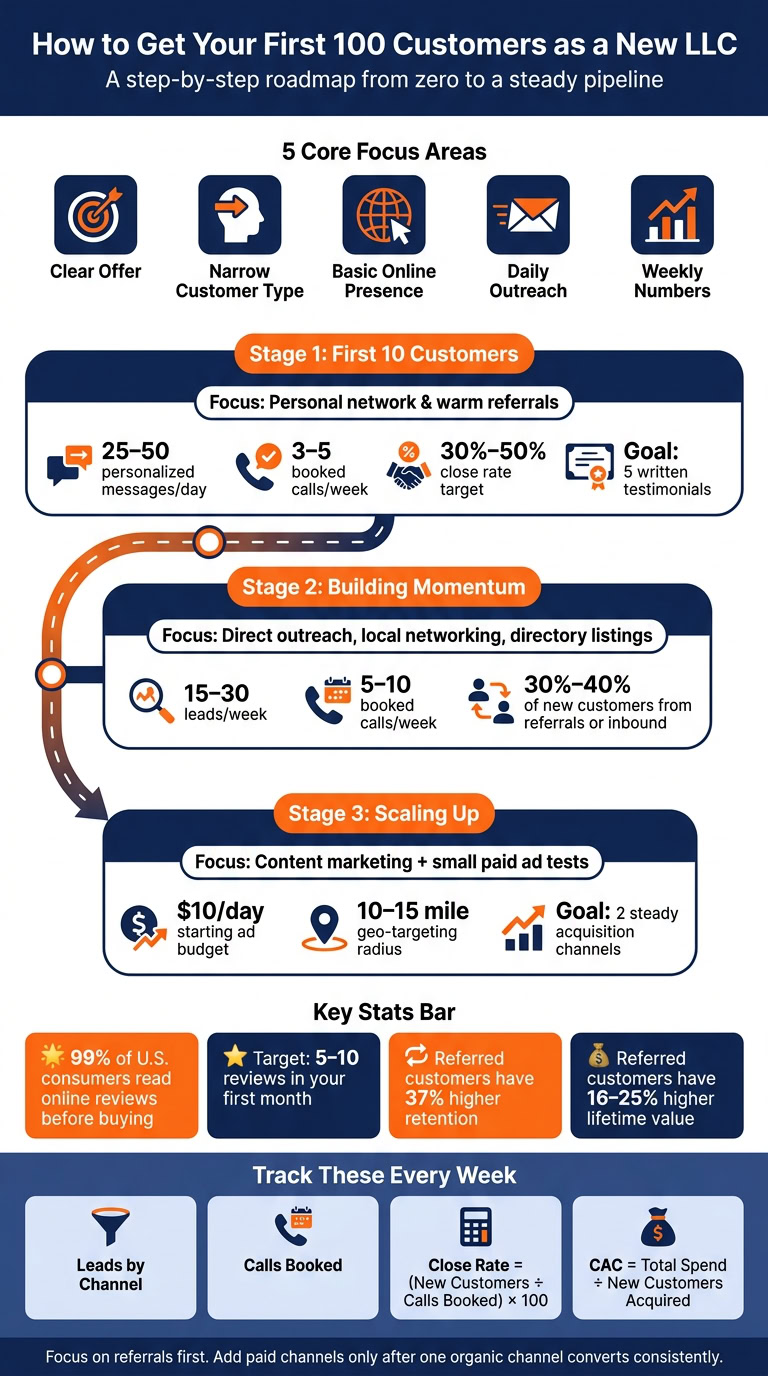
- 1–10 customers: Lean on your personal network and warm referrals. Aim for 25–50 personalized messages a day, 3–5 booked calls a week, and a 30%–50% close rate. The goal here is simple: get at least five written testimonials and prove that people will pay your price without heavy discounting.
- 10–40 customers: Move into direct outreach, local networking, and directory listings. Aim for 15–30 leads and 5–10 booked calls per week. The target at this stage is for 30%–40% of new customers to come from referrals or inbound, not just cold outreach.
- 40–100 customers: Add content and small paid tests on top of the channels that already work. The goal is to have at least two steady channels bringing in new customers every month.
Track the same numbers across every channel so the best source stands out fast. Keep these in one sheet or CRM each week: leads by channel, calls booked, close rate, and customer acquisition cost (CAC).
A simple way to calculate them:
- Close rate = (New customers ÷ Calls booked) × 100
- CAC = Total marketing and sales spend ÷ New customers acquired
Keep one row per lead with the source, stage, notes, and revenue. Then review everything every Sunday for 15–30 minutes. If leads dip, send more outreach. If close rate drops, fix your pitch. If CAC starts taking too much from each customer’s early revenue, stop that channel for now.
Refine your offer, messaging, and channel mix
Once the numbers are in front of you, use them to sharpen your offer and put more time into the channel that performs best. After every win or loss, write down the main objection or reason behind it. Patterns show up fast.
If prospects keep pushing back on guarantees or budget fit, change the offer. A satisfaction guarantee, a lower-commitment entry package like a paid audit or single session, or a payment plan can reduce friction without making you slash your price.
Use the exact language customers use in positive reviews – phrases like fast, clear communication, saved us time, and no jargon – in your email scripts, website copy, and LinkedIn profile. That wording tends to hit home because it came straight from buyers. You can also test a 10%–20% price increase every 5–10 new customers once your testimonials are in place and your process feels smoother. Let objection trends, pricing signals, and channel data shape your next round of outreach.
Start with email and referrals. Add paid channels only after one organic channel converts on a steady basis. Referred customers have 37% higher retention and 16%–25% higher lifetime value than non-referred customers. That’s why referrals can be one of the most efficient ways to grow.
FAQs
How long should it take to get your first 100 customers?
There’s no one-size-fits-all timeline here. It depends on your industry, how much outreach you’re doing, and how well your marketing is working.
If you’re leaning on content marketing, expect a 30- to 90-day sales cycle instead of instant results. Early organic leads may start showing up around weeks 8 to 10.
The goal is to build a repeatable system: service pages, case studies, and email sequences that work together.
What if my outreach gets replies but no sales?
If your outreach is getting replies but not sales, there’s probably some friction after that first touchpoint. In many cases, the issue shows up in your pricing or booking process. Go back to your service pages and make sure everything is clear, easy to follow, and free of guesswork. Then look at your pricing and ask a simple question: is it making people hesitate?
It also helps to review your trust signals. Customer testimonials, polished branding, and a professional look can all shape how safe people feel moving forward.
If results still don’t improve, go straight to the source. Use client feedback and surveys to learn what people need, where they’re getting stuck, and what parts of your operation may need work.
When should I raise my prices?
Consider raising your prices when you need to protect profit margins and bring your rates more in line with the quality of your service. It also helps to review your branding and market position on a regular basis, so your pricing doesn’t fall behind shifts in customer perception or changes across your industry.
Strong site traffic paired with flat bookings can be a sign that your current pricing is creating friction. In that case, a rate change may make sense. If you do adjust your prices, explain the change clearly and factor in seasonal demand.