

Starting a cleaning business as an LLC takes five steps: choose a service model, form the LLC with the state, get a free EIN from the IRS, register for the city or county licenses and any sales tax account required locally, then activate general liability insurance before the first paid job. Most states do not issue a cleaning-specific license — the general business license comes from the city or county — though California requires janitorial employers to register with the state and Oregon licenses property services contractors. Typical costs run $50 to $500 in LLC filing fees, $0 for the EIN, and about $50 per month for a $1 million / $2 million general liability policy. Sales tax treatment varies: Texas and Ohio tax janitorial services, while Florida taxes commercial cleaning at 6% plus local surtax and exempts residential work. Hiring the first employee adds workers’ compensation at roughly $2 to $6 per $100 of payroll, plus state payroll tax accounts.
- Entity: Articles of Organization filed with the Secretary of State — $50–$500, approved in a few business days to a few weeks
- EIN: free from the IRS, issued online in minutes
- Local licensing: city or county general business license; DBA if operating under a trade name; home occupation permit for a residential address
- Sales tax: seller’s permit where cleaning is taxable (Texas, Ohio, Nebraska, Minnesota among them); no statewide sales tax in Alaska, Delaware, Montana, New Hampshire, or Oregon
- Insurance: general liability averages ~$51/month for house cleaning and ~$50/month for janitorial; $1M per occurrence / $2M aggregate is standard
- Bonding: janitorial bond $100–$500/year for $5,000–$25,000 of coverage
- Employees: workers’ comp ~$2–$6 per $100 of payroll; commercial auto $1,200–$3,500 per vehicle per year
- State exceptions: California janitorial employer registration (AB 1978); Oregon property services contractor license
If I want to start a cleaning business the right way, I need to do five things first: pick my service type, form my LLC, get an EIN, apply for the licenses and tax accounts my city and state require, and set up insurance before I take clients.
In plain terms, that means I should expect LLC filing fees of about $50 to $500, possible sales tax rules on some cleaning services, and insurance costs that often start around $50 per month for general liability. If I hire workers, I may also need workers’ comp and payroll accounts right away.
Here’s the short version:
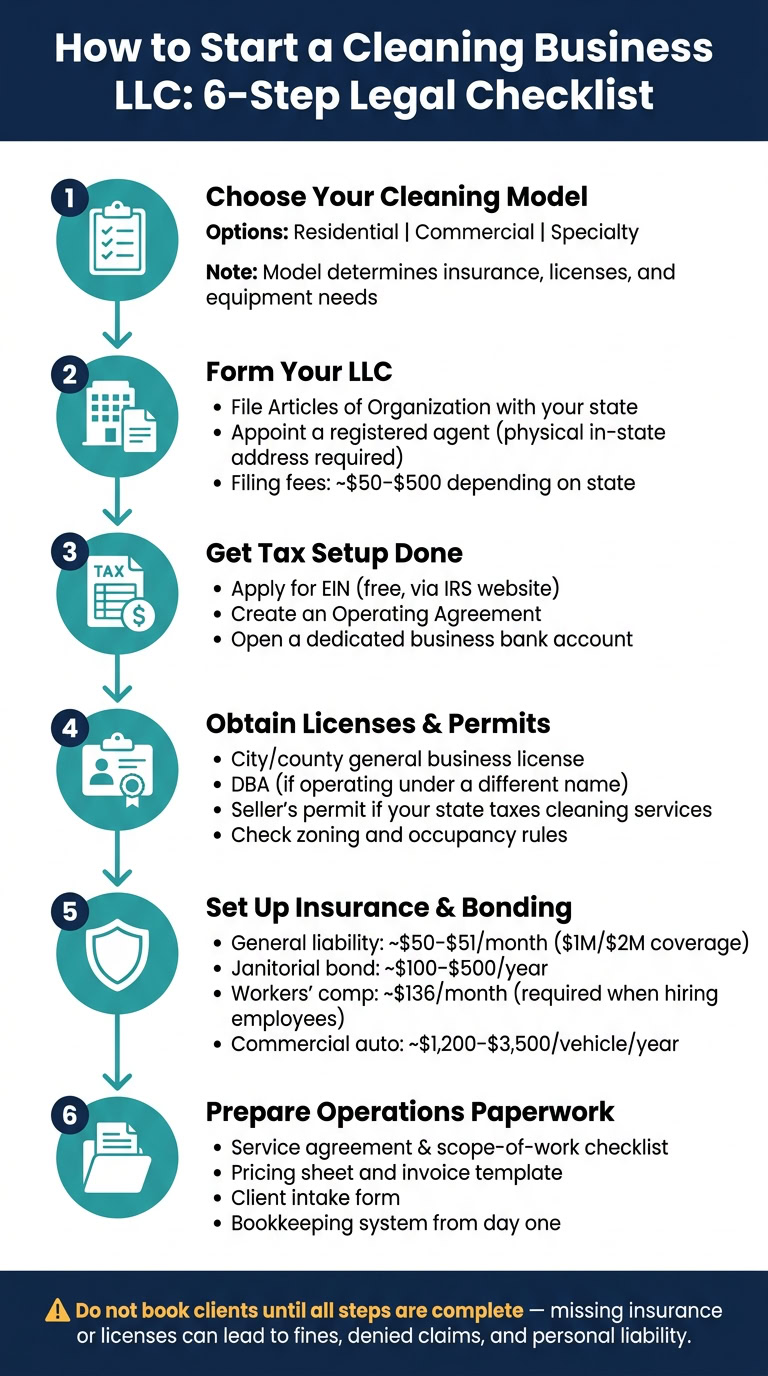
- Choose my model: residential, commercial, or specialty cleaning
- Form the LLC: file Articles of Organization and name a registered agent
- Get tax setup done: apply for an EIN and open a business bank account
- Check licenses: city, county, DBA, seller’s permit, zoning, and any state rules
- Buy coverage: general liability first, then bond, workers’ comp, and auto if needed
- Get paperwork ready: service agreement, pricing, invoices, and bookkeeping
A few rules change by state. For example, some states tax janitorial work, some do not, and filing times can range from a few business days to a few weeks. So before I book any job, I need to confirm that my LLC, license, tax, and insurance steps are all done.
This guide walks through that process in a simple order so I can launch without missing a legal step.
1. Choose Your Cleaning Business Model and LLC Structure
Before you file any formation documents, get clear on the kind of cleaning business you’re starting. That choice shapes almost everything that follows: pricing, equipment, insurance, contracts, staffing, and any licenses or permits you may need.
Residential, Commercial, or Specialty Cleaning: Which One Fits
Each model comes with its own costs, risks, and compliance demands:
| Model | Typical Services | Client Expectations | Key Compliance Needs |
|---|---|---|---|
| Residential | Weekly or biweekly home cleaning, deep cleans, move-in/move-out cleaning, short-term rental turnover | Trust, steady quality, flexible scheduling | General liability, business license, bonding |
| Commercial | Office janitorial, retail cleaning, medical facilities, schools | Formal contracts, after-hours access, dependable crews | Higher liability limits, janitorial bond, service agreements |
| Specialty | Post-construction cleanup, carpet cleaning, biohazard cleanup, eco-friendly cleaning | Specialized equipment, project-based pricing, technical skill | Extra certifications, permits, or pollution coverage |
If you’re starting on your own, residential cleaning is often the simplest path. Commercial and specialty work can bring in more money, but they usually come with more insurance needs, more paperwork, and more gear.
Why an LLC Works Well for a Cleaning Business
An LLC can help protect your personal assets if you keep business and personal finances separate. For many owners, a single-member LLC is usually reported on Schedule C, and tax elections can wait until profit makes a change worth it.
That setup gives you a clean base for the filings and registrations that come next.
Decide How the Business Will Run
Before you file, decide how the business will operate day to day. Will it be home-based, mobile, or run from a commercial space?
Home-based and mobile setups are common in residential cleaning. They keep startup costs lower and make it easier to get moving. But local home-occupation rules may limit things like signage, chemical storage, and employee traffic at a residential address.
If you lease an office, storage unit, or warehouse, expect a bit more red tape. You may need zoning approval, a certificate of occupancy, and fire inspections.
A solo owner-operated LLC usually has a lighter compliance load. Once you hire cleaners, things change fast. You may need state unemployment insurance and withholding accounts, payroll withholding, and workers’ compensation coverage. Many states require workers’ comp once you have employees, and some require it as soon as you hire one.
Bonding also matters more when workers enter client locations without you.
sbb-itb-ba0a4be
2. Form Your Cleaning Business LLC Step by Step
Once you’ve picked your cleaning model, it’s time to make the business official.
Choose a Business Name and Check Availability
Pick a name that’s easy to spell, easy to remember, and clearly tied to cleaning. Then search your state’s Secretary of State business database to make sure the name is distinguishable from other registered entities. Most states also require an LLC ending in the legal name, such as "LLC", "L.L.C.," or "Limited Liability Company."[65]
After the state search looks good, check the domain name and social media handles too. That step can save you a headache later. If you want to market the business under a name that’s different from the LLC’s legal name, file a DBA or assumed name with the right state or county office before you start promoting it.
Hold off on business cards, uniforms, and vehicle wraps until the name is approved. It’s a lot easier to wait than to pay twice.
After the name is cleared, file the LLC documents that put it on the books.
File Articles of Organization and Appoint a Registered Agent
The Articles of Organization, sometimes called a Certificate of Formation, are the state filing that creates your LLC. These forms usually ask for a few basic details:
| Field | What to Include |
|---|---|
| LLC name | Full legal name with the required LLC designator |
| Principal address | Home office, rented space, or other business address |
| Business purpose | A brief description, such as "residential and commercial cleaning services" |
| Management structure | Member-managed or manager-managed |
| Registered agent | Name and physical in-state street address |
| Member or manager information | If your state requires it |
Once the state accepts the filing, you’ll get approval documents you can use to open accounts, sign contracts, and apply for licenses.
Every LLC also needs a registered agent with a physical street address in the state. P.O. boxes don’t count. If you run the business from home or spend most of the day on job sites, the best registered agent service can keep your home address off public records and accept legal notices during business hours.
With the LLC formed, the next move is tax and banking setup.
Get an EIN, Create an Operating Agreement, and Open a Bank Account
After your LLC is approved, apply for an EIN on the IRS website. It’s free, and U.S.-based applicants can usually finish the online application in just a few minutes. You’ll need that EIN to open a business bank account.
Next, create an operating agreement. Even if your state doesn’t require one, it’s still a smart document to have. It spells out ownership, control, profit splits, and exits. More than anything, it helps show that the LLC is separate from you as an individual.
Then open a business checking account using your formation documents, EIN confirmation, photo ID, and operating agreement if the bank asks for it. Use that account ONLY for business income and expenses. Mixing personal and business funds can weaken your LLC liability protection.
3. Get the Licenses, Permits, and Tax Registrations You Need
Once your LLC is set up, the next step is making sure the business lines up with local tax, license, and permit rules.
General Business License, DBA, and Local Permits
Most U.S. cities and counties require a general business license – sometimes called a business tax certificate – before you can legally operate in that area. In most cases, this is one of the first filings you’ll handle, and it usually comes from city hall or the county clerk’s office.
You only need to file a DBA for your LLC if you plan to use a business name that’s different from your LLC’s legal name. If that’s the name you’ll put on invoices, contracts, and bank paperwork, file it first. Then use that same name across your license and tax applications so everything matches.
Seller’s Permit and State Cleaning Tax Rules
Cleaning tax rules change from state to state, and sometimes from one service type to another. A house cleaning job may be treated one way, while commercial janitorial work is taxed another way.
| State | Tax Rules |
|---|---|
| Florida | Nonresidential cleaning taxed at 6% + local surtax; residential cleaning exempt |
| Ohio | Building maintenance and janitorial services generally taxable |
| Texas | Maid and janitorial services taxable; sales tax permit required |
| Nebraska | Building cleaning and maintenance taxable since October 1, 2002; permit required |
| Minnesota | Carpet, upholstery, and industrial cleaning taxable; sales tax applies |
States with no statewide sales tax – Alaska, Delaware, Montana, New Hampshire, and Oregon – don’t have a statewide collection rule, though local rules may still apply.
If your state taxes cleaning services, register for a seller’s permit or sales tax account with the state’s Department of Revenue before you bill taxable jobs. And here’s the part that trips people up: even if cleaning labor is exempt, selling taxable supplies may still trigger a permit requirement. Check the tax treatment before you send invoices.
After tax registration, make sure your business can legally operate from your chosen location.
Zoning, Occupancy, and Industry-Specific Requirements
If you run the business from home or lease space, check zoning, occupancy, and storage rules before you open your doors. This helps confirm that the business fits local residential-use rules. If you’re leasing commercial space, make sure the zoning classification allows janitorial or service-based operations before you sign anything. A certificate of occupancy from the local planning or community development department shows the building’s use is allowed.
Some specialty services, including post-construction and biohazard cleaning, may call for extra permits or training. California, for example, requires registration under the Janitorial Contractor Registration Act (AB 1978), and Oregon requires a Property Services Contractor License for companies that employ janitorial workers. Those two states show how state-level rules can go beyond the usual business license setup.
4. Set Up Insurance, Bonding, and Day-One Operations
With your licenses and tax registrations done, the next move is simple: protect the business and put a few core systems in place so you can start cleanly on day one.
Get General Liability Insurance and Consider Bonding
General liability insurance is usually the first policy a cleaning business should have before taking client jobs. It covers third-party property damage, bodily injury, and legal defense costs. So if a cleaner breaks a client’s glass table, damages hardwood floors with the wrong product, or someone slips near a freshly mopped area, this is the policy that may respond. A common benchmark is $1M per occurrence / $2M aggregate in coverage. Insureon reports that janitorial companies pay about $50/month ($603/year), while house cleaning companies pay about $51/month ($608/year).
A janitorial bond, also called an employee dishonesty bond, covers a different risk. It reimburses clients if a worker steals from them. It is not insurance. It is a surety bond. Many small cleaning businesses pay $100 to $500 per year for $5,000 to $25,000 in bond coverage. For a small operation, a basic general liability policy plus a janitorial bond often costs $700 to $2,000 per year.
The type of work you do shapes what clients and insurers expect:
| Factor | Residential Cleaning | Commercial Cleaning |
|---|---|---|
| Risk level | Moderate-to-high due to accidental damage inside private homes and direct contact with valuables | Higher due to larger facilities, after-hours work, and heavier equipment |
| Typical insurance needs | General liability at $1M/$2M | General liability at $1M/$2M; sometimes umbrella coverage up to $5M |
| Common client requirements | Proof of being insured and bonded; background-checked staff; clear expectations for what is cleaned | Certificate of insurance, additional insured status, written contracts, safety procedures, and vendor paperwork |
| Bonding expectations | Frequently requested to build trust for in-home access | Often required by contract, especially for office, hospitality, or government facilities |
Workers’ Compensation, Commercial Auto, and Other Coverage
Once you hire your first W-2 employee, workers’ compensation insurance may be legally required, depending on your state. It covers medical costs and lost wages tied to work injuries. For cleaning businesses, workers’ comp rates often run $2 to $6 per $100 of payroll, with small operations averaging about $136 per month or $1,627 per year. Florida is one example where the rule starts at five or more employees, so you’ll need to check your own state’s threshold.
If you use a van, car, or truck to move staff, chemicals, and tools, commercial auto insurance should be in place. This matters because personal auto policies often exclude business use. If there’s an accident, leaning on personal coverage can leave the LLC facing a denied claim. Cleaning businesses often pay $1,200 to $3,500 per vehicle per year for commercial auto coverage.
If you carry gear like vacuums, floor buffers, pressure washers, or other specialty tools, inland marine coverage can help protect equipment while it’s in transit or at job sites. And if you store equipment at a set business location, commercial property coverage is worth a look too.
Contracts, Pricing, Bookkeeping, and Client Intake
Before you take your first job, get a few basic documents ready:
- A service agreement
- A scope-of-work checklist
- A pricing sheet or estimate template
- An invoice template
- A client intake form
Your service agreement should spell out what’s included, what’s excluded, how disputes are handled, and when payment is due. A detailed cleaning checklist attached as an exhibit helps make expectations more objective and can cut down on scope disputes.
Your pricing model should also be steady. Whether you charge hourly, flat-rate, by square footage, or by service package, the point is to keep it clear. For deep cleans, move-outs, or post-construction jobs, it makes sense to use a separate custom-quote process. On the payment side, card payments, ACH, and digital invoicing can make life easier for both sides. Commercial clients often want invoice-based billing, while residential clients may like simple online payment.
For bookkeeping, run all income and expenses through your business bank account and business credit card from day one. Track income, mileage, supplies, insurance premiums, equipment purchases, payroll, contractor payments, and permit renewals right away. It’s a lot easier to build a clean system now than to dig through a mess at tax time.
Keep separate folders for bank statements, receipts, LLC records, business licenses, insurance certificates, and signed contracts. Put renewal dates for insurance policies and business licenses on your calendar so nothing slips by quietly. This kind of plain, steady recordkeeping makes tax filing easier, supports insurance claims, and helps you stay on top of compliance.
Written safety procedures matter too. They help a new cleaning business run with more consistency and fewer mistakes. Use proper chemical labeling, staff training, and steady job checklists. Make sure cleaners know how to enter homes, protect surfaces, handle client keys or access codes, document damage, and report incidents right away. It also helps to read insurance policy exclusions closely, since some claims may be denied if a cleaner uses the wrong chemical, ignores instructions, or works outside the policy’s covered scope.
Conclusion: A Simple Compliance Checklist Before You Start Taking Clients
Use this final checklist to make sure your LLC, tax, license, insurance, and day-to-day setup are done before you start taking clients.
Rules change by state and city, so check local filing, tax, and licensing rules before you launch.
Once your formation, licensing, insurance, and operations are set, use this as your last pre-launch check.
| Category | What to Confirm |
|---|---|
| Entity & Tax | LLC approval on file; registered agent designated; EIN obtained; operating agreement signed |
| Banking | Business checking account open; payment method ready |
| Licenses & Permits | City/county license, DBA, and sales tax permit, as required |
| Insurance & Bonding | General liability policy active; certificate of insurance ready to share with clients; workers’ compensation and commercial auto in place if applicable |
| Operations | Service agreements drafted; pricing and scope-of-work templates ready; bookkeeping system running from day one |
| Compliance Tracking | Calendar reminders set for LLC annual reports and compliance requirements, license renewals, and insurance policy renewals |
Don’t book clients until every required item is done. Missing insurance or licenses can lead to fines, denied claims, and personal liability.
FAQs
Do I need an LLC to start a cleaning business?
No. You can start a cleaning business as a sole proprietorship. But an LLC can give you a few important advantages.
The big one is separation. An LLC helps separate your personal assets from your business liabilities. So if the business gets sued, your home, car, or personal savings may have more protection.
The right choice comes down to your goals around liability, taxes, and paperwork. Either way, you’ll still need any state and local licenses and permits required for your area.
What licenses do I need for a cleaning business?
Cleaning businesses usually need a small set of basic licenses and permits, but the exact rules depend on where you operate and what kind of cleaning you offer. Your city or county clerk should be your first stop.
In many cases, you may need:
- a general business license
- a seller’s permit if your state charges sales tax on your services or products
- a DBA if you operate under a business name that’s different from your legal name
- a home occupation permit if you run the business from home
- any required professional licenses for specialized cleaning services
On top of that, liability insurance and bonding are often important. They may not always be required by law, but they can matter a lot when you’re trying to win clients and protect your business if something goes wrong.
Can I run a cleaning business from home?
Yes, but check your residential zoning first to make sure business activity is allowed. Many cities and counties also require a home occupation permit, which covers things like traffic, noise, and signage.
It’s also smart to review your lease or HOA covenants. They can limit home-based businesses even if your city gives the green light. If privacy is a concern, a virtual business address can help keep your home address private and create a cleaner line between your business and personal life.