


If you want tight owner control and less paperwork, a close corporation usually fits better. If you want outside investors, more shareholders, or a path to an IPO, a regular corporation is usually the better pick.
I’d boil it down like this: a close corporation is built for a small group of owners, often with 30 to 35 shareholders in some states, and share sales are often restricted. A regular corporation has no shareholder cap, uses a board-and-officer setup, and is easier to use for outside funding.
Before I choose between the two, I’d focus on four things:
- Who stays in control
- How shares can be sold or transferred
- How much paperwork I can handle
- Whether I want future investor money
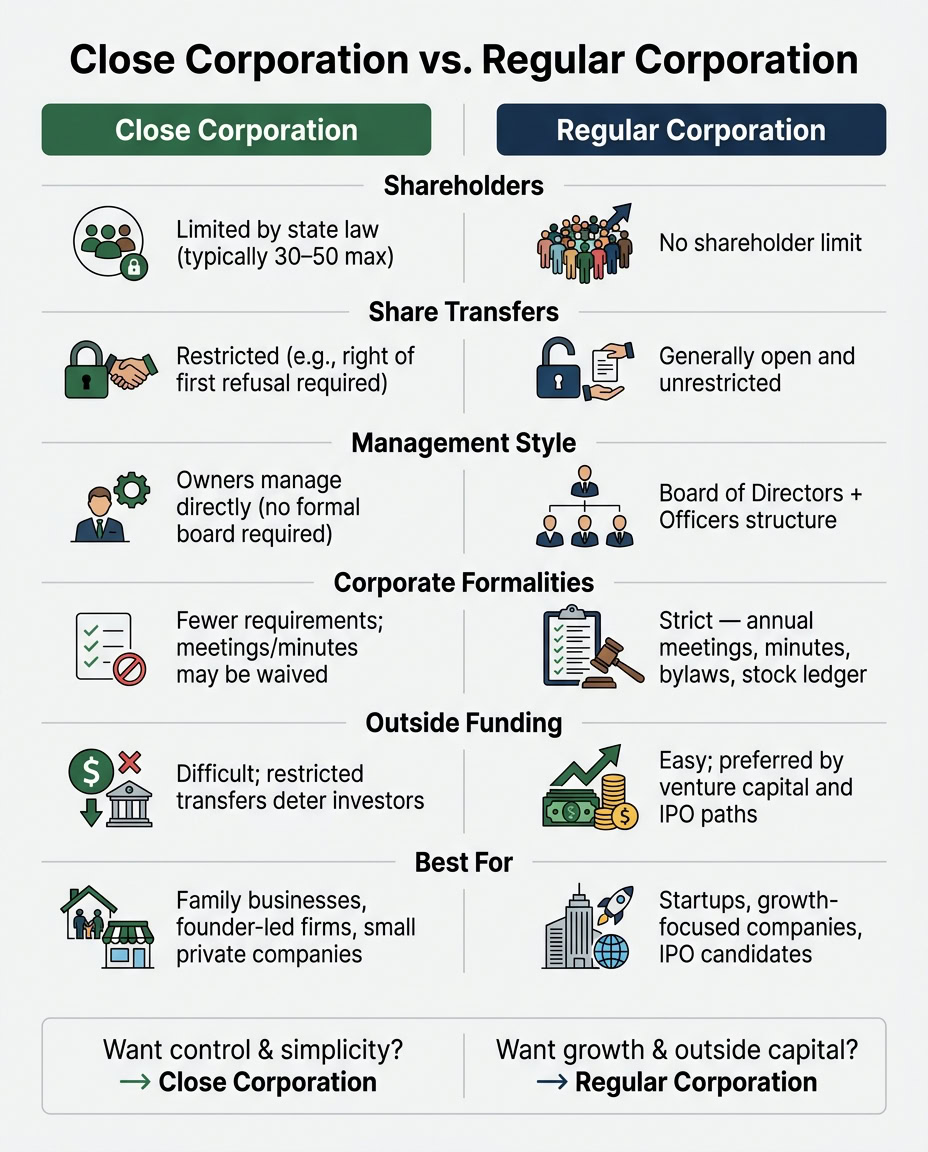
Quick Comparison
| Feature | Close Corporation | Regular Corporation |
|---|---|---|
| Shareholders | Limited by state law, often 30 to 50 | No limit |
| Share transfers | Often restricted | Usually more open |
| Management | Owners may run the business directly | Board and officers run it |
| Owner involvement | Usually high | Often lower |
| Corporate formalities | Often fewer | More meetings, minutes, and records |
| Outside funding | Harder | Easier |
| Best for | Family firms, small private companies | Startups, growth-focused companies |
The short version: if I want to keep ownership inside a small circle, I’d look at a close corporation. If I want room for new investors and long-term expansion, I’d look at a regular corporation.
sbb-itb-ba0a4be
What each corporation type means
What a close corporation is
A close corporation is a privately held company owned by a small group of people, often founders, family members, or key employees. You’ll see this setup a lot in family businesses and founder-led companies.
Its shares aren’t sold to the public, and owners usually need approval before they can transfer shares. In many states, close corporations also face fewer formal requirements than regular corporations. Even so, owners still need to keep basic corporate records in order to protect your personal assets.
That setup tends to favor control and simplicity, which sets up the legal differences covered next.
What a regular corporation is
A regular corporation is the standard U.S. corporate setup. It has shareholders, a board of directors, and officers who run day-to-day operations. It also stands as a separate legal entity, and there’s no limit on how many shareholders it can have.
Here’s how the structure works:
- Shareholders own the company
- The board of directors oversees the company
- Officers manage daily operations
This setup makes it easier to bring in outside investors and support long-term growth. The downside is more formal compliance, including meetings, minutes, and record-keeping.
That extra flexibility also brings more rules, which the next section breaks down.
Key legal and practical differences
Ownership limits and stock transfer restrictions
The biggest split comes down to who can own the company and how easily shares can change hands.
Regular corporations don’t have a cap on shareholders . Close corporations, on the other hand, are built for a small, set group of owners, and those shareholder limits depend on state law .
That smaller ownership circle usually comes with tighter rules on stock transfers. Close corporations often limit transfers through tools like rights of first refusal, which means an owner has to offer shares to current shareholders before selling to someone else . Plainly put, it helps keep control within the group that already owns the business.
For a family-owned restaurant or a small professional firm, that’s often a plus. It keeps outsiders from walking in through a stock sale. But for a startup that wants venture capital or hopes to go public one day, it’s a nonstarter.
That one difference has ripple effects. It changes how the business is run and how easy it is to bring in outside money.
Management structure and shareholder involvement
In a regular corporation, the setup is more formal. Shareholders own the company, the board of directors sets direction, and officers run day-to-day operations . Each role has its own lane.
Close corporations work differently. They often give shareholders a more direct role in running the business, sometimes without a formal board sitting between ownership and daily management .
That’s why close corporations tend to fit owners who want to stay hands-on. Regular corporations fit founders who want the classic board-and-officer setup, which many investors expect.
You can see that same split in compliance.
Compliance obligations and corporate formalities
Regular corporations have more paperwork and more process. They must hold annual shareholder and board meetings, keep meeting minutes, maintain bylaws, and track ownership in a detailed stock ledger.
Close corporations usually have fewer internal formalities. In some states, they can scale back or waive annual meetings and formal board rules . For a small private business, that can mean less admin work and fewer boxes to check.
That said, both structures still share the same basic state-level filing duties, including:
- Filing articles of incorporation
- Appointing a registered agent
- Submitting annual reports
This gap in formalities also affects funding and exit plans. A regular corporation’s more formal governance tends to work better for businesses that want venture capital or may aim for an IPO later . Close corporations fit companies that plan to stay private and keep ownership tightly held.
At the heart of it, the choice often comes back to one tension: control versus growth.
Which structure fits different business goals
That control-versus-growth trade-off stops being abstract here. It turns into a pretty direct business choice.
When a close corporation makes more sense
A family-owned business that wants to keep ownership within the founder group is often a good match for a close corporation.
Restricted transfers help keep ownership inside that group . And with fewer formalities, the day-to-day admin load is lighter .
That said, “simpler” doesn’t mean “hands-off.” Basic records and separate bank accounts still matter if you want to keep liability protection in place. If those steps are ignored, owners’ personal assets can be exposed to business debts . So the upside is tighter control, but that comes with the need to keep the business clearly separate from the people running it.
When a regular corporation makes more sense
A software startup that plans to bring in outside investors usually fits better as a regular corporation.
Regular corporations usually allow shares to move more freely, and they don’t cap the number of shareholders. That gives the business more room to grow and makes outside investment easier to support . It also works well for founders who want a formal board structure from the start.
If the plan includes equity compensation or an IPO, a regular corporation is the stronger fit . In plain English, this is the setup for companies building toward growth with outside capital.
Decision factors: control, simplicity, fundraising, and long-term planning
The choice usually comes down to four things: how much control you want to keep, how much admin work you can live with, whether you’ll need outside capital, and where you expect the business to be a few years from now.
| Factor | Close Corporation | Regular Corporation |
|---|---|---|
| Control and transferability | High; owners manage directly with restricted share transfers | Lower; managed by a board and officers with broader transferability |
| Formalities | Fewer formalities required | Strict requirements, including meetings, minutes, and records |
| Investor appeal | Low; restricted share transfers limit outside capital | High; preferred by venture capital firms and for going public |
| Growth potential | Limited; access to capital markets is restricted | High; designed for major growth |
At that point, the decision is less about finding a perfect structure and more about picking the trade-offs that match your plans.
Conclusion: Choosing the right corporation structure
The main decision is pretty straightforward: a close corporation works best for small, privately held businesses where the owners want direct control and less paperwork . A regular corporation makes more sense for businesses that plan to bring in more shareholders, seek outside funding, or keep the door open for an IPO .
From there, look at your state’s rules. Close-corporation limits and filing rules can change depending on the jurisdiction .
No matter which structure you choose, keep personal and business finances separate and maintain basic records. That helps protect your limited liability .
Check state-specific requirements through the U.S. Small Business Administration.
FAQs
Can I convert a close corporation later?
Yes. You can change your business structure later as your needs shift – for example, when you’re ready to grow, bring in outside investors, or get set for an initial public offering.
That said, changing a business structure isn’t just a paperwork swap. It can involve taxes, state filings, and changes to how the business is set up. Because of that, it’s smart to talk with a qualified tax professional or business attorney before you move ahead.
The exact steps depend on your state, but the process usually includes filing a plan and other related documents.
Do close corporations get the same liability protection?
Yes. A close corporation usually gives owners the same liability shield as a regular corporation because the business is treated as a separate legal entity.
That said, the shield isn’t automatic or absolute. To keep it in place, you need to follow corporate formalities, maintain accurate records, document major decisions, and avoid mixing personal and business money. If you don’t, a court may allow piercing the corporate veil, which can lead to personal liability.
Which structure do investors usually prefer?
Investors often lean toward the C corporation structure because it comes with a clear governance setup and can support more than one class of stock, including common and preferred.
It also keeps taxes at the company level, makes equity incentives like stock options easier to handle, and gives companies well-known legal routes for exits such as IPOs or acquisitions.