
If I sell online in the U.S., an LLC usually starts to make sense once I have steady sales, inventory, contractors, or customer data to protect. I can start as a sole proprietor, but once risk goes up, the gap between simple and safe gets a lot smaller.
Here’s the short version:
- I can sell without an LLC
- An LLC helps put legal space between me and the business
- A sole proprietorship is cheaper, but my personal assets stay exposed
- A corporation is usually more work than most online sellers need
- One LLC can cover Amazon, Shopify, and Etsy
- For most sellers, filing in the home state is the cleanest path
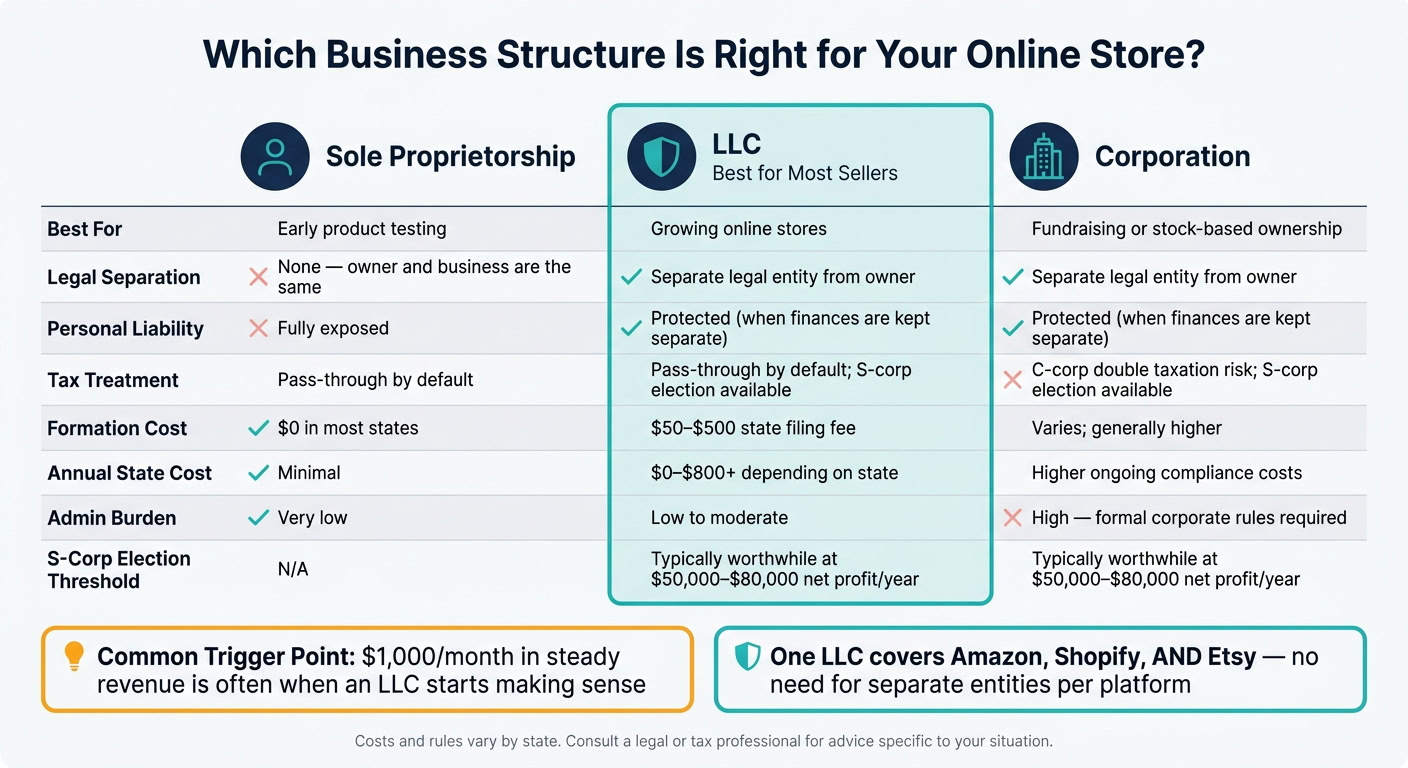
- Costs often range from $50 to $500 to form, with annual state costs from $0 to $800+
- S-corp tax treatment often starts getting attention around $50,000 to $80,000 in yearly net profit
- A common early checkpoint is about $1,000/month in steady revenue
If I had to boil it down even more, it would be this: test small if I want, but once the store has traction, an LLC is often the safer setup.
Quick Comparison
| Structure | Best for | Main upside | Main downside |
|---|---|---|---|
| Sole proprietorship | Very early testing | Low cost and easy start | No legal split between me and the business |
| LLC | Most growing online stores | Personal asset protection and simple tax setup | State filing fees and yearly state tasks |
| Corporation | Fundraising or stock ownership plans | Fits investor-backed growth | More paperwork and more rules |
I’m not repeating the full guide below. Instead, I’d sum it up this way: for most U.S. e-commerce sellers, the smart move is to keep it simple at the start, then switch to an LLC when sales, stock, or risk make that extra layer worth the cost.
Why an LLC fits most online sellers
An LLC separates business risk from your personal assets. If a customer files a claim or a supplier dispute pops up, that claim is against the business, not you as an individual. For online sellers, that line starts to matter a lot more once your store carries inventory or handles customer data.
There’s one catch: the shield only works if you treat the business like a business. If you mix personal and company money, the liability protection can weaken. Separate bank accounts and clean bookkeeping help keep the LLC in good standing.
Taxes are another reason many online sellers go this route. By default, an LLC uses pass-through taxation, so profits flow to the owner’s tax return. Later, if profit levels make it worth it, owners can choose S-corp tax treatment.
When an LLC makes sense for an online store
The right time to form an LLC is often when the business starts taking on more day-to-day risk. That usually happens when:
- You’re carrying physical inventory
- You’re hiring contractors for fulfillment, design, or customer service
- You’re handling sensitive customer data
At that stage, setting up an LLC usually stops feeling like extra paperwork and starts looking like plain risk control.
What an LLC helps with beyond liability
An LLC can also make the day-to-day side of e-commerce easier to manage. It gives the business a cleaner structure, which can make banking, bookkeeping, contracts, and recordkeeping less messy. Those same habits also help you run the LLC the right way.
The next step is looking at whether a sole proprietorship or corporation makes more sense for a smaller setup or a bigger one.
LLC vs. sole proprietorship for e-commerce
For most online sellers, this comes down to a simple trade-off: easy setup now versus more protection as the business grows.
A sole proprietorship is the default for many new sellers. It’s easy to start, and in most cases, there isn’t a state filing step. But there’s a catch. You and the business are legally the same thing, which means you can be personally on the hook for business debts and claims.
An LLC creates a separate legal entity. That legal split is a big deal for e-commerce stores that are starting to grow, carry inventory, process more orders, or face more risk.
| Factor | Sole Proprietorship | LLC |
|---|---|---|
| Legal separation | No legal separation between owner and business | Separate legal entity from owner |
| Personal liability | Owner is personally liable for business debts and claims | Liability protection is strongest when business and personal finances stay separate |
| Tax treatment | Pass-through by default | Pass-through by default, with possible tax election flexibility |
| Formation | No state formation filing required in most cases | State formation filing required |
| Banking | Can be harder to keep fully separate | Dedicated business banking is easier to maintain |
| Credibility | More informal | More established for suppliers, platforms, and partners |
| Ongoing compliance | Minimal | Annual state fees and reports may apply |
| Best fit | Early test launch | Growing store with inventory, revenue, or risk exposure |
An LLC can also help you look more established to suppliers and platform partners. In plain English, that can mean better pricing, better payment terms, and smoother access to platform programs like Amazon Brand Registry. A sole proprietorship can feel informal to outside partners, even when the store itself is making solid money.
Cost is where many sellers hesitate. A sole proprietorship costs almost nothing to start. An LLC, on the other hand, usually comes with a state filing fee of $50 to $500, depending on where you register, plus annual maintenance costs that may range from $0 to over $800 depending on the state. For a seller with steady revenue, that’s often a fair trade for the legal buffer and stronger business setup.
When staying a sole proprietor may still be reasonable
If you’re just testing a product idea and keeping your upfront spend low, staying a sole proprietor can make sense. Maybe you’re checking demand before buying inventory or putting much cash on the line. In that kind of low-risk trial run, keeping things simple is fine.
That math shifts once the store starts to gain traction. If you’re bringing in steady sales, storing a lot of inventory, or handling sensitive customer data, the downside of staying a sole proprietor gets a lot harder to ignore. A useful benchmark is $1,000 per month in steady revenue. Once you’re consistently above that level, the risk to your personal assets will often outweigh the ease of doing nothing.
At that point, the cost of setting up an LLC is small compared with what you could lose if a claim, debt, or other problem lands on your doorstep. If your store is moving past a bare-bones setup, the next move is to compare an LLC with a corporation.
LLC vs. corporation for e-commerce
For most online sellers, the main issue isn’t liability protection. Both LLCs and corporations can help shield personal assets. The real question is simpler: which one gives you room to grow without piling on extra paperwork?
In most cases, the choice comes down to admin load, ownership setup, and taxes.
| Factor | LLC | Corporation |
|---|---|---|
| Management formalities | Generally simpler | More formal corporate rules and records |
| Ownership structure | Flexible membership structure | Stock-based ownership structure |
| Tax options | Default pass-through, with possible election options | Depends on tax election |
| Ongoing administration | Usually lighter | Usually more administrative work |
Taxes often tip the scale. LLCs default to pass-through taxation, which means profits usually flow straight to the owners’ personal tax returns. C-corporations can get hit twice: once at the company level, and then again at the shareholder level when dividends are paid.
When a corporation may be worth considering
A corporation tends to make sense in a fairly small set of cases. Think fundraising, stock-based ownership, or a path to an IPO.
If you’re going after venture capital, this matters a lot. Most investors want a Delaware C-Corp with stock-based ownership. The same logic applies if you plan to give stock to employees or co-founders.
That’s why corporations usually fit narrower situations, while LLCs work better for most online stores. For many e-commerce sellers, an LLC is still the default choice.
There’s one more tax angle worth noting. Both LLCs and corporations can elect S-corp status, but that move often makes sense only when annual net profit stays above $50,000 to $80,000.
Once you settle on an LLC, the next steps are pretty practical: pick a state, set up a registered agent, get an EIN, and open a business bank account.
sbb-itb-ba0a4be
How to set up and run an e-commerce LLC
Once you’ve decided an LLC makes sense, the next move is to set it up the right way and keep business activity separate from your personal finances.
Choose your state: home state vs. foreign qualification
For most e-commerce sellers, the best move is to form the LLC in the state where you live and run the business. That usually means the state where you handle daily decisions, manage orders, or store inventory.
Some sellers look at another state because it seems cheaper or easier on paper. But there’s a catch. If you form the LLC outside your home state and still run the business where you live, you’ll probably need to register there as a foreign LLC anyway. That can mean two sets of filings, two sets of fees, and more paperwork to stay on top of.
| Choice | When it usually makes sense | Main tradeoff |
|---|---|---|
| Form in home state | You live and operate there, manage the business there, or have in-state inventory or activity | Simpler compliance path with one set of state fees and filings |
| Form out of state and foreign qualify at home | You have a specific legal or tax reason to use another state despite living elsewhere | Creates two layers of filings, fees, and ongoing maintenance requirements |
Once you’ve picked the state, the rest comes down to filing the paperwork, getting a tax ID, and setting up banking.
Set up the core documents and accounts
After you choose the state, the setup usually follows a simple path: check that your business name is available, appoint a registered agent, file your formation documents, get an EIN (Employer Identification Number), draft an operating agreement, and open a business bank account.
Each step has a clear role.
- Your EIN identifies the LLC for taxes and banking.
- Your operating agreement lays out who owns what and how decisions are made, even if you’re the only owner.
- Your registered agent receives state mail and legal notices for the LLC, so this needs to be someone dependable.
- Your business bank account should handle all sales, refunds, inventory purchases, and software costs.
That last part matters more than many people think. If you mix personal and business spending, things can get messy fast.
Run one LLC across Amazon, Shopify, and Etsy
Once the LLC is formed, you can use that same entity across all your sales channels. You do not need a separate LLC for Amazon, another for Shopify, and a third for Etsy.
One LLC can sit behind all of them. Your Amazon Seller Central account, Shopify store, and Etsy shop will each have their own platform settings and seller profiles, but the legal entity stays the same. You’ll use the same EIN across each platform and send payouts into the same business bank account.
The big job after that is keeping the books clean. Sort transactions by sales channel so your records don’t turn into a pile of mystery deposits later. For example, track Amazon payouts in one category, Shopify revenue in another, and Etsy deposits in a third. That makes tax time far less painful. And keep personal spending out of the account if you want to help protect the LLC’s liability shield.
Conclusion: Choosing the right structure for a scalable online business
For most sellers who are past the testing phase and now deal with customer payments, inventory, or sensitive customer data, an LLC is usually the most practical option. It hits a solid middle ground: simpler than a corporation and far safer than a sole proprietorship.
That said, an LLC only does its job if you maintain it the right way. You need to file in the right state, get an EIN, sign an operating agreement, open a separate business bank account, and keep personal and business funds strictly separate. If you blur that line, the protection can fall apart.
Pick the structure that fits your risk, growth plans, and tax situation today, and it’ll be much easier to scale later on Amazon, Shopify, or Etsy.
FAQs
Do I need an LLC to sell online?
No, you don’t need to form an LLC to start selling online. You can start as a sole proprietorship, which begins by default as soon as you start doing business.
That said, many sellers set up an LLC once the business starts picking up. It can help protect your personal assets, give you more tax options, and make your business look more professional as it grows.
When should I switch from a sole proprietorship to an LLC?
Switch once the business is no longer just a side project or trial run – especially when you start taking customer payments, managing inventory, or collecting sensitive personal data.
A sole proprietorship does not create a legal line between you and the business. That means your personal assets could be at risk if the business runs into debt, gets sued, or faces a marketplace dispute.
An LLC puts that legal separation in place. It can help shield your personal assets and may give you more options on the tax side once profits start to come in on a steady basis.
Can one LLC cover all sales channels?
Yes. A single LLC can cover more than one sales channel, including Amazon, Shopify, and Etsy. That can make admin work simpler and help you keep the same brand across each platform.
If those channels share the same team, products, or systems, one LLC can often run them under different trade names, also called DBAs.
But there’s a catch. If each channel runs on its own or carries a very different level of risk, setting up separate LLCs may give you better liability separation.