

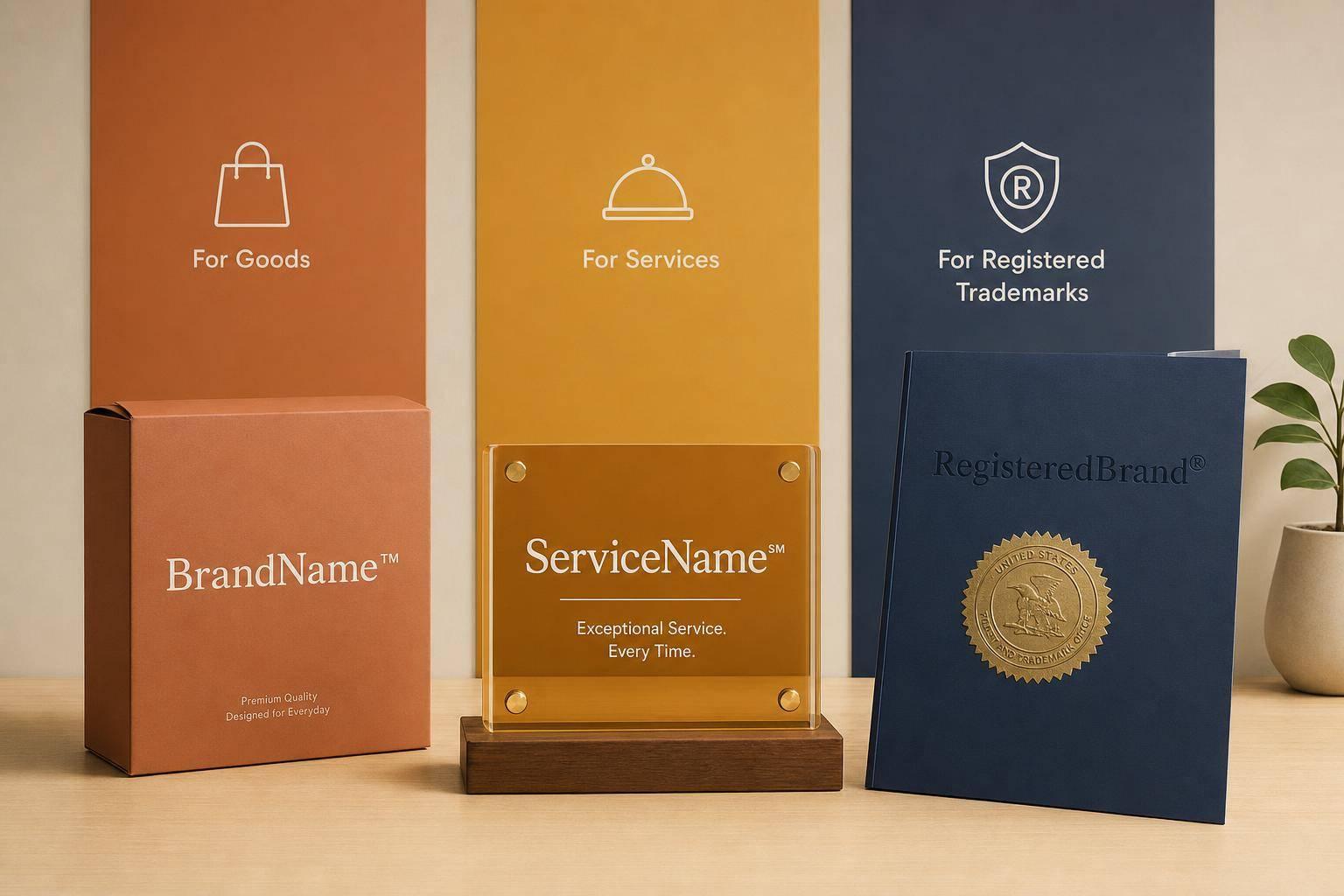
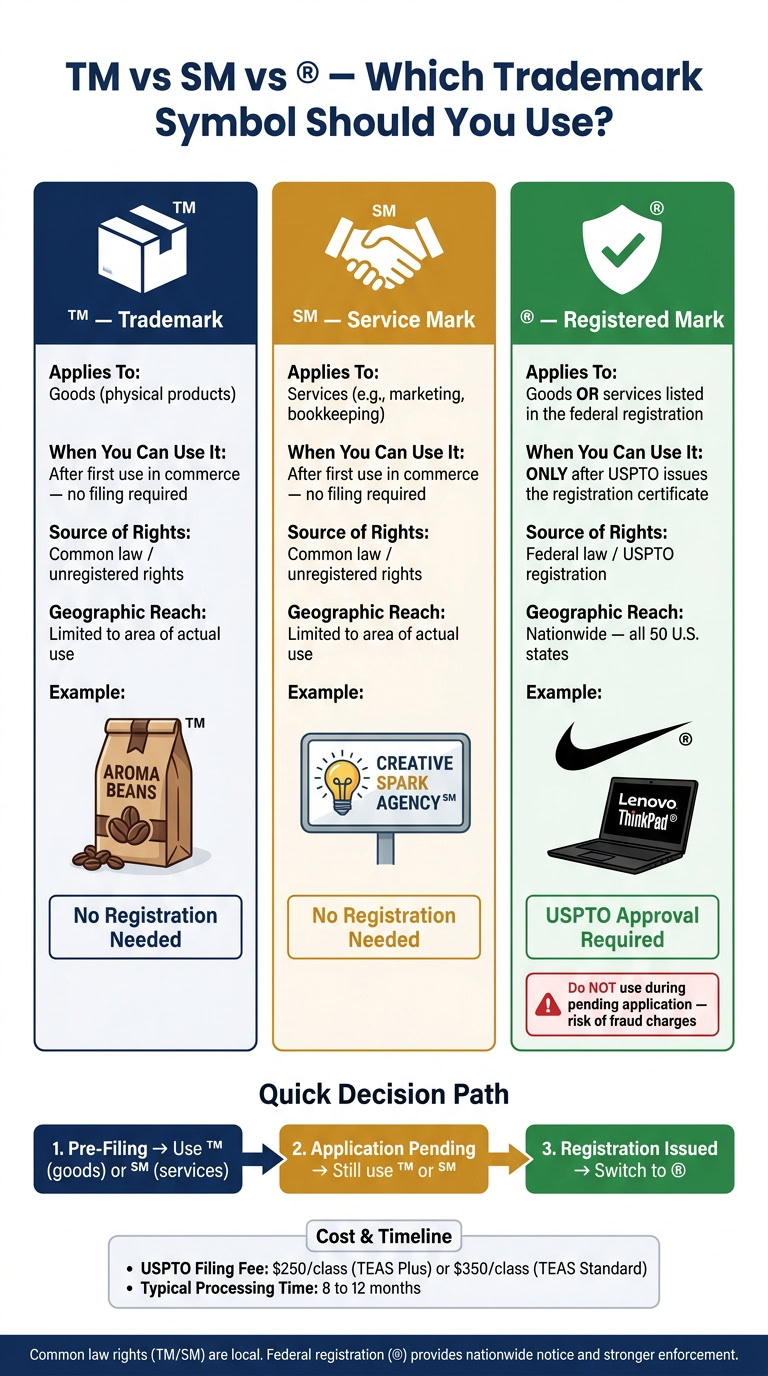
Use the wrong trademark symbol, and you can create legal risk. The short rule is simple: use ™ for goods, ℠ for services, and use ® only after the USPTO issues a federal registration.
If I boil the article down, it comes to this:
- ™ = I’m using a brand for goods without a federal registration
- ℠ = I’m using a brand for services without a federal registration
- ® = I have a live USPTO registration for that mark
- A pending application is not enough for ®
- Federal filing fees in the article are listed at $250 or $350 per class
- The article says the process often takes 8 to 12 months
Most mistakes happen when a business uses ® too early or uses it for items not covered by the registration.
| Symbol | Use it for | When I can use it |
|---|---|---|
| ™ | Goods | After first use in commerce |
| ℠ | Services | After first use in commerce |
| ® | Registered goods or services | After USPTO registration issues |
The core point is simple: use-based rights support ™ and ℠, while federal registration supports ®.
Trademark Basics: Rights From Use vs. Rights From Federal Registration
What Counts as a Trademark or Service Mark
To use the right symbol, you first need to know whether the mark points to goods or services.
A trademark is any word, name, logo, or slogan that identifies the source of goods. A service mark identifies the source of services. The line is pretty simple: goods use trademarks, while services use service marks.
For example, a brand name on a bag of coffee beans is a trademark. A brand used for bookkeeping services is a service mark.
Common Law Use vs. USPTO Registration
When you start using a brand name or logo in commerce, you start building common law rights. You don’t need to file anything first. Those rights are real, but they usually cover only the area where you actually use the mark.
USPTO says federal registration is not required to own a mark. Common law rights can still exist even after a registration expires or is canceled.
Federal registration requires filing with USPTO and gives you more protection. That includes nationwide notice, a presumption of ownership, and stronger federal enforcement. TM and SM show that you claim rights in a mark. ® shows that the mark has federal registration.
So here’s the practical split: common law rights are often local, while federal registration adds nationwide notice and stronger enforcement. That difference is what tells you whether TM, SM, or ® fits your brand.
Next, match each symbol to the correct type of brand use.
What Each Symbol Means and When You Can Use It
Each symbol has its own job. The main rule is simple: use the symbol that matches the legal status of your mark.
TM: For Unregistered Product Brands
Use TM for unregistered marks tied to goods. You can start using TM as soon as the mark is used in commerce, and you do not need a USPTO filing first.
For example, Lenovo uses ® for ThinkPad because that mark is federally registered.
For services, the rule is a little different.
SM: For Unregistered Service Brands
Use SM for unregistered marks that identify services. If your brand is built around a service, SM is the more exact choice. A marketing agency should use SM.
Registered marks work under a different rule.
®: Only After USPTO Registration
® is different. A pending application does not give you the right to use ®. You can use ® only after the USPTO issues the registration certificate.
Also, use ® only for the goods or services covered by that registration. Nike‘s Swoosh, for example, uses the ® symbol because it is a federally registered mark tied to specific goods and services listed in the registration.
| Symbol | Applies To | When You Can Use It | Source of Rights |
|---|---|---|---|
| TM | Goods | After first use in commerce | Unregistered/common law rights |
| SM | Services | After first use in commerce | Unregistered/common law rights |
| ® | Goods or services listed in a federal registration | After USPTO registration | Federal law |
Use this chart as a quick check before you print packaging, update your website, or send in registration materials.
How to Use Trademark Symbols Correctly in Your Business
Once you know what each symbol means, use it the same way everywhere your brand shows up. That includes your website, product pages, packaging, sales sheets, ads, and social profiles. This is the day-to-day version of the rights-versus-registration rule.
A Simple Decision Path: TM, SM, or ®
Use TM for goods, SM for services, and switch to ® only after registration.
| Stage | Goods | Services |
|---|---|---|
| Pre-filing | ™ | ℠ |
| Pending application | ™ | ℠ |
| Post-registration | ® | ® |
While your USPTO application is pending, keep using TM or SM. After the USPTO issues your official registration certificate, switch to ®. Put the symbol right after the mark, usually as a superscript, and use it the same way across your website, packaging, and marketing materials.
The next part is where many businesses slip up: everyday misuse.
Common Mistakes That Lead to Mislabeling
- Do not use ® before the USPTO issues registration. A pending application does not qualify, and early use can lead to fraud charges or cancellation.
- Protecting your business name and brand requires more than an LLC name or state filing, which does not create trademark rights.
- Use ® only for the goods or services named in the registration.
If your branding is inconsistent, or you use the wrong symbol, that can show up in legal disputes as evidence of confusing or deceptive practices.
After registration, the big shift is the symbol you use, not the brand itself.
sbb-itb-ba0a4be
TM and SM vs. ®: What Changes After Registration
Once your mark is registered, the big shift is reach and legal strength. TM and SM show that you’re claiming rights through use. ® shows the mark is federally registered, which gives public notice across the U.S. and puts more force behind enforcement.
Here’s what that looks like in practice:
| Feature | TM / SM (Unregistered) | ® (Federally Registered) |
|---|---|---|
| Registration Requirement | None; based on use in commerce | Must be officially approved by the USPTO |
| Geographic Reach | Limited to the area of actual use | Nationwide (all 50 U.S. states) |
| Enforcement Value | Can send cease-and-desist; limited legal standing | Can sue for damages and stop infringing use in federal court |
Common law rights are tougher to enforce. And without federal registration, cease-and-desist letters often carry less weight.
What This Means for Small Business Owners
For many small business owners, registration starts to matter when the brand needs protection beyond a local market. If your business is still local, TM or SM can help protect the brand as you grow.
There’s also the cost and timing to think about. USPTO filing fees run $250 per class for TEAS Plus or $350 per class for TEAS Standard. The process usually takes 8 to 12 months. Until registration is officially issued, keep using TM or SM.
How BusinessAnywhere Supports Trademark and Compliance Workflows
BusinessAnywhere helps founders connect with trademark attorneys for searches, filing, and monitoring. It also supports other core startup tasks, which can make the admin side of building a business a lot less messy.
Conclusion: Use the Right Symbol at the Right Time
The rule is simple: use TM, SM, or ® based on the mark’s legal status. That one detail shapes every labeling choice. Use-based rights support TM and SM, while federal registration supports ®.
Then make sure your brand assets match. Check your website, packaging, and social profiles to confirm each mark uses the right symbol. If registration is still pending, keep using TM or SM until approval is issued.
Once registration is approved, change every public-facing use to ®. Making that switch after approval keeps your branding in line with the registration. The right symbol shows the status of your rights and helps keep your brand in line with U.S. trademark law. Use TM or SM before registration, then ® after approval.
FAQs
Can I use ™ before I file?
Yes. You can use ™ before filing for a trademark.
Use ™ for goods or SM for services as soon as you start using the mark, even if it isn’t registered yet.
These symbols tell people you’re claiming rights to the brand while registration is pending – or even before you file. Use ® only after the USPTO officially approves your registration.
Do I need both ™ and ®?
No. You don’t use both symbols for the same mark at the same time.
Use TM or SM while the mark is unregistered or still pending. Once the USPTO officially registers it, switch to ®.
Using ® before registration is illegal and can lead to penalties or affect your application.
What if my registration covers only some products?
If your registration covers only certain products, use ® only for the exact goods or services listed in your USPTO registration.
If you use ® on anything outside that registration, it can be seen as misleading or even fraudulent.
For products, services, or versions of your mark that aren’t covered by the registration, use ™ or ℠ to show your claim under common law.