

If I had to boil it down to one line: pick a co-op for member control, an LLC for simple pass-through ownership, and a corporation for stock and investor money.
I’d look at 6 things first: ownership, voting, management, taxes, liability, and funding. That tells me most of what I need to know before filing anything with a state. It also helps me avoid a setup that fits today but causes problems later.
A few facts make the choice easier:
- C corporations pay a flat 21% federal corporate tax
- LLCs usually use pass-through tax treatment by default
- Co-ops often use one-member, one-vote rules
- Corporations can issue stock, options, SAFEs, and convertible notes
- LLCs do not issue stock
- Co-ops often rely on member money, retained earnings, and loans
If I’m choosing between these three, here’s the short version:
- Cooperative: best when the people who use or work in the business should control it
- LLC: best when I want liability protection, lighter upkeep, and flexible profit splits
- Corporation: best when I want outside equity, a board structure, and a setup investors know
Quick Comparison
| Structure Ownership Voting Taxes Liability Best for | |||||
|---|---|---|---|---|---|
| Cooperative | Member-owned | Usually one member, one vote | Often uses Subchapter T rules; patronage refunds may be deductible | Often limited liability under state co-op law | Worker-owned groups, member-run businesses |
| LLC | Members hold percentage interests | Set by operating agreement | Usually pass-through by default; can elect corporate tax treatment | Members usually protected if the LLC is set up and run the right way | Freelancers, consultants, landlords, small teams |
| Corporation | Shareholders hold stock | Usually tied to shares | 21% federal corporate tax for C corps; dividends may be taxed again | Shareholders usually protected if formalities are followed | Startups seeking investor funding |
What matters most is how I want the business to run day to day. Control, tax treatment, and access to outside money usually decide the answer fast.
sbb-itb-ba0a4be
Cooperative
A cooperative is a member-owned business set up to serve a shared need. That setup affects how the business is owned, how votes work, how money is shared, and how the co-op brings in funds.
Ownership and Voting in a Co-op
In a co-op, ownership is tied to membership, not capital. Members usually put in some starting capital, like a membership fee or share, but that money does not give them more voting power. The usual rule is one member, one vote, regardless of capital contributed.
Patronage is usually tied to how much a member uses the co-op or how much work they put in, while voting stays at one member, one vote. Put simply, payouts tend to follow participation. Control does not follow cash.
Governance, Taxes, Liability, and Fundraising
Co-op governance usually revolves around members, a board of directors, and bylaws or another governing document. Members elect the board, and the board handles strategy and management. Bylaws lay out membership rules, voting procedures, patronage formulas, and dispute resolution.
On taxes, many U.S. co-ops qualify for Subchapter T treatment under the Internal Revenue Code. Under this system, a qualifying cooperative can usually deduct patronage refunds paid to members. That means net profit from patron business is taxed once: either at the co-op level if the money is kept, or at the member level if it is paid out as patronage refunds. Non-patronage income, such as revenue from non-member business, is taxed like standard corporate income.
Liability protection depends on the entity form used under state law. Many co-ops organize as cooperative corporations or similar statutory entities, which generally give members and directors limited liability. Even then, founders still need the right formation documents and must follow required formalities to help protect personal assets.
Raising outside capital is usually tougher for co-ops. Investors often want voting rights and unlimited upside, and that doesn’t line up well with the co-op model. So most co-ops lean on member equity, retained earnings, and co-op-friendly loans.
That member-first setup is the co-op’s big advantage. It’s also what can make fundraising harder.
| Feature | Cooperative |
|---|---|
| Ownership | Members/users, not outside investors |
| Voting | One member, one vote (standard) |
| Governance | Board + bylaws; member democracy is central |
| Taxes | Subchapter T may apply; patronage refunds can be deductible if requirements are met |
| Liability | Depends on state entity form and proper formation |
| Fundraising | Harder to raise outside capital; relies on member equity, retained earnings, and co-op-friendly loans |
If your top priority is member control, the co-op model is a strong fit. If you want more flexibility in ownership, the LLC section is up next.
LLC
An LLC, or limited liability company, puts a wall between business liability and the owner’s personal assets, while staying simpler to run than a corporation. That’s why it appeals to many solo founders, freelancers, remote teams, and real estate investors. Compared with a co-op’s member-first setup, an LLC sits closer to the corporation model in terms of flexibility, but it still keeps control with the owners. The first big difference comes down to ownership and control.
Ownership and Management in an LLC
LLC owners are called members, not shareholders. Their ownership is measured in membership interests or percentages, not stock. An LLC can have one member or many, and members can include non-U.S. citizens.
The operating agreement is the main document behind the business. It lays out how management works, how profits are split, what limits apply to transfers, and what happens if a member leaves. This is where an LLC starts to look very different from a co-op. In a co-op, voting and payouts usually follow a one-member-one-vote approach. In an LLC, profits, losses, and control can be divided in ways that don’t match each person’s cash contribution. One member might put in money while another puts in labor, and the agreement can spell that out.
LLCs can be managed in two ways:
- In a member-managed LLC, the owners handle the day-to-day work themselves.
- In a manager-managed LLC, the members appoint one or more managers to run operations.
That setup works well for people who want to stay hands-on, and also for owners who’d rather stay passive. It’s a big reason LLCs fit small partnerships and remote teams so well.
That same flexibility carries into taxes and the way an LLC can bring in money.
Taxes, Liability, and Fundraising Limits
By default, a single-member LLC is treated as a disregarded entity, and a multi-member LLC is taxed as a partnership. In plain English, profits and losses usually pass through to the owners’ personal tax returns. An LLC can also choose corporate tax treatment if that lines up better with payroll, reinvestment, or income goals. That’s usually something to review with a tax professional.
A properly formed and maintained LLC will generally protect members’ personal assets from business debts and lawsuits. But that shield isn’t automatic. It can weaken if owners mix personal and business funds, ignore recordkeeping, undercapitalize the business, or personally guarantee debts.
LLCs also have limits when it comes to fundraising. They don’t issue stock, so they aren’t usually the best match for venture capital or IPO-style growth. They tend to work better with private capital, such as member contributions, loans, or deals with angels and partners who are comfortable with membership interests.
| Feature | LLC |
|---|---|
| Ownership | Members holding membership interests or percentages, not stock shares |
| Governance | Member-managed or manager-managed; set by operating agreement |
| Taxes | Default pass-through (disregarded entity or partnership); optional corporate tax election |
| Liability | Personal assets protected from business debts when properly formed and maintained |
| Fundraising | No stock issuance; limited venture-style fundraising; suited to private capital |
Here’s how that plays out in a freelance or real estate setup.
Best-Fit Example: Freelancer or Real Estate LLC
Take a U.S.-based independent UX consultant who works remotely with clients across several states. By setting up a single-member LLC, she separates client contracts and business risk from her personal assets. Her income still passes through to her personal tax return, and the compliance load stays lighter than it would in a corporation. She still has to stay on top of state filings, a registered agent, and clean bookkeeping.
Real estate owners often use LLCs in a similar way. A landlord may put each property into its own LLC to keep risk from one property from spilling into another.
If a founder wants to issue stock and bring in outside equity, the corporation is the next structure to look at.
Corporation
If the LLC leans toward flexibility, the corporation leans toward scale and outside capital.
A corporation is the most formal of the three structures. It’s also the easiest one to use for stock-based fundraising. The business stands apart from its owners, which means the company can own assets, sign contracts, and usually protect shareholders from business debts.
Ownership and Governance in a Corporation
Corporations divide ownership and control among shareholders, directors, and officers. Shareholders elect directors. Directors set strategy. Officers handle day-to-day operations.
That split between owners and managers is a big reason corporations are the go-to choice for investor-backed companies. They also have to follow formal steps, like adopting bylaws, holding meetings, recording minutes, and keeping organized corporate records. Those steps help protect limited liability and make investor due diligence much easier.
Taxes, Liability, and Fundraising Strength
A C corporation pays federal income tax on its profits at a flat 21% rate. If those profits are later paid out as dividends, shareholders pay tax again on their personal returns. That’s the classic double-tax issue.
Shareholders are usually protected from corporate debts beyond the amount they invested. But that shield isn’t absolute. Personal guarantees, fraud, or skipped formalities can still create personal exposure.
When it comes to fundraising, corporations have the clearest path. They can issue common stock, preferred stock, options, SAFEs, and convertible notes. That’s why they’re often the strongest match for outside equity.
| Feature | Corporation (U.S., typical C corp) |
|---|---|
| Ownership | Shareholders own stock, and ownership can range from one person to many investors. |
| Governance | Shareholders elect a board; the board appoints officers and oversees major decisions. |
| Taxes | C corps are taxed at the entity level; dividends can be taxed again to shareholders. |
| Liability | Shareholders are generally protected from corporate debts if formalities are followed. |
| Fundraising | Can issue common and preferred stock, options, SAFEs, and convertible notes. |
Best-Fit Example: Venture-Backed Startup
Here’s how that plays out in a startup built to raise money.
A U.S. software founder building a B2B SaaS platform incorporates as a Delaware C corporation from day one, adopts bylaws, and forms an initial board. The board approves issuing her common stock on a vesting schedule, and the company grants stock options to early employees through an equity incentive plan. To raise a seed round, the startup issues SAFEs to angels and small funds. Later, it closes a Series A preferred stock round with a venture fund. The process goes smoothly because the Delaware C corporation structure is exactly what those investors expected to see.
Side-by-Side Comparison and Which Structure Fits Your Goals
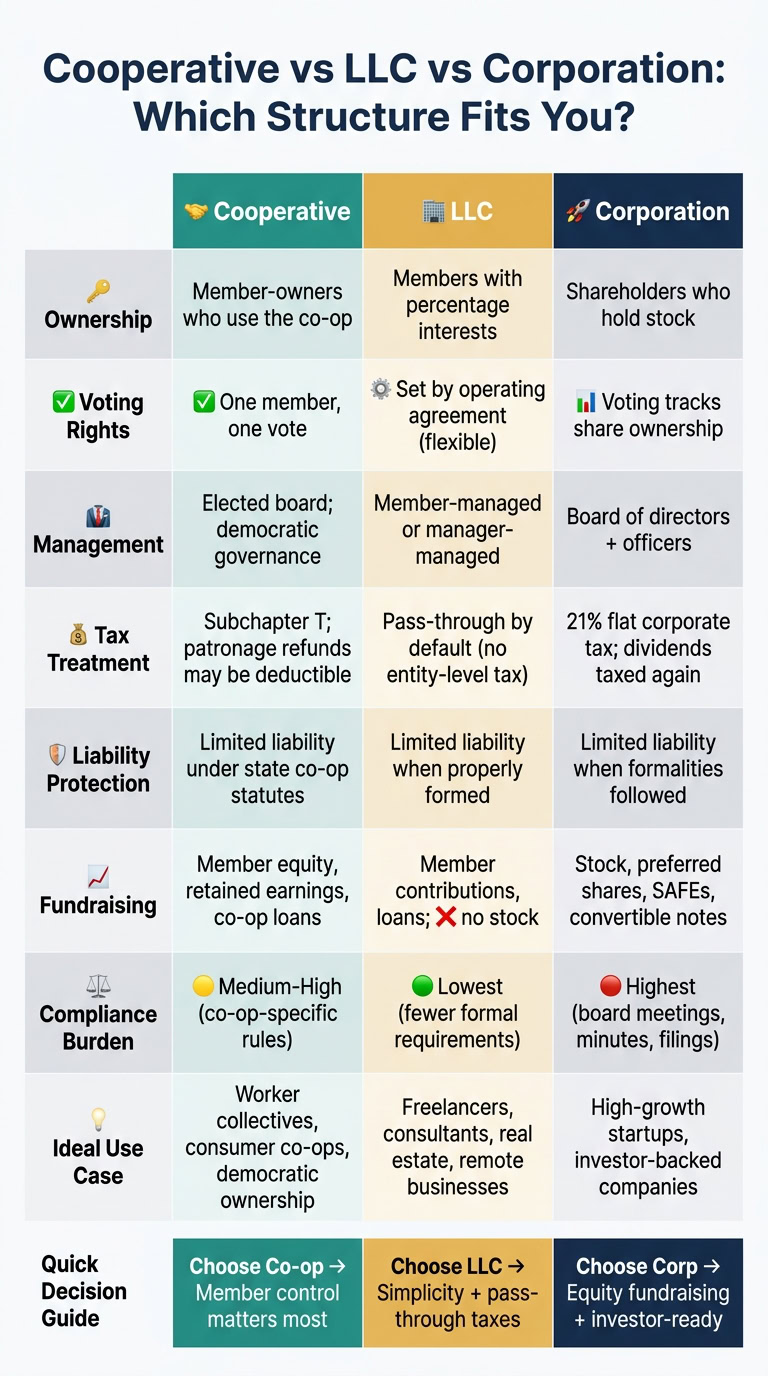
Comparison Table: Cooperative vs LLC vs Corporation
Here’s the side-by-side view using the same six factors covered above. It gives you a fast way to see where each structure fits.
| Feature | Cooperative | LLC | Corporation |
|---|---|---|---|
| Ownership | Member-owners who use the co-op | Members with percentage interests | Shareholders who hold stock |
| Voting Rights | One member, one vote | Set by operating agreement (flexible) | Voting usually tracks share ownership |
| Management | Elected board; democratic governance | Member-managed or manager-managed | Board of directors and officers |
| Tax Treatment | Generally taxed like a corporation, but patronage dividends may be deductible at the entity level | Pass-through by default; no entity-level tax | C corporation pays corporate income tax; dividends are taxed again to shareholders |
| Liability Protection | Limited liability under state co-op statutes | Limited liability protection | Limited liability protection for shareholders |
| Fundraising | Member equity, retained earnings, and member loans | Member contributions and loans; no stock | Stock and stock-based instruments like preferred shares, SAFEs, and convertible notes |
| Compliance Burden | Similar to corporations, plus co-op-specific rules | Lowest – fewer formal meeting and record-keeping requirements | Highest – board meetings, minutes, complex filings |
| Ideal Use Case | Worker collectives, consumer co-ops, democratic ownership | Freelancers, consultants, real estate, remote businesses | High-growth startups, investor-backed companies |
Matching Each Structure to Your Founder Profile and Goals
The best pick comes down to four things: control, taxes, liability, and fundraising. That’s the trade-off.
Choose a cooperative when equal worker control and patronage-based payouts matter most. This setup makes the most sense when the people using or working in the business should also guide it.
Choose an LLC when you want flexible governance, pass-through taxes, and lighter compliance. For remote founders, the operating agreement can spell out how virtual meetings happen, how decisions get recorded, and how new members join – without the formal board-and-minutes setup tied to corporations.
Choose a corporation when you need stock-based fundraising and investor-ready governance. Most venture-backed companies use Delaware C corporations. If you’re running the business remotely, you’ll still need a registered agent in the state where the corporation is formed so legal notices and state mail have somewhere to go.
Conclusion: Making the Decision
A simple way to think about the decision is to run it through five filters: ownership, governance, taxation, liability, and fundraising. Each option gives you something, and each asks you to give something up.
Pick a cooperative when democratic member control matters more than investor appeal. Pick an LLC when you want simplicity, pass-through taxes, and room to shape governance without heavy compliance. Pick a corporation when you need to issue equity, bring in institutional capital, or use a formal governance setup that investors know well.
The right structure is the one that matches how your business will actually run day to day.
FAQs
Can I convert an LLC into a corporation later?
Yes. An LLC can often become a corporation later as your business grows.
A lot of owners start with an LLC because it’s simpler to run and usually costs less. Then, if the company wants to bring in venture capital or get ready for an initial public offering, they switch to a corporation.
That move is common for a reason. Corporations can issue multiple classes of stock and can have an unlimited number of shareholders, which gives them more room to scale.
Before making the change, talk with a business attorney or accountant. The switch can affect taxes, paperwork, and other filing requirements.
How do I know if a co-op is too hard to fund?
It depends on your growth goals. One big factor is whether your business structure can issue stock, because that shapes how easily you can bring in outside money.
C-Corps are often the top pick for venture capitalists and institutional investors. Why? They can issue multiple classes of stock, have an unlimited number of shareholders, and follow a formal governance setup that investors know well.
If you plan to seek major outside investment or eventually go public, a co-op can be tougher to fund than a standard corporation.
Which structure is best for a remote founder?
For most remote founders, an LLC is the best fit. It gives you personal asset protection without adding a lot of extra hassle, which makes it a strong match for a business you run from anywhere.
Compared with corporations, LLCs usually come with less formal governance and less record-keeping. Pass-through taxation can make taxes simpler too. And if your business changes later, you can elect S-Corp tax status or convert to a C-Corp.