


Colorado does not require a written LLC operating agreement or state filing. But putting ownership, voting, signing authority, and payment rules in writing lets members choose permitted terms instead of relying on state defaults.
This guide explains the legal limits and provides a template for single-member and multi-member LLCs. It covers contributions, management, taxes, member exits, and dissolution – plus how to approve, store, and update the agreement.
Keep the signed agreement with company records, not the Secretary of State. Colorado’s annual Periodic Report is a separate requirement.
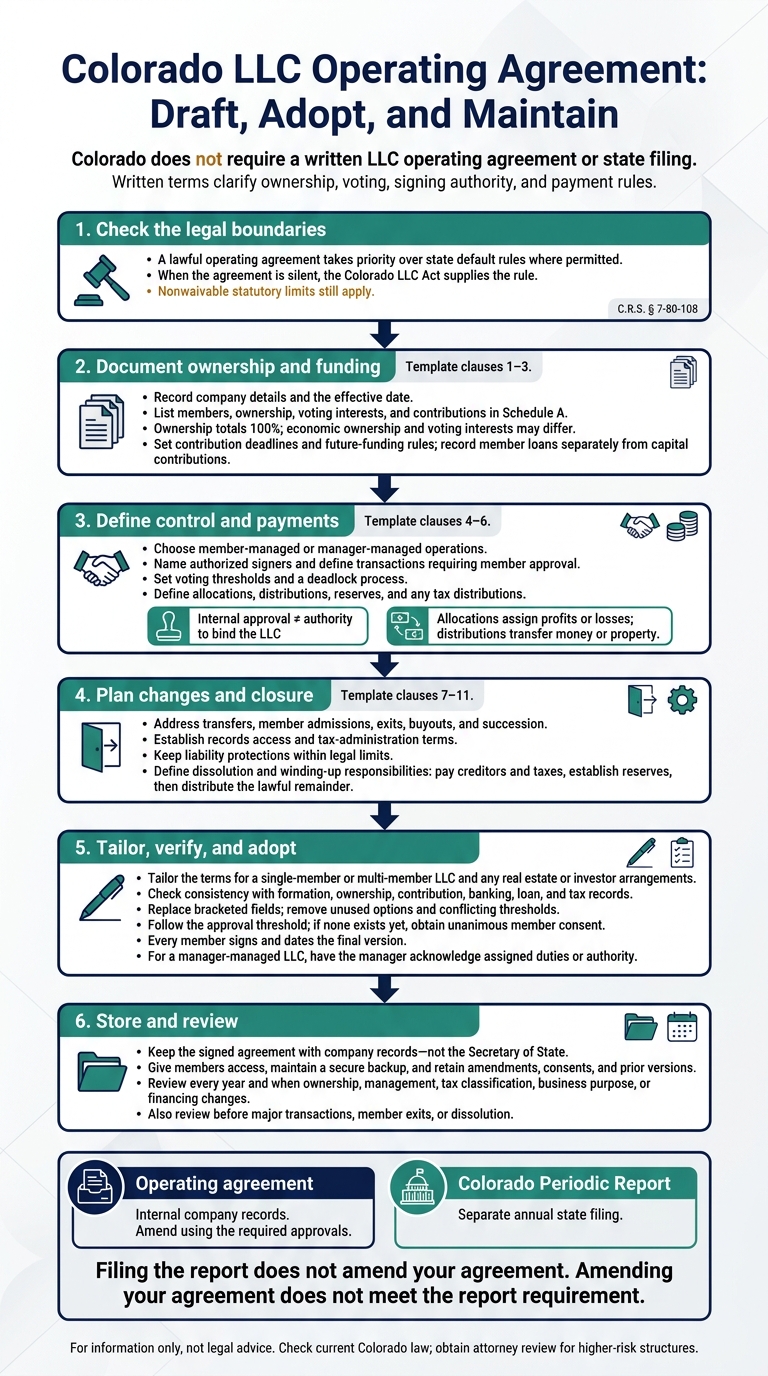
Colorado LLC Operating Agreement: Draft, Adopt, and Maintain
How to Start an LLC in Colorado (Step-by-Step Guide 2026)
sbb-itb-ba0a4be
Colorado Default Rules and Legal Limits
Under C.R.S. § 7-80-108, a lawful operating agreement takes priority over default rules for internal governance, member rights, and management – except where the statute restricts changes. When the agreement is silent, the Colorado LLC Act supplies the rule. Members can change many governance terms, but they cannot override the statute’s nonwaivable limits.
Use these defaults as the starting point for the template below. Change only the rules Colorado allows members to change.
Management, Voting, and Member Rights
Spell out voting rights separately from ownership. Also distinguish the power to approve decisions internally from the authority to bind the LLC. Before assuming either rule, check § 7-80-401 and the rules for management and signing authority.
Account for the statutory fallback rules, then write the company’s own terms where allowed.
| Topic | Drafting instructions |
|---|---|
| Management | State whether the LLC is member-managed or manager-managed, who manages it, who can bind it, and which transactions need member approval. |
| Voting and major decisions | Set voting thresholds for ordinary decisions, reserved matters, mergers, asset sales, borrowing, and dissolution. Include a process for resolving deadlocks. |
| Amendments and admissions | Set separate approval thresholds for changing the agreement and admitting new members. |
| Transfers | Separate transferred financial rights from management and voting rights. Define permitted transfers, admission requirements, and buyout rights. |
| Records access | Set reasonable procedures for requesting, inspecting, and copying records without unreasonably restricting members’ access to books and records. |
Financial Rules, Dissolution, and Nonwaivable Protections
Allocations and distributions are separate terms, and their formulas can differ. Allocations assign profits or losses; distributions transfer money or property. State the rules for both, including payment timing, reserves, and tax distributions. Don’t rely on ownership percentages or contributions alone.
| Topic | Drafting instructions |
|---|---|
| Profit and loss allocations | State whether allocations follow ownership, contributions, or another lawful formula. |
| Distributions | Set payment conditions, timing, reserves, and restrictions that meet statutory limits. |
| Dissolution | List contractual dissolution events separately from statutory grounds. |
| Winding up | Assign authority to liquidate the company and require debts to be paid according to creditor priorities before owners receive payouts. |
| Duties and protections | Keep fiduciary-duty changes within what §§ 7-80-108 and 7-80-404 allow. Preserve required disclosure, approval, ratification, good faith, fair dealing, and access protections. |
Check the current Colorado Revised Statutes before treating any default rule as settled law.
Colorado LLC Operating Agreement Template
This template is for information only, not legal advice. Use it to put the rules above into written company terms. Set the effective date to the formation date or another stated date. Replace every bracketed field, choose one option where indicated, and delete unused terms before signing. Have a Colorado attorney review higher-risk structures.
Clauses 1–3: Company Details, Ownership, and Contributions
Fill in the brackets for a single-member or multi-member LLC.
COLORADO LLC OPERATING AGREEMENT Effective date: [Month Day, Year] 1. Company. [Legal LLC Name] (“Company”) was formed in Colorado on [Month Day, Year]. Principal office: [Address]. Registered agent: [Name]. Registered office: [Colorado Address]. Purpose: [Any lawful business permitted under Colorado law / Specific purpose]. Duration: [Perpetual / Specified end date]. 2. Ownership. Schedule A lists every member. Economic ownership and voting interests may differ. Ownership totals 100%. Voting follows [CHOOSE ONE: ownership percentages / one vote per member / separate voting percentages / custom voting schedule]. SCHEDULE A - Repeat for each member: Member legal name: [Member Name] Address: [Address] Ownership percentage: [Ownership Percentage] Voting interest: [Voting Percentage or Number of Votes] Initial contribution and agreed value: [Description; $10,000.00] Special economic rights: [None / Attorney-reviewed attached terms] New interests require [Approval threshold] written approval stating the price, resulting dilution, and revised percentages. Record fractional interests to [Number] decimal places; totals must remain 100%. 3. Contributions. Each member must deliver the contribution listed in Schedule A by [Date]. For property, attach its description, title, liens, condition, agreed value, and valuation date. For services, attach duties, milestones, valuation, and vesting terms. Future funding: [CHOOSE ONE: No obligation without a separate signed commitment / Capital calls require [Approval threshold] and payment within [Number] days]. Funding default: Give written notice and [Number] days to cure. [CHOOSE ONE: Enforce the unpaid commitment without changing ownership / Apply the attorney-reviewed dilution or buyout formula attached as Exhibit B]. Record member loans separately from capital contributions. Clauses 4–6: Management, Voting, and Distributions
4. Management. Choose one option and delete the other. Option A - [Member-managed](https://businessanywhere.io/member-managed-vs-manager-managed-llc/): [Names] manage ordinary operations, bind the Company, sign contracts, access bank accounts, and incur debt. Option B - Manager-managed: [Names] serve as managers until [Term ends / Resignation or removal]. Appointment and removal require [Percentage]% of voting interests. Compensation: [Amount and payment terms]. Under either option: Approved signers: [Names/Titles]. Bank access: [Names/Titles]. Document reasonable business expenses before reimbursement. Commitments made without approval are prohibited. 5. Decisions. Quorum requires [Percentage]% of voting interests. Ordinary decisions require more than 50% of all voting interests. Unanimous approval is required for amendments, admissions of new members, new issuances, mergers, sales of all or nearly all assets, dissolution, and removal of managers. Reserved matters also require unanimous approval: transactions over [$25,000.00], borrowing, guarantees, real estate transactions, related-party transactions, and contracts longer than [Number] months. Written or electronic consent requires the same approval threshold as a meeting, delivery to every member, an effective date, and retention with Company records. Deadlocks: Members must negotiate for [Number] days, then attend mediation in [County], Colorado, within [Number] days. If the dispute remains unresolved, either party can seek court relief. [OPTIONAL: Attorney-reviewed buy-sell procedure in Exhibit C.] 6. Allocations and distributions. Allocate taxable income, gain, loss, deduction, and credit by [Ownership percentages / Attached tax-adviser- reviewed formula], subject to tax law. Taxable allocations do not guarantee cash payments. Distribute available cash quarterly by [Ownership percentages / Attached distribution schedule], after reserves for payroll, taxes, debt, capital expenses, and contingencies. Tax distributions: [CHOOSE ONE: None required / Pay quarterly using allocated taxable income multiplied by [Rate]%, less earlier tax distributions; reconcile annually]. No distribution is permitted if Colorado law prohibits it or if it leaves the Company unable to pay its debts. Clauses 7–11: Member Changes, Records, Liability, and Dissolution
7. Transfers. Transfers require [Approval threshold], except [None / Specified transfers to trusts or affiliates]. Before an outside sale, give the Company and remaining members [Number] days to match the written offer. A transferee has only economic rights until admitted as a member by [Approval threshold] and signing this agreement, subject to rights required by law. 8. Exits and buyouts. Withdrawal requires [Number] days’ notice. Death, documented incapacity, divorce-related transfers, and bankruptcy trigger notice and the purchase procedure below, only to the extent enforceable under applicable law. Expulsion requires [Defined misconduct], notice, an opportunity to respond, and [Approval threshold excluding the affected member]. Purchase obligation: [CHOOSE ONE: Mandatory purchase / Company option exercisable within [Number] days]. Buyer: [Company / Remaining members]. Value: Fair market value as of [Trigger date], determined by an independent appraiser selected through [Selection process]. Discounts: [None / Specified discounts]. Payment: [Percentage]% at closing; balance over [Number] months at [Rate]% annual interest. Security and permitted offsets: [Terms]. Interim management and sole-member succession: [Names, authority, and lawful admission procedure]. Obtain counsel review before using these provisions. 9. Records and taxes. Keep formation documents, this agreement and amendments, ownership and contribution schedules, consents, member and manager lists, financial statements, bank records, material contracts, and tax returns. Provide inspection and electronic copies upon [Number] business days’ notice, without restricting statutory access rights. Protect confidential information without blocking lawful access. Fiscal year: [Year-end]. Accounting method: [Cash / Accrual]. Intended tax classification: [Disregarded entity / Partnership / Corporation under a valid election]. Partnership representative, if applicable: [Name]. Tax elections require [Approval threshold]. No member is guaranteed distributions or tax outcomes. 10. Liability and protection. Liability limitations apply only to the extent permitted by law. Indemnification requires [Approval procedure] and excludes fraud, theft, bad faith, unlawful acts, and self-dealing without approval. Expense advances require a written promise to repay if indemnification proves unavailable. Insurance: [Coverage types and limits]. This clause does not eliminate nonwaivable duties or liability for personal guarantees or personal misconduct. 11. Dissolution and general terms. Dissolution occurs upon unanimous approval, [Specified event], judicial order, or another event required by law. [Name/Title] must wind up the Company, collect assets, resolve claims, pay creditors and taxes, establish reserves, and distribute the lawful remainder by [Formula]. After dissolution, the Company continues only to wind up. Complete required tax, state, and licensing filings; provide a final accounting; retain records for [Number] years. Amendments require unanimous written consent and updated schedules. Notices go to Schedule A addresses and [Email addresses], effective upon [Confirmed receipt]. Colorado law governs. Unresolved disputes belong in courts in [County], Colorado, subject to Clause 5. Invalid provisions are severable to the extent lawful. Waivers must be written. Members must sign documents needed to carry out this agreement. Counterparts and electronic signatures are accepted. This agreement and its exhibits control over prior agreements on the same subject. MEMBER SIGNATURE - Repeat for every member: Member legal name: [Name] Authorized signer, if an entity: [Name and Title] Signature: ______________________ Date: [Month Day, Year] Tailor the Template to Your LLC
Adjust the template clauses above to fit your LLC’s ownership, control, funding, and records. Start with who owns the company and who makes decisions.
Single-Member vs. Multi-Member Agreements
For a single-member LLC: Spell out the sole owner’s authority over contracts, banking, borrowing, hiring, and property transactions. Require written approval for major actions. Align succession and incapacity terms with estate planning documents, and explain how the membership interest passes after death or incapacity. State whether the company continues or dissolves in either case. Also clarify that the owner’s personal creditor does not automatically become a member or gain management rights.
For a multi-member LLC: Make sure the ownership schedule reflects actual contributions and agreed economic rights – not just management roles. Separate voting control from profit shares, and align transfer restrictions, buyout rights, and exit terms. Equal owners need a deadlock rule. Unequal economic ownership does not require unequal voting power, so state the chosen arrangement clearly. Then tailor authority, property rules, and investor terms to match.
Authority, Real Estate, and Investor Terms
Match authority to transaction risk. Set signing limits by transaction type and dollar amount. For manager-managed LLCs, explain how managers are appointed and removed, and which decisions remain with members. For real estate, distinguish routine operations from sales, refinancing, liens, and guarantees.
Name authorized signers and protect debt-service and repair reserves before making distributions. Keep the agreement consistent with bank resolutions and closing documents.
Match investor rights to the funding deal. Use the ownership and distribution clauses to address valuation, vesting, funding, dilution, admission, reporting, and preemptive rights. Decide whether existing members can participate in new issuances to protect their ownership percentages. Align any preferred returns or liquidation preferences with the distribution and dissolution provisions.
Check Company, Tax, and Banking Records
Compare the final agreement with the Articles of Organization, membership ledger, contribution receipts, banking resolutions, loan documents, and actual management practices. Resolve differences between ownership and tax records, but don’t assume capital-account balances equal ownership percentages.
The agreement does not elect tax status, and an EIN application does not change it. Before approval, remove drafting notes, unused alternatives, and conflicting approval thresholds.
Approve, Store, and Update the Agreement
Once you’ve drafted the operating agreement, formally adopt it and keep the signed copy with company records. A signed agreement documents members’ decisions and reduces reliance on default rules. It must also comply with Colorado law.
Approval, Signatures, and Recordkeeping
Check company and member details before approval. Follow the agreement’s approval threshold. If no threshold exists yet, obtain unanimous member consent. Every member must sign and date the final version. For a manager-managed LLC, have the manager acknowledge any assigned duties or authority.
Store the signed agreement with company records, give members access, and keep a secure backup. Save all amendments, consents, and prior versions. Each amendment should be dated and approved, with its effective date recorded.
When to Review the Agreement and Check Compliance
Review the agreement every year and whenever ownership, management, tax classification, business purpose, or financing changes. Check any voting, distribution, and dissolution terms those changes affect. Also review it before major transactions, member exits, or dissolution.
Colorado requires an annual Periodic Report. Filing the report does not amend your agreement, and amending your agreement does not meet the report requirement. Check whether any changes also call for updates to state, tax, or banking records.
FAQs
Is an unsigned Colorado LLC operating agreement enforceable?
In Colorado, an unsigned operating agreement generally isn’t enforceable among members. All LLC members must sign it for it to be binding.
Colorado doesn’t require an operating agreement. But when members create one, it serves as a private contract that governs the business’s internal affairs. Store the signed agreement securely with the company’s permanent records.
What happens if my operating agreement conflicts with my Articles of Organization?
If your operating agreement conflicts with your Articles of Organization, the Articles generally take precedence. The Articles are the public document filed with the state to establish your LLC. Your operating agreement is a private contract that sets the rules for running it.
Keep both documents consistent to help prevent confusion and disputes. When you change your company’s structure or rules, update the appropriate document.
Can I adopt an operating agreement after forming my LLC?
Yes. You can adopt an operating agreement after forming your LLC, but it’s best to finalize and sign it before making large contributions.
Colorado doesn’t require an operating agreement. Without one, state default rules apply. An agreement lets you replace default provisions with terms that fit your management and financial needs. Once all members have signed it, keep it with your permanent company records.