

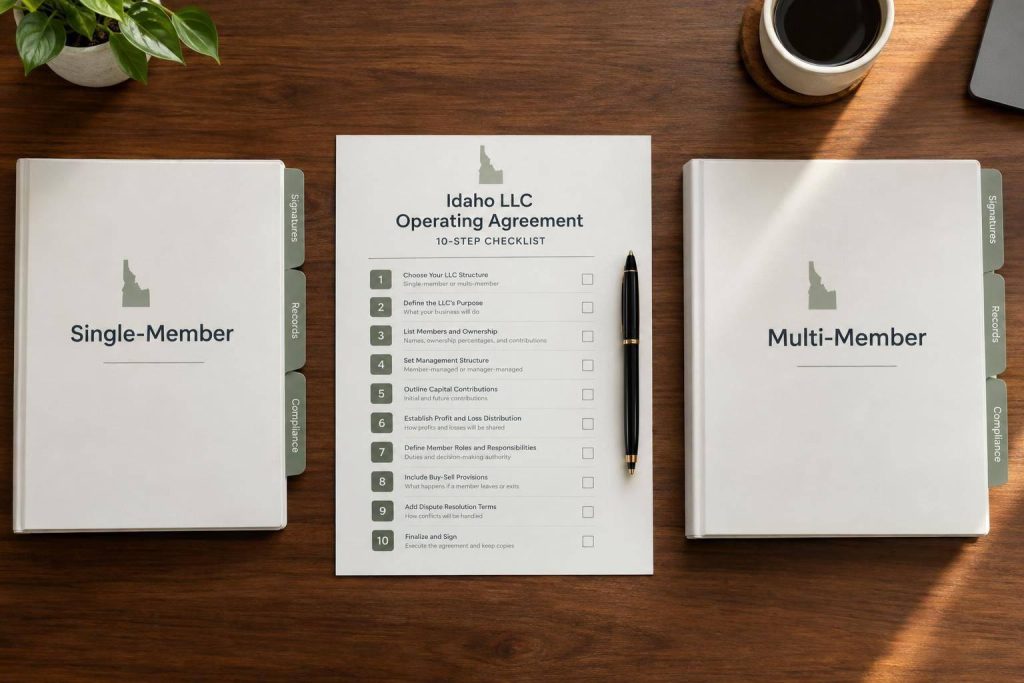
Idaho does not require a written LLC operating agreement – and it does not belong in a state filing. But putting the rules in writing helps document who owns the company, who can act for it, and how money and member departures are handled.
Choose the template that matches the LLC’s current ownership:
- Single-member: One owner with 100% ownership.
- Multi-member: Two or more owners who need written rules for voting, contributions, distributions, transfers, buyouts, and disputes.
Complete every blank, remove unused options, and have every member sign and date the agreement. Keep it with the company’s records and review it when ownership, management, or financial terms change. Idaho’s default rules apply where the agreement is silent, and some legal requirements cannot be changed by agreement.
The templates below cover both structures, followed by steps for completing, signing, and storing the agreement. Legal or tax review is recommended for complex terms.
Single-Member Idaho LLC Operating Agreement Template
Company Details, Ownership, and Owner Authority
Agreement and ownership. This Single-Member Operating Agreement takes effect on [effective date] for [LLC name], an Idaho limited liability company formed on [formation date]. Idaho law governs this Agreement. The Company’s principal office is [principal office], and its registered agent is [registered agent]. [Member name], residing at [member address] (“Member”), owns 100% of the membership interests. The table below records the Member’s contributions. Any additional contributions require the Member’s written approval.
| Contribution type | Description and supporting document | Agreed value | Contribution date |
|---|---|---|---|
| Cash | [Amount and deposit record, or “None”] | $[amount] | [Month Day, Year] |
| Property or equipment | [Asset and receipt or title, or “None”] | $[amount] | [Month Day, Year] |
| Other assets | [Asset and assignment document, or “None”] | $[amount] | [Month Day, Year] |
Management and authority. The Company is member-managed. The Member controls banking, contracts, hiring, insurance, borrowing, tax elections, and transactions involving Company property. Any delegation requires signed written authorization that names the authorized person and states their duties, spending limits, authorization period, and whether they may delegate to others. Contributed property belongs to the Company, not the Member personally. The Company will keep supporting receipts, titles, valuations, and assignments with its records.
Finances, Taxes, and Company Records
Financial separation and distributions. The Company will maintain separate bank accounts and books in its legal name. Company funds will not cover personal expenses, and reimbursements require proof of a business expense. All tax items are allocated to the Member, subject to applicable tax law. The Member may approve the timing and amount of distributions, but each distribution must be lawful and leave the Company able to meet its obligations. Each payment must be recorded by date, amount, purpose, and type.
Taxes and records. The Company will keep its default federal tax classification unless the Member properly files an election for different treatment. This Agreement does not replace tax returns, payroll filings, sales-tax obligations, or other required filings. Foreign owners should review the foreign-owned LLC tax filing guidance for additional information-return requirements that may apply.
The Company will retain its Certificate of Organization, Agreement, amendments, contribution records, bank statements, contracts, tax records, licenses, and asset titles. Major decisions require dated, signed written consent stating the action and its purpose.
Liability, Amendments, Dissolution, and Signature
Liability and closing terms. Company obligations belong to the Company. Membership alone does not create personal liability, except as provided by law. Indemnification covers only authorized, good-faith actions allowed by Idaho law. Amendments require a written document approved and signed by the Member that states the effective date and identifies the sections changed.
The Company will dissolve upon the Member’s written decision, an event specified in the formation documents, or another legally required event. Winding up includes collecting assets, paying or providing for creditors and taxes, completing final filings and accounting, and distributing remaining assets to the Member.
Adoption: I adopt this Agreement as sole Member. Printed name: [member name] · Signature: [signature] · Date: [Month Day, Year].
If your LLC has more than one member, use the multi-member template below.
sbb-itb-ba0a4be
How to Start an LLC in Idaho 2026 | Costs, Steps & Requirements | What You Need to Know?
Multi-Member Idaho LLC Operating Agreement Template
Use this template for an Idaho LLC owned by two or more people. It sets the rules for ownership, voting, management, transfers, exits, and disputes. Fill in every bracketed field and choose one management model before signing.
Member Details, Contributions, and Voting
Agreement and membership schedule. This Agreement takes effect on [effective date] for [exact LLC legal name]. Its Idaho Certificate of Organization was filed on [filing date]. Principal office: [address]. Registered agent: [name and address]. Business purpose: [purpose]. Fiscal year: [year-end]. The schedule below is part of this Agreement. Ownership and voting must each total 100%, but a member’s ownership and voting percentages don’t have to match.
Future contributions are [voluntary / mandatory under attached funding schedule]. Additional funding requires [approval threshold] and [notice period]. Missed contributions trigger [remedy], not automatic forfeiture. Quorum is [percentage] of voting power. Ordinary decisions require [threshold] of total voting power. Admitting members, changing economic rights, selling substantially all assets, and dissolving require unanimous written consent. Other written consents require the applicable voting threshold, signatures, and delivery to every member.
| Member legal name and mailing address | Ownership | Voting | Initial contribution: type, description, agreed value, due date | Opening capital account |
|---|---|---|---|---|
| [Member 1] | [%] | [%] | [Cash, property, services, or promise; value; date] | $[amount] |
| [Member 2] | [%] | [%] | [Cash, property, services, or promise; value; date] | $[amount] |
| [Additional member, or delete] | [%] | [%] | [Details] | $[amount] |
| Total | 100% | 100% | $[total agreed value] | $[total] |
Management, Finances, and Member Records
Management and finances. Choose one model: [member-managed], with duties, banking access, signing limits, and reimbursement rules set out in [authority schedule]; or [manager-managed], with [names] appointed for [term], removable and replaceable by [voting threshold], paid [compensation], and authorized to act within [limits]. Managers [must / need not] be members. Extraordinary transactions require [member approval threshold]. Decision-makers with a conflict must disclose it and abstain. Related-party transactions require [disinterested approval threshold].
Profits and losses follow [ownership percentages / attached tax-reviewed allocation]. Cash distributions follow [formula] on [schedule], after approved reserves and a solvency check. Optional tax distributions are [excluded / calculated under attached formula], subject to available cash and lawful distribution limits. Allocations are not cash payments. Nonstandard allocations require tax review under applicable federal rules.
Keep records at [location] using [accounting method]. Electronic copies are [permitted / required]. [Responsible person] maintains formation documents, agreements, contribution and capital accounts, financial statements, bank records, contracts, consents, distribution history, annual reports, and tax filings. Members have reasonable access to inspect and copy records, subject to confidentiality and reasonable copying costs.
Transfers, Member Exits, Disputes, and Dissolution
Transfers and exits. These terms govern member exits, ownership changes, and related disputes. Sales, assignments, and pledges require [approval threshold]. Permitted transfers are limited to [specified recipients] and require notice and signed documentation. A proposed outside sale requires notice stating the buyer, price, payment terms, and closing date. The Company has [days] to exercise its right of first refusal. Nontransferring members then have [days] to exercise that right. Closing occurs within [days]. Changes to material terms restart the process. A transferee receives economic rights only; membership requires unanimous approval.
Withdrawal requires [notice period]. Death, disability defined as [definition], bankruptcy, and expulsion for [defined misconduct and approval process] trigger [buyout option or obligation], subject to applicable law. Otherwise, the departing person keeps economic rights but has no management rights. Buyout value is [valuation standard] as of [date], determined through [independent appraisal process], with [discount rule and appraisal-dispute process]. Payment terms are [down payment, installments, interest, security, and closing deadline]. Departure alone does not erase existing obligations or create a right to immediate payment.
Disputes and deadlock. Disputes require written notice, [days] of negotiation, mediation in [Idaho location] with [cost allocation], and then [binding arbitration procedure / specified Idaho court]. Emergency asset-protection relief remains available. Deadlock occurs after [number] properly noticed meetings. Escalation and mediation must precede [buy-sell procedure or judicial relief]. Idaho law governs. Notice, service, confidentiality, and attorneys’ fees follow [attached terms], which also bind former members and transferees.
Amendments and dissolution. Amendments require [threshold] in signed writing. Changes to fundamental rights also require each affected member’s consent. Dissolution follows unanimous written consent, [specified event], or a legal requirement. A member’s departure alone does not dissolve the LLC. [Winding-up representative] collects assets, pays or provides for creditors and taxes, completes final filings, and distributes the balance under [liquidation formula] and applicable law.
Adoption – repeat for every member: Printed legal name: [name] · Address: [address] · Signature: [signature] · Date: [MM/DD/YYYY].
Manager acceptance, if applicable: Printed name: [name] · Signature: [signature] · Date: [MM/DD/YYYY].
How to Complete, Sign, and Store Your Agreement
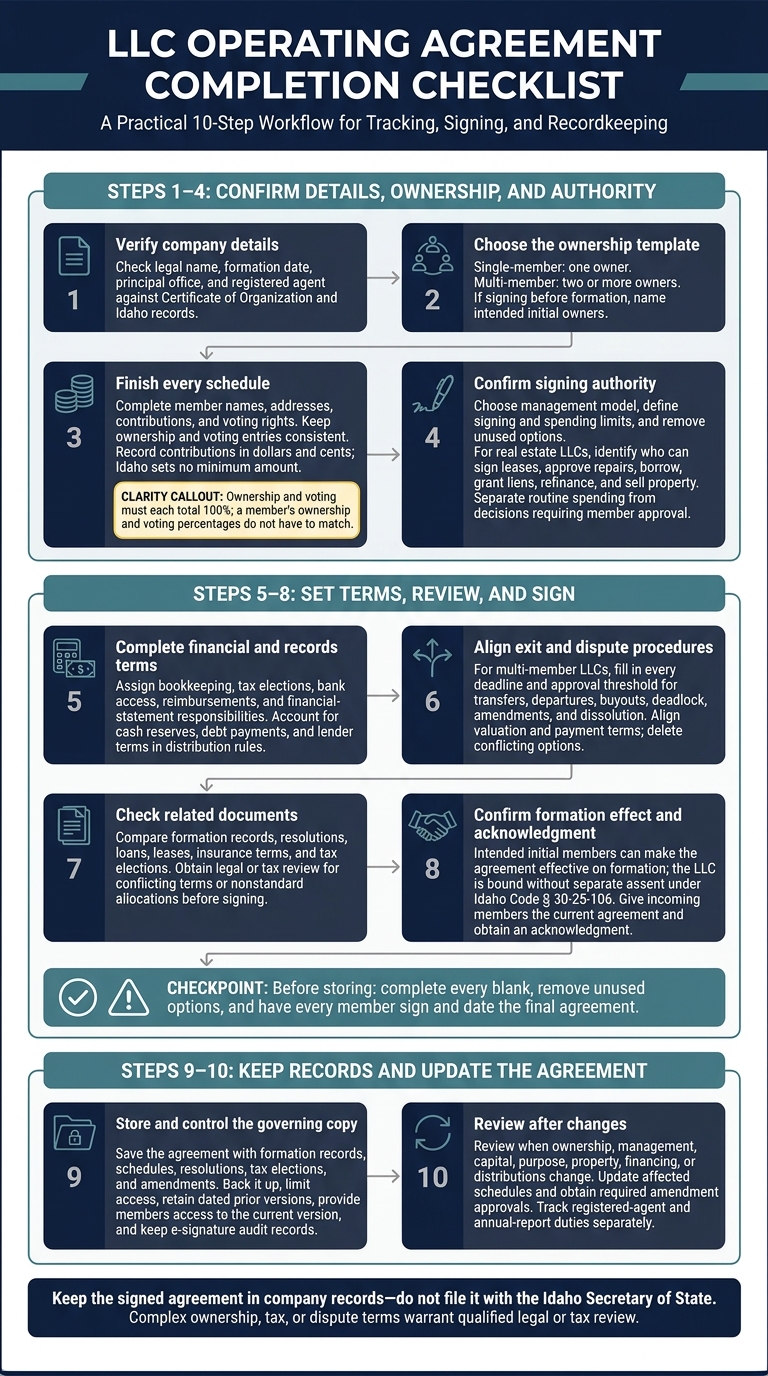
Idaho LLC Operating Agreement: 10-Step Checklist
Finalize the template, sign the agreement, and keep the final version with your LLC records.
Steps 1–4: Confirm Details, Ownership, and Authority
Verify company details. Check the legal name, formation date, principal office, and registered agent against the Certificate of Organization and Idaho records.
Choose the ownership template. Use the single-member template for one owner or the multi-member template for two or more. If you’re signing before formation, name the intended initial owners.
Finish every schedule. Confirm member names, addresses, contributions, and voting rights. Make sure ownership percentages and voting rights match throughout the agreement. Record contributions in dollars and cents; Idaho sets no minimum amount.
Confirm signing authority. Match signing authority to your chosen management model and remove unused options. For real estate LLCs, name who can sign leases, approve repairs, borrow, grant liens, refinance, and sell property. Separate routine spending from decisions that need member approval.
Steps 5–8: Set Terms, Review, and Sign
With authority settled, complete the financial and recordkeeping terms.
Complete financial and records terms. Assign responsibility for bookkeeping, tax elections, bank access, reimbursements, and financial statements. Make sure distribution rules account for cash reserves, debt payments, and lender terms.
Align exit and dispute procedures. In the multi-member template, fill in every deadline and approval threshold for transfers, departures, buyouts, deadlock, amendments, and dissolution. Align valuation and payment terms, and delete conflicting options.
Check related documents. Compare the agreement with formation records, resolutions, loans, leases, insurance terms, and tax elections. Get legal or tax review of conflicting terms or nonstandard allocations before signing.
Confirm formation effect and acknowledgment. Under Idaho Code § 30-25-106, intended initial members can make the agreement effective on formation, and the LLC is bound without separate assent. Give incoming members the current agreement and obtain an acknowledgment.
Steps 9–10: Keep Records and Update the Agreement
After signing, keep the final version as the company’s governing copy.
Store and control the governing copy. Save the agreement digitally with formation records, schedules, resolutions, tax elections, and amendments. Back it up, limit access, and retain dated prior versions. Give members access to the current version, and keep e-signature audit records.
Review after changes. Review the agreement whenever ownership, management, capital, purpose, property, financing, or distributions change. Update affected schedules and obtain any required amendment approvals. Track registered-agent and annual-report duties separately in your compliance records.
Conclusion: Finalize Your Idaho LLC Operating Agreement
With your template complete, move on to signing and recordkeeping. Make sure you used the correct template, then check ownership, management authority, financial terms, and exit procedures. Collect all required approvals and signatures on the final version.
Keep the signed agreement in your company records. Do not file it with the Idaho Secretary of State. Update it whenever ownership, management, or financial arrangements change. File annual reports and any required state amendments separately to keep your operating agreement apart from state compliance records.
If your agreement includes complex ownership, tax, or dispute terms, have a qualified Idaho attorney or tax professional review it before you rely on it.
FAQs
Does my Idaho LLC operating agreement need notarization?
No. Idaho law does not require notarization. Your operating agreement is an internal document, so you don’t need to file it with the Secretary of State.
Notarization can strengthen the agreement’s legal standing and is often recommended for amendments. Financial institutions may also require it to open an account.
Remote online notarization costs $37 per document and can help when members live in different states or countries.
How do I update my agreement when adding a second owner?
Follow the amendment process in your current operating agreement, including its voting requirements and approval steps. Put the changes in writing. Specify the new ownership percentages, capital contributions, and any changes to management or decision-making authority.
Get formal approval and signatures from all members, including the new owner. Give each member an updated copy, and store the signed amendment securely with your company records.
What happens if my operating agreement conflicts with Idaho law?
If your operating agreement conflicts with Idaho law, state statutes will generally override the noncompliant terms. That could lead to unexpected legal outcomes and reduce your control over how the business runs.
Include a severability clause to help keep the rest of the agreement in effect if a provision is illegal or unenforceable. Work with a qualified business attorney to make sure your agreement follows Idaho law and supports your business goals.