


Starting an LLC in Washington? Here’s what you need to know:
In Washington, the Articles of Organization are officially called the Certificate of Formation. Filing this document with the Washington Secretary of State is required to legally establish your LLC. You can file online for $200 (processed in a few days) or by mail for $180 (processed in a few weeks).
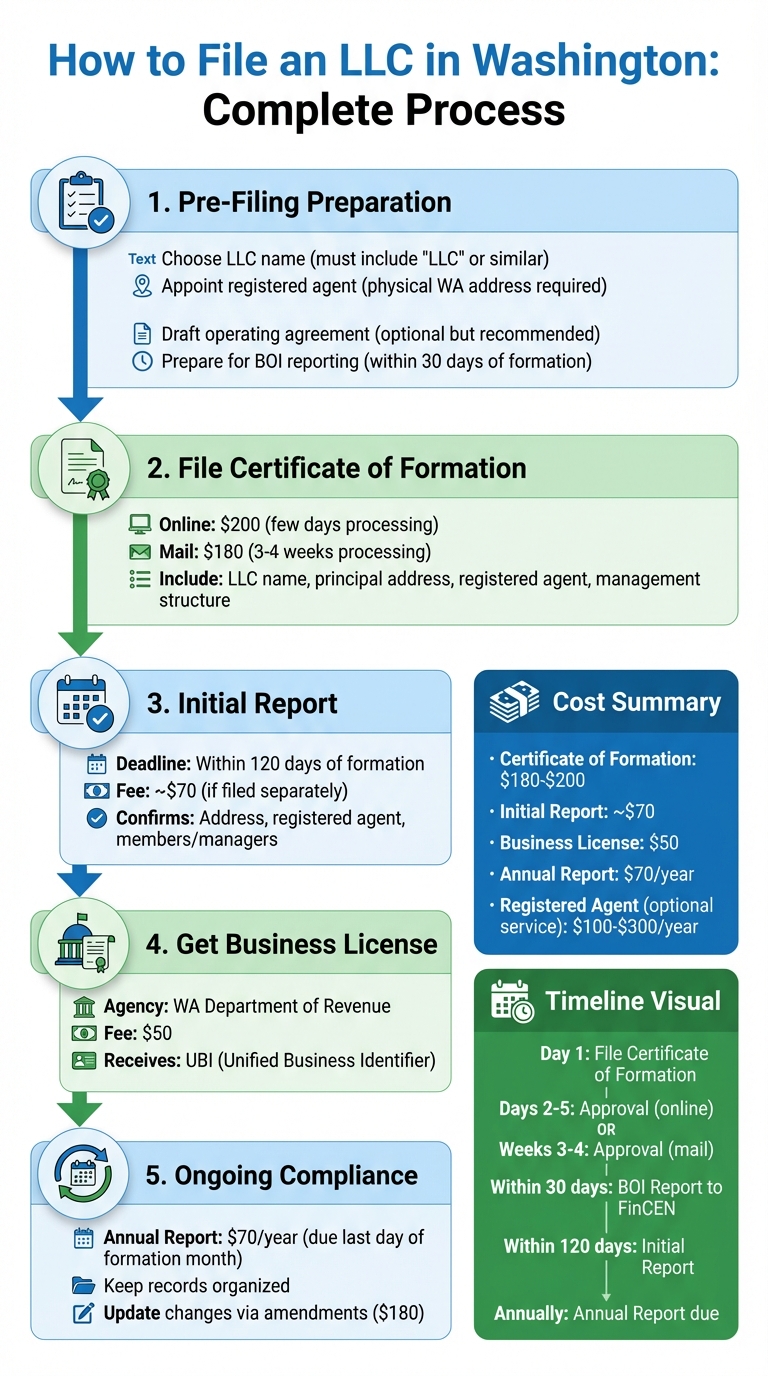
Here’s a quick breakdown of the process:
- Choose a name: Must include “LLC” or similar and meet state naming rules.
- Appoint a registered agent: Must have a physical Washington address to receive legal documents.
- Prepare your Certificate of Formation: Include details like your LLC name, principal address, and management structure.
- File online or by mail: Online is faster and more convenient.
After filing, you’ll need to submit an Initial Report within 120 days, file annual reports ($70/year), and get a Washington business license ($50). Proper recordkeeping and an operating agreement (optional but helpful) will keep your LLC compliant and organized.
Ready to start? Let’s dive into the details.
What to Do Before Filing
Before submitting your Certificate of Formation, it’s essential to gather all the necessary information. Providing accurate details upfront can save you from unnecessary delays.
Choosing a Name for Your Washington LLC
When naming your LLC in Washington, you’ll need to follow specific rules. Your LLC’s name must include a designator like “Limited Liability Company,” “Limited Liability Co.,” “LLC,” or “L.L.C.” If you don’t specify your preference, the state will automatically use “LLC” in your formation documents.
The name you choose cannot suggest a different type of business structure. For example, terms like “corporation,” “incorporated,” “partnership,” or “cooperative” are not allowed.
Before filing, you should check the availability of your desired name using the Washington Secretary of State’s business entity search tool. This ensures your name is distinguishable from existing businesses. To avoid potential conflicts, search for multiple variations – consider differences in punctuation, abbreviations, or spacing. For instance, “Cascade Coffee, LLC” would meet the requirements, but “Cascade Corporation, LLC” would likely be rejected because it implies a different entity type.
If your preferred name is already taken, you’ll need to tweak the distinctive part of the name or come up with a new one. Once you’ve confirmed availability, you can either proceed with filing or reserve the name to ensure no one else claims it before you’re ready.
Registered Agent Requirements in Washington
Every LLC in Washington must designate a registered agent with a physical address in the state. Keep in mind, P.O. boxes are not allowed. The registered agent will handle important documents on your behalf, such as legal notices, lawsuits, and state correspondence, during normal business hours.
Your registered agent can be an individual (such as yourself, an employee, or an attorney) or a commercial registered agent service authorized to operate in Washington. The agent must provide written consent, and their name and address will be listed on your Certificate of Formation.
While some small business owners choose to act as their own registered agent to save money (fees typically range from $100 to $300 per year), there are trade-offs. Using your personal address means it will become public, and you must be available during business hours to receive documents. If you work from home, travel often, or value privacy, hiring a commercial registered agent service might be a better option. For instance, BusinessAnywhere offers registered agent services for $147 per year after a free first year when you register your LLC through their platform.
Other Pre-Filing Steps
Before filing your Certificate of Formation, it’s wise to draft an operating agreement. This document outlines key details like ownership percentages, capital contributions, profit and loss allocation, management structure (whether member-managed or manager-managed), voting rights, and procedures for adding or removing members. While not required by the state, an operating agreement can prevent disputes, streamline decision-making, and may even be needed to open a business bank account.
Additionally, prepare for Beneficial Ownership Information (BOI) reporting to FinCEN. Starting January 1, 2025, most LLCs must file a BOI report within 30 days of formation. This report requires identifying all beneficial owners – typically anyone with at least 25% ownership or significant control. You’ll need to gather their full legal names, dates of birth, residential addresses, and acceptable identification documents. Staying organized will help you meet these federal requirements on time.
Finally, think about choosing an effective date for your LLC. Washington allows you to decide whether your LLC becomes official upon filing or on a future date. Picking a date that aligns with your business timeline can simplify accounting and licensing processes.
With these steps completed, you’ll be ready to move forward and file your Certificate of Formation in the next stage.
How to File Articles of Organization in Washington
Once you’ve completed the necessary pre-filing steps, it’s time to submit your Certificate of Formation – Washington’s equivalent of Articles of Organization – to the Secretary of State. The process is straightforward, but paying attention to filing options and ensuring accuracy will help you avoid delays. Here’s how to file your Certificate of Formation efficiently.
Filing Methods and Processing Times
In Washington, you can file your Certificate of Formation either online or by mail.
- Online filing costs $200 and is typically processed within a few business days. Once approved, you’ll receive your documents electronically.
- Mail filing is slightly cheaper at $180, but it takes longer – about three to four weeks, plus mailing time, due to manual processing requirements.
Most new LLC owners prefer online filing because it’s faster and more convenient. With online filing, you can pay using a credit or debit card, receive instant confirmation, and download your approved documents immediately. Mail filing, on the other hand, may be better if you need paper records or have to include additional attachments. It involves printing the form, signing it, and sending it along with a check or money order payable to the Washington Secretary of State.
If you’re planning to open a business bank account or secure financing soon after forming your LLC, the quicker processing of online filing might justify the extra $20.
Completing the Certificate of Formation
Before you begin, ensure you have all the required details from your pre-filing checklist. The Certificate of Formation requires the following information about your LLC:
- LLC Name: Enter your business name exactly as you want it to appear, including one of the required designators like "Limited Liability Company", "LLC", or "L.L.C." If you don’t include a designator, the form will default to "LLC." Avoid terms that suggest your business is another type of entity.
- Principal Office Address: Provide the physical address where your LLC’s records will be kept. This cannot be a P.O. box. The address doesn’t need to be in Washington but must be a real location where documents can be accessed.
- Registered Agent Information: List the full name and physical Washington address of your registered agent.
- Management Structure: Specify whether your LLC will be member-managed (all owners handle daily operations) or manager-managed (specific individuals manage the LLC while others have passive roles). For member-managed LLCs, you might note, "Management of the LLC is vested in its members." For manager-managed LLCs, you could state, "Management is vested in one or more managers."
- Duration: Indicate if your LLC will exist perpetually or have a set end date. Most LLCs leave this blank for perpetual existence, but you can specify an expiration date for projects or limited-time ventures.
- Organizer Information: Include the name and address of the person submitting the Certificate of Formation. This could be one of the LLC’s founders or an attorney handling the filing.
- UBI (Unified Business Identifier): If this is your first Washington business, leave this field blank. The state will assign a UBI once your LLC is approved.
Submitting Your Application and Getting Approval
For online filing, visit the Washington Secretary of State’s corporations and LLC filing portal. Log in or create an account, then select "Certificate of Formation – Limited Liability Company" and choose "Domestic LLC." Enter your information carefully, review it for accuracy, and pay the $200 fee with a credit or debit card. Make sure to save your confirmation and tracking/reference number.
For mail filing, download the latest Certificate of Formation form from the Secretary of State’s website (check for updates, such as revisions made in June 2025). Print the form, complete it in dark ink or type the information, and sign where required. Prepare a check or money order for $180 payable to the Washington Secretary of State. Mail your completed form and payment to the Corporations & Charities Division. Using a trackable mail service is recommended, and always keep copies of the documents you send.
Once your application is approved, you’ll receive confirmation along with your Certification of Formation and stamped copies of your form. For online filings, these documents are emailed, while paper copies may also be mailed to your registered agent’s address. Be sure to save these documents securely – you’ll need them to get your EIN, open a business bank account, and apply for a Washington business license.
What to Do After Filing
Once your Washington LLC is approved, there are a few key steps to ensure you stay compliant with state requirements.
Filing the Initial Report
In Washington, all new LLCs must submit an Initial Report to the Secretary of State within 120 days of formation. This report confirms details like your LLC’s principal office address, registered agent information, and the names and addresses of its members or managers.
You can file the Initial Report online through the Secretary of State’s portal or by mail using the appropriate form. Filing online is generally quicker and more convenient. If you file the Initial Report along with your Certificate of Formation, you might avoid paying an additional fee. However, if you file it separately later, the fee is approximately $70, which matches the annual report fee.
Missing the 120-day deadline can lead to late fees and possibly administrative dissolution of your LLC. To avoid this, make a note of your LLC’s formation date and the 120-day deadline as soon as your LLC is approved. If you’re filing online, it’s a good idea to submit the Initial Report at the same time as your formation documents to simplify the process.
Annual Report and Ongoing Compliance
After submitting the Initial Report, your LLC must file an annual report each year to maintain its active status. The annual report is due by the last day of the month in which your LLC was formed. For example, if your LLC was formed on June 10, your annual report will be due by June 30 each year.
The filing fee is $70 per year, and the report is used to update or confirm your LLC’s name, principal office address, registered agent, and member or manager details. Filing on time is essential to avoid penalties.
If you miss the deadline, your LLC’s status may change to "delinquent", and continued noncompliance could result in administrative dissolution. Reinstating a dissolved LLC can be costly and may require additional paperwork. To avoid this, set up a recurring annual reminder and ensure the Secretary of State has your current contact information for any notices.
Once your annual reporting is handled, the next step is obtaining the necessary business licenses.
Obtaining a Washington Business License
Most Washington LLCs need to file a Business License Application with the Washington Department of Revenue. This is especially important if you plan to hire employees, collect or remit state taxes, or engage in ongoing business activities in the state. The application can be completed online or in person, and the fee for new businesses is $50.
Once processed, the state will issue a nine-digit UBI (Unified Business Identifier) for tax and reporting purposes. If you received a temporary UBI during formation, this process will confirm and activate it.
Beyond the state business license, your LLC may need additional local licenses, zoning approvals, home-occupation permits, or industry-specific licenses, depending on your location and business type. To identify what’s required, use the Washington Department of Revenue’s Business Licensing Wizard, check with local licensing offices, and consult relevant state licensing boards if your business operates in a regulated field.
| Requirement | Deadline | Agency | Fee | Details |
|---|---|---|---|---|
| Initial Report | Within 120 days of formation | Secretary of State | ~$70 (if filed separately) | Confirms address, registered agent, and members/managers |
| Annual Report | Last day of formation month (yearly) | Secretary of State | $70 | Maintains good standing; updates business information |
| Business License | After formation (if applicable) | Dept. of Revenue | $50 | Issues UBI; required for taxes and hiring employees |
To stay organized, keep all filed reports, licenses, and confirmations in one central location – whether digitally or in a physical file. Creating a compliance calendar with reminders for annual reports, license renewals, and other recurring obligations can help you stay on top of these requirements and avoid penalties.
sbb-itb-ba0a4be
Common Mistakes and Tips
Getting your LLC set up correctly and staying organized afterward can save you a lot of trouble – think time, money, and avoiding legal headaches.
Common Filing Errors
A lot of Washington LLC filings hit roadblocks because of preventable mistakes. One big issue? Picking a name that’s either unavailable or doesn’t meet state requirements. Your LLC name must include one of the following: "Limited Liability Company", "Limited Liability Co.", "LLC", or "L.L.C." It also can’t use restricted terms like "bank", "attorney", "corporation", or "State Department" without proper authorization. Before filing, take a moment to search the Washington Secretary of State’s business entity database to ensure your chosen name stands out from existing ones.
Another common mistake involves registered agent details. For example, listing a P.O. box or naming someone who isn’t responsive can delay your filing. If your registered agent changes, notify the Secretary of State right away using the Corporations and Charities Filing System – this ensures you don’t miss critical notices.
Missing the Initial Report deadline is another big mistake, leading to fees and even potential dissolution. For more on deadlines and what happens if you miss them, check out the "What to Do After Filing" section. Steering clear of these errors will make the entire process much smoother.
Updating Your Certificate of Formation
Once your LLC is up and running, keeping your information current is just as important. If anything changes – like your LLC’s name, management structure, or principal office address – you’ll need to file an Amendment to the Certificate of Formation with the Secretary of State. This costs $180 by mail (online options may vary), and the form must match your LLC’s existing name and UBI exactly as listed in state records.
A common misstep here is jumping the gun – using a new name in marketing materials or on your website before the amendment is officially approved. This can lead to confusion with banks, tax agencies, or business partners. Always wait for state confirmation before updating official documents or conducting business under the new details. Also, be sure to use the latest amendment form and clearly outline the changes to avoid delays.
Recordkeeping and Internal Documents
Staying organized with your LLC’s internal records is just as critical as filing the right forms. Good recordkeeping helps protect your limited liability status, keeps you compliant, and simplifies audits and state filings. Keep digital or physical copies of all key documents – like your Certificate of Formation, amendments, Initial and Annual Reports, business licenses, EIN confirmation, and tax filings. Setting up reminders for filing deadlines can save you from last-minute scrambles.
Even though Washington doesn’t require you to file an Operating Agreement, having a written one is a smart move. It lays out essential details like ownership percentages, management roles, voting rules, profit sharing, and procedures for adding or removing members. Without this, your LLC defaults to state laws under RCW 25.15, which might not reflect how you want your business to run. Also, maintain records of member contributions, meeting minutes, and key contracts like leases or vendor agreements. These documents can be lifesavers when preparing reports or resolving disputes.
To make things easier, consider using cloud storage or LLC management software to keep everything centralized and easy to access. Many registered agent and compliance services offer tools like dashboard reminders and filing help, which can be especially handy if you’re juggling multiple LLCs or have several members involved.
Conclusion
Filing your Certificate of Formation in Washington is a fairly straightforward process. Start by choosing an LLC name that meets state requirements and appointing a registered agent based in Washington. You can file your formation documents online for $200 or by mail for $180, though online filing is processed more quickly. Once your application is approved, the Secretary of State will email your Certificate of Formation, and a copy will also be sent to your registered agent.
Once your LLC is officially formed, there are a few key steps to keep in mind to stay compliant. Within 120 days, you’ll need to file an initial report to confirm your LLC’s details. After that, annual reports are due every year during the month of your LLC’s formation, with a $70 filing fee required each time. Additionally, you’ll need a business license from the Department of Revenue, which costs $50 for new businesses, and you should apply for an EIN through the IRS to handle taxes and open a business bank account.
It’s also important to keep your records organized. Retain copies of your formation documents, reports, and other key paperwork. Setting reminders for filing deadlines can help you avoid penalties. While Washington doesn’t require you to file an operating agreement, drafting one is a smart move. It outlines ownership, management responsibilities, and profit-sharing arrangements, which can help prevent disputes and protect your LLC in the future. Missing deadlines for your annual reports could lead to fines or even the dissolution of your LLC, so staying on top of these requirements is essential.
FAQs
What are the advantages of filing the Certificate of Formation online instead of by mail?
Filing your Certificate of Formation online comes with some clear perks compared to mailing it in. For starters, it’s usually much faster – processing times are quicker, and you get instant confirmation once your submission is complete. No waiting around for mail to arrive or be processed.
It’s also more convenient since you can handle everything from the comfort of your home (or anywhere else) as long as you have internet access. Plus, the online process helps minimize errors by walking you through each step, which isn’t something you get with paper forms. Mailed documents also run the risk of delays or even getting lost along the way. Opting to file online makes the whole process smoother and less stressful.
How can I choose the right name for my LLC in Washington?
To pick the right name for your LLC in Washington, it’s important that the name stands out and isn’t already taken or reserved by another business in the state. It also needs to follow Washington’s naming rules, which require the inclusion of "Limited Liability Company" or an abbreviation like "LLC" or "L.L.C.".
To confirm your chosen name is available and meets these criteria, you can use the Washington Secretary of State’s business database for a quick check.
What happens if I miss the deadline for filing the Initial Report?
Failing to submit the Initial Report on time can result in penalties, fines, or even the administrative dissolution of your LLC. If this happens, your business could lose its good standing with the state, which may affect its ability to operate legally or enter into contracts.
To steer clear of these issues, ensure you file your Initial Report before the deadline and remain compliant with all state requirements.