

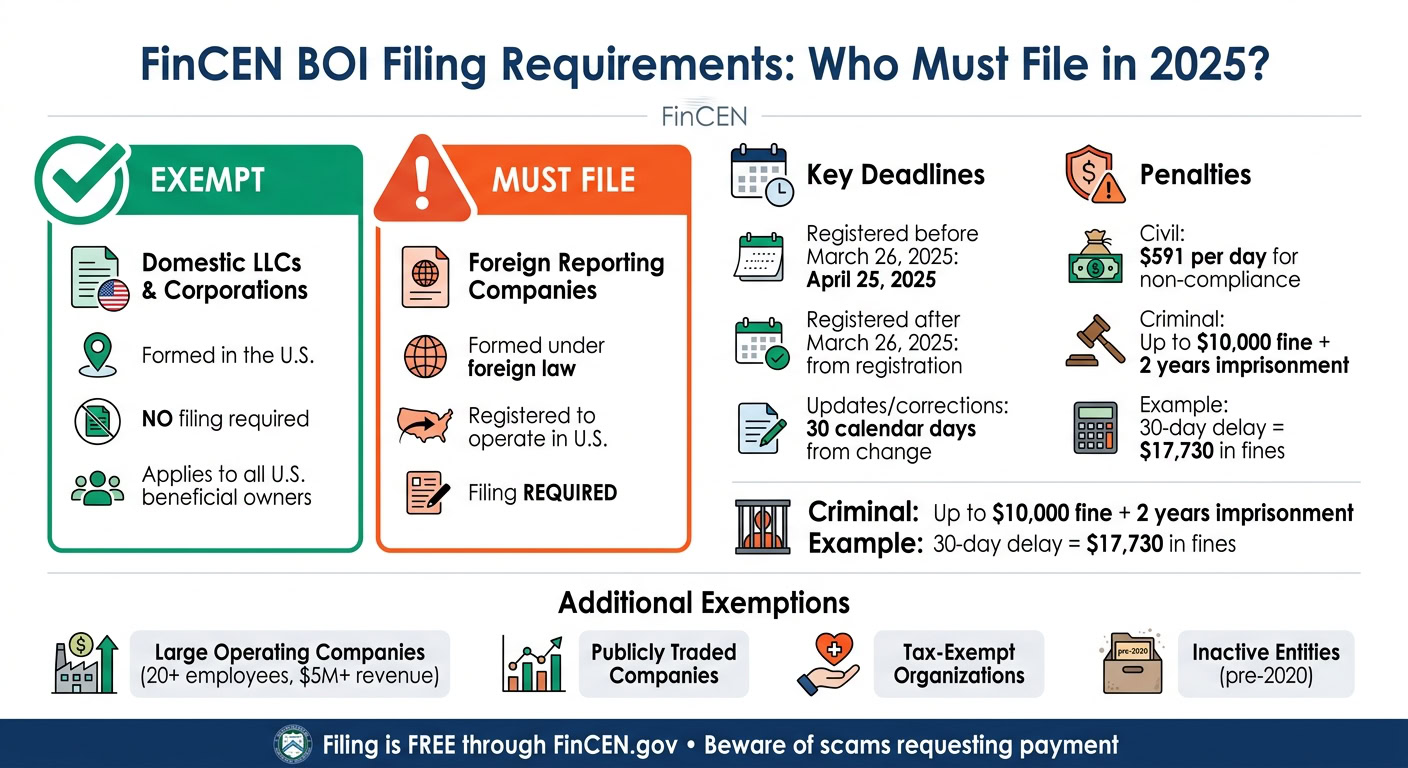
If you own a U.S.-based LLC, here’s the good news: You don’t need to file a Beneficial Ownership Information (BOI) report. Starting March 26, 2025, all domestic entities – including LLCs formed in the U.S. – are exempt from this requirement under the Corporate Transparency Act.
However, foreign entities registered to do business in the U.S. must comply. If your foreign LLC was registered before March 26, 2025, you have until April 25, 2025, to file. For those registered after that date, filings are due within 30 calendar days of registration.
Failure to comply can result in penalties of up to $500 per day or even criminal charges. To avoid issues, foreign LLCs must submit detailed ownership information, including legal names, addresses, and ID verification, through FinCEN’s secure portal. Domestic LLC owners can skip this entirely.
Key Points:
- Domestic LLCs: No BOI filing required.
- Foreign LLCs: Filing required if registered to operate in the U.S.
- Deadline for foreign entities: April 25, 2025, or 30 days after registration.
- Penalties: Up to $500/day for non-compliance.
If you’re unsure about your filing status, check FinCEN’s guidelines to confirm whether your entity is exempt or required to report.
What the BOI Report Is and Why It Exists
Definition of the BOI Report
The BOI report is a federal filing that requires companies to provide specific details about their owners or those who control them to the Financial Crimes Enforcement Network (FinCEN) [2]. This mandate stems from the Corporate Transparency Act (CTA), a bipartisan law passed by Congress in 2021 [2][4].
The report gathers detailed information for each beneficial owner, including their full legal name, date of birth, current residential address, and a unique ID number from an acceptable document, such as a passport or driver’s license. Additionally, an image of the document must be submitted [4]. All of this information is securely stored in the Beneficial Ownership Secure System (BOSS), which is not accessible to the public and is exempt from the Freedom of Information Act (FOIA) [2].
FinCEN’s interim final rule exempts U.S.-formed entities from this requirement, applying it only to foreign reporting companies. These are entities formed under the laws of a foreign country that have registered to operate in a U.S. state or tribal jurisdiction [1][5]. If your LLC was established domestically in the U.S., you are not required to file. Additionally, there is no fee to submit the BOI report directly to FinCEN [2].
Understanding these details helps clarify the purpose behind Congress’s decision to implement this reporting requirement.
Why Congress Created This Requirement
Congress introduced the BOI reporting requirement to expose anonymous shell companies and front organizations that bad actors use to conceal their identities and launder money through the U.S. financial system [4]. FinCEN explained:
"This law creates a new beneficial ownership information reporting requirement as part of the U.S. government’s efforts to make it harder for bad actors to hide or benefit from their ill-gotten gains through shell companies or other opaque ownership structures." [2]
The requirement aims to tackle various financial crimes, including money laundering, tax evasion, human and drug trafficking, fraud targeting American taxpayers, and corruption involving foreign oligarchs [4]. By mandating the disclosure of individuals who own at least 25% of an entity or hold significant control, the law closes loopholes that previously allowed anonymity [4]. These efforts are part of a larger initiative to ensure accountability and combat financial misconduct.
In 2025, the Department of the Treasury reevaluated the impact of these regulations on small businesses in the U.S. FinCEN noted:
"The Secretary has assessed that exempting U.S. businesses would ensure that these regulations are appropriately tailored to advance the public interest, considering the burdens imposed by the regulations without sufficient benefits." [5]
As a result, the transparency requirements now focus exclusively on foreign entities registered to do business in the U.S., while domestic LLCs and other U.S.-formed entities are no longer subject to this reporting obligation [1][5].
Who Must File and Who Is Exempt
Entities That Must File
Let’s break down who’s required to file a BOI report and who doesn’t have to worry about it. Starting March 26, 2025, only foreign reporting entities are required to submit the BOI report. If your LLC was formed in the United States, you’re in the clear – no filing necessary[1]. This exemption applies to all domestic LLCs, corporations, and any other entity created by filing formation documents with a U.S. state or tribal jurisdiction.
The rules now focus solely on foreign reporting companies. These are entities formed under foreign laws but registered to do business in the U.S.[2]. Importantly, foreign reporting companies only need to report beneficial owners who are not U.S. persons. FinCEN has clarified:
"Reporting companies now also do not need to report the BOI of any U.S. persons, and U.S. persons are exempt from having to provide BOI with respect to any reporting company for which they are a beneficial owner."[1]
So, while it’s crucial to know if you must file, it’s equally vital to understand if your business qualifies for one of the exemptions.
Entities That Are Exempt
Beyond domestic exemptions, certain foreign reporting companies can also skip filing, depending on their business type or size. There are 23 specific exemption categories for foreign reporting companies[2], covering a variety of scenarios.
Here’s one example: large operating companies are exempt if they meet three conditions – having over 20 full-time U.S. employees, maintaining a physical office in the U.S., and reporting more than $5 million in gross receipts or sales on the prior year’s federal tax return. Keep in mind, related companies’ figures can’t be combined to hit these thresholds. Other exempt entities include publicly traded companies and their subsidiaries, as well as most tax-exempt organizations like nonprofits and charities. Inactive entities also qualify if they’ve existed since or before January 1, 2020, are no longer actively conducting business, and don’t hold assets.
Here’s a quick overview of the filing requirements:
| Entity Type | Filing Requirement (as of March 2025) |
|---|---|
| Domestic LLC or Corporation | Exempt |
| Foreign Entity | Must file (unless a specific exemption applies) |
| U.S. Beneficial Owners | Exempt from being reported |
| Large Operating Companies | Exempt |
| Publicly Traded Companies | Exempt |
| Tax-Exempt Entities | Exempt |
| Inactive Entities | Exempt |
If you’re unsure whether your foreign entity qualifies for one of the 23 exemptions, check the full list on FinCEN’s website. It’s better to double-check than assume you’re exempt!
Required Information for the BOI Report
How to Identify Beneficial Owners
Before submitting your report, it’s crucial to determine who qualifies as a beneficial owner. According to FinCEN’s guidelines, a beneficial owner is someone who either directly or indirectly:
- Exercises "substantial control" over the company, or
- Owns or controls at least 25% of the company’s ownership interests [4].
The concept of "substantial control" goes beyond just owning shares. It includes individuals in senior roles – like a CEO, CFO, or General Counsel – or anyone who has the authority to make critical decisions about the company’s operations, finances, or structure. Even those without shares but with significant decision-making power are considered beneficial owners.
Ownership interests, on the other hand, focus on individuals who hold 25% or more of the company’s equity, stock, voting rights, or equivalent mechanisms. This includes both direct and indirect ownership, such as shares held through other entities.
Here’s a quick breakdown of the two main criteria:
| Criteria | Substantial Control | Ownership Interest |
|---|---|---|
| Threshold | Authority-based, not tied to a percentage | 25% or more of total ownership interests |
| Typical Roles | Senior officers (e.g., CEO, CFO, General Counsel, Board Members) | Shareholders, members, or partners |
| Focus | Decision-making authority | Financial stake or voting power |
These distinctions help clarify who qualifies as a beneficial owner, setting the groundwork for the information you’ll need to include in your BOI report.
Information You Must Report
Once you’ve identified the beneficial owners, the next step is gathering the required details for your BOI report. For every non-U.S. beneficial owner of a foreign reporting company (who may also face Form 5472 filing requirements), you’ll need to provide the following:
| Required Information Category | Specific Details to Provide |
|---|---|
| Personal Identification | Full legal name and date of birth |
| Address | Current residential street address |
| Identification Document | A unique identifying number from an acceptable document (e.g., a non-expired passport or driver’s license) |
| Issuing Jurisdiction | The state or country that issued the identification document |
| Verification Image | A digital image of the identification document used to obtain the identifying number |
The residential street address must be included – P.O. boxes won’t meet the requirements. Accepted identification documents include:
- A non-expired U.S. driver’s license
- A state or local government-issued ID
- A U.S. passport
- A foreign passport (if no U.S. identification is available)
Ensure that the digital images of identification documents are clear and ready for upload to the FinCEN system. Additionally, the person filing the report must certify that all the submitted information is "true, correct, and complete."
If a beneficial owner appears in multiple entities, you can simplify the process by requesting a FinCEN identifier. This unique number can replace the need to submit personal details and identification images repeatedly, making the reporting process more efficient.
BOI Filing Deadlines
Now that we’ve covered the necessary details for the BOI report, let’s break down the important filing deadlines.
Important Update: Starting March 26, 2025, there’s been a major shift in BOI reporting requirements. If you own a domestic LLC – an entity established under U.S. state or tribal law – you are now entirely exempt from filing a BOI report [1][2]. The reporting obligation now applies solely to foreign reporting companies, which are entities formed under the laws of a foreign country but registered to do business in any U.S. state or tribal jurisdiction [1].
Deadlines for LLCs Formed Before 2024
Domestic LLCs created prior to January 1, 2024, remain exempt from BOI filing. However, foreign reporting companies registered before March 26, 2025, had a deadline of April 25, 2025 [2][8]. Missing this deadline could lead to serious consequences, including civil penalties of up to $591 per day and criminal penalties that may include fines of up to $10,000 and/or imprisonment for up to two years [9].
Deadlines for LLCs Formed After 2024
Domestic LLCs, regardless of their formation date, continue to be exempt. For foreign reporting companies registered on or after March 26, 2025, the initial BOI report must be filed within 30 calendar days of receiving notice that the registration is effective [1][8]. This 30-day deadline is strict and begins as soon as your registration is confirmed.
"All entities created in the United States – including those previously known as ‘domestic reporting companies’ – and their beneficial owners are now exempt from the requirement to report beneficial ownership information (BOI) to the Financial Crimes Enforcement Network (FinCEN) under the Corporate Transparency Act (CTA)." – FinCEN [2]
Entities located in FEMA-designated disaster areas or those granted IRS tax filing relief are eligible for a 90-day extension [7].
Up next, we’ll walk you through the step-by-step process of filing your BOI report using the FinCEN portal.
sbb-itb-ba0a4be
How to File: Step-by-Step Instructions
Foreign reporting companies – entities established under foreign law but registered to operate in a U.S. state or tribal jurisdiction – are required to file the BOI report electronically through FinCEN’s portal. It’s important to note that only foreign reporting companies need to file; domestic entities are exempt.
Before starting, confirm whether your entity is required to file. As of March 26, 2025, all domestic U.S. entities, including LLCs formed under U.S. state or tribal law, are exempt from BOI reporting. Additionally, FinCEN does not charge a filing fee.
"There is NO fee to file BOI directly with FinCEN. FinCEN does NOT send correspondence requesting payment to file BOI." – FinCEN
Once you’ve determined your eligibility, follow these steps to complete your filing.
Step 1: Access the FinCEN Portal
Head to the official BOI E-Filing website at https://boiefiling.fincen.gov. Verify that you’re on the official FinCEN site. Click "File BOIR" to begin.
You can either complete the report using the online form or upload a PDF version. No account creation is necessary. Avoid using any forms or links that aren’t directly from the official portal.
Step 2: Enter Your Information
The portal will guide you through entering your company details. You’ll need to provide:
- The company’s legal name and any trade or DBA names.
- The current U.S. address.
- The jurisdiction of formation or registration.
- Your Taxpayer Identification Number (TIN).
Next, input information for each beneficial owner, including:
- Full legal name.
- Date of birth.
- Current residential address.
- A unique identifying number from an acceptable ID document.
Make sure to have digital copies of each beneficial owner’s ID ready to upload. For companies with multiple beneficial owners, use the "Add Beneficial Owner" button on the online form (or the "+" button in the PDF version) to include all required entries.
The individual submitting the report must be authorized by the company and will need to provide their own name and email address. Double-check all fields for accuracy, as you are certifying that the information is "true, correct, and complete."
Step 3: Submit and Save Your Report
After completing the form, carefully review all the details for accuracy. Once you’re satisfied, certify the report and click "Submit." The system will generate a confirmation of filing – download and save this confirmation immediately for your records.
If you need help with the process, BusinessAnywhere offers support to ensure your filing is accurate and timely.
Penalties for Missing the Deadline or Filing Incorrectly
Submitting accurate and timely BOI reports is essential, especially for foreign reporting companies, as non-compliance can lead to hefty penalties. According to FinCEN, U.S. citizens and domestic reporting companies are not subject to penalties for beneficial ownership reporting violations [1]. These penalties are strictly enforced for foreign reporting companies.
Civil Fines
Foreign reporting companies that miss the BOI filing deadline are subject to $591 per day in civil penalties for each day the violation continues [9]. These fines can add up quickly: a delay of 30 days results in $17,730 in fines, while a full year of non-compliance could rack up $215,715 [9]. Additionally, these fines may extend to officers, directors, or employees responsible for the report [9].
Fortunately, errors can be corrected without incurring additional fines if addressed within a 90-day safe harbor period from the original filing date, as long as the mistake was not intentional [9].
However, willful non-compliance can lead to more severe consequences, including criminal charges.
Criminal Charges
Willfully failing to file, update, or providing false information on a BOI report carries significant criminal penalties. Offenders may face fines of up to $10,000 and imprisonment for up to 2 years [9]. This liability can apply to individual beneficial owners, as well as officers and directors involved in the violation.
There’s also a separate criminal penalty for unauthorized access or sharing of BOI. Anyone found improperly disclosing beneficial ownership information could be fined up to $250,000 and face up to 5 years in prison [9].
Lastly, beware of scams. FinCEN does not initiate penalty-related correspondence via email or phone. Any such contact requesting payment is likely fraudulent [1].
Updating Your BOI Report After Ownership Changes
When Updates Are Required
Keeping your BOI (Beneficial Ownership Information) up to date is essential for foreign reporting companies. While domestic LLC owners are entirely exempt from BOI reporting – no matter the ownership changes – foreign reporting companies must adhere to stricter rules. Entities created in the United States are not required to file initial reports, updates, or corrections with FinCEN, so domestic entities can skip this step altogether [1][5].
For foreign reporting companies, the story is different. If your business was formed under the laws of a foreign country but is registered to operate in the U.S., you’re required to file an updated BOI report within 30 calendar days of any change. This obligation kicks in immediately when the change occurs [4][6].
What counts as a change? Here are some examples:
- Ownership transfers
- Appointment or removal of senior officers like a CEO, CFO, or COO
- Updates to a beneficial owner’s legal name or residential address
- New identification details, such as a different driver’s license or passport number
If you find an error in a previously filed report, you’re required to file a corrected report within 30 days of discovering the mistake [4].
To stay compliant, foreign reporting companies should have systems in place to track these changes as they happen. It’s also worth noting that U.S. persons are exempt from providing BOI, even if they are beneficial owners of a foreign reporting company [2][5]. Keeping accurate and updated records isn’t just good practice – it’s critical to avoid daily penalties for non-compliance.
BOI Requirements for Non-U.S. Resident LLC Owners
Here’s what non-U.S. resident LLC owners need to know about BOI reporting.
If you’re a non-U.S. resident owning an LLC in the United States, you’re exempt from BOI reporting. Starting March 26, 2025, all U.S.-formed entities – including LLCs owned by foreign nationals – are no longer required to file beneficial ownership information reports with FinCEN [2][3]. This applies regardless of where you reside or the passport you hold.
Whether you’re a digital nomad, a Canadian entrepreneur, or an investor from Europe, as long as your LLC is formed in the U.S., you don’t need to file a BOI report, submit foreign passport documentation, or stress about FinCEN deadlines [2][3].
"All entities created in the United States – including those previously known as ‘domestic reporting companies’ – and their beneficial owners are now exempt from the requirement to report beneficial ownership information (BOI) to FinCEN." – FinCEN [1]
The only entities still required to file are foreign reporting companies – businesses formed under the laws of a foreign country but registered to operate in a U.S. state [2][5]. For instance, if you formed a limited company in the United Kingdom and registered it to do business in California, that entity must file. However, if you’re a U.K. resident who formed a California LLC, you’re exempt.
For foreign reporting companies, only non-U.S. beneficial owners need to be reported. This includes providing their full legal name, date of birth, residential address (not a P.O. box), and a unique identifying number from an acceptable document, such as a foreign passport, along with an image of that document [4][5]. If the foreign entity doesn’t have a U.S. Taxpayer Identification Number, a tax ID from its home country can be used instead [5]. These guidelines clarify which entities must comply, highlighting the focus on foreign reporting companies.
Conclusion
Understanding the BOI filing process is crucial, but here’s the bottom line for LLC owners in the United States: you don’t need to file a BOI report. Starting March 26, 2025, all domestic entities created in the U.S. – including LLCs – are exempt from beneficial ownership reporting requirements. This applies whether you’re a U.S. citizen, foreign national, or even a digital nomad running your business remotely [1][2].
The only businesses required to file are foreign reporting companies, which are formed under foreign laws but registered to operate in a U.S. state [1][5]. For domestic LLCs, there are no filing obligations, deadlines, or penalties associated with BOI reporting [9].
It’s important to note that these rules aim to enhance financial transparency and reduce crime. While BOI reporting may not concern you, staying on top of other compliance requirements – like annual reports, registered agent services, and tax filings – is still essential.
Be cautious of scams. Filing directly with FinCEN is free, and they do not send penalty notices via email or phone calls. If you encounter suspicious communications about BOI penalties, ignore them [1][2].
For those looking to simplify compliance, BusinessAnywhere offers a range of services tailored for LLCs. From registered agent services starting at $147 per year to U.S. LLC tax filings at $700, everything can be managed through a single dashboard – saving time and eliminating confusion .
For expert guidance and hassle-free compliance, BusinessAnywhere provides a streamlined solution so you can focus on growing your business – entirely remote, with clear pricing and no surprises.