
Yes – you can get a U.S. mailing address without having a permanent home. In most cases, I’d narrow it down to three options: a virtual mailbox for scanning and forwarding, a USPS PO Box for basic mail pickup, or General Delivery for short-term use. If I’m running an LLC, I’d also keep in mind that a registered agent address is separate from my normal business mail address from my normal business mail address.
Here’s the short version:
- Use a virtual mailbox if I want a street address, mail scans, and forwarding from anywhere.
- Use a PO Box if I only need USPS mail and can show up in person for setup.
- Use General Delivery if I need a no-fee, short-term backup for up to 30 days.
- Use a registered agent only for legal notices tied to an LLC or corporation.
A few rules matter up front:
- Virtual mailbox providers usually require USPS Form 1583, plus 2 IDs and notarization.
- PO Boxes use PS Form 1093, plus 2 IDs, and USPS usually requires an in-person visit.
- Some banks and government forms won’t accept a PO Box or CMRA address as a home address.
- USPS mail forwarding from an old address to a PO Box usually lasts 12 months.
If I had to sum it up in one line: match the address to the job – mail, banking, or business compliance.
| Option | Best for | Main limits |
|---|---|---|
| Virtual mailbox | Nomads, remote workers, founders | Monthly fees; some banks may reject it |
| USPS PO Box | Basic domestic mail | Usually USPS-only; in-person ID check |
| General Delivery | Short-term backup | Temporary use; pickup only |
| Registered agent address | LLC legal notices | Not for normal day-to-day mail |
Below, I’d walk through how each option works, what paperwork you need, and where people usually run into trouble.
1. Figure out which type of U.S. address you actually need
Start with the job the address needs to do.
If you move a lot or don’t have one fixed home, the best setup is the one that still gets your mail to you without problems. Pick the wrong type, and you can run into trouble fast. A bank may reject your application, or your LLC may fall out of compliance.
Personal mail, remote work, and business mail each need a different address
Most people only need to sort through three main address types:
- Personal mailing address – This is for bank statements, IRS mail, and day-to-day letters. A virtual mailbox or private mailbox gives you a real street address. A PO Box may not work for banks, since they often ask for a physical street address.
- Business mailing address – This is a street address you use for LLC registration, vendor invoices, and keeping your home address off public records. It’s worth saying plainly: a business mailing address is not the same thing as a registered agent address.
- Registered agent address – Every LLC and corporation must name a registered agent with a physical in-state address where someone is available during business hours to accept lawsuits and official state mail. Banks often won’t accept a registered agent address as your main business address.
Here’s the simple version: a registered agent is there for legal notices. A virtual mailbox is there for normal mail, statements, invoices, and packages.
Once you know which one fits your situation, you can pick the service that will receive and forward your mail the right way.
What ID and documents are typically required to get a U.S. mailing address
The paperwork depends on the service you choose.
Virtual mailboxes and private mailboxes use USPS Form 1583, and that form must be notarized. USPS PO Boxes use Form 1093 instead. That form does not need notarization, but you’ll usually need to show up in person.
In both cases, you need two forms of ID:
- one primary photo ID
- one secondary ID that shows your address
| Service Type | Required Form | Typical ID Requirements |
|---|---|---|
| Virtual mailbox / PMB | USPS Form 1583 | Primary: U.S. passport, driver’s license, state ID, military ID, or Permanent Resident Card; Secondary: lease, mortgage, voter registration, or vehicle/home insurance |
| USPS PO Box | USPS Form 1093 | Primary: passport, driver’s license, military ID, or Permanent Resident Card; Secondary: lease, mortgage, voter registration, or vehicle insurance |
Form 1583 can be completed from afar through approved audio or video notarization. One small but common gotcha: Social Security cards and credit cards do not count for either form.
With your documents lined up, you’re ready to compare a virtual mailbox, a USPS option, or a business address setup.
2. Use a virtual mailbox or mail forwarding service for the most flexibility
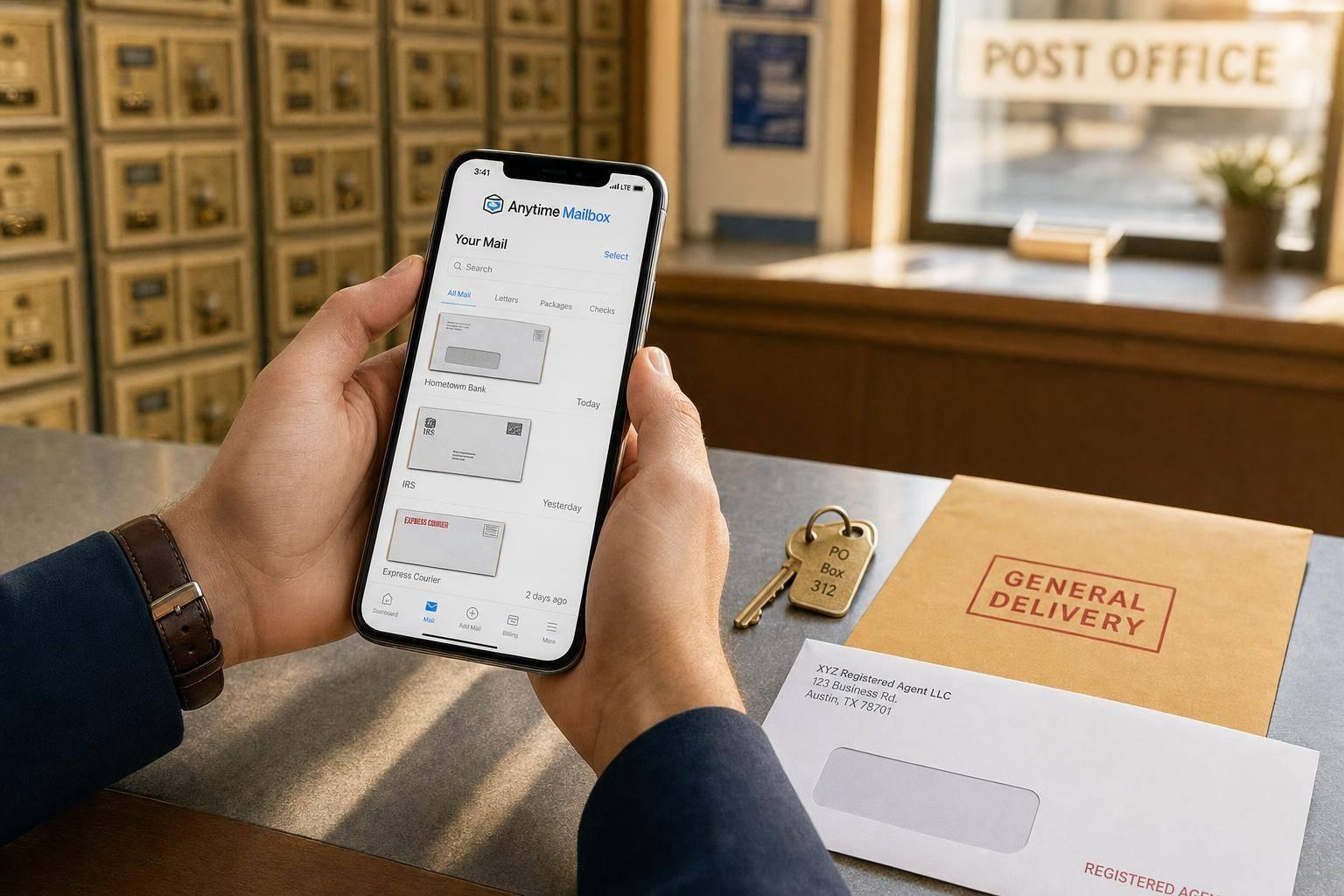
A virtual mailbox gives you a real street address that can receive mail and packages from major carriers and retailers, including UPS, FedEx, DHL, and Amazon shipments. That’s the big draw. You’re not stuck with USPS-only delivery, and you don’t need to be in one place to stay on top of your mail.
You also get a secure online dashboard where you can see incoming mail, ask for envelope scans, request that the contents be opened and scanned, forward items inside the U.S. or abroad, and shred junk mail. If you want one address that can handle mail, scans, and forwarding from anywhere, this is the most flexible option.
How setup works with services like Anytime Mailbox, iPostal1, and Traveling Mailbox
Setup is fully remote. You pick a street address from the provider’s network, complete USPS Form 1583, upload two forms of ID, and get the form notarized online. Form 1583 must be notarized before approval. In many cases, remote online notarization takes less than five minutes over a video call.
Costs usually depend on:
- Monthly plan fees
- Scan volume
- Forwarding charges
One practical tip: update each key sender directly instead of filing one blanket USPS change-of-address form.
If you only need simple domestic pickup, the next section covers USPS-only options.
When BusinessAnywhere is a good fit for mobile entrepreneurs
BusinessAnywhere works well for mobile entrepreneurs who want mail handling, registered agent service, and compliance support in one dashboard.
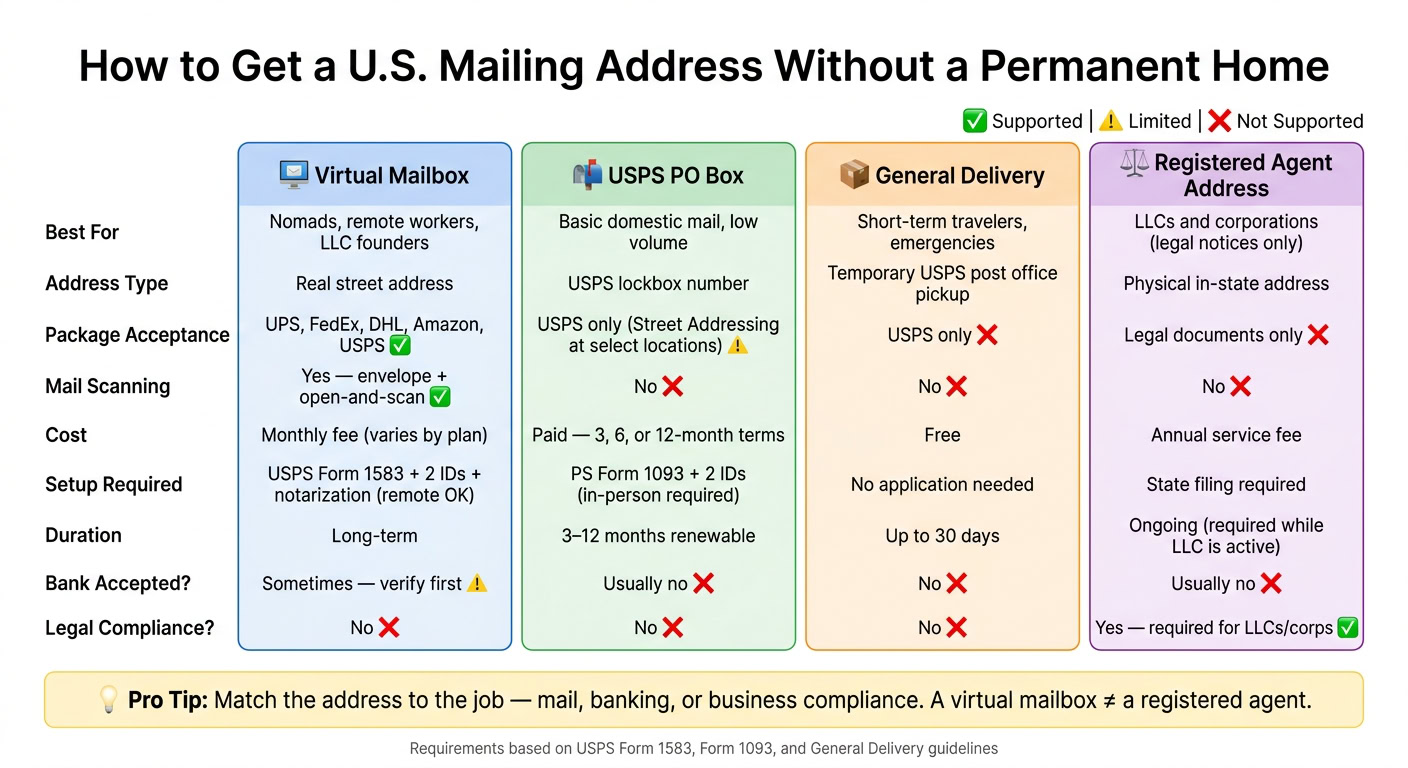
Comparison table: Virtual mailbox vs. PO Box vs. General Delivery
Use this comparison to separate full-service mail handling from basic pickup-only options.
| Feature | Virtual Mailbox (CMRA) | USPS PO Box | General Delivery |
|---|---|---|---|
| Address type | Real street address | USPS lockbox | Temporary USPS pickup at a post office |
| Package acceptance | Mail and packages from major carriers and retailers, including UPS, FedEx, DHL, and Amazon shipments | USPS mail only | USPS only |
| Online mail scanning | Yes – envelope scans and open-and-scan requests | No – physical pickup only | No – physical pickup only |
| Best for | Travelers, remote workers, LLC owners | Simple domestic mail, low volume | Short-term travelers, emergencies |
3. Use USPS options when you need a simple domestic mailing solution
USPS offers two main domestic mail options: a PO Box for steady, long-term pickup, and General Delivery for short-term mail access. Each one fits a different situation. If you need a place to get mail on a regular basis, a PO Box makes more sense. If you just need a temporary fallback and don’t have a permanent address, General Delivery can do the job.
How to rent a USPS PO Box and what limits to expect
You can apply for a USPS PO Box online or in person. But there’s one part you can’t skip: you still have to visit the post office in person to verify your identity and pick up your keys.
To apply, you must complete PS Form 1093 and bring two IDs: one photo ID and one secondary ID that shows your address. USPS does not accept Social Security cards or birth certificates for this step.
PO Box rentals come in 3-, 6-, or 12-month terms. That gives you some flexibility, but there’s an important catch: a PO Box is not the same as a home address. Banks and government forms will usually still ask for a street address.
Street addressing, forwarding, and when General Delivery makes sense
Need more than basic USPS mail pickup? Some post offices offer Street Addressing. At participating Premium locations, this lets you use the post office’s street address with your box number, such as 123 Main St #456, so you can receive packages from private carriers like UPS, FedEx, DHL, and Amazon.
That said, this option is only offered at select locations. So it’s worth checking before you count on it.
USPS also lets you forward mail from your old address to your PO Box, but that forwarding lasts 12 months.
If renting a box feels like too much for what you need, General Delivery is the simpler route. There’s no application and no fee. Mail is sent to a participating Post Office and held for pickup for up to 30 days before it’s returned to the sender.
The address format matters here. Use Your Name, General Delivery, City, State, ZIP+9999. General Delivery is meant for short-term use, not as a long-run mailing setup.
Comparison table: USPS PO Box vs. General Delivery
Use the table below to compare steady mail pickup with a short-term backup option.
| Feature | USPS PO Box | General Delivery |
|---|---|---|
| Cost | Paid; 3-, 6-, or 12-month terms | Free |
| Setup | PS Form 1093 + 2 IDs in person | No application required |
| Duration | Long-term (3-, 6-, or 12-month terms) | Short-term, up to 30 days |
| Package handling | USPS only unless Street Addressing is available | USPS only; counter pickup only |
| Access | 24/7 at many locations | Counter hours only |
| Legal use | Mailing address only | Temporary fallback only |
| Best for | Stable domestic mail | Short-term fallback |
sbb-itb-ba0a4be
4. Use a business address or registered agent when legal and public-record needs apply
If you run an LLC or corporation and don’t have a permanent home address, you still need a mail setup that works in practice. You also need a separate legal address. In every U.S. state, formal business entities must keep a registered agent on file. That agent serves as the in-state contact for legal notices. So if you need help with both daily mail and legal compliance, the smart move is to keep those roles separate.
When a business mailing address is enough and when a registered agent is required
A business mailing address is for normal business mail. Think invoices, vendor mail, IRS letters, and the address you put on public-facing listings. It also helps keep your home address off public records.
A registered agent address does a different job. It’s used only for legal notices. You file it with the Secretary of State, and it becomes part of the public record. It should stay separate from your day-to-day mail. Banks also often reject it when you’re opening an account because it doesn’t show a real business location.
Put simply, these two addresses solve different problems. If you operate a formal business entity, you still need a registered agent.
There’s one more detail here, and it matters. If you set up a business address in a state where you don’t actually live or work, that can trigger tax duties in that state.
How BusinessAnywhere combines a mailing address, registered agent, and compliance support
BusinessAnywhere puts several services in one dashboard: a virtual mailbox, registered agent service, EIN filing, online notarization, and compliance support. That split between mailing and legal addresses matters most when you want one place to handle mail, legal notices, and compliance tasks without mixing them together.
Comparison table: Personal mailing address vs. business mailing address vs. registered agent address
| Feature | Personal Mailing Address | Business Mailing Address | Registered Agent Address |
|---|---|---|---|
| Main Use | Personal mail and packages | Day-to-day business correspondence | Legal compliance and service of process |
| On public record? | No | Often used publicly on websites or marketing | Yes, on state filings |
| Receives Regular Mail? | Yes | Yes | No – legal and state docs only |
| Legal Compliance? | No | No | Yes – required for LLCs and corporations |
| Best For | Individuals, travelers, nomads | Remote businesses and freelancers | All formal business entities |
Once you’ve sorted out whether you need a business address, a registered agent, or both, the last step is picking the setup that fits how you actually get your mail.
5. Pick the right option and set it up correctly
The right address comes down to what you need it to do. Here’s the short version:
| Your Situation | Best Option | Key Reason |
|---|---|---|
| Traveler, nomad, or freelancer | Virtual mailbox | Privacy, scanning, and forwarding |
| Non-U.S. Founder | Virtual mailbox + registered agent | Useful for LLC compliance and IRS mail |
Once you narrow it down, check your bank’s rules and your state’s rules before you apply.
Some banks reject CMRA addresses, so verify the address type first. That one step can save you a headache later. State choice matters too. If you use an address in a state where you don’t operate, you can run into filing or tax questions.
After you pick a provider, complete USPS Form 1583 and online notarization. A virtual mailbox handles your mail. It does not replace a registered agent.
If this is for a business, update your records next. File Form 8822-B to change your IRS address. Then notify your bank and other key senders, and send a test letter to make sure scanning and alerts are working correctly.
Match the address to the job: compliance, mail, or banking.
FAQs
Can I use a virtual mailbox as my legal home address?
No. A virtual mailbox can’t be used as your legal home address.
Government agencies and banks need a physical residential address for things like:
- voter registration
- driver’s license applications
- bank accounts
Virtual mailboxes are classified as CMRAs, which means they don’t meet the legal rules for a permanent residence.
If you don’t have a permanent home, you still need to keep a verifiable residential street address on file.
What if I don’t have a secondary ID with my current address?
USPS rules require Form 1583 plus two IDs:
- one government-issued photo ID
- one secondary document that shows your current home address
If you travel full time or don’t have a fixed home, some commercial mail receiving agencies may allow you to use their facility address on the form. Rules can vary from one provider to the next, so check your mail service’s policy before you sign up.
Will the IRS and banks accept the mailing address I choose?
The IRS will usually accept a virtual mailbox address for mailing purposes, including tax filings and EIN applications, as long as the address stays stable and consistent.
Banks tend to be stricter. Some let you use a virtual address for correspondence, but many flag CMRA addresses during account setup. Policies differ from bank to bank, so check first. Your bank may ask for proof of a physical address, like a lease or utility bill.