

Securing 501(c)(3) tax-exempt status is essential for nonprofits that want to avoid federal taxes on mission-related income and allow donors to make tax-deductible contributions. Here’s a quick overview of the process:
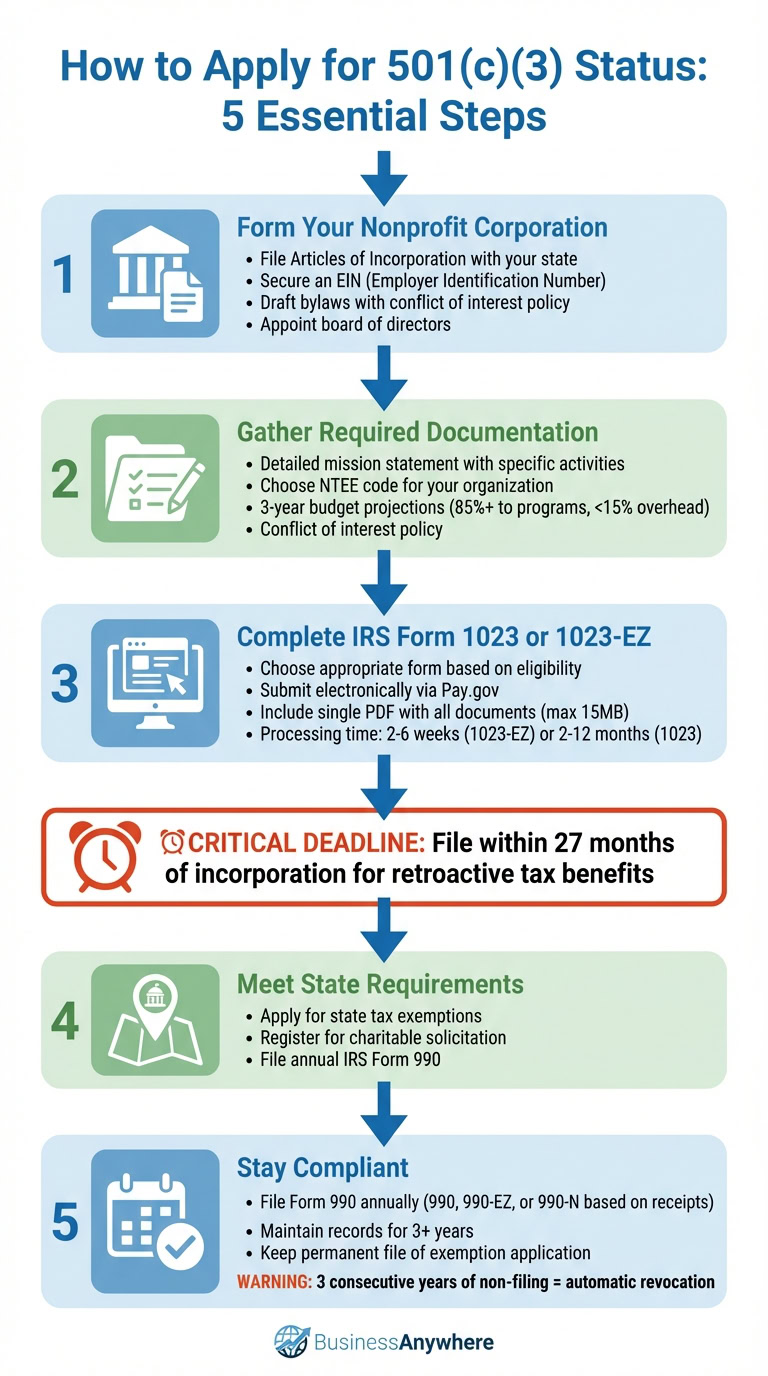
- Form Your Nonprofit Corporation: File Articles of Incorporation with your state, secure an EIN, and draft bylaws with a conflict of interest policy.
- Gather Required Documents: Prepare a detailed mission statement, operational plans, and a three-year budget with clear financial projections.
- Complete IRS Form 1023 or 1023-EZ: Choose the appropriate form based on your organization’s size and submit it electronically via Pay.gov.
- Meet State Requirements: Apply for state tax exemptions and register for charitable solicitation if you plan to fundraise.
- Stay Compliant: File annual IRS Form 990 and maintain proper records to avoid losing your tax-exempt status.
Timing matters – file within 27 months of incorporation to ensure retroactive tax benefits. For smaller organizations, Form 1023-EZ offers a streamlined option. Focus on accuracy and compliance to secure and maintain your nonprofit’s tax-exempt status.
Step 1: Form Your Nonprofit Corporation
To apply for 501(c)(3) status, your first step is to legally establish your nonprofit as a corporation. Many organizations opt for a corporate structure because it offers liability protection for directors and officers. This process involves three key steps: filing Articles of Incorporation with your state, securing an EIN from the IRS, and setting up your governance framework.
File Articles of Incorporation
Start by filing Articles of Incorporation with your state’s Secretary of State office. This filing formally establishes your nonprofit. Make sure your Articles include two essential clauses:
- Purpose Clause: This restricts your nonprofit’s activities to those allowed under 501(c)(3) guidelines.
- Dissolution Clause: This specifies that any remaining assets will go to another tax-exempt organization if your nonprofit dissolves.
Important tip: Never include Social Security numbers in your Articles of Incorporation. Once the IRS grants your tax-exempt status, these documents become part of the public record.
Obtain an Employer Identification Number (EIN)
Even if you don’t plan to hire employees, your nonprofit needs an EIN – a nine-digit tax identification number. The IRS emphasizes this requirement:
Every tax-exempt organization needs an employer identification number (EIN), even if they don’t have any employees.
You can apply for an EIN online using Form SS-4. This number is essential for submitting Form 1023, opening a bank account, and handling tax reporting.
Draft Bylaws and Appoint Directors
Bylaws are the internal rules that dictate how your nonprofit operates. They cover everything from board meetings and voting procedures to officer roles and decision-making processes. Unlike your Articles of Incorporation, which are filed with the state, bylaws are generally kept as internal documents.
Next, appoint your board of directors and document their roles in both your bylaws and Form 1023 (Part I, Line 9). This ensures your nonprofit stays focused on its exempt purposes and avoids private inurement – any illegal financial benefit to insiders like board members or key employees.
Don’t forget to include a conflict of interest policy in your bylaws. This helps prevent excess benefit transactions, which the IRS monitors closely. Violations can lead to excise taxes for both the individuals involved and any managers who approved the transaction.
Step 2: Gather Required Documentation
Once you form a nonprofit organization, it’s time to pull together the essential documents needed for your 501(c)(3) application. The IRS requires detailed proof of your mission and operational plans to grant tax-exempt status.
Mission Statement and Organizational Purpose
The IRS emphasizes the importance of specificity:
"We won’t be able to recognize you as tax exempt based on a mission statement (such as providing assistance to the poor) unless you also describe the activities that further accomplish your mission."
This means you need to go beyond general goals. Clearly outline your past, current, and planned activities. Explain how your programs work, who carries them out, how they’re funded, and how they directly fulfill your mission. For instance, if your goal is to support low-income families, don’t just state that aim – detail programs like tutoring services, food distribution systems, or housing assistance. The IRS also requires you to choose a National Taxonomy of Exempt Entities (NTEE) code that best represents your primary activities.
Financial Records and Budget Projections
A solid three-year budget is a must. The IRS uses this to confirm that your organization operates as a nonprofit rather than a business.
Your budget should align perfectly with the description of your activities. For example, if you mention a tutoring program, your budget should include specific expenses like educational materials or instructor salaries. Avoid vague terms like "Miscellaneous" and instead use clear labels such as "Postage", "Fuel", or "Printing."
It’s also important to allocate at least 85% of your budget to program activities, keeping overhead costs below 15%. Break down revenue into distinct categories – like event income, grants, merchandise sales, and donations – rather than lumping everything together.
Once your budget is prepared, you’ll need to establish safeguards for ethical governance.
Conflict of Interest Policy
Adopting a conflict of interest policy is essential. This policy should require directors and officers to disclose any financial interests, step aside from related decisions, and sign an annual compliance statement. Many organizations use the sample policy provided in Appendix A of the Form 1023 instructions as a starting point.
Step 3: Complete and Submit IRS Form 1023 or Form 1023-EZ
Once you’ve gathered all the necessary documents, the next step is to fill out and submit the appropriate IRS form. There are two options available, depending on your organization’s size and structure: the detailed Form 1023 or the simplified Form 1023-EZ.
Form 1023 vs. Form 1023-EZ
Form 1023 is the full, detailed application for 501(c)(3) status. It requires extensive information about your organization’s activities, governance, and financials. You’ll need to upload a single PDF (up to 15MB) that includes your articles of incorporation, bylaws, and any additional responses.
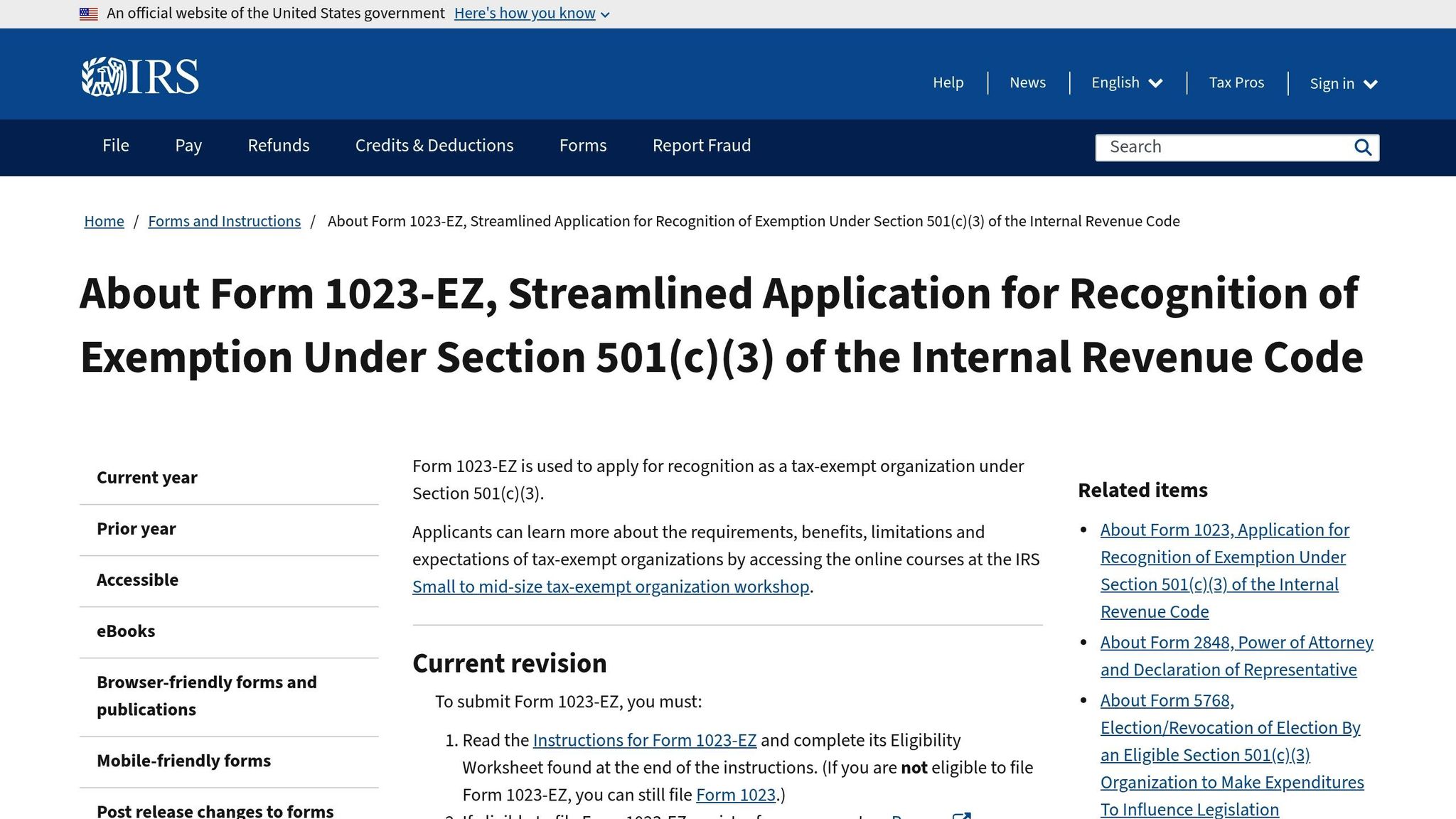
Form 1023-EZ, on the other hand, is a more streamlined option designed for smaller organizations. Before using it, you must complete the Form 1023-EZ Eligibility Worksheet included in the instructions. If you answer "Yes" to any question on the worksheet, you’ll need to use the full Form 1023 instead.
| Feature | Form 1023 | Form 1023-EZ |
|---|---|---|
| Who Can Use It | All 501(c)(3) applicants | Only organizations meeting worksheet criteria |
| Detail Level | Detailed and comprehensive | Simplified and streamlined |
| Attachments | Single PDF with required documents | Generally no attachments needed |
| Submission | Electronic via Pay.gov | Electronic via Pay.gov |
Both forms must be submitted electronically through Pay.gov, as paper applications are no longer accepted. Be sure to get an EIN for your organization before you begin.
Filing Process via Pay.gov
To submit your application, create an account on Pay.gov and search for "1023" or "1023-EZ." Fill out the online form, ensuring the tax year aligns with your bylaws. If you’re filing Form 1023, prepare your PDF attachment ahead of time, ensuring it includes all required documents. If your file exceeds the 15MB limit, contact IRS Customer Account Services for help.
The submission fee can be paid via ACH, credit card, or debit card. Fee amounts change annually, so check the latest Revenue Procedure for the current amount.
Important: Do not include Social Security Numbers in your application, as approved applications are made public.
After submitting, you can monitor your application’s progress using IRS tools.
IRS Processing and Timelines
The IRS reviews applications in the order they are received. While your application is under review, you must file annual information returns, such as the Form 990 series.
To check your application’s status, use the "Where’s My Application" tool on IRS.gov or call IRS Customer Account Services at 877-829-5500.
In some cases, the IRS may expedite your application, such as if you’re applying for grants, providing disaster relief, or addressing errors. If the IRS needs additional information, they will contact you directly.
sbb-itb-ba0a4be
Step 4: Meet State-Level Requirements and Compliance
Getting an IRS determination letter is just the beginning. While it confirms your federal tax-exempt status, it doesn’t automatically cover state-level tax relief. To keep your nonprofit in good standing, you’ll need to address state-specific requirements.
State Corporate Tax Exemptions
Federal tax exemption under 501(c)(3) doesn’t mean you’re automatically exempt from state taxes like corporate, sales, or property taxes. Each state has its own process, and you’ll need to apply separately through your state’s Department of Revenue. Be sure to include key documents, such as your IRS determination letter and articles of incorporation.
"After receiving federal tax exemption, an organization may also be required to register with one or more states where it holds assets or where it will solicit contributions. You may also need a registered agent to handle legal correspondence in those states. The organization may also need to seek exemption from state taxes."
For example, North Carolina only requires a written request alongside your IRS determination letter. To learn what your state requires, check out the National Association of State Charity Officials (NASCO) website at nasconet.org. This resource links to each state’s specific registration and tax exemption guidelines.
Once approved, request a formal state tax-exempt letter. This document is essential for proving your nonprofit’s status to state agencies.
Charitable Solicitation Registrations
Planning to fundraise? Before you start asking for donations, you’ll need to register in each state where you plan to solicit contributions or hold assets. This applies no matter how you’re fundraising – whether it’s door-to-door, through direct mail, or online campaigns.
The NASCO website is a great starting point for finding state-specific registration forms and requirements. If your fundraising efforts span multiple states or target donors online, make sure you understand and comply with the rules for every jurisdiction where potential donors might live.
Annual IRS Filings (Form 990)
Maintaining your tax-exempt status also means staying on top of your annual IRS filings. Your determination letter will outline which version of Form 990 your nonprofit needs to file – usually Form 990, 990-EZ, or the 990-N (e-Postcard). The version you file depends on your organization’s gross receipts:
- Form 990 or 990-EZ: Required for nonprofits with gross receipts over $25,000.
- Form 990-N: For smaller organizations with lower gross receipts.
This is non-negotiable: If you fail to file for three consecutive years, your tax-exempt status will be automatically revoked.
To stay prepared, keep a permanent file with your approved exemption application and the last three years of annual filings. If someone requests these documents, you’re obligated to provide copies, though you can charge a small fee to cover reproduction costs. Ignoring this requirement can lead to penalties, so it’s worth staying organized.
Step 5: Tools and Resources for the Application Process
applying for 501(c)(3) status involves juggling numerous digital requirements, and staying organized is crucial. As mentioned earlier, accurate documentation plays a central role in the process. Here are some tools to help you stay on track.
Pay.gov is the go-to platform for submitting Form 1023 or Form 1023-EZ electronically. Through Pay.gov, you can upload all necessary attachments and pay the IRS filing fee. Make sure to combine all your attachments into a single PDF file under 15MB before starting your session – this helps avoid any timeouts during the process.
Keep in mind that processing times can differ significantly. For Form 1023-EZ, expect a turnaround of 2 to 6 weeks. The full Form 1023, however, could take anywhere from 2 to 12 months. To make the process even smoother, additional services can be a real game-changer.
How BusinessAnywhere Can Help
Once your nonprofit is formed, managing ongoing tasks can feel overwhelming. That’s where tools like BusinessAnywhere come in, providing essential services to simplify nonprofit operations.
First, you’ll need to incorporate your nonprofit at the state level and secure an Employer Identification Number (EIN) from the IRS. BusinessAnywhere offers an EIN application service for a one-time fee of $97, ensuring you get the tax ID number required to proceed with your federal application.
Most states also mandate having a registered agent – someone designated to receive official legal and government correspondence on your nonprofit’s behalf. BusinessAnywhere’s registered agent service is free for the first year and $147 annually after that. This service ensures you never miss important notices, especially when managing state tax exemption applications or charitable solicitation registrations after receiving your IRS determination letter.
To keep all your critical documents in one place, BusinessAnywhere offers a virtual mailbox service. With unlimited mail scanning and a centralized dashboard, you can securely access essential records like your articles of incorporation, bylaws, conflict of interest policy, and IRS determination letter anytime, anywhere.
Lastly, staying compliant is non-negotiable. BusinessAnywhere provides compliance support and annual filing reminders to help you stay on top of Form 990 submissions. Missing this filing for three consecutive years leads to an automatic loss of tax-exempt status, so these reminders can save your nonprofit from unnecessary setbacks.
Conclusion
Applying for 501(c)(3) status requires careful attention to detail. From forming your nonprofit corporation and drafting your organizing documents to completing Form 1023 (or Form 1023‑EZ) and meeting state-specific requirements, every step lays the groundwork for your tax-exempt status. The IRS is strict about complete and accurate applications, so double-check that all necessary information and schedules are included before submission.
Timing is just as critical as accuracy. You have a 27-month window from your organization’s formation date to file for tax-exempt recognition. Filing within this timeframe ensures your status is retroactive to your creation date. Missing this deadline means losing those retroactive benefits. Also, make sure your organizing documents align with IRS standards, and keep your financial records in order to back up your stated activities.
Once you gain approval, staying compliant is non-negotiable. Failing to file Form 990 for three consecutive years will result in losing your tax-exempt status. Regular compliance ensures your nonprofit remains in good standing.
For operational support, tools like BusinessAnywhere can simplify the process. They offer services like EIN acquisition for $97, choosing a registered agent for assistance, and compliance reminders, helping you focus on your mission while staying on track with legal requirements.
With thorough preparation and the right tools, your nonprofit can confidently navigate the 501(c)(3) application process and build a lasting, positive impact in your community. Each step you master brings you closer to securing and maintaining your tax-exempt status.
FAQs
What are the advantages of obtaining 501(c)(3) status for a nonprofit organization?
Obtaining 501(c)(3) status comes with several important benefits for nonprofits. First and foremost, it provides federal tax-exempt status, which means the organization is generally not required to pay federal income taxes on revenue tied to its charitable activities. This can lead to significant cost savings, allowing more funds to be directed toward advancing the nonprofit’s mission.
Beyond financial relief, 501(c)(3) status boosts credibility and trust with the public. It often makes it easier to secure donations and grants, as contributors know their gifts may qualify for tax deductions. This incentive can encourage more generous support from individuals and organizations alike. Additionally, nonprofits with this designation may also be eligible for state and local tax exemptions, further lowering their operational expenses.
Another key advantage is access to exclusive funding opportunities, such as grants that specifically require tax-exempt status. This designation also reinforces the organization’s legitimacy and transparency, which can be crucial for building long-term support and partnerships. For nonprofits aiming to expand their reach and impact, achieving 501(c)(3) status is a critical milestone.
How do I decide between Form 1023 and Form 1023-EZ for my nonprofit application?
When deciding between Form 1023 and Form 1023-EZ, it all comes down to your nonprofit’s size and financial situation.
The Form 1023-EZ is designed for smaller organizations. To qualify, your nonprofit must have annual gross receipts of $50,000 or less (over the past three years) and total assets not exceeding $250,000. This version is simpler, requires less information, and can be completed more quickly.
On the other hand, if your organization surpasses these financial limits or has a more intricate structure, you’ll need to go with the standard Form 1023. This form involves a more comprehensive application process. Be sure to carefully review the IRS eligibility criteria to determine which form is the right fit for your nonprofit.
What state requirements must nonprofits follow after receiving federal 501(c)(3) status?
After securing federal 501(c)(3) tax-exempt status, nonprofits must navigate a range of state-specific requirements to maintain their legal status and enjoy tax benefits. These typically include registering with the state’s charity office or attorney general, submitting annual reports, and applying for state tax exemptions, such as sales or property tax relief. Depending on their activities, nonprofits may also need specific permits or licenses to operate legally.
For organizations involved in fundraising, additional steps are often necessary. Many states require nonprofits to register for charitable solicitation and comply with ongoing rules, like filing financial disclosures or renewing registrations annually. Since these regulations differ from state to state, it’s essential to thoroughly research and meet all applicable requirements to avoid fines or risking the loss of tax-exempt status.