

If I want to start a trucking company in 2026, I usually need to handle two jobs: form the LLC, then finish the trucking filings that let me haul freight.
Here’s the short version:
-
I can often form the LLC in 1–2 weeks, based on state processing time.
-
I may still need USDOT registration, MC authority if I haul for hire across state lines, a BOC-3, and commercial insurance before I can start.
-
My first-year setup cost often falls around $300 to $1,000+, not counting truck, trailer, and insurance costs.
-
If I run interstate with a heavy truck, I may also need IRP, IFTA, and UCR.
-
After launch, I need to track state reports, MCS-150 updates every 2 years, tax filings, and carrier records.
One point stands out: an LLC is not required to get a USDOT number or MC authority. But for many owner-operators and small delivery companies, it helps separate business and personal finances and adds a legal shield for business debts and claims.
Here’s what I’d focus on, in order:
-
Decide whether an LLC fits my trucking setup
-
File the LLC with my state
-
Get an EIN and open a business bank account
-
Apply for USDOT and, if needed, MC authority
-
Finish BOC-3, insurance, and state fuel/registration filings
-
Keep the company in good standing after I start hauling
A few details can save delays: I’d use the same legal name, address, and EIN on every filing, keep business money separate from personal money, and avoid taking my first load until my authority and insurance filings show as active.
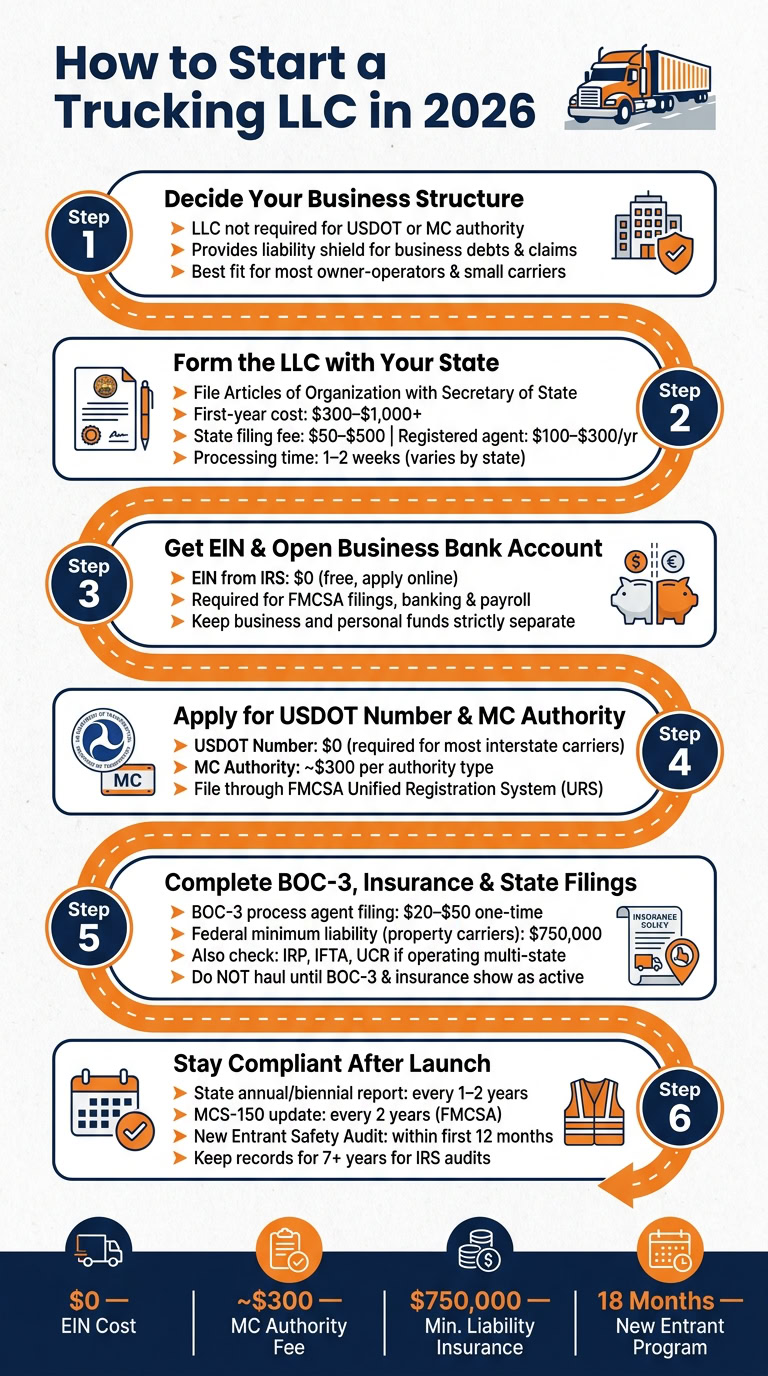
How to Start a Trucking LLC: Step-by-Step Setup Guide (2026)
Quick comparison
|
Topic |
What I need to know |
|---|---|
|
LLC required? |
No, not for USDOT or MC by itself |
|
Best fit for many small carriers? |
LLC, especially for one-truck and small delivery setups |
|
EIN cost |
$0 through the IRS |
|
MC authority filing fee |
About $300 per authority type |
|
BOC-3 cost |
About $20–$50 one time |
|
Federal minimum liability for many for-hire property carriers |
$750,000 |
|
New Entrant Program length |
18 months |
|
Safety audit timing |
Usually within the first 12 months |
Bottom line: if I want to form a trucking LLC, the path is simple on paper – state filing first, FMCSA filing next, then tax and recordkeeping after that. The hard part is making sure each filing matches and nothing is missed.
1. Decide if an LLC is the right structure for your trucking business
The FMCSA does not require you to form an LLC to get a USDOT number or MC authority.[1] You can still run as a sole proprietor and get the authority you need.
That said, your business structure still matters. It can affect how brokers and lenders see you, and it makes it easier to keep business money separate from personal money.
An LLC puts a liability shield between you and the business. If a crash, cargo claim, or vendor dispute turns into a lawsuit, your personal assets are generally protected. Put simply, the business takes on business liabilities, not you personally. If an LLC makes sense for your setup, it’s smart to form it before you deal with trucking registrations.
LLC vs. sole proprietorship vs. S corporation for truckers
Here’s the plain-English tradeoff for trucking startups.
|
Structure |
Liability Protection |
Tax Treatment |
Setup Cost |
Admin Burden |
|---|---|---|---|---|
|
Sole Proprietorship |
No |
Personal return (Schedule C) |
Low ($0 + local permits) |
Low |
|
LLC (Default) |
Yes |
Pass-through by default |
Moderate ($50–$500+) |
Moderate |
|
S-Corporation |
Yes |
Pass-through; potential SE tax savings |
High (formation + payroll setup) |
High |
For most one-truck owner-operators and small delivery businesses, an LLC is the best place to start.
When an LLC makes the most sense for owner-operators and delivery businesses
Owner-operators and local delivery businesses often choose an LLC because it can make the business look more established with brokers, shippers, and lenders.
That tends to matter in a few common cases:
-
When you’re signing contracts with freight brokers or shippers, an LLC can signal that you’re running a serious business and may be expected.
-
When you’re financing a truck or trailer, lenders may be more open to extending credit to a registered business entity than to a person operating under their own name.
An LLC also helps you present a cleaner business setup to shippers and lenders.
One thing it does not do: it won’t protect you from liability for your own driving negligence. Insurance is still required, because an LLC does not shield you from your own negligent driving.[1]
With the structure decided, the next step is choosing a formation state, name, and registered agent. (Learn what a registered agent is and why you need one.)
2. Form the LLC: choose a state, name the company, appoint a registered agent, and file
Choose a formation state and check filing costs
For most trucking businesses, the simplest move is to form the LLC in the state where you live, keep the truck, and run the business. Filing in another state often creates a headache: foreign qualification, extra fees, and duplicate paperwork. So once you choose the state, lock down the company name and registered agent before filing.
Before you send anything to the state, budget for four main cost buckets:
|
Cost Category |
Typical Range |
Notes |
|---|---|---|
|
State filing fee |
$50–$500+ |
One-time fee to the Secretary of State |
|
Annual report / franchise tax |
$0–$800+ |
Recurring; some states have no annual report, while California has a minimum $800 annual franchise tax |
|
Registered agent |
$100–$300/year |
Commercial registered agent services commonly fall in this range |
|
Formation support |
$0–$500+ |
Professional formation help |
In most cases, your first-year total lands between $300 and $1,000, based on your state and whether you pay for filing help. [2]
Pick a compliant LLC name and appoint a registered agent
Your LLC name needs an approved designator: “LLC”, “L.L.C.”, or “Limited Liability Company.” It also has to be different enough from other businesses already on file in your state’s records. Before filing, use your state’s official business search tool and check both exact matches and names that look or sound too close.
For a trucking company, plain and specific usually works best. Names like “I-70 Express Trucking LLC” or “River City Freight & Logistics LLC” make it clear what the business does and fit state naming rules.
You also need a registered agent. This must be a person or company with a physical street address in your formation state who is available during normal business hours. If you’re on the road for days or weeks at a time, serving as your own agent usually isn’t a great fit. A commercial registered agent can keep your home address off public records and receive legal and state mail while you’re hauling. BusinessAnywhere offers registered agent service for $147/year. [2]
With the name and agent in place, the next step is filing the Articles of Organization.
File Articles of Organization and create an operating agreement
The Articles of Organization is the filing that legally creates your LLC. Most states ask for the same basic details:
-
Your LLC’s legal name
-
Principal office address
-
Registered agent’s name and physical address
-
Whether the LLC is member-managed or manager-managed
Some states also ask for a business purpose statement. Keep it clear and tied to what you do. For example: “To operate a trucking and transportation business, including freight hauling and delivery services.” That wording usually lines up well with later USDOT and MC filings.
After the state approves your Articles, put together a written operating agreement even if you’re the only member. For a trucking LLC, this document should spell out who owns the trucks, how maintenance reserves are funded, how profits are split, and what happens if a partner wants out or can no longer work. BusinessAnywhere offers an Operating Agreement Template for $97. [2]
Once the LLC is approved, the next move is to get the EIN, open the bank account, and gather the records you’ll need before hauling.
3. Set up the LLC for business use: EIN, banking, and startup records
Get an EIN from the IRS
Once your Articles of Organization are approved, the next move is to get an Employer Identification Number (EIN) from the IRS. Your EIN is the IRS tax ID for your LLC.
Most trucking LLCs need an EIN before they can open a bank account or file with the FMCSA. You’ll use it to open a business bank account, run payroll if you hire drivers or dispatchers, file excise taxes, and complete FMCSA paperwork. Even if you’re a single-member LLC with no employees yet, most banks still want to see an EIN.
The IRS does not charge a fee for an EIN application. The fastest way is to apply online. Fax and mail options are slower.
Open a business bank account and keep personal funds separate
Once you have your EIN, open a business checking account before you haul your first load. Mixing freight income or business expenses with personal money can mess up your books and weaken your LLC’s liability protection.
Banks usually ask for:
-
Articles of Organization
-
EIN confirmation letter
-
Operating agreement
-
Valid photo ID for each person allowed to sign on the account
Run every business transaction through this account. That includes freight income, fuel costs, truck payments, maintenance, and insurance premiums. It keeps your records clean and makes tax season a lot less painful.
With the LLC funded and records in order, the next step is trucking compliance.
Create a startup file before your first load
Before you pick up your first load, put together a core document file. Digital copies usually make the most sense since you’ll likely spend plenty of time on the road. At a minimum, keep these documents together:
-
Articles of Organization (state-approved copy)
-
EIN confirmation letter (IRS Form CP 575 or 147C)
-
Operating agreement
-
Driver qualification file for every driver in your operation, including you if you’re the owner-operator
-
Insurance binder (commercial liability and cargo insurance)
-
Truck title or lease agreement and any lender documents
These records back up your federal authority, insurance, and state tax filings, including the USDOT, MC authority, and state trucking registrations that come next.
4. Complete trucking-specific registrations and compliance under the LLC
Once your LLC is set up, the next step is the trucking paperwork that lets you operate legally. Keep your legal business name, EIN, and address the same on every filing. Even small mismatches can slow things down.
Apply for a USDOT number and MC authority if your operation requires it
Most interstate commercial vehicles need a USDOT number. This is FMCSA’s main identifier for tracking a carrier’s safety record. Some states also require a USDOT number for certain intrastate-only carriers, so even local delivery companies should check state DOT rules. Commercial vehicles at 10,001 lbs or more, along with some passenger and hazmat operations, will usually need one. [13][14][16][18][19]
MC operating authority is different. A USDOT number identifies the carrier. MC authority gives certain carriers permission to operate for hire across state lines. If you’re an owner-operator hauling freight from Texas to Ohio for pay, you’ll usually need both a USDOT number and MC authority. Private carriers usually need only a USDOT number, not MC authority. [9][6]
New applicants file through FMCSA’s Unified Registration System (URS). [15][17][20]
File a BOC-3 and meet insurance requirements before authority goes active
After you submit your MC authority application, two items must be in place before that authority goes active: a BOC-3 filing and an insurance filing from your insurer.
A BOC-3 names a process agent in every state where you operate. That agent can receive legal documents for your business, and the filing must be done through a BOC-3 service. [5][8][11] The usual one-time cost is about $20 to $50. [34][35][36][37][40][43]
Your insurer sends proof of coverage straight to FMCSA. [7][10][12] For most for-hire interstate carriers hauling non-hazardous property in vehicles over 10,001 lbs, the federal minimum liability amount is $750,000. [39] For for-hire passenger carriers, vehicles built to carry 16 or more passengers need $5,000,000, while those built to carry 15 or fewer passengers need $1,500,000. [41][42]
Cargo insurance depends on what you haul. And this part matters: do not haul your first load until both the BOC-3 and insurance filing show as complete. [38][40][43]
Check IRP, IFTA, UCR, and new entrant obligations
If your truck is heavy enough and runs in more than one jurisdiction, IRP may apply before your first multi-state load. IRP gives you apportioned registration across jurisdictions based on mileage. It generally applies to commercial vehicles over 26,000 lbs or vehicles with three or more axles. [21][22][25][27][30][32]
IFTA handles quarterly fuel tax reporting for qualified vehicles that operate in more than one jurisdiction. You get an IFTA license and decals from your base jurisdiction, then file quarterly returns. [23][24][26][28][29][33]
UCR applies to most interstate motor carriers, brokers, and freight forwarders that are subject to USDOT registration. It’s an annual fee based on fleet size, and it has to be renewed each year. [4][31]
From day one, keep your driver qualification files, maintenance records, and drug-and-alcohol records in order. FMCSA will expect them during an audit. Every new interstate motor carrier enters FMCSA’s New Entrant Safety Assurance Program. That program lasts 18 months and includes a safety audit within the first 12 months after authority is granted. [4][31]
Here’s a simple view of the filings most trucking companies deal with and when they usually come up:
|
Requirement |
Who Needs It |
When to File |
Typical Cost |
Agency |
|---|---|---|---|---|
|
USDOT Number |
Interstate carriers; certain intrastate operators |
After LLC formation & EIN |
$0 |
FMCSA |
|
MC Authority |
For-hire interstate carriers |
After USDOT application |
~$300 per authority type |
FMCSA |
|
BOC-3 |
Interstate motor carriers seeking MC authority |
Before authority activates |
$20–$50 one-time |
BOC-3 service |
|
Insurance Filing |
For-hire carriers |
Before authority activates |
Varies by coverage |
Insurer (files with FMCSA) |
|
IRP |
Qualified vehicles operating in two or more jurisdictions |
Before first multi-state run |
Varies by state/mileage |
State DMV/DOT |
|
IFTA |
Qualified vehicles used in more than one jurisdiction |
Before first multi-state run |
Varies by jurisdiction |
Base jurisdiction |
|
UCR |
Interstate carriers, brokers, freight forwarders |
Annual; before interstate operations |
Tiered by fleet size |
|
|
New Entrant Audit |
All new interstate motor carriers |
Within 12 months of authority |
$0 |
FMCSA |
After these filings are active, the next job is staying on top of annual reports and carrier recordkeeping.
5. Keep the trucking LLC in good standing after launch
Once your LLC is formed and your authority is active, the next job starts: staying compliant.
Track annual reports, FMCSA updates, and operating records
Most states require you to file an annual or biennial report with the Secretary of State to keep your LLC in good standing. If you miss that filing, you may face late fees. Wait too long, and the state can administratively dissolve the LLC. That can disrupt your operating authority and your ability to haul legally.[3]
State filings are only part of the picture. FMCSA also requires carriers to update their MCS-150 (Motor Carrier Identification Report) every two years to keep the USDOT number active. Insurance renewals matter just as much. If your liability or cargo coverage lapses, FMCSA can suspend your operating authority right away. Driver files, maintenance logs, and accident records also need to stay current.[1]
Here are the main deadlines to track:
|
Filing / Requirement |
Frequency |
Authority |
|---|---|---|
|
Annual/Biennial Report |
Every 1–2 years |
Secretary of State |
|
MCS-150 Update |
Every 2 years |
FMCSA |
|
Federal Tax Return |
Annual |
IRS |
Tax deadlines follow their own schedule, separate from state and FMCSA filings. Single-member LLCs report income on Schedule C (Form 1040). Multi-member LLCs file Form 1065. Keep business tax records, including fuel, repairs, insurance, and payroll, for at least seven years in case of an IRS audit.[1]
Use simple tools and support to stay organized remotely
If you’re an owner-operator spending long days on the road, paperwork can pile up fast. A simple digital filing system helps you keep tabs on notices and deadlines without turning your cab into a file cabinet.
Use a registered agent or virtual address to receive legal notices while you’re away. Then store your operating agreement, permits, driver files, and maintenance logs in cloud-based document storage. That way, your paperwork stays easy to reach wherever the truck goes.[2]
Conclusion: From LLC filing to legal trucking operations
Use this recurring checklist to keep the LLC active between loads. Put your state report deadlines, MCS-150 update, insurance renewals, and recordkeeping system on the calendar so the LLC stays active and the carrier can keep operating legally.
FAQs
Should I form the LLC before applying for USDOT or MC authority?
Yes. Forming the LLC comes first because that’s what officially sets up your business entity.
Once the LLC is approved, get your EIN. After that, apply for your USDOT number and MC authority.
One small mismatch can slow the whole thing down, so check the details closely. Your LLC’s legal name and address should match exactly across:
-
your state formation documents
-
your EIN records
-
your FMCSA filings
If those records don’t line up, you can run into rejections or delays.
What filings do I need before I can legally haul my first load?
To legally haul your first load under your own authority, an LLC and EIN aren’t enough. You also need a USDOT number and active MC authority from the FMCSA.
Your authority stays pending until the FMCSA has all of the following on file:
-
A BOC-3 from a licensed process-agent service
-
Proof of required commercial insurance filed by your insurer
-
Your initial BOI report with FinCEN
Do I need IRP, IFTA, and UCR for a one-truck operation?
Yes. If you run as an interstate carrier, you usually need UCR, IRP, and IFTA – even if you only have one truck.
Here’s the simple version:
-
UCR is an annual fee program for interstate carriers.
-
IRP gives you apportioned plates so you can travel across member jurisdictions.
-
IFTA handles multi-state fuel tax reporting.
These filings help keep your operation legal and compliant, along with your LLC, USDOT number, and MC authority.