
A strong tagline is short, clear, and easy to remember – usually just 3–7 words. If I had to boil this down to the main point, it’s this: your tagline should tell people what you do, who it’s for, or the main result you help them get.
Here’s the short version:
-
A tagline is your long-term brand line
-
A slogan is usually tied to a campaign
-
A mission statement explains your company’s purpose in 1–3 sentences
-
The best taglines are brief, specific, and easy to say
-
Vague lines like “Quality you can trust” are easy to forget
-
Good lines often focus on:
-
what you do
-
the result you help create
-
-
A simple test: if someone can read it in under 2 seconds and repeat most of it a day later, it’s probably strong
-
Before using it, check:
-
search results
-
whether it still fits your business a few years from now
-
One stat stands out: brand recall often improves after about 5–7 repeated exposures. That’s why I’d use the same tagline on your website, social profiles, email signature, invoices, and other customer touchpoints.
At its core, a tagline has one job: help people understand your business fast. The rest of the article shows how to write one that does that without sounding vague, long, or forced.
What a tagline is and how it differs from other brand messages
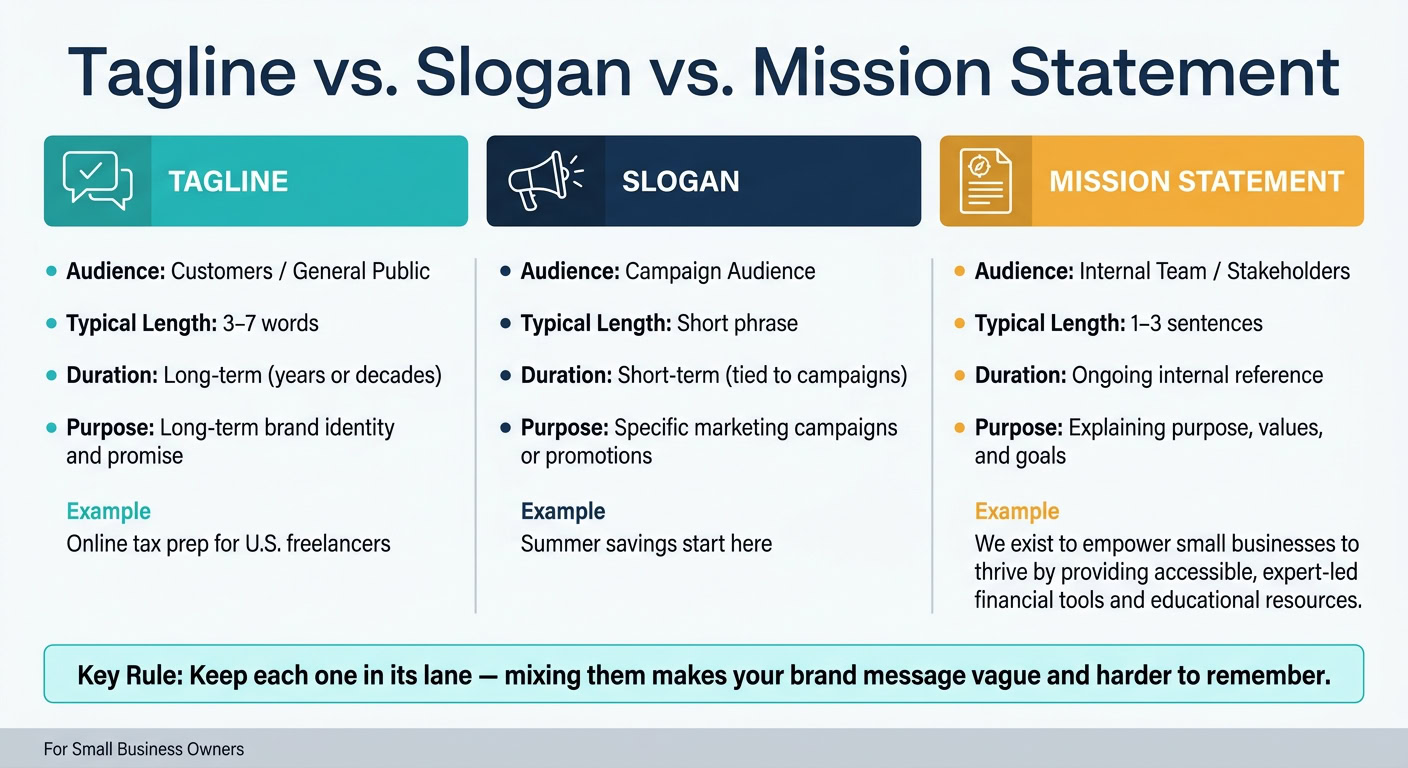
Tagline vs. Slogan vs. Mission Statement: Key Differences
What a tagline is
A tagline is a short phrase that sums up your core promise, main benefit, or brand personality. Think of it as your brand line – usually 3–7 words – that helps people connect your name with what you do, fast.
That’s what sets a tagline apart from other brand messages: clarity at a glance.
A tagline needs to work in a split second. You can use it in your homepage hero section, logo lockup, social media bio, email signature, packaging, and digital ads – pretty much anywhere people come across your brand name.
Tagline vs. slogan vs. mission statement
Taglines, slogans, and mission statements each have a different job.
A tagline is a long-term brand phrase. It can stay with a company for years, sometimes even decades. A slogan is usually tied to a campaign, promotion, or product. A mission statement is longer and explains the company’s purpose and values to the team and stakeholders.
Once those roles are clear, it gets much easier to write a line people will remember.
|
Brand Element |
Audience |
Typical Length |
Purpose |
|---|---|---|---|
|
Tagline |
Customers / general public |
3–7 words |
Long-term brand identity and promise |
|
Slogan |
Campaign audience |
Short phrase |
Specific marketing campaigns or promotions |
|
Mission Statement |
Internal team / stakeholders |
1–3 sentences |
Explaining purpose, values, and goals |
Why this difference matters for small business owners
For small business owners, this isn’t just word choice. It affects how fast people understand the brand.
When these roles get mixed together, the message can turn vague. And when that happens, it’s harder to explain your value in places like search results, online directories, and social profiles. Use a mission statement as a tagline, and it’s too long. Use a campaign slogan as your permanent brand line, and your identity starts to drift.
Keeping each one in its lane helps your tagline do its job: stay short, stay steady, and make your brand clear right away.
What makes a tagline stick
5 traits of a strong tagline
A strong tagline is short, clear, distinct, relevant, and memorable.
Brevity keeps the line easy to scan. When it’s short, a tagline fits neatly in a logo, social bio, or homepage header without cramming the space. Clarity means a customer can tell what the business does – or what they’ll get – in under two seconds, with no extra explanation. Distinctiveness is what keeps the line from sounding like it could belong to any other company in the same space. If you can swap in a competitor’s name and the line still works, it’s not distinct enough.
Relevance ties the tagline to the actual offer and the actual audience. For small businesses, that usually means speaking to the problem the business solves. Memorability tends to come from getting the other four right, but rhythm, contrast, or a concrete image can help the line stay in someone’s head.
|
Trait |
Why it matters |
How to test it |
|---|---|---|
|
Brevity |
Short lines are easier to remember and repeat. |
Count words; aim for 3–7. Check if it fits cleanly in a website header. |
|
Clarity |
Customers should “get it” in under 2 seconds. |
Ask 5 people what the business does after reading only the tagline. |
|
Distinctiveness |
Helps you stand out from similar businesses. |
Search competitors’ sites; check that no one uses similar wording. |
|
Relevance |
Ensures the line matches your real offer and audience. |
Compare the tagline to your core services and target customer; look for mismatches. |
|
Memorability |
Increases word-of-mouth and repeat recall. |
Share the tagline, wait 24 hours, then ask people to repeat it from memory. |
After that, pick the angle that best fits your offer and your audience.
Tagline angles that work
Once the traits are in place, the next step is choosing the angle that fits your brand. Most taglines fall into one of three types: descriptive, benefit-led, or personality-led.
Descriptive lines say what the business does. They’re a good fit when the brand is new, the business name doesn’t explain the service, or people need fast category clarity. A SaaS tool for remote teams might use “Scheduling software for remote teams” on its homepage hero, where visitors need to understand the product before they scroll. Local businesses can use marketing strategies for location-based businesses to apply this angle effectively. A line like “Online tax prep for U.S. freelancers” also signals relevance for local search.
Benefit-led lines focus on what the customer gets out of it. They work best when people already understand the service category and the main job is showing the outcome. A bookkeeping firm using “More time for your business, less time on your books” doesn’t have to explain bookkeeping. It just has to show why this firm is worth choosing.
Personality-led lines lean on tone and attitude. A agency might use “Serious results. Zero boring.” to show its style before a prospect even reaches the about page. This angle works best when clients pick providers partly based on chemistry, like coaching, design, or other boutique services – and when the rest of the brand voice actually sounds the same.
These approaches can overlap. “Smarter payroll. Less headache.” mixes a descriptive anchor (“payroll”) with a clear benefit (“less headache”), and it still stays under the 7-word limit.
Common mistakes that make taglines forgettable
Even a good angle can fall apart if the wording gets vague, crowded, or untrue.
The most common mistake is vagueness. Generic lines like “Quality you can trust” or “Solutions for your business” fade into the background. They don’t tell people what the business does, who it serves, or why it’s different. The fix is simple: get specific. “On-time repairs, guaranteed” for an appliance shop or “IT support that keeps you online” for a managed IT service both say something concrete the business can stand behind.
Another common problem is trying to squeeze too much into one line. If a tagline tries to mention marketing, design, strategy, and consulting all at once, it gets too long to scan and too broad to remember. Pick the one thing that matters most to your target customer, then build the line around that.
It also helps to avoid claims you can’t prove. “The #1 plumber in America” with no data behind it feels shaky, and customers can spot that. “Fast, reliable plumbing in Phoenix” is more specific, more believable, and easier to back up with response-time data and reviews. If the promise and the actual experience don’t match, the tagline can hurt trust instead of helping it.
How to write a tagline step by step
Start with your audience, offer, and main benefit
A good tagline starts before the writing does.
First, get clear on four things:
-
Who you serve
-
What you sell
-
What problem you solve or result you help create
-
What sets you apart
This gives you a simple filter for every draft. It also keeps your line tied to your business instead of drifting into vague brand fluff. The aim is simple: customers should get it at a glance.
A helpful way to pin this down is to turn those answers into a one-sentence positioning summary:
“We help [specific audience] get [specific result/benefit] by providing [product/service] that is [key differentiator].”
For example:
“We help busy U.S. small business owners set up and manage their companies online through fast, compliant filing and ongoing support.”
You probably won’t use that sentence as your tagline. But it works as a strong filter when you compare final options.
It also helps to borrow language straight from customers. Look at reviews, support emails, chat logs, and short interviews. Pay attention to the words people use for their problem – like “frustrating paperwork” or “confusing forms”. Then look for the words they use for the result they want – like “set up my business fast” or “no headaches”. That language is gold when you start drafting.
Brainstorm, shorten, and test 3-5 options
Give yourself 15–20 minutes and write at least 25 tagline ideas without stopping to judge them. Don’t edit as you go. Just get the ideas out.
Try a few angles:
-
Benefit-led
-
Descriptive
-
Personality-led
Once you have a long list, cut it down to the strongest options. Then edit with one rule in mind: shorter, sharper, easier to say. Trim extra words. Make the meaning more exact. Pay attention to rhythm.
Then read each one out loud.
If a line feels awkward in your mouth, it’ll probably be awkward in someone else’s head too. And if people can’t say it, they usually won’t remember it.
From there, narrow the list to 3–5 finalists and test them with people who look like your target customer. Show them each option and ask:
“What do you think this business does?”
Then wait a few minutes and ask them to repeat the line from memory.
That second part matters. Strong taglines tend to come back with close wording. Weak ones come back scrambled – or not at all. You don’t need a formal focus group here. A short email poll or simple social post can do the job.
Check trademark, search results, and long-term fit
Before you lock anything in, do a few quick checks.
First, search the USPTO trademark database for clear conflicts.
Second, search the phrase in Google and scan the first several pages of results. If another business in your space is already using the same wording in a big way, that’s a sign to tweak yours – even if no registered trademark shows up.
Third, test the line against where your business is headed. This is where a lot of taglines fall apart. A line that fits today can feel too narrow later.
Say you serve one city now but plan to grow across the country. A tagline with a city name may box you in. The same goes for lines tied too tightly to one narrow service. You want a promise that still works if your offer expands.
For example, “Launch your business, minus the stress” can still work if your offer grows over the next three years. “Form LLCs in 24 hours” might not.
If your search brings up close matches, change the wording or talk with a qualified trademark attorney. If the line clears those checks, use it the same way across your brand.
Using your tagline across your business
Where to place your tagline for consistency
Once you choose the line, the next step is repetition. If a tagline shows up in only one place, it won’t do much for brand recall. The payoff comes when people see it again and again across the places where they interact with your business.
Research suggests it takes roughly 5–7 repeated exposures for a brand to become easier to remember.[1] For an online business, those exposures often happen in proposals, invoices, onboarding documents, packaging, and paid ads, not just on your homepage or social bios.
Use one exact tagline version across every brand asset. Keep the wording, capitalization, and placement the same each time. That might mean placing it near the logo in a header or footer, or using it in the bio field. Even a one-page brand style guide can help keep things in line as you bring in contractors or designers.
If customers never visit a physical office, your brand exists almost entirely through digital contact. A tagline that appears across transactional touchpoints like invoices and payment confirmations sends a simple message: this business is stable, verified, and established, not something random or unclear.
That repeated use is what turns a tagline into a brand cue people start to recognize.
How BusinessAnywhere supports a consistent brand presence
Consistency matters even more when the business behind the message looks solid. A tagline carries more weight when the company also appears established and compliant. It tends to land better when customers can see that the business is set up through its legal name, registered agent, U.S. address, and current compliance records.
Keep the same wording across every customer-facing document and profile.
Conclusion: Keep it short, clear, and true to the business
A tagline is your long-term brand line. It should be short, steady, and tied to the main promise behind your business.
Once you pick one, stick with it. Use the same line in the places people see most often:
-
Your website header
-
Business cards
-
Email signature
-
Invoices
Short, direct lines tend to stay in people’s heads more easily than long, tangled ones.
Before you lock in a tagline, do one last check. Look at who you want to reach, the main outcome they care about, and how your business stands in the market.
Then ask:
-
Is it under 7 words and easy to say out loud?
-
Does it point to a clear benefit or audience, instead of vague terms like “quality” or “service”?
-
Would someone visiting for the first time quickly get what you do?
-
Can you use it on your homepage, social profiles, email signature, and invoices without it sounding awkward?
If the answer is yes, you’ve got a tagline worth keeping. It doesn’t need to sound clever on day one. It needs to be honest, clear, and matched to how you serve customers.
A line that reflects what you actually offer will do more for brand recognition than one that sounds polished but says very little. If it’s short, clear, and true to the business, use it.
FAQs
How often should I update my tagline?
Ideally, your tagline should feel built to last from day one, so you won’t need to keep changing it.
As your business grows, keep your branding consistent. Check your brand guidelines on a regular basis to make sure your tagline still matches your goals, but a strong tagline should remain memorable and stick with people over time.
Can a small business use more than one tagline?
Yes. A small business can keep a few tagline options while it tests which one connects best with its audience.
But if you want a strong brand identity, pick one primary tagline and use it the same way across your marketing materials, like your website and business cards.
What if my business changes over time?
Your brand should change as your business changes. Check your branding on a regular basis so it still fits how people see you and where your industry is headed.
If your business changes direction, look at your intellectual property too. Update legal records so your protections match what you actually use. That includes removing goods or services you no longer offer when you renew trademarks.