
An LLC operating agreement is a key document that outlines how your business operates, including rules for decision-making, profit-sharing, and member roles. While not always legally required, it protects your personal assets, ensures smooth operations, and is often necessary for opening a business bank account or securing funding. Without one, your LLC defaults to state laws, which may not align with your business’s needs.
Key Takeaways:
- Who needs it? Required in states like California, Delaware, Maine, Missouri, and New York. Optional but recommended elsewhere.
- Why have one? Avoid profit-sharing disputes, protect liability status, and establish business credibility.
- What to include? LLC ownership percentages, management structure, voting rights, profit distribution, dispute resolution, and exit strategies.
- Single vs. Multi-Member LLCs: Single-member LLCs need simpler agreements; multi-member LLCs require detailed provisions to prevent conflicts.
- DIY or Lawyer? Templates work for simple cases, but complex setups benefit from legal assistance.
Having an operating agreement isn’t just smart – it’s essential for protecting your business and avoiding costly disputes.
Do You Legally Need an Operating Agreement?
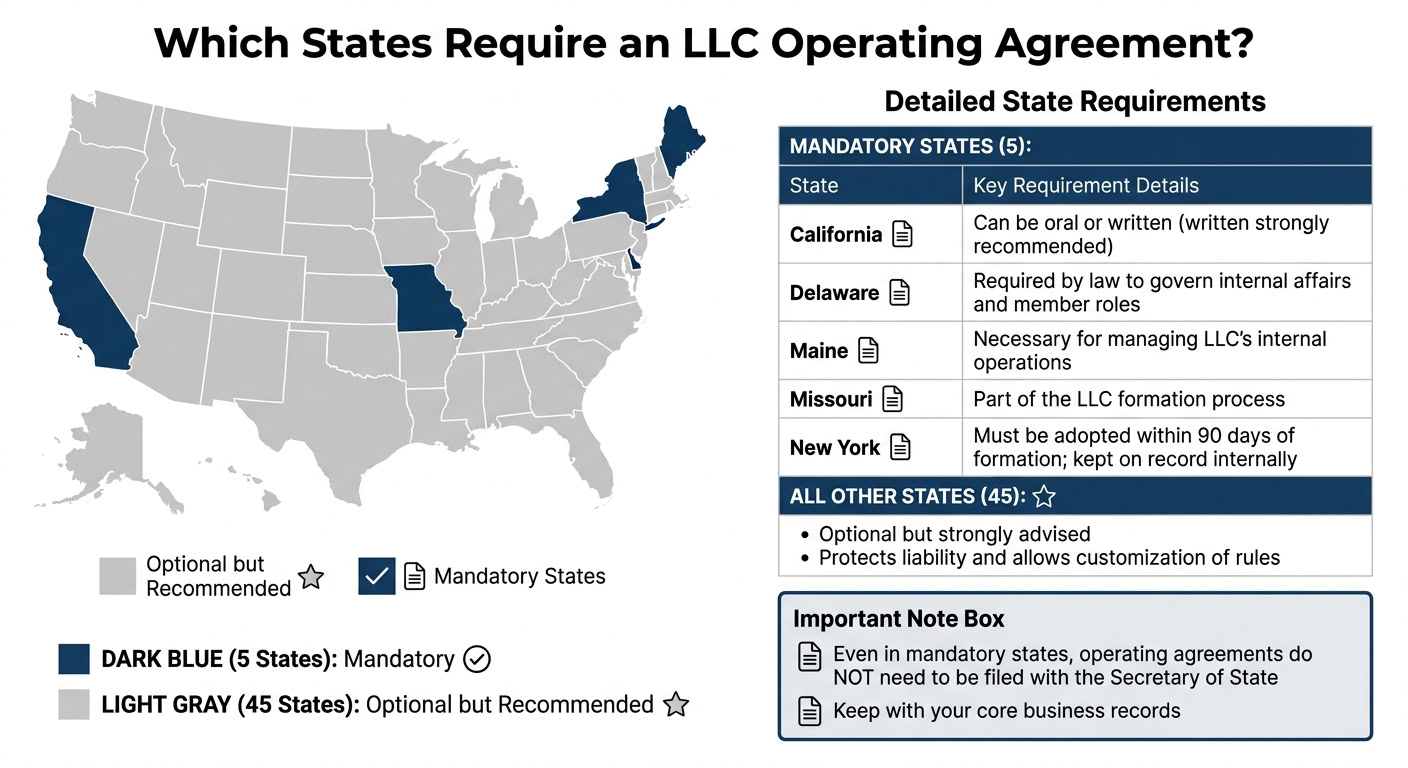
The legal requirement for an LLC operating agreement depends on the state where your business is formed. Five states – California, Delaware, Maine, Missouri, and New York – require an operating agreement by law. In New York, for example, the agreement must be adopted within 90 days of filing the articles of organization.
However, regardless of whether it’s legally required, having an operating agreement is always a smart move. Without one, your LLC will default to generic state rules that may not suit your business’s specific needs. These default rules can lead to unnecessary complications.
Which States Require an Operating Agreement
| State | Legal Requirement | Key Detail |
|---|---|---|
| California | Mandatory | Can be oral or written, though written agreements are strongly recommended. |
| Delaware | Mandatory | Required by law to govern internal affairs and member roles. |
| Maine | Mandatory | Necessary for managing the LLC’s internal operations. |
| Missouri | Mandatory | Part of the LLC formation process. |
| New York | Mandatory | Must be adopted within 90 days of formation and kept on record internally. |
| All Other States | Optional | Strongly advised to protect liability and customize rules. |
Even in states where an operating agreement is required, it doesn’t need to be filed with the Secretary of State. Instead, keep it with your core business records.
Beyond meeting legal requirements, an operating agreement helps address operational issues that default rules simply don’t cover.
Why You Need One Even When It’s Not Required
State default rules can create several challenges that a well-drafted operating agreement can help you avoid:
1. Default rules may not reflect your business’s structure or contributions.
Without an operating agreement, many state laws assume profits are split equally among members, regardless of capital contributions or ownership percentages. Similarly, states often default to a member-managed vs. manager-managed structure, giving all members equal authority to make decisions and bind the company, even if that’s not your intention.
2. Banks and lenders often require an operating agreement.
If you want to open a business bank account or secure funding, you’ll likely need to provide a copy of your operating agreement. Investors and lenders often view this document as proof of your business’s governance and legitimacy.
"A formal operating agreement demonstrates that the business has established governance procedures and is being run as a distinct legal entity, not just an extension of the owners’ personal affairs." – Blake Cantrell, Attorney, Cantrell Law Firm
3. It protects your limited liability status.
An operating agreement helps establish your LLC as a separate legal entity, distinct from your personal finances. This separation is critical for maintaining limited liability protection. Without this document, creditors might argue that your LLC is just an extension of yourself, potentially exposing your personal assets to business liabilities. This is especially important for single-member LLCs, where the line between personal and business affairs can blur.
Additionally, state default rules can complicate succession planning. For example, in many states, an LLC must dissolve if it has no remaining members, such as when a single member passes away. An operating agreement allows you to designate a successor, ensuring continuity and avoiding forced dissolution.
sbb-itb-ba0a4be
12 Provisions Every LLC Operating Agreement Should Include
This section covers the 12 key provisions that form the backbone of your LLC’s operating agreement. These clauses are essential for avoiding disputes and creating a solid framework for your business operations.
"The operating agreement is not a formality. It is the backbone of the business relationship among members." – Michael Tarro, Jr., Esq., Tarro Law
Most LLC operating agreements are between 10 and 20 pages long, depending on the complexity of ownership. Below are the must-have provisions every agreement should include.
1. Company Formation and Purpose
This provision specifies your LLC’s name, the state where it was formed, its primary address, and the registered agent. It also defines the scope of your business activities. Using broad language like "to engage in any lawful business activity" allows flexibility, so you don’t need to amend the agreement frequently as your business evolves.
2. Member Information and Ownership Percentages
Lists all members along with their personal details and ownership stakes. Clearly defining ownership percentages is crucial because it determines voting power and profit-sharing rights, helping you avoid future conflicts over equity.
3. Capital Contributions
Documents each member’s contributions – whether cash, property, or services – and sets rules for future funding needs. For instance, if a member fails to meet a $10,000 capital call while others cover the shortfall, their ownership stake could drop from 33.33% to 16.67%.
4. Management Structure
Defines whether the LLC is member-managed or manager-managed. Member-managed LLCs involve all owners in day-to-day operations, while manager-managed LLCs delegate authority to specific individuals. This section also clarifies who can legally bind the company and may include spending limits or decision-making responsibilities.
5. Voting Rights and Decision-Making
Explains how voting works and specifies approval thresholds for various decisions. Routine matters might require a simple majority, while significant actions – like selling the business or amending the agreement – often need a supermajority or unanimous consent. For 50/50 ownership splits, a tiebreaker mechanism is essential to avoid deadlocks.
6. Profit and Loss Distributions
Details how profits and losses are shared among members and when distributions will be made. Without this clause, many states default to equal profit sharing, regardless of contributions. Including tax distribution provisions ensures members have enough cash to cover tax obligations on their income shares, avoiding "phantom income" problems.
7. Meetings and Record-Keeping
Sets rules for meetings, including notice periods, quorum requirements, and whether digital voting is allowed. Members are guaranteed the right to review the LLC’s financial records during business hours. Clear reporting procedures build transparency and trust, particularly with passive investors.
8. Transfer of Membership Interests
Establishes rules for selling or transferring ownership stakes. A "Right of First Refusal" (ROFR) clause ensures that existing members have the first opportunity to buy any shares before they are sold to outsiders, helping maintain alignment among owners.
9. Buyout and Exit Provisions
Covers what happens when a member leaves the LLC, whether due to voluntary exit, death, divorce, or bankruptcy. It defines triggering events, valuation methods (like independent appraisals or formulas), and payment terms (lump sum or installments). Without these details, disputes over valuation can lead to expensive legal battles.
10. Dispute Resolution
Establishes a process for resolving conflicts, often through mediation or binding arbitration before litigation. This approach is cost-effective and keeps disputes private. Lawsuits between LLC members can easily rack up legal costs exceeding $100,000.
11. Dissolution Procedures
Explains what could trigger the dissolution of the LLC and outlines the steps for winding down. This includes a "distribution waterfall", which prioritizes payments to creditors first, followed by members based on their capital accounts. Clear procedures ensure a smooth shutdown and minimize potential liabilities.
12. Indemnification and Liability Limits
Protects members and managers from personal liability for decisions made in good faith during regular business operations. This encourages capable individuals to take on leadership roles without fear of personal lawsuits. However, it excludes protection for acts like fraud, gross negligence, or willful misconduct, preserving the LLC’s limited liability structure.
Single-Member vs. Multi-Member Operating Agreements
The complexity of your LLC’s operating agreement depends heavily on the number of owners involved. A single-member LLC typically requires a simpler agreement, often just 1–5 pages, because there’s minimal potential for internal conflict. On the other hand, multi-member LLCs need more detailed agreements, often 10–25 pages or longer, to address issues like voting rules, dispute resolution, and ownership buyouts. Let’s break down the key differences, starting with single-member LLCs.
Single-Member LLC Operating Agreements
For single-member LLCs, the operating agreement is essential to establish a legal distinction between the business and your personal assets, which helps protect your liability. Without this document, courts might not recognize the separation, exposing your personal assets to risk. Additionally, banks and lenders often require a signed operating agreement before allowing you to open business accounts or secure loans.
A single-member operating agreement should cover the basics, including:
- The company name and formation date
- Choosing the right registered agent
- Your 100% ownership and management authority
- Succession planning in case of death or incapacity
Succession planning is especially important. Without it, your heirs could face legal challenges when trying to access or close the business.
"It’s always a good idea to have an operating agreement, even for a single-member LLC. It shows that there’s some sort of structure, that you’re still following the formalities of a business – and that can help maintain liability protection." – Jonathan R. Panossian, Esq., Business Attorney
For most single-member LLCs, a free or low-cost template (ranging from $0 to $200) is usually enough. However, if you own significant assets, having an attorney review the agreement (at a cost of $200 to $500) can provide extra peace of mind.
Multi-Member LLC Operating Agreements
When an LLC has multiple owners, the operating agreement serves as a crucial contract to prevent disputes and protect everyone’s interests. These agreements go beyond basics, clearly defining:
- How profits and losses are divided (which doesn’t always match ownership percentages)
- Decision-making rules, such as when a simple majority versus unanimous consent is required
- Procedures for handling a member’s exit due to events like death, disability, or bankruptcy
One common source of conflict in multi-member LLCs is compensation, particularly between active managers and passive investors. To avoid disputes, agreements should specify salaries or guaranteed payments and include detailed buy-sell provisions. These provisions outline what happens in triggering events, such as voluntary departure or divorce, and establish valuation methods and payment terms.
For LLCs with a 50/50 ownership split, deadlock resolution mechanisms are critical. These might include appointing a neutral third-party mediator, requiring mediation, or implementing a "shotgun" clause where one partner must buy out the other. Without these safeguards, equal ownership can lead to gridlock on key decisions.
"If you’re the only owner, you’re not going to argue with yourself, so a simple operating agreement is usually fine. With partners, especially a 50/50 split, you need some sort of mediation, conflict resolution, or tiebreaker, and that’s usually when you want an attorney involved." – Jonathan R. Panossian, Esq., Business Attorney
For multi-member LLCs with complex ownership structures, such as unequal contributions or varying membership classes, professional drafting is often the best choice. While this can cost between $500 and $2,000 upfront, it’s a small price compared to the $50,000–$200,000 (or more) that legal disputes can cost if the agreement is poorly written.
What Not to Include in Your Operating Agreement
An operating agreement is designed to establish high-level rules for your company, such as ownership, voting rights, and profit-sharing. It’s not meant to manage the day-to-day details or personal arrangements. Keeping this focus ensures the document serves its purpose as a governance tool. Here’s what you should leave out:
Avoid overly specific business purposes. Instead of defining a narrow objective, use broad language like "to engage in any lawful business activity." This approach gives your business room to grow and adapt over time without needing constant amendments.
Leave out daily operational details. The agreement isn’t the place for listing tasks that change frequently, like employee schedules or daily procedures. Since amendments require formal votes and written approval from all members, including such details can create unnecessary administrative headaches. Instead, focus on broader managerial powers, like setting spending limits or outlining who can sign contracts.
Don’t include employment specifics. Employment terms – such as salaries, job descriptions, and benefits – should be handled in separate documents. Operating agreements are often shared with banks or investors, so including sensitive personal information could lead to privacy concerns. Plus, mixing employment terms with governance rules can blur the lines between company operations and individual roles.
"The operating agreement is what actually tells everyone how the company works behind the scenes. It is the combination of corporate bylaws and a stockholders’ agreement, all rolled into one flexible document" – Blake Cantrell, Attorney, Cantrell Law Firm
This quote highlights the role of the agreement as a structural guide, not a tool for managing individual employment matters.
Exclude informal or verbal arrangements. Stick to formal, written agreements that focus on the business itself. Personal favors or handshake deals between members can lead to confusion and disputes, undermining the limited liability protections of the company.
When to Use a Template vs. Hire a Lawyer
Deciding whether to use a template or hire a lawyer comes down to your LLC’s ownership structure and the complexity of your arrangements. For a single-member LLC with straightforward goals, a template often gets the job done. But if you’re dealing with multiple members, unequal capital contributions, or intricate profit-sharing arrangements, professional legal help becomes essential.
For single-member LLCs, templates work well when the goal is simply to establish your business as a separate legal entity. Banks generally accept a well-prepared operating agreement when setting up business accounts.
On the other hand, multi-member LLCs require more attention. If you have a 50/50 ownership split, unequal capital contributions, or custom profit distribution rules, hiring a lawyer is a smart move. Legal fees, ranging from $500 to $2,000, are minor compared to the potential costs of litigation, which can spiral to $50,000 or more if disputes arise from a poorly drafted agreement. As Panossian explains:
"With partners, especially a 50/50 split, you need some sort of mediation, conflict resolution, or tiebreaker, and that’s usually when you want an attorney involved".
For founders on a budget, a hybrid approach can work well. Start with a template, then pay $200 to $500 for an attorney to review it. This ensures your agreement complies with state laws and addresses critical gaps, such as buy-sell provisions. If your operating agreement includes complex tax allocation language – like the "target capital account" method or clauses to avoid phantom income – consult a tax advisor to ensure it aligns with IRS rules under Section 704(b).
Ultimately, using a tailored template is far better than having no agreement at all. That said, generic boilerplate documents aren’t suitable for multi-member LLCs or situations involving complex financial arrangements. Investing in professional drafting now can save you from costly disputes down the road. These points lay the groundwork for tackling common questions about LLC operating agreements.
Conclusion
Your LLC operating agreement is the backbone of your business. It safeguards your personal assets, outlines your business structure, and helps avoid unnecessary disputes. This document establishes your company as a separate legal entity, clarifies ownership stakes, decision-making processes, and exit strategies. Beyond being a legal necessity, it also sets the groundwork for smooth operations.
Drafting an operating agreement doesn’t have to be overwhelming or expensive. If you’re running a single-member LLC with a simple structure, a well-prepared template can offer reliable protection. For multi-member LLCs with more intricate setups, professional legal help is often worth the investment. Alternatively, combining a template with a legal review can strike a good balance. Having a solid agreement in place can save you from costly disputes and meet the expectations of banks or investors, boosting your business’s credibility. Whether you’re a solo entrepreneur or part of a team, tailoring the agreement to fit your business structure is key.
It’s best to finalize your operating agreement before you start serving customers or open a business bank account. The ideal time to negotiate terms is at the beginning, when everyone involved is on the same page and optimistic about the future. As attorney Jonathan R. Panossian explains:
"It’s always a good idea to have an operating agreement, even for a single-member LLC. It shows that there’s some sort of structure, that you’re still following the formalities of a business – and that can help maintain liability protection".
Make it a habit to review and update your operating agreement regularly – at least once a year and whenever there are changes in ownership. Ensure all members sign any amendments. A small time investment now can save you from years of potential legal headaches and protect the business you’ve worked hard to build.
FAQs
1. Is an LLC operating agreement required in my state?
This targets the high-intent query “LLC operating agreement requirements by state” while allowing the answer to naturally mention California, Delaware, Maine, Missouri, New York, and states where it is optional but recommended.
What should an LLC operating agreement include?
This directly targets “what should an LLC operating agreement include” and gives search engines a clear question-and-answer relationship around the 12 provisions covered in the article.
Do I need an operating agreement for a single-member LLC?
This targets “single-member LLC operating agreement” and “do I need an operating agreement for an LLC”, while also capturing users who are specifically deciding whether they need one as a solo business owner.