

When deciding between a Single-Member LLC (SMLLC) and a Multi-Member LLC (MMLLC), here’s what you need to know:
- Ownership:
- SMLLC: Owned by one person, offering full control.
- MMLLC: Owned by two or more people, requiring collaboration.
- Taxation:
- SMLLC: Treated as a "disregarded entity" by the IRS. Income is reported on your personal tax return (Schedule C).
- MMLLC: Taxed as a partnership by default. Requires filing Form 1065 and issuing Schedule K-1s to members.
- Costs:
- SMLLC: Tax prep typically costs $500–$1,500 annually.
- MMLLC: Higher tax prep costs, ranging from $1,500–$3,000+.
- Liability Protection:
- Both structures offer personal asset protection, but MMLLCs generally provide stronger safeguards against personal creditors.
- Complexity:
- SMLLC: Easier to manage with fewer formalities.
- MMLLC: Requires an operating agreement and more compliance.
- Investor Appeal:
- MMLLCs are better suited for attracting investors or partners.
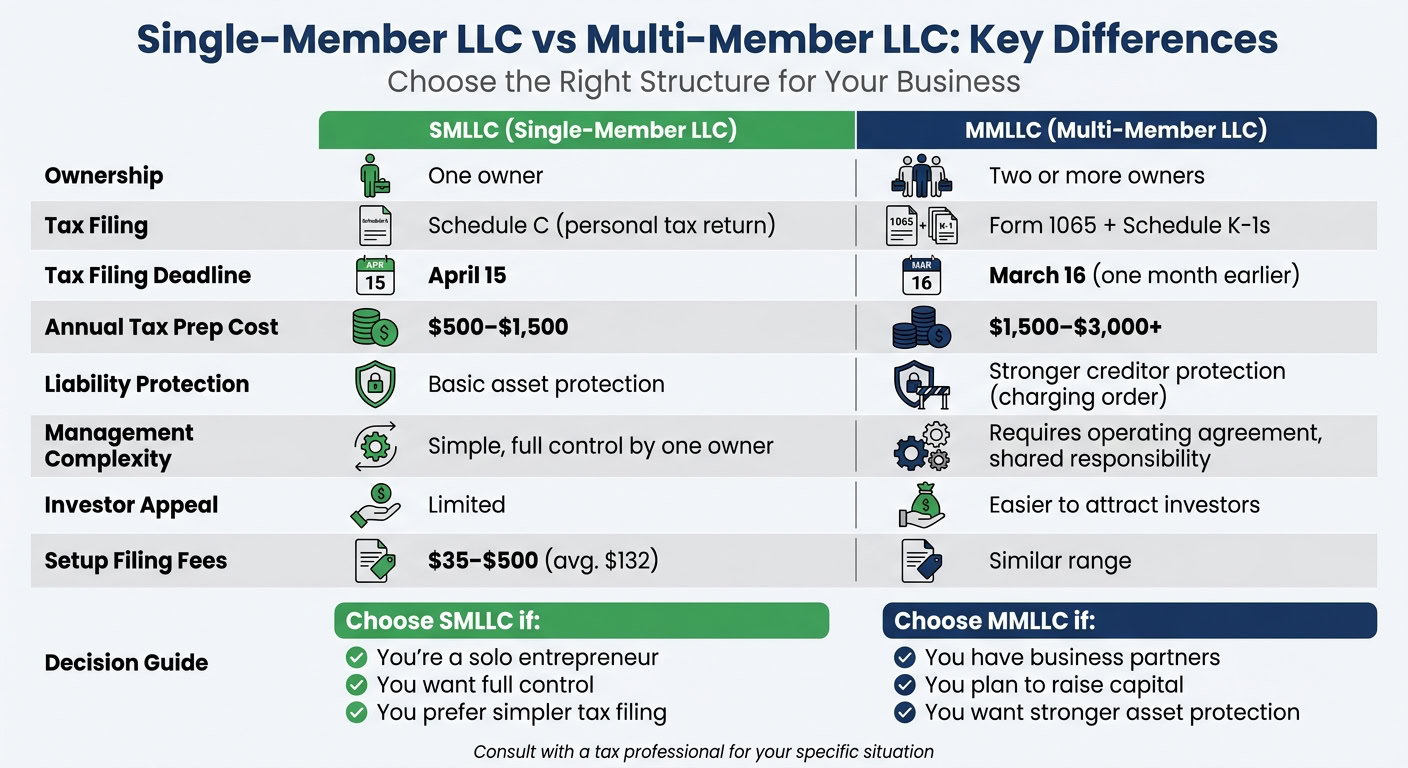
Quick Comparison:
| Feature | Single-Member LLC (SMLLC) | Multi-Member LLC (MMLLC) |
|---|---|---|
| Ownership | One owner | Two or more owners |
| Tax Filing | Schedule C (personal tax return) | Form 1065 + Schedule K-1s |
| Tax Prep Cost | $500–$1,500 annually | $1,500–$3,000+ annually |
| Liability Protection | Basic asset protection | Stronger creditor protection |
| Management | Full control by one owner | Shared responsibility |
| Investor Appeal | Limited | Easier to attract investors |
Key Takeaway: Choose an SMLLC for simplicity and full control, or an MMLLC for shared ownership and growth potential.
What is a Single-Member LLC?
A single-member LLC (SMLLC) is a type of limited liability company designed for businesses with just one owner. It’s a popular choice for freelancers, consultants, and solo entrepreneurs because it offers personal asset protection without the complexities of running a corporation. This means your personal assets – like your home, car, or savings – are protected from business debts or legal judgments. Comparing sole proprietorships vs. LLCs, the former doesn’t provide this level of protection.
Managing an SMLLC is straightforward. You don’t need to hold formal meetings or get board approvals, leaving you free to make decisions on your own – whether that’s hiring, signing a lease, or setting business goals. This level of autonomy is a big reason why many independent business owners opt for this structure.
Costs to set up an SMLLC are also manageable. State filing fees range anywhere from $35 to $500, with the average across the U.S. being about $132. Annual report fees vary too, averaging around $91, though some states charge nothing while others may go up to $300. Tax preparation is another area where SMLLCs are cost-efficient, typically running between $500 and $1,500 annually – much less than the expenses faced by multi-member LLCs.
Ownership and Control
As the sole owner of an SMLLC, you have full control over the business. Every decision – big or small – is yours alone, whether it’s about spending, choosing clients, or expanding operations. This freedom comes with responsibility, though. If the business incurs debt or is sued, you’re the one accountable. That said, your personal assets remain protected, provided you keep your business and personal finances completely separate.
How Single-Member LLCs Are Taxed
For tax purposes, the IRS considers an SMLLC a "disregarded entity". This means the LLC itself doesn’t file a separate tax return. Instead, all business income and expenses are reported on Schedule C of your personal Form 1040. For 2026, this will be due by April 15. You’ll also owe self-employment tax, which is 15.3% on 92.35% of your net earnings. For earnings above $184,500 in 2026, only the Medicare portion of 2.9% applies.
If your net income lands between $75,000 and $80,000, you might want to consider electing S-Corp tax status. This allows you to divide your income into a reasonable salary (subject to self-employment tax) and distributions (not subject to it), which could save you a significant amount in taxes.
Pros and Cons of a Single-Member LLC
| Benefits | Drawbacks |
|---|---|
| Simple Tax Filing: Report business income on your personal tax return using Schedule C – no separate filing needed. | Veil-Piercing Risk: If you mix personal and business finances, courts may disregard your liability protection. |
| Full Control: You make all the decisions without needing partner approval. | Self-Employment Tax: You’re responsible for 15.3% on 92.35% of your net earnings unless you choose S-Corp status. |
| Personal Asset Protection: Your home, car, and other personal assets are shielded from business liabilities. | Limited Access to Funding: Attracting investors is harder since you can’t offer membership stakes unless you convert to a multi-member LLC. |
| Lower Compliance Costs: Fewer administrative requirements mean reduced legal and accounting fees compared to multi-member LLCs. | IRS Attention: This structure may draw closer scrutiny in certain tax situations. |
One key risk to watch out for is mixing personal and business finances. Always keep a separate business bank account and avoid using it for personal expenses. This financial separation is crucial to maintaining your liability protection in court. The simplicity and control of an SMLLC make it an appealing choice compared to the more complex management of multi-member LLCs.
sbb-itb-ba0a4be
What is a Multi-Member LLC?
A multi-member LLC (MMLLC) is a limited liability company owned by at least two individuals or entities, such as other corporations or LLCs. While there’s no maximum number of members, choosing S-Corp tax status later limits you to 100 members. This structure spreads financial risk among members and offers stronger asset protection, but it also brings added complexity to operations.
An MMLLC itself doesn’t pay federal income tax. Instead, it files Form 1065 (U.S. Return of Partnership Income) and provides a Schedule K-1 to each member. The K-1 outlines each member’s share of profits, losses, deductions, and credits.
One of the biggest perks of a multi-member setup is asset protection. Courts often uphold charging order protection for MMLLCs, which prevents creditors from seizing company assets to settle a member’s personal debts. In contrast, single-member LLCs may lack this protection in certain states. Additionally, having multiple members strengthens the separation between personal and business finances, reducing the risk of piercing the corporate veil.
However, this structure isn’t without its challenges. A detailed operating agreement is essential to outline profit distribution, decision-making processes, and how to handle disputes or member exits. Without one, state default rules apply, which might not suit your business needs. Tax preparation costs are also higher, typically ranging from $1,500 to $3,000 per year, and partnership tax returns are due by March 15 – earlier than the April 15 deadline for individual filers.
Ownership Structure and Member Roles
Ownership in a multi-member LLC is typically based on each member’s contribution, whether it’s cash, property, or services. However, the operating agreement can allocate profits and losses differently, rewarding members for expertise or contributions beyond their initial investment.
Members can take on active or passive roles. Active members are involved in daily operations and decision-making, while passive members contribute capital but don’t manage the business.
As one expert puts it:
"One or more members could bring an expertise or contribute funds that you don’t have or that is needed for the new business. You also could share in expenses or collaborate as to your startup’s creative vision and business plan."
MMLLCs can be either member-managed or manager-managed. In a member-managed structure (the default in most states), all members can make decisions and sign contracts. In a manager-managed LLC, designated managers – who may or may not be members – handle operations. This setup works well for members who prefer a passive role.
How Multi-Member LLCs Are Taxed
The tax structure of a multi-member LLC requires careful planning. These LLCs are treated as partnerships for tax purposes, meaning the entity itself doesn’t pay federal income tax. Instead, it files Form 1065 by March 15 and issues Schedule K-1s to its members. Members then report their share of the profits, losses, and other tax items on their personal Form 1040.
It’s important to note that members are taxed on their allocated share of profits, as defined in the operating agreement, even if those profits aren’t distributed. For example, if your agreement allocates you 40% of a $200,000 profit, you must report $80,000 on your tax return, even if you withdraw less than that amount.
Active members must also pay self-employment tax – 15.3% on net earnings – up to the Social Security wage base of $184,500 for 2026, with only the 2.9% Medicare portion applying to earnings above that limit. Passive members may avoid self-employment tax, depending on their level of involvement, but this should be confirmed with a tax professional.
For profits exceeding $75,000, electing S-Corp tax status might reduce self-employment taxes. Under this setup, you can pay yourself a reasonable salary (subject to payroll taxes) while taking the remaining profits as distributions, which aren’t subject to self-employment tax. However, S-Corp election requires all members to be U.S. residents and limits the LLC to 100 members.
Be mindful of IRS penalties for late filing: $260 per partner, per month, for up to 12 months. For example, a three-member LLC filing four months late could face a penalty of $3,120. Staying on top of deadlines is crucial.
Pros and Cons of a Multi-Member LLC
| Benefits | Drawbacks |
|---|---|
| Pooled Resources: Members can combine capital and expertise, fueling growth. | Complex Tax Filing: Filing Form 1065 and issuing Schedule K-1s can increase tax prep costs to $1,500–$3,000 annually. |
| Shared Responsibility: The workload is distributed among members instead of falling on one person. | Potential for Conflicts: Without a strong operating agreement, disputes over decisions or profit sharing can disrupt operations. |
| Stronger Asset Protection: Charging order protection shields business assets from personal creditors. | Higher Compliance Requirements: Detailed recordkeeping and formal agreements are necessary to maintain liability protection. |
| Increased Credibility: Lenders and investors may view MMLLCs as more stable and professional. | Earlier Tax Deadline: Partnership tax returns are due a month earlier than individual returns. |
| Flexible Profit Allocation: Profits and losses can be distributed based on contributions or other factors. | IRS Scrutiny: Starting in 2026, the IRS plans to increase audits on complex partnerships. |
To make your multi-member LLC successful, keep personal and business finances separate. Use a dedicated business bank account to avoid commingling funds, which can lead to personal liability. A custom operating agreement, typically costing $500 to $2,000, is also a smart investment. It can clarify voting rights, buyout procedures, and dispute resolution, helping to avoid conflicts down the road.
Tax Differences Between Single-Member and Multi-Member LLCs
The way an LLC is taxed depends entirely on its ownership structure. Knowing these differences ahead of time can save you money and spare you from unnecessary stress during tax season. Here’s a closer look at how tax classifications impact filing requirements, elections, and what happens when membership changes.
Disregarded Entity vs. Partnership Tax Filing
If you’re running a single-member LLC, the IRS sees it as a "disregarded entity." In simple terms, this means your LLC isn’t treated as a separate entity for income tax purposes. Instead, all business income and expenses are reported on Schedule C of your personal Form 1040, which is due on April 15, 2026 (for the 2025 tax year).
On the other hand, a multi-member LLC is treated as a partnership. This requires filing Form 1065 (U.S. Return of Partnership Income) by March 16, 2026 – a month earlier than the individual filing deadline. While the LLC itself doesn’t pay federal income tax, it provides each member with a Schedule K-1, outlining their share of the business’s profits, losses, deductions, and credits. Members then report this information on their personal Form 1040.
The filing process for partnerships is more complex. Missing the March 16 deadline for Form 1065 can result in hefty penalties: $260 per partner, per month. For instance, a three-member LLC filing two months late could face penalties totaling $1,560.
Regardless of the structure, members of both single-member and multi-member LLCs must pay self-employment tax on net earnings up to the Social Security wage base of $184,500 for 2026. Any earnings above that are subject only to the 2.9% Medicare tax.
S-Corp Tax Election for Both Types
Both single-member and multi-member LLCs can elect to be taxed as an S-Corporation, which can help reduce self-employment taxes. This is done by filing Form 2553 with the IRS. While this election doesn’t change your LLC’s legal structure, it shifts the way your income is taxed. Instead of paying self-employment tax on all profits, you pay yourself a "reasonable salary" subject to payroll taxes, while the remaining profits are taken as distributions, which aren’t subject to the 15.3% self-employment tax.
For example, a business earning $150,000 could save roughly $9,719 in self-employment taxes by choosing S-Corp taxation. However, there are some catches: all members must be U.S. residents, the LLC is limited to 100 members, and you’ll need to manage payroll, which adds both costs and complexity. Generally, S-Corp status is most beneficial when annual profits exceed $75,000. Below that level, the added administrative expenses may outweigh the tax savings.
What Happens When You Add a Member to a Single-Member LLC
Bringing a new member into a single-member LLC triggers a major tax change. The LLC transitions from a disregarded entity to a partnership, requiring a new Employer Identification Number (EIN) from the IRS.
At this point, you’ll stop filing Schedule C and begin filing Form 1065. If the new member joins mid-year, you’ll need to file Schedule C for the solo portion of the year and Form 1065 for the partnership period. This reclassification process typically takes 4–6 weeks.
You’ll also need to update your operating agreement to reflect the new member’s ownership percentage, capital contribution, and voting rights. This is crucial for maintaining clear tax and operational guidelines. In some states, you may need to file Articles of Amendment with the Secretary of State, which usually costs between $25 and $150. Additionally, you’ll need to notify your bank about the ownership change and update account signers.
Due to the added complexity of partnership tax filings, hiring a CPA is highly recommended to manage capital account tracking. Attorney-drafted operating agreements for partnerships can cost between $500 and $2,000, and annual tax preparation fees are likely to increase significantly.
As Daniel Wong, Legal & Compliance Analyst at StartupOwl, points out:
"The IRS requires a new Employer Identification Number when your tax classification changes from disregarded entity to partnership."
Plan for these higher costs and complexities when transitioning to a multi-member LLC to ensure smooth operations and compliance.
Operating Agreements and How Each Type is Managed
Having a well-defined operating agreement is a cornerstone for smooth operations, whether you’re running your LLC solo or with partners. These agreements not only clarify management roles but also complement the tax and liability considerations discussed earlier, giving you a complete picture of your LLC’s ownership structure.
When You Need an Operating Agreement
While an operating agreement isn’t always legally required, its importance varies depending on whether you have a single-member or multi-member LLC.
For a single-member LLC, most states don’t demand an operating agreement. However, drafting one can solidify your LLC’s legal standing and protect your personal assets. It serves as proof that your business is a separate legal entity, reducing the risk of courts disregarding the distinction between personal and business assets. Without this document, you could face complications if disputes or legal challenges arise.
In contrast, a multi-member LLC essentially requires an operating agreement. This document lays out key details like ownership percentages, profit distribution, voting rights, and procedures for events like a member’s departure or death. Without this framework, disagreements could disrupt your business or even lead to costly legal battles. While attorney-drafted operating agreements for multi-member LLCs typically cost between $500 and $2,000, single-member LLC owners can often find free templates to use.
Once your operating agreement is in place, the next step is deciding how your LLC will be managed.
Member-Managed vs. Manager-Managed Structures
After finalizing your operating agreement, you’ll need to choose a management structure. Both single-member and multi-member LLCs can operate as either member-managed or manager-managed entities.
By default, states assume LLCs are member-managed, where all owners are actively involved in day-to-day operations and decision-making. For single-member LLCs, this means you handle everything yourself. In multi-member LLCs, all members share responsibilities unless the operating agreement specifies otherwise.
A manager-managed structure, on the other hand, is ideal when you have investors who contribute capital but prefer to stay out of daily operations. In this setup, one or more managers – who could be members or external hires – handle the day-to-day tasks and routine decisions. This approach simplifies operations and lets passive members focus on their investment. As Nellie Akalp, CEO of CorpNet, puts it:
"An operating agreement, although typically not required by a state, helps ensure all owners are on the same page about how the business should be operated and what are each individual’s roles, responsibilities, and decision-making authority."
How Profits and Voting Rights Are Divided
Your operating agreement also outlines how profits and voting rights are distributed among members, which varies depending on whether you have a single-member or multi-member LLC.
In a single-member LLC, you retain 100% of the profits and the voting power. This allows for quick decision-making but eliminates the advantage of collaborative input.
For multi-member LLCs, the operating agreement specifies how profits, losses, and voting rights are split. While many LLCs follow ownership percentages – like 50/50 or 60/40 splits – flexible arrangements are also possible. For example, one member might invest $80,000 and receive 60% of profits, while another contributes expertise or labor for the remaining 40%. Major decisions typically require either majority approval or unanimous consent, as laid out in the agreement. While shared control can lead to stronger strategies, it may also slow down decision-making compared to the autonomy of a single-member LLC.
Non-Resident Owners and Married Couples: Special Cases
Some LLC ownership situations bring extra layers of complexity, especially when non-resident owners or married couples are involved. These scenarios come with specific tax and compliance rules that go beyond the usual single-member or multi-member considerations. Let’s break down what you need to know if you’re navigating one of these special cases.
Non-Resident Owners in Multi-Member LLCs
Non-resident aliens are allowed to own U.S. LLCs in any state, even without being physically present in the country. However, when a non-resident becomes a member of a multi-member LLC, there are added federal withholding obligations. Specifically, your LLC must withhold federal income tax on any U.S.-source income allocated to non-resident members. This requires filing several forms, including:
- Form 8804: Annual return for partnership withholding.
- Form 8805: Information statement for foreign partners.
- Form 8813: Quarterly payment vouchers.
Additionally, non-resident members must file Form 1040NR to report their share of income.
For income not directly tied to U.S. business activities – such as dividends or rental income – non-residents are generally taxed at a flat 30% rate on the gross amount, unless a tax treaty reduces this rate. However, not all states honor federal tax treaty exemptions. For example, states like California, New Jersey, and Pennsylvania may still impose state income taxes.
It’s also worth noting that non-resident aliens cannot be shareholders in an LLC that elects S-corp tax status. To meet U.S. tax requirements, non-resident members must obtain an Individual Taxpayer Identification Number (ITIN), while the LLC itself will need an Employer Identification Number (EIN) to open financial accounts and stay compliant with the IRS. To avoid missing critical notices, securing a Registered Agent with a U.S. address is highly recommended. Given these complexities, a well-drafted operating agreement becomes essential to ensure smooth operations.
Married Couples Forming an LLC
Starting an LLC with your spouse introduces its own set of rules, which can vary depending on where you live. In most states, a married couple forming an LLC is automatically classified as a multi-member LLC for tax purposes. This means you’ll need to file Form 1065 and follow partnership accounting rules.
However, if you live in one of the nine community property states – Arizona, California, Idaho, Louisiana, Nevada, New Mexico, Texas, Washington, and Wisconsin – you have another option. In these states, married couples can choose to be treated as a single-member LLC for federal tax purposes, even if both spouses co-own the business.
"In a community property state, most of what a married couple acquires during their marriage is owned by both partners equally. As a result, married couples in these states can form an LLC together and be a single-member LLC."
This election simplifies tax filing significantly. Instead of filing Form 1065, you can report your business income directly on your personal Form 1040 (Schedule C). That said, some couples in community property states still opt for multi-member status because it may provide stronger asset protection. For instance, charging order protection can limit creditors’ ability to go after LLC assets to satisfy a member’s personal debts.
Regardless of the structure you choose, drafting a detailed operating agreement is critical. It should clearly define each spouse’s roles and responsibilities while addressing scenarios like divorce or one spouse exiting the business. The right structure not only simplifies tax filing but also helps align your LLC’s ownership with your broader business goals.
Which LLC Structure Should You Choose? 5 Scenarios
Choosing the right LLC structure depends on your business setup, goals, and the people involved. Here are five common scenarios with tailored recommendations to help you decide.
Scenario 1: You’re Running a Business Alone
If you’re a solo entrepreneur, freelancer, or consultant, a single-member LLC (SMLLC) is likely the best fit. It provides liability protection while keeping tax filing simple. You’ll report your business income on Schedule C of your personal Form 1040, which means no separate partnership tax returns to deal with. This setup is cost-effective and straightforward.
Another advantage? You have full control over decisions without needing to consult anyone else. Just make sure to keep your personal and business finances separate. This step is crucial to protect your liability status and avoid the risk of courts "piercing the corporate veil", which is more common for single-member LLCs.
Scenario 2: You’re Starting a Business with Partners
For businesses with two or more owners, a multi-member LLC is the way to go. This structure is required when multiple people share ownership and helps define roles, responsibilities, and profit-sharing from the start. Your LLC will file Form 1065, and each partner will receive a Schedule K-1 that outlines their share of the income, deductions, and credits.
Before forming the LLC, invest in a professionally drafted operating agreement (costs range from $500 to $2,000). This document is essential for outlining ownership percentages, contributions, profit-sharing, voting rights, and exit strategies. Without it, disputes can arise and jeopardize the business. Keep in mind that your tax filing deadline for partnerships is March 16, 2026, a month earlier than the personal filing deadline.
Scenario 3: You’re Adding a Partner to Your Existing Single-Member LLC
If you’re transitioning from an SMLLC to a partnership by adding a new partner, you’ll need to go through a formal conversion process. This includes obtaining a new EIN from the IRS – a rare requirement for most business changes. The process is quick and free, taking about 15 minutes online.
You’ll also need to update your operating agreement to reflect the new partnership terms. Most states require you to file Articles of Amendment (fees typically range from $25 to $150) to officially update your LLC’s membership details. Don’t forget to revise your business bank account and any contracts to include the new partner. The entire process usually takes 4 to 6 weeks. If the change happens mid-year, you’ll file a Schedule C for the solo period and a Form 1065 for the partnership period.
Scenario 4: You’re a Married Couple Starting a Business Together
If you’re married and starting a business, your LLC structure depends on your location. In community property states – like Arizona, California, and Texas – you can elect to be treated as a single-member LLC for federal tax purposes using a "qualified joint venture" election. This allows you to report business income on Schedule C, avoiding the complexity of Form 1065.
However, some couples in these states still opt for multi-member status for enhanced asset protection. For example, charging order protection can shield LLC assets from creditors pursuing one spouse’s personal debts. Whichever option you choose, make sure your operating agreement addresses scenarios like divorce or one spouse exiting the business.
Scenario 5: You Have Non-Resident Co-Owners
If your LLC has non-resident co-owners, a multi-member LLC is necessary, but be prepared for extra compliance steps. U.S. law requires withholding federal income tax on U.S.-source income allocated to non-resident members. This involves filing Form 8804 (annual return), Form 8805 (information statement), and Form 8813 (quarterly payment vouchers).
Non-resident members must also file Form 1040NR to report their income and cannot be shareholders if the LLC elects S-Corp tax status. Passive income, such as dividends or rental earnings, is typically taxed at a flat 30% rate, unless reduced by a tax treaty. Due to these complexities, working with a tax professional experienced in international tax law is highly recommended. A detailed operating agreement is also critical to ensure smooth operations across borders. Budget for higher accounting costs to manage these additional requirements effectively.
Conclusion
Choosing between a single-member LLC and a multi-member LLC comes down to three main factors: ownership, taxation, and management. A single-member LLC offers full control and simpler tax filing, as it allows you to report income and expenses directly on Schedule C of your personal Form 1040. On the other hand, a multi-member LLC requires filing a partnership return (Form 1065 with K-1s for each member), adheres to earlier filing deadlines (March 16 instead of April 15), and follows stricter compliance rules. However, it provides stronger asset protection through charging order provisions and makes it easier to add partners or investors.
From a management standpoint, single-member LLCs are straightforward, enabling quick, independent decisions. Multi-member LLCs, however, demand collaboration, often governed by an operating agreement that defines voting rights, profit sharing, and exit strategies. Without this, disagreements can disrupt the business.
Tax considerations also differ significantly. Single-member LLCs often handle their own taxes with less expense, typically spending between $500 and $1,500 annually on preparation. Multi-member LLCs, due to the complexity of partnership returns, face higher accounting costs – usually ranging from $1,500 to $3,000 or more. With the IRS planning more audits in 2026, accurate and detailed record-keeping is becoming even more critical.
As your business grows, you might need to reassess your LLC structure. Adding partners, raising capital, or involving non-resident owners can complicate things. Transitioning from a single-member to a multi-member LLC involves administrative tasks like obtaining a new EIN, updating your operating agreement, and completing state filings. Non-resident members also bring additional tax requirements, including withholding obligations and limitations on S-Corp elections.
The choice ultimately depends on your current needs and future goals. A single-member LLC is ideal for solo entrepreneurs seeking simplicity, while a multi-member LLC offers the framework needed for partnerships or businesses planning for growth. Carefully evaluate your situation to select the structure that best aligns with your ambitions.
FAQs
What happens to my taxes when I add a member to a single-member LLC?
Adding a member converts the LLC from a disregarded entity into a partnership for tax purposes, and that requires a new Employer Identification Number from the IRS. You stop filing Schedule C and start filing Form 1065. If the new member joins mid-year, you file Schedule C for the solo portion of the year and Form 1065 for the partnership period.
The reclassification typically takes four to six weeks. You will also need to update your operating agreement to reflect the new member’s ownership percentage, capital contribution and voting rights, and some states require Articles of Amendment with the Secretary of State, usually somewhere between $25 and $150. Confirm the current fee with your state before filing. Finally, notify your bank about the ownership change and update the account signers.
Does a single-member LLC need an operating agreement?
Most states do not demand one for a single-member LLC, but drafting one is still worth the effort. It solidifies the LLC’s legal standing and helps protect your personal assets, because it serves as proof that the business is a separate legal entity and reduces the risk of a court disregarding the line between personal and business assets.
A multi-member LLC is different: there, an operating agreement is effectively required. It sets out ownership percentages, profit distribution, voting rights, and the procedure for a member’s departure or death. Without that framework, a disagreement can disrupt the business or turn into a costly legal fight.
Can a married couple run an LLC as a single-member LLC?
In most states, a married couple forming an LLC together is automatically classified as a multi-member LLC for tax purposes, which means Form 1065 and partnership accounting rules.
The nine community property states are the exception: Arizona, California, Idaho, Louisiana, Nevada, New Mexico, Texas, Washington and Wisconsin. In those states a married couple can elect to be treated as a single-member LLC for federal tax purposes even though both spouses co-own the business, which simplifies the filing considerably.