


- Initial Filing Fees: Range from $35 (Montana) to $500 (Massachusetts), averaging around $150.
- Annual Costs: Include annual reports, franchise taxes, and registered agent fees. These can range from $0 (New Mexico) to $800+ annually (California).
- Additional Fees: States like New York may require publication notices ($300–$1,500), while expedited processing, operating agreements, and business licenses can add $50–$500+.
- Registered Agent Services: Optional but common, costing $100–$300 annually.
- Foreign LLC Registration: If operating in another state, expect to pay duplicate filing and compliance fees.
Key Insights:
- States with low filing fees often have higher recurring costs.
- California has the highest ongoing fees, with an $800 annual franchise tax.
- DIY formation saves money but requires more effort. Formation services simplify the process but add to your costs.
Pro Tip: Form your LLC in the state where you operate to avoid extra foreign LLC fees, and use free resources like the IRS website for your EIN.
Quick Comparison of Costs by State:
| State | Filing Fee | Annual/Biennial Fee | Franchise Tax | Total Annual Cost |
|---|---|---|---|---|
| Montana | $35 | $20 | N/A | $20 |
| California | $70 | $20 (biennial) | $800 | ~$820/year |
| New York | $200 | $9 (biennial) | $25 | $34/year + $300–$1,500 publication fee |
| Florida | $125 | $138.75 | N/A | $138.75 |
| Wyoming | $103.75 | $60 | N/A | $60 |
Understanding these costs upfront can help you budget effectively and avoid penalties. Let’s dive into the details of forming and maintaining an LLC in 2026.
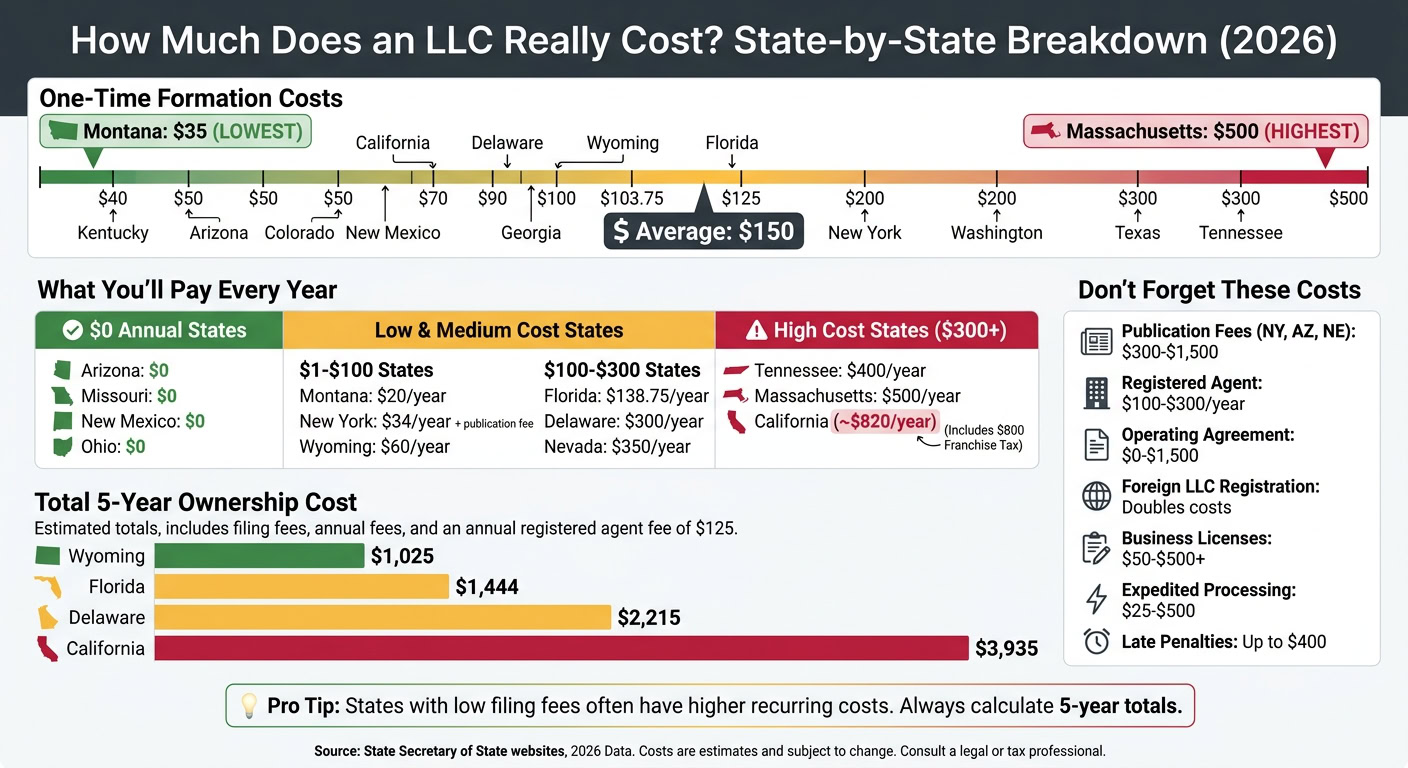
LLC Formation and Annual Costs by State 2026 Comparison
One-Time LLC Formation Costs
When starting an LLC, the state filing fee is the primary upfront cost you’ll need to pay. This fee officially registers your LLC by filing its Articles of Organization [2]. In 2026, these fees vary widely, ranging from as low as $35 in Montana to as high as $500 in Massachusetts [2]. On average, the cost is around $150, though this figure masks significant differences between states and can heavily influence the overall cost of forming an LLC.
In addition to the filing fee, there are several optional but frequently encountered startup expenses. For instance, many states offer expedited processing services, which can cost anywhere from $20 to $500, reducing the processing time to 1–3 business days [2]. If you need certified copies of your formation documents for banking or licensing, expect to pay $10 to $50 per copy [2]. Some states also charge a name reservation fee, typically between $10 and $50, which allows you to secure your desired business name before filing [2].
In New York, there’s an additional publication requirement. Depending on the county, this can cost anywhere from $300 in upstate areas to over $1,500 in Manhattan [2].
State Filing Fees for 15 Popular States
Here’s a quick look at the 2026 filing fees for LLC formation in 15 popular states, ranked from lowest to highest: State State Filing Fee Notable Requirements Montana $35 Lowest in the U.S. Kentucky $40 Second lowest fee Arizona $50 No annual report required Colorado $50 Online filing standard New Mexico $50 No annual report required California $70 $800 franchise tax due by month 4 Delaware $110 Popular for VC-backed startups Georgia $100 Standard processing Wyoming $103.75 Popular for non-U.S. residents Florida $125 Includes registered agent fee New York $200 Plus $300–$1,500 publication fee Washington $200 High initial cost Texas $300 No annual report fee Tennessee $300 Can vary with member count Massachusetts $500 Highest in the U.S.
While the filing fee is a key expense, there are additional costs that often come up during the LLC formation process.
Other Common Start-Up Costs
Although the state filing fee is the only required cost, most LLC founders face other one-time expenses. For example, LLCs need a registered agent to handle legal documents. While you can serve as your own registered agent for free, professional services charge between $100 and $300 per year.
Another essential for your business is an Employer Identification Number (EIN). This is necessary for tasks like opening a business bank account or hiring employees, but you can get it for free by applying directly through the IRS website. Be cautious of third-party services that charge for this simple process – it only takes about 10 minutes to complete on your own.
A less obvious but critical document is an Operating Agreement, which outlines ownership details and helps limit personal liability. While not legally required in all states, it’s highly recommended. You can either use a free online template or pay $500 to $1,500 to have an attorney draft a custom agreement [2].
“An LLC registration is just permission to exist. To operate, you might need city or industry-specific permits.” – NextTool.online [2]
Finally, don’t forget about local business licenses and permits. Depending on your industry and location, these can range from $50 to $500 or more [2].
Once you’ve covered these one-time expenses, you’ll need to prepare for ongoing costs to keep your LLC in good standing.
sbb-itb-ba0a4be
Annual and Recurring LLC Costs
When planning to own and operate an LLC in 2026, understanding the annual and recurring costs is crucial. While forming your LLC is an essential milestone, keeping it compliant requires budgeting for ongoing state-imposed fees. Missing these payments can lead to administrative dissolution, which could jeopardize your business.
“If your state does require LLCs to pay fees each year, you must pay the annual fees. Otherwise the state can shut down your LLC – and you can lose your liability protection.”
– Matt Horwitz, Founder, LLC University
On average, annual LLC fees across the U.S. hover around $73, but this figure varies dramatically by state. Some states charge nothing, while others impose hefty fees through annual reports or franchise taxes. To maintain compliance, you’ll need to account for these recurring expenses.
Annual Report and Franchise Tax Fees by State
Many states require LLCs to file annual or biennial reports to update official business information. These filings often come with a fee and, in some cases, an additional franchise tax. Here’s a snapshot of what you can expect:
- California: Charges an $800 minimum franchise tax starting in the second tax year, plus a $20 biennial report fee.
- Delaware: Skips the annual report fee but imposes a $400 annual franchise tax.
- Massachusetts: Holds the highest annual report fee at $500. Tennessee and Maryland follow with $300 each, though Tennessee’s fee can increase based on LLC membership.
- Wyoming: Keeps costs low with a $60 annual report fee and no franchise tax.
- Florida: Requires a $138.75 annual report fee.
- New York: Charges $9 every two years, plus a $25 biennial tax.
In states like Arizona, Missouri, New Mexico, and Ohio, there are no annual fees, making them some of the most budget-friendly options for LLC maintenance. On the flip side, states like Nevada include hidden costs – such as a $150 annual list fee and a $200 business license – bringing total recurring fees to $350.
Late fees can add a significant burden. For example, Florida imposes a $400 penalty for late filings, and California tacks on a $250 late fee. Setting reminders can help you avoid these unnecessary charges.
| State | Annual/Biennial Report Fee | Frequency | Franchise Tax (Min) | Total Annual Cost |
|---|---|---|---|---|
| Arizona | $0 | None | N/A | $0 |
| Missouri | $0 | None | N/A | $0 |
| New Mexico | $0 | None | N/A | $0 |
| Ohio | $0 | Annual (info only) | N/A | $0 |
| Wyoming | $60 | Annual | N/A | $60 |
| Florida | $138.75 | Annual | N/A | $138.75 |
| Delaware | $0 | Annual | $400 | $400 |
| Tennessee | $300 | Annual | $100 | $400 |
| Massachusetts | $500 | Annual | N/A | $500 |
| California | $20 | Biennial | $800 | ~$820/year |
| Nevada | $150 | Annual | $200 (Business License) | $350 |
Registered Agent Costs
Another ongoing expense to consider is the cost of a registered agent. Every LLC must designate a registered agent in its state of formation to handle legal documents, tax notices, and official correspondence during business hours.
You can act as your own registered agent for free if you have a physical address in the state and are available during business hours. However, this comes with some downsides: your personal information becomes public, and you bear full responsibility for receiving critical documents. Alternatively, professional registered agent services cost between $100 and $300 annually. These services help maintain your privacy and ensure you don’t miss important deadlines.
If your LLC operates in multiple states, additional registered agent fees may apply. Some LLC formation services, like BusinessAnywhere, offer the first year of registered agent service for free. After that, the cost typically starts around $147 annually. Be sure to include this in your budget for ongoing expenses.
Hidden Costs and Optional Expenses Most Founders Miss
When forming an LLC, it’s easy to focus on the obvious filing and annual fees. However, there are additional costs that can sneak up on you, potentially adding hundreds – or even thousands – of dollars to your first-year expenses. These hidden costs often go unmentioned in many formation guides, leaving new founders unprepared.
Hidden Fees That Catch Founders Off Guard
To get a complete picture of LLC formation costs, it’s important to look beyond the basics. Here are some unexpected fees that may arise:
- Publication Requirements: States like New York, Arizona, and Nebraska mandate that LLCs publish their formation notice in local newspapers. This can cost anywhere from $300 in smaller towns to over $1,500 in larger metropolitan areas [8][11][4].
- Foreign Qualification Fees: Forming an LLC in a “business-friendly” state like Delaware or Wyoming might seem appealing, but if your operations are based elsewhere (e.g., California or New York), you’ll need to register as a Foreign LLC in your home state. This doubles your costs, as you’ll pay filing fees, annual report fees, and registered agent fees in both states. For instance, running a Wyoming LLC in California could cost around $960 annually, compared to $870 for forming directly in California [7][2].
- BOI Reporting: The new Beneficial Ownership Information (BOI) reporting requirement mandates that most LLCs file with FinCEN. While the filing itself is free, penalties for non-compliance can reach $500 per day [7].
- Notarization Fees: Some states, such as Arizona, Nevada, and Texas, require notarized formation documents. These fees generally range from $2 to $16 per signature [8].
- Additional State Filing Requirements: In California, for example, LLC owners must file a Statement of Information within 90 days of formation, and then biennially or annually. This requirement, separate from the annual franchise tax, often catches new business owners off guard [7][11].
- DBA Filing Fees: If you want to operate under a name different from your LLC’s legal name, you’ll need to file a DBA (Doing Business As). These fees vary widely, from $10 to $200, depending on your state and county [8][12].
- Business Licenses and Permits: Registering your LLC only gives you the right to exist as a business entity – it doesn’t automatically grant you permission to operate. Depending on your location and industry, you may need permits like a Certificate of Occupancy (around $100) or professional licenses, which can range from $25 to $500 or more [8][2].
- Late Filing Penalties: Missing deadlines can be costly. For example, Florida imposes a $400 penalty for late annual report filings, while Delaware charges a $200 penalty plus 1.5% monthly interest for late franchise tax payments. Staying organized and setting reminders is crucial to avoid these fines.
Optional Costs for Business Setup
While some expenses are unavoidable, others are optional but can still add value or convenience to your business setup:
- Operating Agreements: Though not legally required in most states, an operating agreement is highly recommended to protect your limited liability and prevent disputes. You can create one yourself using free templates, or pay $50 to $200 for a professional version. For more complex LLCs, hiring an attorney can cost between $300 and $3,000 [8][6].
- EIN (Employer Identification Number): Getting an EIN directly from the IRS is free, but some services charge $50 to $100 for this straightforward process [8][2].
- Expedited Processing: If you need your LLC formed quickly, expedited processing fees can range from $25 to $500, depending on your state and the speed of service (from 2 hours to 24 hours) [11][12].
- Certified Copies: Certain banks or vendors may require certified copies of your formation documents. These typically cost $5 to $50 per document [8][10].
Summary of Hidden and Optional Fees
To help visualize these potential costs, here’s a quick breakdown:
| Hidden/Optional Expense | Estimated Cost | Frequency |
|---|---|---|
| Publication Fees (NY, AZ, NE) | $300 – $1,500+ | One-time |
| Foreign LLC Registration | Varies by state | One-time + annual |
| DBA Filing | $10 – $200 | One-time (varies) |
| Name Reservation | $10 – $50 | One-time (optional) |
| Notary Fees | $2 – $16 per signature | As needed |
| Certificate of Occupancy | ~$100 | One-time |
| Business Licenses/Permits | $25 – $500+ | Annual or as needed |
| Operating Agreement (DIY) | $0 – $200 | One-time |
| Operating Agreement (Attorney) | $300 – $3,000+ | One-time |
| Expedited Processing | $25 – $500 | One-time (optional) |
| Certified Copies | $5 – $50 per document | As needed |
| BOI Report Penalty (if missed) | Up to $500/day | Penalty only |
Additionally, business owners can deduct up to $5,000 in startup costs in their first year, provided total expenses remain under $50,000 [7][2].
State-by-State Cost Comparison: Wyoming, Delaware, Florida, and California
Deciding where to form your LLC involves more than just the initial filing fee – it’s about understanding the ongoing costs tied to compliance. These include state filing fees, annual report fees or franchise taxes, and registered agent services, all of which can vary widely depending on the state. Let’s break down these costs to give you a clearer picture of what to expect over time.
Wyoming vs. Delaware
Wyoming stands out as one of the most affordable states for LLC formation. It requires a $100 initial filing fee and a $60 annual report fee, with no franchise tax. Delaware, on the other hand, has a $110 filing fee and imposes a flat $400 annual franchise tax, regardless of your LLC’s revenue.
If you add a yearly registered agent fee of about $125, the five-year cost for a Wyoming LLC is approximately $1,025. In contrast, a Delaware LLC can cost over $2,215 in the same timeframe. While Delaware’s Court of Chancery is appealing for large corporations, the $400 annual franchise tax might not be worth it for solo entrepreneurs or small businesses.
“Delaware is popular for large corporations but offers fewer advantages for small LLCs. The $300 annual franchise tax adds up over time.” – Chamber of Commerce Team [3]
Florida vs. California
Florida and California offer a stark contrast in their fee structures, reflecting their differing regulatory approaches.
Florida’s costs are moderate, with a $125 filing fee and an annual report fee of $138.75. There’s no franchise tax, which keeps ongoing expenses manageable. California, however, is known for its high costs. Every LLC in California is subject to a minimum $800 annual franchise tax, even if the business generates no income. Add a $70 filing fee and a $20 biennial fee for the Statement of Information, and the first-year cost for a California LLC typically exceeds $1,000.
Over five years, a Florida LLC is estimated to cost around $1,444, while a California LLC can exceed $3,935. If you form your LLC in a low-cost state like Wyoming but operate in California, you’ll likely need to register as a Foreign LLC in California. This additional step can push annual fees beyond $1,200.
“California is the most talked-about expensive state for LLCs. Every LLC operating in California owes an $800 minimum franchise tax per year, regardless of whether the business earns any revenue.” – Bizstructure.io [9]
These comparisons highlight how vital it is to align your LLC’s formation state with where your business operates. This decision can have a significant impact on your long-term costs.
DIY Formation vs. Using a Formation Service
When deciding how to form your LLC, the choice between doing it yourself (DIY) or using a formation service can significantly impact both your upfront and ongoing costs. The best option depends on factors like your budget, time availability, and how comfortable you are handling legal paperwork.
When DIY Formation Makes Sense
Filing directly through your state’s website is the most affordable route since you’ll only need to pay the state’s filing fee. These fees vary widely, from $35 in Montana to $500 in Massachusetts, and skipping service fees can save you money [2]. For single-member LLCs with straightforward structures, this approach works well.
DIY formation is particularly practical if you’re setting up your LLC in your home state, where you live and operate. Acting as your own registered agent eliminates additional costs, though it does mean your home address will become public. You can also find free tools to help with the process – operating agreement templates are readily available, and the IRS provides free EIN applications online, so there’s no need to pay for those services [2].
That said, DIY formation requires a significant time investment. You’ll need to research your state’s specific requirements, which can take hours, and mistakes could lead to delays, resubmission fees, or even penalties [8][15]. Additionally, staying on top of annual filing deadlines is critical. Missing these can result in steep fines (Florida, for instance, charges a $400 late fee) or even administrative dissolution, which compromises your liability protection [9].
If you’re pressed for time or want added compliance support, a formation service might be a better fit.
When to Use a Formation Service
Formation services simplify the process, cutting setup time down to 15–30 minutes. They handle the paperwork and often include extras like registered agent services, compliance reminders, and customer support [8][13][15]. These services are particularly helpful for remote founders who want to keep their home address private or need assistance navigating out-of-state registration requirements.
“LLC formation attorney fees range from $500 to $2,500, depending on your business complexity and state requirements.”
- Richard Gora, Business Attorney [14]
While formation services charge a fee, they help avoid costly errors that could increase your total LLC formation costs. One of the biggest advantages is ongoing compliance support. Automated reminders for annual reports and franchise tax deadlines can save you from expensive penalties, and professional registered agent services (usually $100–$400 per year) ensure you have a dedicated business address to receive legal notices during business hours.
For entrepreneurs managing multiple responsibilities or unfamiliar with state-specific requirements, these services offer peace of mind. If you’re forming an LLC in a state where you don’t live, a formation service becomes almost essential. They provide a physical registered agent address in the state and can guide you through the complexities of foreign LLC registration if you later need to operate in your home state [1][9][5].
How to Reduce LLC Costs Without Cutting Corners
You can trim expenses without risking compliance. Here’s how to lower LLC costs while keeping your legal protections intact.
Pick a Low-Cost Formation State
For most small businesses, forming your LLC in the state where you operate is the cheapest option. Registering out-of-state often means you’ll need a Foreign LLC in your home state, which doubles your costs for filing fees, annual reports, and registered agent services.
If your business is remote, consider states like Arizona, Missouri, or New Mexico – they charge just $50 for filing and don’t require annual reports or franchise taxes [3][2]. Montana offers the lowest filing fee in the U.S. at $35, though it does require a $20 annual report [3][2]. Kentucky is another affordable choice with a $40 filing fee and a $15 annual report [9][3].
Once you’ve chosen your state, take advantage of free tools to cut additional costs.
Use Free Government Resources
Skip third-party fees by applying for an EIN directly through the IRS – it’s free [3][2]. Similarly, file your Articles of Organization through your Secretary of State’s website to avoid service fees, which can range from $50 to $300 [2][3].
Instead of hiring an attorney to draft your operating agreement, use free templates available online. These templates are often sufficient for straightforward LLCs and can save you between $200 and $1,000 [3]. Plus, the IRS allows you to deduct up to $5,000 in startup costs in your first year, as long as your total expenses are under $50,000 [2][3].
Beyond free resources, bundling services can also help reduce costs.
Bundle Services to Save Money
Bundling services with a single provider can be more cost-effective than buying them separately. Many LLC formation companies include the first year of registered agent services for free when you bundle them with your initial filing, saving you $100 to $300 [3][1][4]. These services often include automated compliance alerts, which can help you avoid costly penalties – like Florida’s $400 late fee for missing annual report deadlines [2].
You can also bundle registered agent services with a virtual mailbox to secure a business address and protect your personal information. Managing these services through one platform simplifies compliance tracking and reduces administrative headaches [1].
Conclusion: Planning for the Full Cost of LLC Ownership
When it comes to managing an LLC, the expenses don’t end with the initial filing. LLC ownership involves ongoing costs like renewals, compliance fees, and state-specific charges [1]. While many business owners spend between $50 and $1,000 in their first year [3], recurring expenses such as annual reports, franchise taxes, and registered agent fees can add up – even if your business isn’t generating revenue.
To budget effectively, it helps to break costs into two categories: one-time expenses (like filing fees and operating agreements) and recurring expenses (such as annual reports and franchise taxes) [2]. This approach provides a clearer financial picture, especially since states with low initial fees may come with higher ongoing costs, ultimately increasing long-term expenses.
For most businesses, forming your LLC in the state where you operate is the most cost-efficient choice. Trying to save on filing fees by registering out-of-state can backfire if you’re required to register as a Foreign LLC in your home state. This can double your expenses for filing fees, annual reports, and registered agent services [1][2]. For instance, if a California resident forms an LLC in Wyoming, they’d still owe California’s $800 franchise tax on top of Wyoming’s fees, bringing the total annual cost to over $960 [1].
Staying organized is key – set calendar reminders for annual report deadlines to avoid penalties or administrative dissolution, which could put your liability protection at risk [2][4]. On a positive note, the IRS allows you to deduct up to $5,000 in startup costs during your first year if total expenses stay under $50,000 [2][3]. By keeping detailed records of all LLC-related expenses from the beginning, you’ll ensure compliance and better manage costs over time.
FAQs
Is it cheaper to form an LLC in another state?
Forming an LLC in a different state might seem like a cost-saving move because states like Arizona or Colorado offer lower filing fees and fewer recurring expenses. But don’t overlook the hidden costs that can come with this choice. For instance, if your business operates primarily in your home state, you’ll likely need to register as a foreign LLC there. This process comes with its own set of fees and compliance requirements, which can quickly add up. Weigh both the initial costs and the ongoing responsibilities before deciding where to establish your LLC.
Should I form my LLC myself or use a service?
Choosing whether to set up your LLC yourself or hire a service comes down to your budget and how comfortable you are handling legal paperwork. Doing it yourself is cheaper – you’ll only pay the state filing fees, which range from about $35 in Montana to over $500 in Massachusetts. On the other hand, using a service typically costs between $50 and $300 or more. These services take care of filings, act as your registered agent, and help with compliance, saving you time and minimizing mistakes. DIY is a good option if you’re confident managing the process, but services are a smart choice if you prefer convenience or have more complex needs.
What ongoing filings does my LLC need each year?
By 2026, most LLCs will need to submit annual or biennial reports and pay franchise taxes, depending on the state where they’re registered. These filings are essential to keep your LLC in good standing with the state.
The specifics – like fees and deadlines – can vary widely. For instance, California requires a minimum $800 franchise tax, which is one of the highest in the country. On the other hand, states like Delaware and Wyoming offer simpler processes with lower costs.
Failing to meet these obligations can lead to penalties or even jeopardize your LLC’s status, so staying on top of these requirements is critical.