

| What it actually is | Forming a new LLC + winding down the sole proprietorship |
| Steps | 5 (name → Articles of Organization → registered agent → operating agreement → EIN) |
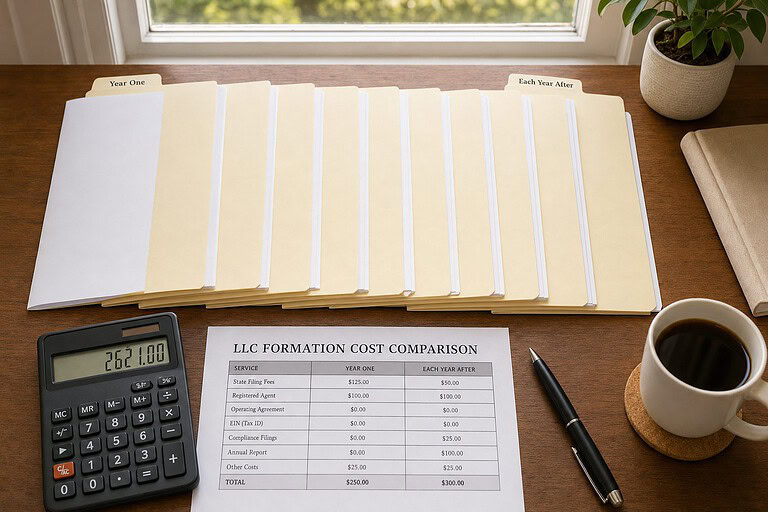
| State filing fee | $35–$500; US average ~$132 |
| Formation time | Same-day to ~4 weeks, state dependent |
| New EIN required? | Only with employees, excise tax, or corporate/S-corp election |
| Ongoing | Annual report or franchise tax in most states |
| Last verified | September 2026 |
Switching from a sole proprietorship to an LLC can protect your personal assets, improve your business’s reputation, and offer tax flexibility. Here’s how to make the transition:
- Choose a Name: Pick an LLC name that meets state rules and includes “LLC” or “Limited Liability Company.”
- File Articles of Organization: Submit formation documents to your state with fees ranging from $35 to $500 (average approximately $132).
- Appoint a Registered Agent: Designate someone to handle legal and tax notices.
- Draft an Operating Agreement: Outline your LLC’s management and financial structure, even if not required by your state.
- Obtain a New EIN: Apply for a new Employer Identification Number (EIN) from the IRS.
After forming the LLC, update business licenses, open a new business bank account, notify tax authorities, and transfer assets and contracts to the LLC. These steps ensure compliance and maintain legal separation between your personal and business finances. Following this process strengthens your business’s legal standing and operational efficiency.
Step-by-Step Process for Converting a Sole Proprietorship to an LLC
Transforming your sole proprietorship into an LLC involves several key steps. Here’s a breakdown to help you navigate the process smoothly and stay compliant.
Choose an LLC Name That Meets State Requirements
The first step is picking a name for your LLC that complies with state regulations. Your business name must include terms like “LLC” or “Limited Liability Company”, and many states also allow abbreviations such as “L.L.C.” To ensure the name is available, check your state’s business entity database.
Keep in mind that some terms, like “bank”, “insurance”, or “university”, are restricted and require specific licenses to use. If your preferred name is already taken, you can file for a name reservation to hold it while you finalize your LLC formation.
File Articles of Organization
Filing the Articles of Organization is a critical step in officially forming your LLC. This document is submitted to your state’s business filing office – usually the Secretary of State. It includes essential details like your LLC’s name, principal business address, registered agent information, and sometimes a general description of your business purpose.
Filing fees and processing times vary by state. Many states offer online filing options, which can help minimize errors and speed up the process. If you’re in a hurry, some states also provide expedited filing for an additional fee.
Appoint a Registered Agent
Every LLC is required to have a registered agent who acts as the point of contact for legal documents, tax notices, and other official correspondence. The registered agent must have a physical address in the state where your LLC operates and be available during normal business hours.
You can serve as your own registered agent if you meet these requirements, or you can appoint someone you trust. Many business owners also choose professional registered agent services, which can provide added perks like compliance reminders and enhanced privacy. Whichever route you choose, having a reliable registered agent is essential to ensure important documents are handled promptly.
Draft an Operating Agreement
Even if your state doesn’t mandate it, creating an operating agreement is a smart move. This document outlines how your LLC will operate, including details on profit distribution, decision-making processes, and what happens if you add members or dissolve the business.
Your operating agreement should cover key elements like whether the LLC will be member-managed or manager-managed, financial arrangements, and procedures for resolving disputes. While you can find templates online, consulting a legal professional can help ensure the agreement is tailored to your specific needs.
Do You Need a New EIN
After forming your LLC, you’ll need to get a new Employer Identification Number (EIN) from the IRS. Your old EIN from your sole proprietorship cannot be reused. Applying for a new EIN is free and can be done directly on the IRS website, with the online application generating your EIN instantly.
The application process requires basic information about your LLC, including its legal name, business address, and details about the responsible party. This EIN will be used for tax filings, opening business bank accounts, and other official matters. If you’d rather not handle this yourself, some business formation services can assist with the application for an extra fee.
Updating Tax, Licensing, and Compliance Details
Once your LLC is officially formed, there are a few critical updates you’ll need to make to align with local, state, and federal requirements. These updates are essential to ensure your business stays compliant and operates smoothly under its new structure.
Update Business Licenses and Permits
If you’re transitioning from a sole proprietorship, your existing business licenses and permits – such as professional licenses, sales tax permits, or industry-specific certifications – were likely issued under your name. Now, they must be transferred or reissued under your LLC’s name.
Start by reviewing all your current licenses to identify which ones need updates. Then, contact the issuing agencies to determine the process. Some may allow a simple name change, while others might require a completely new application. For local business licenses, this is often handled at the city or county level, and processing times can vary from a few days to several weeks. State-level permits, like sales tax licenses, may have their own set of requirements, including fees.
Keep track of all confirmations and documentation for each updated license to ensure there are no compliance gaps.
Open a New LLC Bank Account
One of the most important steps after forming your LLC is opening a dedicated business bank account. Why? Because keeping your personal and business finances separate is key to protecting your limited liability status. Mixing funds could put your personal assets at risk if your business faces debts or legal issues.
“A dedicated LLC bank account is an essential step to maintaining the legal distinction between the business and its owners, which is necessary to preserve limited liability protections.” – NerdWallet
When choosing a bank, compare fees, balance requirements, and services like merchant processing or business credit cards. These features are often tailored to business accounts and can provide tools to help your LLC grow.
To open the account, you’ll need specific documents like your Articles of Organization, EIN confirmation letter, and operating agreement. Some banks may also ask for a business license or certificate of good standing. If your LLC has multiple members, all owners may need to be present at the account opening, or you might need notarized authorization forms for absent members. Transition your funds gradually to account for any deposit hold times.
Notify the IRS and State Tax Agencies

It’s essential to update tax authorities about your new LLC structure to avoid filing errors. Start by filing a final sole proprietorship tax return (using Schedule C) for the period before the conversion. Afterward, your LLC will file taxes based on its elected tax status – either as its own entity or as a pass-through to your personal return.
Don’t forget to notify your state tax agencies as well. Update your state tax registration to reflect your LLC status and ensure that all state-level obligations, like sales tax permits or payroll tax accounts, are transferred to the new entity. Filing procedures and deadlines vary by state, so check with your state’s department of revenue or taxation for specific instructions.
To stay organized, consider setting up automatic reminders for tax deadlines. Many states require LLCs to file annual reports or pay franchise taxes, so staying ahead of these requirements can save you from penalties or missed deadlines.
Transitioning Business Operations to the LLC
Shifting from a sole proprietorship to an LLC is more than just a legal formality – it’s a process that requires careful adjustments to your business operations. Ensuring a smooth transition involves proper documentation and updating operational practices to maintain compliance and continuity. Once the paperwork is handled, the next step is transferring assets and updating relationships with stakeholders.
Transfer Assets and Liabilities
One of the most important parts of this transition is transferring your business’s assets and liabilities to the LLC. It’s not an automatic process – your existing assets and debts remain tied to you personally unless you take formal steps to reassign them.
“Business debts and existing contracts from your sole proprietorship don’t automatically transfer to your new LLC. These obligations typically remain with you personally unless specifically assigned to the LLC through formal agreements.” – InCorp Services
To transfer assets like equipment, inventory, or intellectual property to your LLC, you’ll need proper documentation. For physical assets such as machinery, computers, or office furniture, use bills of sale that clearly outline details like the item, its value, and the transfer date. Intellectual property, including trademarks, copyrights, or patents, requires assignment agreements that formalize the transfer of ownership to the LLC.
Keep in mind, personal guarantees for loans or other financial obligations will still be your responsibility unless your creditors agree to transfer those obligations to the LLC.
Notify Clients and Vendors
Your clients, suppliers, and business partners need to know about the change in your business structure. Updating them is not just professional – it’s essential for maintaining trust and ensuring smooth operations.
Start by reviewing your existing contracts. Look for assignment clauses to determine if your responsibilities under the contract can be transferred to the LLC.
“When changing from a sole proprietorship to an LLC, you must examine existing contracts carefully. Depending on the contractual language, you may or may not be able to assign the responsibilities you had as a sole proprietor to the LLC. If the contract doesn’t allow for this, you must discuss the arrangement with the other party.” – Michelle Kaminsky, J.D.
If the contract allows for assignment, work on drafting amendments to reflect the LLC’s role. If it doesn’t, you’ll need to negotiate new terms or create entirely new agreements.
Additionally, update all business materials to reflect your LLC status. This includes invoices, letterhead, business cards, email signatures, your website, and social media profiles. Don’t forget to include your new EIN on these materials.
For businesses with complex contracts or those operating in regulated industries, consulting with an attorney can be a smart move. They can provide guidance on navigating contract assignments and ensuring all asset transfers are handled properly.
sbb-itb-ba0a4be
Key Benefits of Converting to an LLC
Switching from a sole proprietorship to an LLC comes with a host of advantages that can positively influence your financial security, professional image, and tax situation. Let’s break down the key benefits this change brings to the table.
Liability Protection
One of the standout perks of forming an LLC is the robust liability protection it provides. By legally separating your personal assets from your business liabilities, the LLC structure creates a “corporate veil.” This means your personal wealth – like your home or savings – is shielded from business debts or legal claims.
However, this protection isn’t absolute. If personal guarantees are made, fraud occurs, or business and personal funds are mixed, your personal assets could still be at risk. To keep this shield intact, it’s crucial to maintain separate bank accounts and detailed business records.
Boosted Credibility and Professional Image
Operating as an LLC can elevate your business’s reputation. Adding “LLC” to your business name signals professionalism and stability to clients, vendors, and partners. This formal structure often reassures others that your business is legitimate and well-organized.
Additionally, banks may look more favorably at LLCs when considering applications for loans or credit lines. This added credibility can help you build stronger relationships with financial institutions and other businesses.
Tax Flexibility and Potential Savings
Tax advantages are another compelling reason to opt for an LLC. Unlike corporations that deal with double taxation, LLCs are considered “pass-through entities” by default. This means profits and losses are reported directly on your personal tax return, simplifying the process and potentially lowering your tax burden.
“LLCs offer business owners simplicity and flexibility in choosing how their business income will be taxed at the federal level compared to a C corporation.” – Brex
For single-member LLCs, the default tax setup is similar to a sole proprietorship, requiring you to file Schedule C with your Form 1040. But LLCs also offer several tax election options, allowing you to tailor your approach as your business evolves:
- S Corporation Election: By electing S-Corp status, you can save on self-employment taxes. For instance, you can pay yourself a reasonable salary (subject to payroll taxes) and take the remaining profits as distributions, which are not subject to self-employment taxes. For example, Emily, a freelance graphic designer earning $70,000 annually, formed an LLC and elected S-Corp status, saving $4,500 in self-employment taxes during her first year.
- Business Expense Deductions: LLCs make it easier to deduct a wide range of expenses, including startup costs like advertising and training, as well as ongoing expenses like internet service, business meals, accounting fees, and office space. You can even deduct the employer portion of self-employment taxes.
- C Corporation Election: If your business anticipates significant growth, electing C Corporation status could offer benefits, such as lower corporate tax rates on the first $75,000 of income. However, this comes with the trade-off of double taxation.
This flexibility allows you to adjust your tax strategy year by year, ensuring you’re optimizing your tax situation as your business grows and changes.
Final Steps and Key Takeaways
Wrapping up the transition from a sole proprietorship to an LLC involves several essential steps to ensure compliance and strengthen your legal and financial standing. By now, you should have filed your formation documents, obtained a new EIN, transferred assets, and updated any necessary licenses. With these tasks complete, it’s time to focus on running your business in alignment with your new LLC structure.
State filing fees for forming an LLC typically range from $40 to $500, with most states averaging around $100. Processing times can vary widely – from just a few days to several weeks. Be sure to check your state’s specific guidelines to stay on track.
One crucial aspect of maintaining your LLC’s liability protection is keeping personal and business finances completely separate. Use your LLC’s bank account exclusively for business transactions and maintain detailed records of all financial activities. Mixing personal and business funds could put your liability protection at risk, which is one of the primary reasons for making this transition in the first place.
Switching to an LLC comes with several advantages, including liability protection, increased credibility, and greater tax flexibility. These benefits can have a meaningful impact on the long-term success of your business.
If you’re looking for a simpler way to handle this process, consider using a formation service. For example, BusinessAnywhere offers a streamlined LLC formation process starting at $0 plus state fees. Their services include managing the paperwork, providing a free registered agent for the first year, and offering additional tools like virtual mailbox services and EIN applications to support your new LLC.
FAQs
What tax advantages can I gain by converting my sole proprietorship to an LLC, and how do I make the most of them?
Converting your sole proprietorship to an LLC opens up a range of tax benefits. One major perk is the flexibility to decide how your LLC will be taxed. You can stick with the default pass-through taxation or opt for S-corporation or C-corporation status, depending on what works best for your business. This flexibility can help you minimize taxes and sidestep double taxation.
With pass-through taxation, your LLC’s profits go directly to you as the owner, and you report them on your personal tax return. This setup can make tax filing simpler and might even reduce your overall tax bill. Plus, as an LLC owner, you can pay yourself through methods like owner’s draws or a salary, which can be arranged in ways that are more tax-efficient.
To make the most of these benefits, it’s important to carefully choose the right tax classification for your LLC, keep thorough financial records, and work with a tax professional. They can help you stay compliant while identifying deductions and credits that could save you money.
How can I protect my personal assets after converting my sole proprietorship to an LLC?
To safeguard your personal assets after setting up an LLC, it’s crucial to keep your business and personal finances completely separate. Start by opening a dedicated business bank account, ensure that all contracts and legal documents use your LLC’s name, and avoid combining personal and business expenses in any way.
Equally important is staying on top of your LLC’s compliance requirements. This includes tasks like filing annual reports and paying any required fees. By doing so, you help maintain the limited liability protection that keeps your personal assets shielded from business debts. Keeping thorough records and following proper financial and legal practices are essential to preserving this important protection.
How do I notify my clients and vendors about changing my business from a sole proprietorship to an LLC?
When shifting your business from a sole proprietorship to an LLC, it’s crucial to notify your clients and vendors right away. A good approach is to send personalized emails or formal letters explaining the change. Highlight the benefits, such as improved liability protection and a stronger professional image. Make sure to include any updated details, like your new legal name and tax identification number, if relevant.
To keep things running smoothly, update all contracts and agreements with your LLC information. Let your stakeholders know you’re available to answer any questions they may have. Clear, consistent communication will help preserve trust and prevent any misunderstandings during the transition.