


When starting a business in the U.S., it’s essential to understand the differences between a Registered Agent, Virtual Address, and PO Box. Each has specific purposes, requirements, and limitations that can impact your operations. Here’s a quick breakdown:
- Registered Agent: Legally required for LLCs and corporations. Acts as the official contact for legal and government documents. Must have a physical street address and be available during business hours.
- Virtual Address: Provides a commercial street address without renting office space. Ideal for remote businesses, it offers mail scanning, forwarding, and privacy but cannot fulfill Registered Agent duties.
- PO Box: A cost-effective option for receiving mail but unsuitable for business registration, legal notices, or as a Registered Agent address.
Quick Comparison
| Feature | Registered Agent | Virtual Address | PO Box |
|---|---|---|---|
| Primary Use | Legal compliance & notices | Professional address & mail handling | Basic mail receipt |
| Address Type | Physical street address | Physical street address | USPS box number |
| Business Registration | Required for LLCs/Corporations | Accepted in all states | Not accepted |
| Service of Process | Yes | No | No |
| Cost | $100–$300/year | $120–$6,000/year | $40–$200/year |
Bottom Line: A Registered Agent is mandatory for legal compliance. A Virtual Address adds professionalism and privacy, while a PO Box is a basic, limited option for mail. Choose based on your business’s needs and legal requirements.
What Is a Registered Agent and Why Your Business Needs One
If you’re forming an LLC or corporation in the U.S., you’re legally required to designate a Registered Agent in every state where your business operates. This isn’t just a formality – it’s a core compliance requirement under state law. Without a Registered Agent, your business cannot legally function.
What a Registered Agent Actually Does
A Registered Agent acts as the official point of contact for your business, handling important legal and government communications. This includes lawsuits, subpoenas, tax notices, and compliance reminders.
"A registered agent… is a person or company that receives legal documents and official government correspondence on behalf of your business. This includes lawsuits, subpoenas, tax notices, and compliance reminders from your state." – Universal Registered Agents
To fulfill this role, the agent must meet two key criteria:
- Have a physical street address (not a PO Box or virtual mailbox).
- Be available at that address during standard business hours, typically 9 AM to 5 PM, Monday through Friday.
Additionally, the agent’s name and address are included in public state records. This is why many business owners choose professional Registered Agent services instead of using their home address for privacy reasons.
What Happens If You Don’t Have a Compliant Registered Agent
Skipping this requirement can lead to serious consequences. For starters, states can administratively dissolve your business. You could also lose your "Good Standing" status, which affects your ability to file lawsuits or secure financing. Even worse, if no one is available to accept a lawsuit notice, your business could face a default judgment – a court ruling against you simply because you weren’t properly notified.
Failing to maintain a Registered Agent can also expose your personal assets. Without compliance, courts may “pierce the corporate veil,” making you personally liable for business debts. Clearly, having a reliable Registered Agent is not just about meeting legal requirements – it’s about protecting your business and yourself.
How BusinessAnywhere Handles Registered Agent Services

To avoid these risks, many businesses turn to professional Registered Agent services. BusinessAnywhere offers a streamlined solution, ensuring all legal and government notices are received without fail. Their service includes compliance alerts to help you stay on top of deadlines, and they even provide a complimentary first year when bundled with business registration.
Virtual Address: A Professional Business Address Without a Physical Office
A virtual address gives you a commercial street address without the hefty price tag of leasing office space. Any mail sent to this address is scanned and made available online, making it a convenient option for those running their businesses remotely, from home, or even on the move.
What a Virtual Address Offers and Who It Works For
The main features are simple but effective: a legitimate U.S. street address, mail scanning, worldwide forwarding, and package acceptance. All of this is managed through an online dashboard, so your physical location doesn’t matter.
This setup is ideal for digital nomads, online businesses, and home-based entrepreneurs who prefer not to use their personal address for public business filings. A commercial street address not only protects privacy but also adds a layer of professionalism when interacting with clients, banks, or investors.
"A professional business address signals established presence. Listing a P.O. box on your website, business cards, or marketing materials undermines credibility." – Laurie Spicer, Author
This boost in credibility helps strengthen your brand image and ensures compliance with regulations. However, understanding the legal guidelines for virtual addresses is crucial.
Legal Rules Around Using a Virtual Address
A virtual address is valid for many standard business purposes, such as state LLC filings, IRS EIN applications (Form SS-4), and serving as your principal business address. For EIN applications, it’s important to note that while a virtual address can be used for the mailing section, the principal business location must be a physical street address.
That said, a virtual address cannot be used to meet Registered Agent requirements. Registered Agents must be physically present during business hours to accept legal documents like lawsuits, which virtual address providers typically don’t accommodate.
Tax implications are another factor to consider. For example, using a virtual address in California might create a business nexus in the state, potentially triggering a minimum franchise tax of $800 annually – even if you never set foot there. While some businesses choose high-profile locations like Manhattan or Silicon Valley to enhance their brand perception, it’s important to weigh the potential tax consequences.
To legally use a virtual address, you’ll need to fill out USPS Form 1583, provide two government-issued IDs, and have the form notarized. This authorizes the provider to act as a Commercial Mail Receiving Agency (CMRA) and handle mail on your behalf.
BusinessAnywhere’s Virtual Mailbox Plans
BusinessAnywhere offers three Virtual Mailbox plans – Basic, Premium, and Advanced – each with unlimited mail scanning, no hidden fees for extra mail or storage, and global forwarding.
| Plan | Monthly Billing | Annual Billing | Recipients |
|---|---|---|---|
| Basic | $25/mo + $25 sign-up fee | $20/mo (no sign-up fee) | Up to 2 |
| Premium | $40/mo + $25 sign-up fee | $30/mo (no sign-up fee) | Up to 5 |
| Advanced | $85/mo + $25 sign-up fee | $65/mo (no sign-up fee) | Up to 20 |
All plans include junk mail filtering, online dashboard access, and worldwide package forwarding. The Advanced plan also allows for additional users beyond the 20 included, at $7.50/month per user (monthly billing) or $5/month per user (annual billing).
PO Box: A Basic Mail Option with Clear Limits
A PO Box is a numbered, lockable mailbox located at a USPS facility, designed to receive mail and packages. Renting one is relatively inexpensive, typically ranging from $40 to $200 per year, depending on the size and location. However, while it’s simple and affordable, its drawbacks often outweigh its benefits for many businesses.
What a PO Box Can and Cannot Do for Your Business
A PO Box provides a mailing address without a physical street location, which makes it unsuitable for most formal business purposes. For example, every U.S. state mandates a physical street address for business formation. Listing a PO Box on your Articles of Incorporation or LLC registration will result in rejection by the Secretary of State. Similarly, it cannot be used as a Registered Agent address and is only allowed in the mailing address field – not the principal business location – on IRS Form SS-4.
Unlike Registered Agent or Virtual Address services, which meet both legal and operational business needs, a PO Box is strictly for collecting mail.
Banks in the U.S. typically won’t approve business accounts tied to a PO Box due to KYC (Know Your Customer) requirements, and Google Business Profiles also disqualify PO Boxes, which can harm local visibility.
"Using a PO box as a business address is like having a key to a mailbox but not the key to the building. It gets you part of the way there, but you can’t access the most important rooms – like your bank, the Secretary of State, or the IRS." – Set Up Stateside
From a logistics perspective, private carriers like FedEx, UPS, and DHL can’t deliver to standard PO Boxes. Some USPS locations offer a "Street Addressing" option as a workaround, but this service isn’t universally available and doesn’t resolve the legal issues.
Cases Where a PO Box Still Makes Sense
Despite its limitations, a PO Box can be useful in specific scenarios. For a home-based sole proprietor, it’s an inexpensive way to protect privacy by separating personal and business mail – without the need for a lease or service contract.
It can also work as a secondary mailbox for businesses that already have a valid street address on file with the state and the IRS. In this case, it’s great for managing routine correspondence like customer mail, invoices, or marketing materials. Just be careful not to use it in situations where a physical address is required.
sbb-itb-ba0a4be
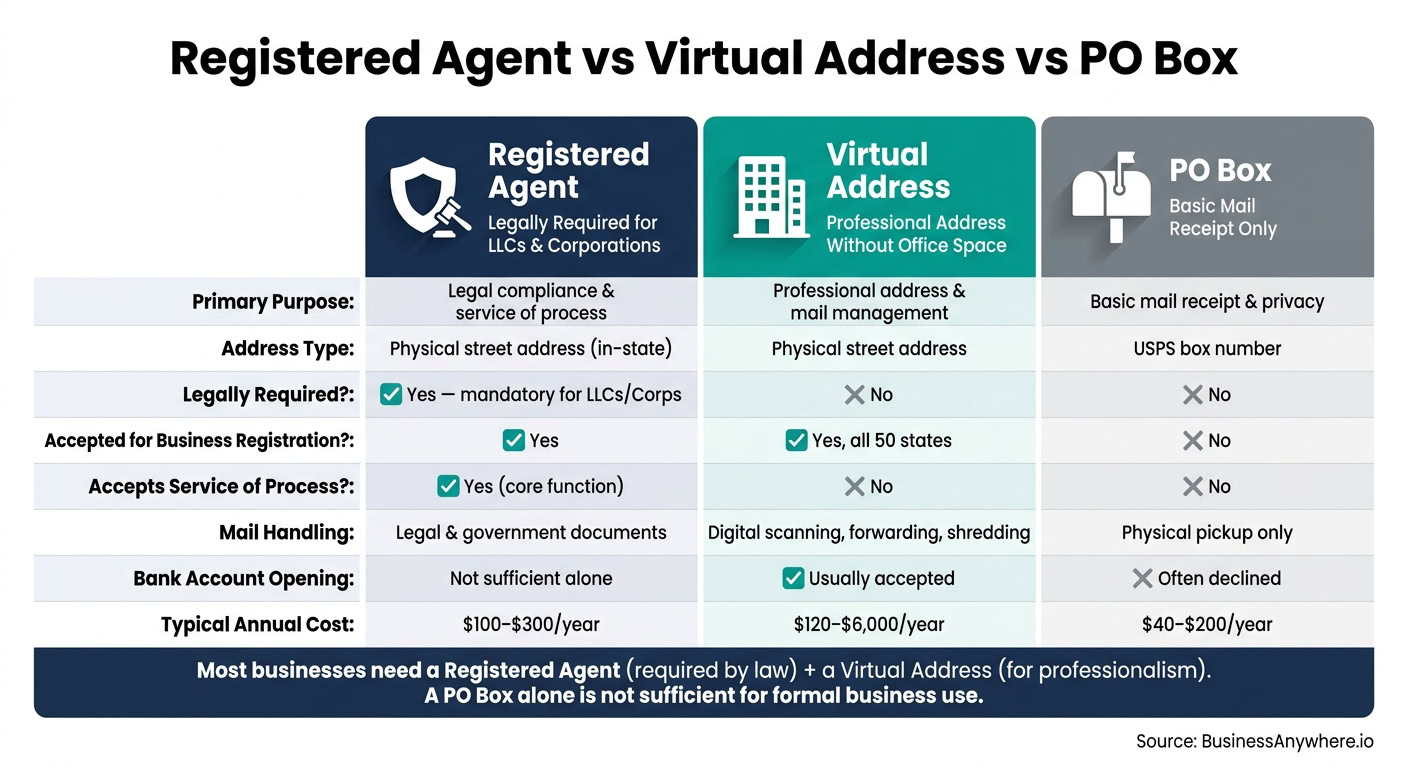
Registered Agent vs. Virtual Address vs. PO Box: A Side-by-Side Comparison
Below is a breakdown of the key features to help you understand how these options differ.
Comparison Table: Registered Agent, Virtual Address, and PO Box
| Feature | Registered Agent | Virtual Address | PO Box |
|---|---|---|---|
| Primary Purpose | Ensures legal compliance & handles service of process | Offers a professional address & manages mail | Provides basic mail receipt & privacy |
| Address Type | Physical street address (must be in-state) | Physical street address | USPS box number |
| Legally Required? | Yes, mandatory for LLCs and corporations | No | No |
| Accepted for Business Registration? | Yes | Yes, in all 50 states | No, generally not accepted |
| Accepts Service of Process? | Yes (this is its main role) | No | No |
| Mail Handling | Handles legal and government documents | Offers digital scanning, forwarding, and shredding | Requires physical pickup |
| Bank Account Opening | Not enough on its own | Usually accepted with proper documentation | Often declined |
| Typical Cost | $100–$300/year | $120–$6,000/year | $40–$200/year |
"While virtual mailboxes and PO boxes are optional tools that might make running your business easier, a registered agent is a legal requirement." – Universal Registered Agents
The table highlights the primary differences, helping you weigh your options based on your business needs.
Which Option Fits Your Situation
A Registered Agent is non-negotiable for LLCs and corporations, ensuring compliance by receiving legal and government notices. Meanwhile, a Virtual Address is a flexible solution for remote businesses needing a professional image and robust mail management. On the other hand, a PO Box works as a basic option for privacy and mail receipt but falls short for legal and business registrations.
For many businesses, using a combination of a Registered Agent and a Virtual Address can cover compliance requirements while also simplifying mail handling and enhancing professionalism .
How to Pick the Right Option for Your Business
Choosing the right setup for your business depends on factors like legal requirements, mail handling needs, and how you want to present your business. Many businesses find they need more than one service to meet their needs.
Recommendations by Business Type and Situation
Home-based startups should prioritize using a professional registered agent to keep their home address off public records. Adding a virtual address can provide a professional street address for your website, marketing materials, and bank applications – without the cost of leasing office space. Keep in mind, PO boxes are not accepted for business registrations by the IRS or Google Business Profiles.
Digital nomads benefit from both a registered agent and a virtual mailbox. A registered agent ensures you stay compliant with legal requirements, while a virtual mailbox allows you to manage your mail digitally from anywhere in the world. This combination keeps your business running smoothly without being tied to a single location.
International entrepreneurs forming a U.S. entity face additional hurdles, such as U.S. banks requiring documents like lease agreements or utility bills to meet Know Your Customer (KYC) regulations. Since PO boxes are often rejected, a virtual office address from a trusted provider can help meet these requirements, making it easier to open a bank account.
Businesses expanding into new states will need a registered agent in each state where they are foreign-qualified. Using a national registered agent service that operates in all 50 states can simplify compliance and save time.
These tailored recommendations highlight how each service fits specific business needs, helping you manage operations more effectively across various scenarios.
How BusinessAnywhere Brings It All Together
BusinessAnywhere offers a streamlined solution by combining registered agent services, a virtual mailbox, and compliance tools into a single dashboard. The registered agent service starts at $147/year, and if you bundle it with a new business formation, the first year is free. Virtual mailbox plans start at $20/month (billed annually) and include unlimited mail scanning, no junk mail, and worldwide forwarding.
For those looking to set up everything from scratch, the Digital Nomad Kit includes LLC formation, registered agent service, a premium address, EIN, bank account setup assistance, and more – all in one package. If you already have an established business, the Existing Company Maintenance plan keeps your registered agent and annual filings up-to-date for $147/year. Everything is managed remotely, so there’s no need for in-person visits.
FAQs
Can I use the same address for my Registered Agent and my business address?
No, you generally can’t use the same address for both purposes. A Registered Agent’s address must be a physical location within the state of registration, accessible during regular business hours to receive legal and official documents. On the other hand, a business address or virtual address is used for general correspondence and public listings, but it doesn’t fulfill the legal criteria for a Registered Agent. Keeping these addresses separate ensures compliance with regulations and proper management of important documents.
Do I need a Virtual Address if I already have a Registered Agent?
A Virtual Address isn’t necessary if you already have a Registered Agent. The Registered Agent’s primary role is to handle official documents and government notices on your behalf, ensuring you meet legal obligations. On the other hand, a Virtual Address is an optional service that provides a business address for purposes like mail handling, enhancing your business’s image, or maintaining privacy. If you’re only focused on fulfilling legal requirements, sticking with a Registered Agent will do the job.
Will a Virtual Address or PO Box affect my taxes or state nexus?
Using a virtual address or PO Box generally doesn’t impact your taxes or create a state nexus. These addresses are primarily for receiving mail and don’t establish a physical presence. However, if you use a virtual address in ways that suggest significant business activity – such as housing employees or running operations – it could create a nexus. This could then affect your tax obligations or registration requirements. The way you utilize the address is what truly matters.
Related Blog Posts
- Virtual Mailbox vs Physical Address: Pros and Cons Guide
- Virtual Mailbox vs. Registered Agent: What’s the Difference and Which One Do You Need?
- Can You Use a Virtual Address as Your Registered Agent? Here’s What You Need to Know
- Virtual Mailbox vs PO Box vs Registered Agent Address – What’s the Difference?