

A micro-business is usually a very small company with 0 to 9 employees and often under $250,000 in yearly revenue. It is a size label, not a business type. So you can be a sole proprietor, LLC, partnership, or corporation and still count as a micro-business.
If I had to boil this down fast, here’s what matters most:
- Micro-business = size
- Sole proprietorship = legal form
- Many groups use different cutoffs
- Most U.S. micro-businesses still follow the same tax, license, and filing rules as other small businesses
- Hiring even 1 employee can add payroll tax duties fast
- Common examples include freelancers, online sellers, consultants, and local service businesses
A simple way to think about it: if I run a small, owner-led business with a tiny team, low overhead, and limited sales, I may fit the micro-business range. But I still need to check the rules tied to my state, city, industry, and tax setup.
Quick comparison:
| Type | What it means | Usual size |
|---|---|---|
| Micro-business | Size category | 0–9 employees in many cases |
| Small business | Broader size category | Often under 500 employees |
| Sole proprietorship | Legal structure | No employee or revenue limit |
So the main question isn’t just, “Am I a micro-business?” It’s also, “What filings, permits, and tax steps apply to me?”
What Is a Micro-Business? Definition and Core Traits
In practice, micro-businesses are grouped by size, not by legal structure. A micro-business, sometimes called a microenterprise, is a very small business. In most cases, that means 1 to 9 employees, including the owner, and less than $250,000 in annual revenue.
That said, the line can move a bit depending on who’s defining it. Some nonprofit and academic programs use a tighter standard: fewer than 5 employees and startup capital under $35,000. Lenders, state programs, and other groups may use their own cutoffs. And in some cases, the revenue ceiling goes higher, up to $500,000.
Common U.S. Thresholds: Employees, Revenue, and Startup Capital
The most common benchmarks are headcount, revenue, and startup capital. They’re a good practical guide, but they are not a single legal test that applies everywhere.
| Benchmark | Common Threshold | Notes |
|---|---|---|
| Employees | Fewer than 10 (including owner) | Some programs use 5 or fewer for stricter microenterprise criteria. |
| Annual revenue | Under $250,000 | Certain programs allow up to $500,000. |
| Startup capital | Commonly under $35,000–$50,000 | Used by some microenterprise programs. |
If your business falls inside these ranges, it’s generally reasonable to treat it as a micro-business for planning and classification purposes.
Typical Traits of a Micro-Business
The numbers tell part of the story. Day to day, micro-businesses are usually owner-run and hands-on. The owner often handles operations, sales, marketing, and admin work all at once. In plain English, one person may wear almost every hat.
These businesses also tend to keep overhead low. Equipment costs are often modest, and payroll is usually small. Many run from:
- a home office
- an e-commerce side hustle
- a client’s location
Common examples include freelance design, consulting, e-commerce, and local service businesses. Most serve a specific local area or a narrow niche, and they usually offer a limited set of products or services.
sbb-itb-ba0a4be
Micro-Business vs. Small Business vs. Sole Proprietorship
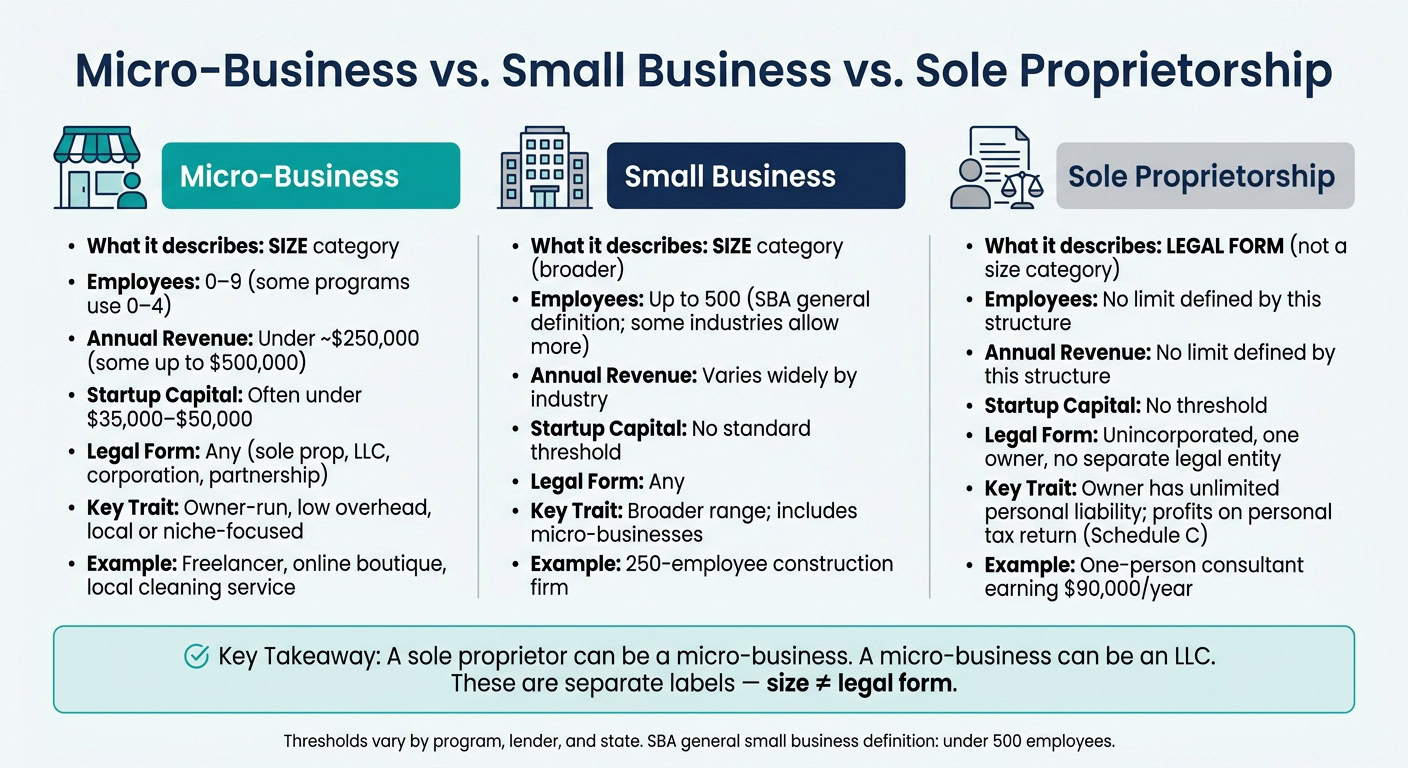
Micro-business and small business describe size. Sole proprietorship describes legal form. That difference matters because size can affect which programs a business can use, while legal form shapes taxes and liability.
How a Micro-Business Differs from a Small Business
A micro-business sits at the very bottom of the size range. A small business is a much broader group. The SBA generally treats firms with fewer than 500 employees as small, and some industry-specific standards allow even more than that.
Here’s the simple breakdown:
| Category | Legal Form | Typical Employees |
|---|---|---|
| Micro-business | Any structure | Typically 1–9 employees, depending on the program |
| Small business | Any structure | Up to 500 employees under the general definition; some industries go higher |
A 3-person cleaning service is a micro-business. A 250-employee construction firm is still a small business, but not a micro-business.
Why a Sole Proprietorship Is a Legal Form, Not a Size Category
A sole proprietorship is an unincorporated business owned by one person. It is not a separate legal entity, so the owner carries unlimited personal liability for business debts and legal judgments. Put plainly, “sole” refers to one owner, not one worker. There is no employee or revenue cutoff that defines it.
For example, a one-person marketing consultant earning $90,000 per year with no employees is both a micro-business by size and a sole proprietor by legal form. Those are two separate labels that overlap in that case.
Once size and structure are clear, the next step is checking registration, licenses, and tax filings. Determining if you need a business license is a critical part of this process.
Rules That Usually Apply to U.S. Micro-Businesses
Micro-businesses don’t get a separate federal rulebook. For the most part, they follow the same federal, state, and local rules as other small businesses. The main difference is scale and paperwork load, not the core duties. So the practical issue isn’t whether special micro-business rules exist. It’s which rules the business has to follow day to day.
Business Registration, Licenses, and Local Permits
Start with your legal structure. That choice affects filing, liability, and taxes. A sole proprietorship usually doesn’t need a state formation filing. A single-member LLC, on the other hand, usually does, and it also needs a registered agent.
State formation is only part of the picture. Many micro-businesses also run into local requirements. Depending on what the business does, that may include:
- A city or county business license
- A home occupation permit
- A state sales tax permit
- An industry-specific license, such as a cosmetology license or health department permit
Once registration and licensing are handled, taxes become the next compliance layer.
Federal, State, and Payroll Tax Obligations
Most micro-businesses are pass-through entities, which means profits flow to the owner’s personal tax return. Sole proprietors and single-member LLC owners usually report business income and expenses on Schedule C (Form 1040). If net self-employment earnings hit $400 or more, the owner must also file Schedule SE to calculate Social Security and Medicare taxes. Many owners also get an EIN for hiring, banking, or privacy.
State tax rules vary. Some states charge a franchise tax or business privilege tax on LLCs and corporations even if the business didn’t make a profit. If the business sells products, it may need to collect and send in state sales tax on the required schedule.
The moment a micro-business hires even one part-time employee, payroll tax duties start. That usually means:
- Withholding federal income tax
- Paying the employer share of Social Security and Medicare
- Filing quarterly Form 941
- Issuing W-2s each year
Once taxes are mapped out, recordkeeping becomes the system that keeps everything on track.
Recordkeeping, Annual Filings, and Remote Operations
Business and personal finances should stay separate. That’s a big deal for liability protection. At a minimum, most owners should have a dedicated business checking account and a separate business credit card. It also helps to track income and expenses all year long instead of scrambling at tax time. That makes Schedule C much easier to prepare and can lower audit risk.
LLCs and corporations also have state annual report deadlines. Miss those, and the business can face late fees, loss of good standing, and, in some states, administrative dissolution.
For remote founders and digital nomads running a U.S. entity while traveling or living abroad, this can get messy fast. IRS notices, state filings, and bank statements still arrive on paper, and missing one piece of mail can turn into a bigger problem. A virtual mailbox service gives the business a professional U.S. street address, receives physical mail, and makes scanned documents available online from anywhere, so important mail doesn’t slip through the cracks no matter where the owner is based.
Common Micro-Business Models and How to Tell If Yours Qualifies
Freelance, E-Commerce, Consulting, and Local Service Examples
Based on the thresholds above, most micro-businesses fall into four common models. The model matters because each one comes with its own set of compliance tasks.
A freelance designer or photographer will usually report income on Schedule C. If net self-employment earnings hit $400, Schedule SE may also apply. On the local side, the usual requirements are a business license and, for home-based work, a home occupation permit. You see this same basic setup across e-commerce, consulting, and local service work.
An online boutique with one employee gets more complex fast. The moment that first employee comes on board, payroll compliance starts. Sales tax can add another layer too. The business may need to register and file returns anywhere it has a sales-tax duty.
A home-based marketing or HR consultant with a short client list often keeps costs low and works off-site or fully online. In many cases, local registration is still required. And if the work falls into a regulated field, like financial advising or law, separate licensing rules apply.
A local cleaning service with a small team will often need a general business license and DBA registration. Once it hires workers, wage, payroll, and employment rules kick in. Even so, it can still count as a micro-business if the team stays small and the operation stays limited in size.
These examples give you a simple way to compare your own setup with the checklist below.
A Simple Checklist for Classifying Your Business
Use this checklist to sort your business fast.
| Factor | Typical Micro-Business Range | What It Means in Practice |
|---|---|---|
| Employee count | 0–9 (some sources use 0–4) | Usually run by the owner alone or with a few part-time W-2 workers. |
| Annual revenue | Under about $250,000 | Small compared with the limits often used for small businesses. |
| Owner involvement | Owner handles daily operations directly | The founder stays close to sales, decisions, and day-to-day service. |
| Scale of operations | Local, home-based, or narrowly niche-focused | Often one location or a mostly remote setup with limited reach. |
Size and legal form are not the same thing. A sole proprietorship, LLC, or corporation can still qualify as a micro-business. Next, check the rules tied to your business structure and location.
Conclusion: Key Rules and Next Steps for Micro-Business Owners
Micro-business is a size label, not a legal status. It doesn’t change your registration, licensing, or tax duties. The same core legal and tax rules still apply, no matter which structure you choose. The difference is scale, not a separate set of laws.
Once you know your business falls in the micro-business range, the next move is simple: shift from classification to compliance. In your first 30–90 days, choose a legal structure, file state formation documents if your setup calls for them, and get a free EIN from the IRS. Even if you don’t have employees, an EIN can help you avoid putting your SSN on business paperwork and can make it easier to open a business bank account.
Before you start operating, get the basics in place. Check local licenses, sales tax registration, and any industry permits you may need before opening. Then open a dedicated business bank account, choose a basic accounting tool, and put tax deadlines and annual report filing requirements on your calendar.
If your business includes employees, a licensed profession, or sales in more than one state, bring in a CPA or attorney early. If you want help before paying for one-on-one advice, SBDCs and SCORE can be a smart place to start for free or low-cost guidance.
FAQs
Does a micro-business need an LLC?
No. A micro-business does not automatically need an LLC.
In the U.S., you can often run a micro-business as a sole proprietor, especially if the work is low-risk and you don’t need liability protection right away.
It’s also worth clearing up a common mix-up: an LLC is a legal business structure, not a permit or license. So even if you form an LLC, you may still need business licenses or permits based on what you do and where you operate.
An LLC can make sense if you want added personal liability protection. That can matter if there’s a higher chance of legal claims, debt, or customer issues.
When does a micro-business need to collect sales tax?
A micro-business needs to collect sales tax when it sells taxable goods or services in a state where it meets that state’s economic nexus rules or hits a seller’s permit threshold.
In most states, the business has to register for a seller’s permit before it starts collecting sales tax. The rules change from state to state, and remote sellers can create nexus based on where their sales are concentrated or where their employees work.
Can a business still be a micro-business after hiring employees?
Yes. A business can still be a micro-business after hiring employees, as long as it still meets the size limits for that classification and takes care of the extra rules that come with having staff.
Once you hire employees, you may need an EIN and extra registrations, such as payroll withholding and unemployment accounts. Licensing rules can also shift as revenue and headcount grow.