

Starting a business doesn’t have to cost a fortune. If you’re a first-time founder, there are plenty of ways to build something meaningful with minimal upfront investment. Here are four affordable ideas to get you started:
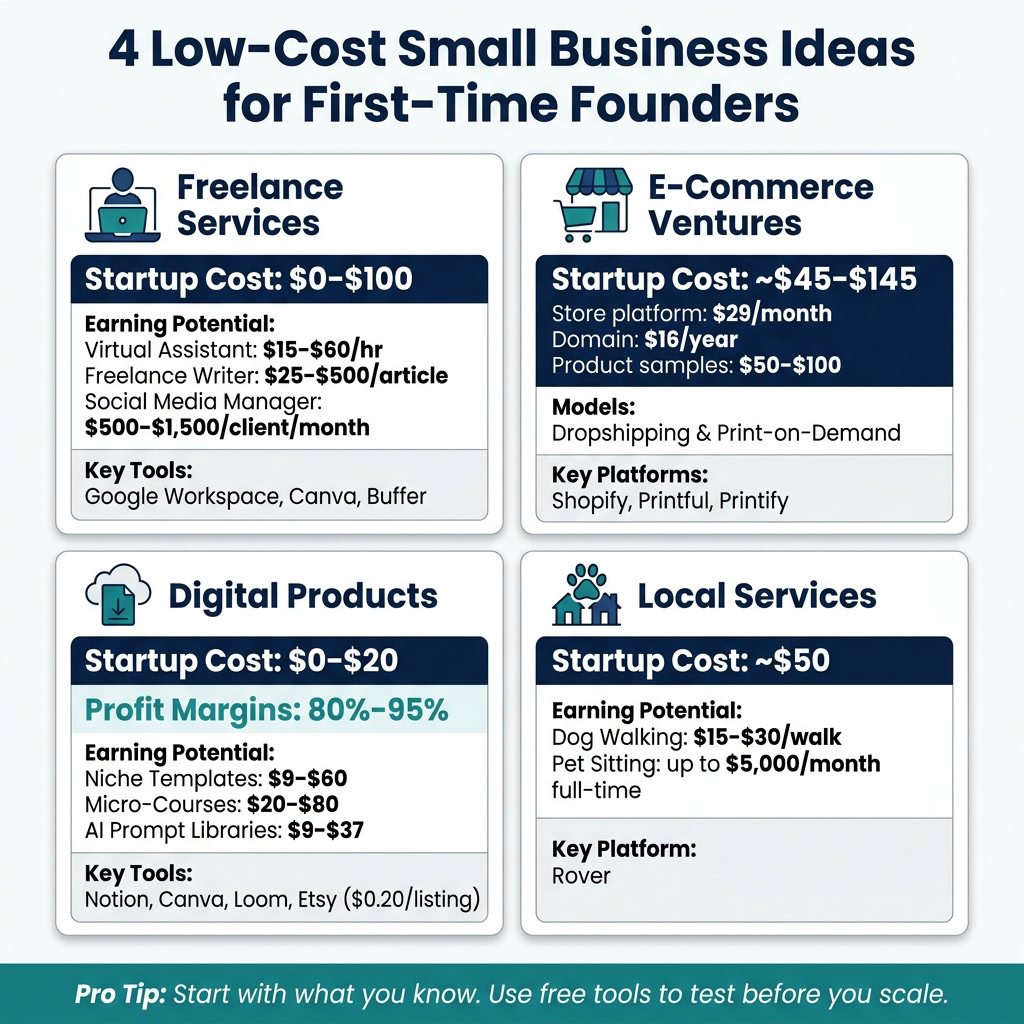
- Freelance Services: Offer your skills as a virtual assistant, freelance writer, or social media manager. Most roles require just a laptop, internet access, and free tools like Google Workspace or Canva.
- E-Commerce Ventures: Start a dropshipping or e-commerce store or print-on-demand store. These options require minimal inventory and setup costs, with platforms like Shopify and Printful simplifying the process.
- Digital Products: Create and sell templates, micro-courses, or AI prompt libraries. These products can be made once and sold repeatedly, offering high profit margins.
- Local Services: Pet sitting, dog walking, or other community-based services are easy to start with low costs and growing demand.
Pro Tip: Focus on what you already know or enjoy doing. Use free or low-cost tools to test your idea before scaling. With patience and consistent effort, even small beginnings can lead to big results.
1. Freelance Services
Freelance services are a quick and affordable way to start earning money. As Alex Birkett, Co-founder of Omniscient Digital, explains:
"Service businesses tend to be the easiest to bootstrap since you’re selling your own time."
Most freelance roles require little more than a laptop and internet access, making them accessible for beginners. Below are three freelance opportunities that demand minimal upfront investment.
- Virtual Assistant (VA)
Virtual assistants provide remote administrative support, such as managing emails, scheduling, and data entry. Startup costs are minimal – between $0 and $100 – thanks to free tools like Google Workspace and Zoom. Hourly rates range from $15 to $60, with higher earnings possible in specialized fields like real estate or project management. Caroline Marshall, Founder of Upsource, highlights:
"A VA business is a great one to start with very little costs."
- Freelance Writer or Editor
Businesses constantly need content for blogs, white papers, and marketing campaigns, often outsourcing these tasks to freelance writers. Beginners can earn $25–$75 per article, while experienced writers can make $200–$500 or more. Getting started is simple – create a free portfolio using Google Sites to showcase your work.
- Social Media Manager
With platforms like TikTok and Instagram dominating the marketing space, many brands need help maintaining a steady flow of content and engaging with their audiences. Freelance social media managers often charge $500 to $1,500 per client each month on a recurring basis. Free tools such as Canva and Buffer help keep expenses low while managing multiple accounts effectively.
sbb-itb-ba0a4be
2. E-Commerce Ventures
E-commerce ventures, much like freelancing, allow aspiring entrepreneurs to kick off their journey without needing a hefty initial investment. Here are two popular models that keep startup costs low:
- Dropshipping: This approach lets you showcase products online while a supplier handles inventory and shipping. Your setup costs? Around $29 per month for a store platform and $16 annually for a domain. As dropshipping entrepreneur Kamil Sattar explains:
"The beautiful thing about dropshipping is it doesn’t judge you based on where you live."
To ensure product quality, it’s a good idea to order samples, which typically cost between $50 and $100. Platforms like TikTok and Instagram can help you identify trending products and attract organic traffic. For a similar inventory-free option, consider print-on-demand services.
- Print-on-Demand (POD): POD allows you to upload your custom designs onto items like t-shirts, mugs, or phone cases. These products are only printed and shipped once an order is placed, so you don’t have to worry about unsold inventory. Services like Printful and Printify integrate seamlessly with your online store, handling fulfillment for you automatically.
Both options provide a low-risk way to test ideas and build an online business.
3. Digital Products
If you’re exploring ways to start a business with minimal upfront costs, digital products are worth considering. The concept is straightforward: create it once, sell it repeatedly. With no need for inventory or shipping, the profit margins can be incredibly high – often between 80% and 95%.
Here are three affordable digital product ideas to get you started:
- Niche Templates (Notion or Canva): While generic templates are everywhere, specialized ones can fetch a premium. For example, a Notion template designed for real estate agents or a Canva pack tailored for fitness coaches faces much less competition than general designs. Notion templates typically sell for $9–$49, while cohesive Canva packs with 20–50 designs can go for $15–$60. You can easily create these using free tools and list them on Etsy for just $0.20 per listing.
- Micro-Courses (Under 2 Hours): Many people now prefer bite-sized, skill-specific courses over lengthy ones. For instance, a screen-share tutorial recorded with the free version of Loom can be packaged and sold for $20–$80. The trick is to keep it specific. A course like "How to Set Up QuickBooks for Freelancers" will likely attract more buyers than a broad topic like "Accounting Basics."
- AI Prompt Libraries: With tools like ChatGPT becoming mainstream, curated prompt libraries are growing in popularity. These collections, tailored to specific professions like content marketers or therapists, typically sell for $9–$37. They take about 2–4 hours to create using platforms like Google Docs or Notion.
What makes these ideas appealing is their low startup cost, aligning perfectly with affordable business strategies. Before committing your time, test the demand. You can use a free Carrd landing page ($19/year) or run a quick social media poll to gauge interest.
4. Local Service Businesses
If you’re looking for a business idea that’s rooted in your community, local services can be a great starting point, especially for first-time entrepreneurs.
Take pet sitting and dog walking, for example. These ventures require minimal upfront costs – around $50 for essentials like leashes and waste bags. The surge in pet ownership during the pandemic has significantly increased the demand for pet care services. Platforms like Rover make it easier to get started by managing reviews, scheduling, and liability, allowing you to focus on providing excellent care. Personal finance expert Andrea Woroch highlights the earning potential:
"You can earn up to $5,000 a month as a full-time pet sitter through sites like Rover.com. The site makes it easy to set up a profile and set your own schedule."
Dog walking rates usually fall between $15 and $30 per walk, so with a steady client base, you can build a reliable income. In 2024, Eva Tang started "Eva Trains Dogs", a home-based dog boarding and training business. She used Instagram to share real-time updates with her clients, like photos and videos of their pets, which helped her build trust without spending heavily on marketing. To test demand in your area, consider posting on social media or offering a discounted first session to a neighbor.
Keep your expenses low by using what you already have, relying on word-of-mouth to attract clients, and asking satisfied customers for Google reviews to improve your local visibility.
Conclusion
Starting a business doesn’t have to drain your savings or require years of expertise. Many ventures can begin with a small budget and grow as revenue starts rolling in.
The trick is to choose something that aligns with your skills, time availability, and financial goals. For instance, a CPA could launch an accounting consultancy with minimal costs, while someone with food service experience might kick off a catering business without needing a full commercial kitchen. When your business idea taps into what you already know, you can shorten the learning curve and start earning quicker.
A smart budgeting tip is to split your initial funds evenly – half for setup costs (like legal registration, branding, and basic tools) and half for marketing and working capital. This approach ensures you don’t exhaust your savings before your business gains traction. Colin Johnson, Founder of Company Bread, highlights the importance of planning for growth:
"You should be able to deliver the same level of service to your 10,000th customer as you did to your first customer. It involves more forward-thinking than I realized, so think about how to scale your business model early."
Beyond finances, setting up the right legal structure is equally important. Opting for an LLC instead of operating as a sole proprietor can protect your personal assets, enhance credibility with clients, and simplify future funding opportunities. Services like BusinessAnywhere make registering an LLC quick, affordable, and hassle-free. Laying this foundation early removes potential roadblocks as your business grows.
"A business idea is just the starting point – what truly matters is how well you execute it." – Capsule CRM
Successful businesses aren’t always the ones with the biggest launch budgets. They thrive on meeting real demand, consistent effort, and reinvesting profits wisely. Start small, test your idea early, and let your revenue fuel the journey ahead.
FAQs
Which idea is best for my skills and schedule?
Choosing the right business idea comes down to matching your skills with the time you have available. If you have expertise in areas like virtual assistance, social media management, or consulting, service-based businesses are a great option. They’re flexible and don’t require much upfront investment.
Enjoy hobbies like baking, pet sitting, or tutoring? These can easily turn into side businesses that fit your schedule and interests.
For those looking for minimal startup costs and flexible hours, online opportunities like freelancing or content creation are worth considering. They allow you to work from anywhere and adapt to your lifestyle.
How do I validate demand before spending money?
To check if there’s demand for your idea without breaking the bank, start with some basic market research and small-scale testing. You can use affordable strategies like setting up a simple landing page or creating a social media profile to see how much interest you can generate and gather early feedback. Try launching a minimum viable product (MVP) – a stripped-down version of your service or product – to measure interest and fine-tune your concept based on actual customer reactions, all while keeping upfront expenses low.
Do I need an LLC to start, or can I begin as a sole proprietor?
Starting as a sole proprietor is an option, but setting up an LLC can offer some key benefits. Liability protection is a major advantage – it helps shield your personal assets from business-related risks. Plus, there are potential tax advantages that might make an LLC more appealing. While forming an LLC isn’t a requirement, it’s often a smart move for new entrepreneurs looking to protect their assets and enjoy greater flexibility in managing their business.